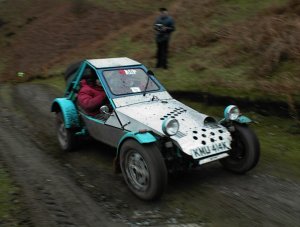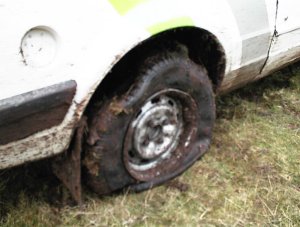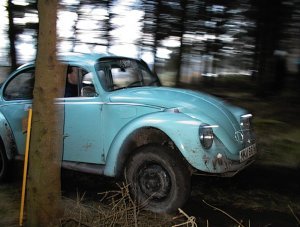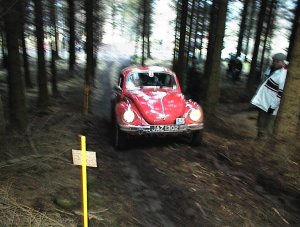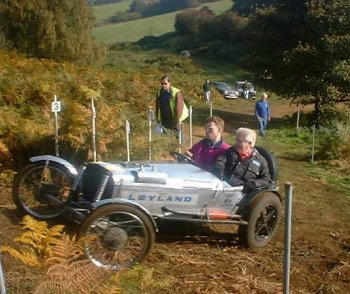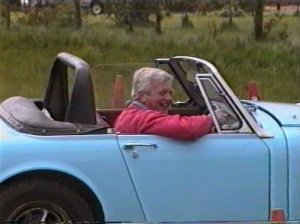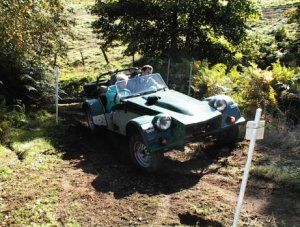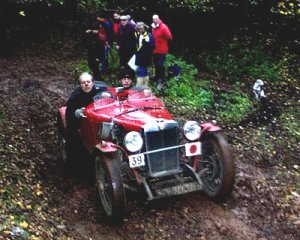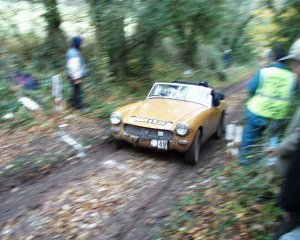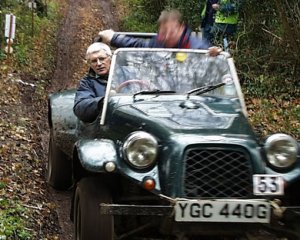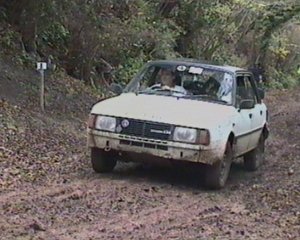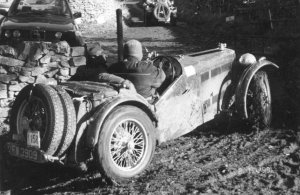
You have stumbled on a delightful box of tricks, Classic Trials & other perverse stuff from Michael Leete. MCC ACTC and other trials. VW Beetles, Dellows, Marlins, or even Suzuki X90's
I like to picture and write about Falcon members trialling exploits. One man has escaped me until recently as I always start so far away from him in the field I never see how he gets on. So I e-mailed Jonathan and persueded him to pen a few word for the worlds favorite internet trials site.
This was an event I had heard so many good reports about and wanted to have a try for myself. Having competed in 3 previous Ebworth Trials (also organised by the Stroud & District Motor Club) I was reckoning on this providing all the thrills and enjoyment of an MCC classic trial but without the excessive road mileage.
The choice of a passenger was quickly solved by my sister in law, Jane, who had been nagging me to take her trialling for the past 5 years. Being almost the last to start, took some of the pressure off driving to Stroud from Buckinghamshire in 1 and 1/2 hours, which helped as I hadn’t got bed until 1.30am the previous night.
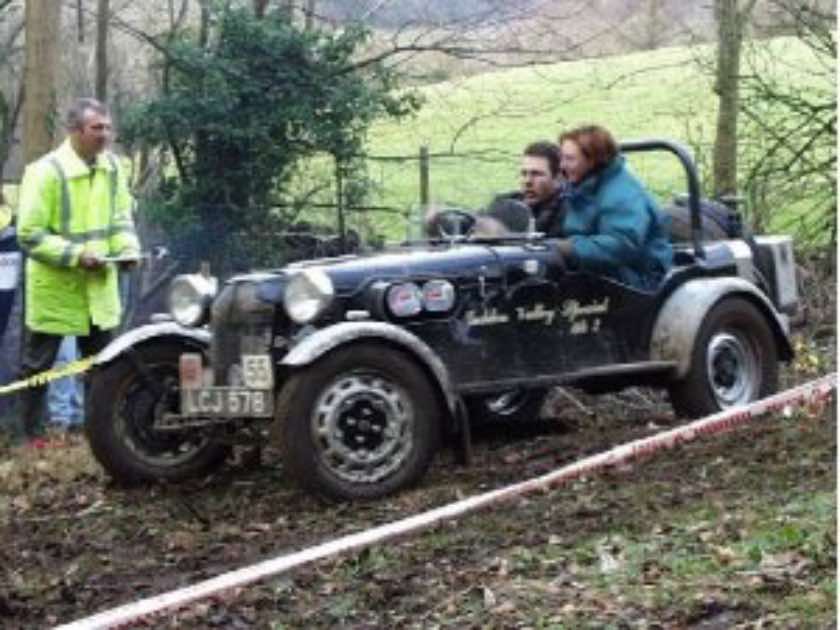
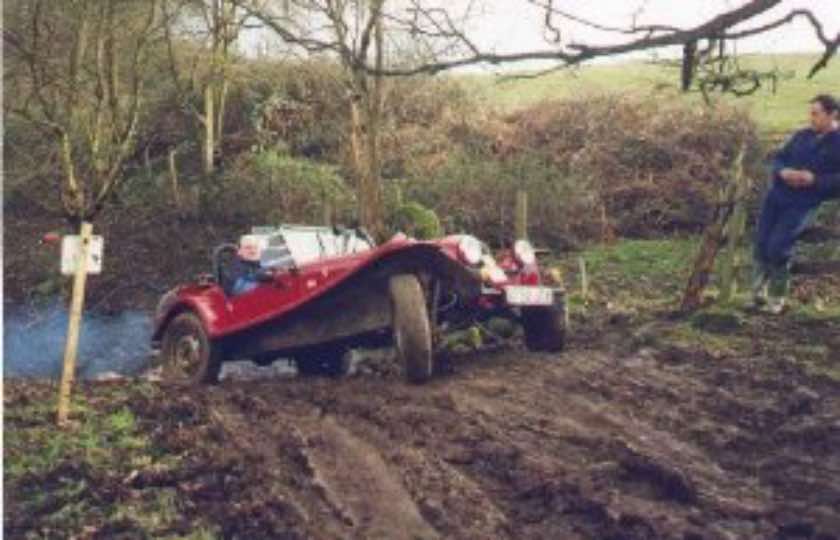
I am never very good at remembering the individual sections, but several things stuck in my mind: · The scenery was spectacular and the route took us to some idyllic out of the way places, with challenging sections to climb · Most of the sections were a good test of skill but were very rough. We managed to clean just 2 and each one reminded me that I must adjust the torsion bars give my poor Marlin some additional ground clearance! · Falcon members were everywhere, which is good for having a friendly face to talk to, but means that your failures (my failures) were witnessed immediately and at first hand. · Jane enjoyed herself, but I failed to give her proper pre event training. Her solution when we failed to get off a restart was to sit and roar with laughter. I don’t claim to be an expert triallist ( I’ve only been doing it for 5 years) but I’ve never yet seen anyone laugh themselves to the top of a hill!
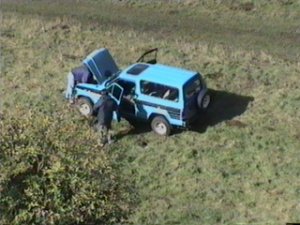
With 2 sections to go before the end, we decided to quit while the Marlin was still in one piece. Just at that moment as the daylight was failing completely, we stumbled upon another competitor who had broken down. A yellow and blue Imp had broken its sump and needing towing to the finish. We acted as good Samaritans and learnt during those last few miles that the car had not been fitted with a sump guard! Those Stroud Motor Club folk are renowned for their hardiness but remembering the sorts of terrain we had just encountered, the lack of undercar protection was asking too much.
As we got to the finish so the weather changed into a steady downpour, perfect for cleaning the mud off during the drive home.
On reflection, a tremendous day, I can’t wait to do it again, but I must get some narrower wheels, more ballast and a big dollop of extra skill.
We have been publishing stuff about Classic Trials on the Web since 1995 and always appreciate feedback. Comments, Corrections, Criticism & Concerns are all welcome. You can leave a comment to have your say here on this web site or our Social Media
Please help spread the word and share this on your Social Media:
The first Cotswold Clouds of the Millennium was a rough, tough, competitive event, and Clerk of the Course Paul Bartleman ensured victory was won on the hills rather than the special tests! The result was a host of closely fought battles throughout the field and overall victory went to the Stroud Club for putting on such a good event!
Simon and Matt Robson leapt for joy when they were the only class four car to clean Merves Swerve (picture by John Salter)Pete and Carlie Hart bounce their way over the hump on Nailsworth Ladder (picture by John Salter)Jim Scott finding a good line on Crooked Mustard on his way to win in a closely fought Class Four (picture by John Salter)Dave Forshew concentrates hard on the way to cleaning Merves Swerve (picture by John Salter)Mal Allen looking very relaxed as he climbs out of Mackhouse 2 in fine style (picture by John Salter)
There was drama at the start when Mike Pearson arrived with a broken alternator pulley. He went off in search of an accessory shop that was open on Sunday morning, while Arnold Lane set about removing the offending item. Mike came back after a fruitless search to find a beaming Fred Gregory with a spare alternator in his hand! The field was soon away, to follow a route where the first five sections were all used before the war, and are featured in Wheelspin.
Sandfords only presented problems to a few cars but Crooked Mustard was a different problem of course. At the start, Ken Green reminded me that “Mustard” was originally known as “Breakheart”. It was a stopper then and it is a stopper now. Apart from David Heale, all the blues and whites ground to a halt on or before the steps on the third corner. A special mention here must go to Terry Coventry who persuaded his Citroen AX to climb to the five marker, which was better than many “more suitable” cars! ‘Mustard started to sort out the pecking order in class seven, catching Jonathan Baggott, Simon Woodall and Fred Gregory. Now Tommy and Clive Kalber are trialling a Melos Fred has a good benchmark for his car and they got up Mustard! So did all of the Web Communities red Marlins. The old hill was not very kind to Falcons class eight’s. Ian Davis got up OK but both Mike Pearson/Arnold Lane and David Thompson/Verdun Webley ground to a halt at the five.
A few years ago Axe went through a “stopper” phase but these days it doesn’t create to much of a problem unless you are in a front wheel drive car, or don’t attack it with enough speed. It didn’t trouble Terry Coventry’s AX though, but poor old Collin Perryman, he who cleaned Simms in his Skoda!, failed half way up for the second year running. Dave Foreshew hit problems when he heard air escaping from a rear tyre just a few yards from the line, and had to nurse the powerful car to the summit, for fear the cover would roll of the rim.
The route continued to follow a well-trodden route and soon reached the foot of Nailsworth Ladder. The old hill didn’t pose too many problems for the lower orders, but it was a different storey for the yellows and reds who had re-starts. In class eight David Thompson got way OK but Mike Pearson didn’t make it and Ian Davis lost his clean sheet as well. Nailsworth also shook things up in class seven as well. Andrew Brown, Pete Hart and Tommy Kalber retained their clean sheets, but Mal Allen lost his and neither Jonathan Baggott or Fred Gregory could get away and Fred broke his throttle cable in the attempt. He had a spare cable but didn’t have a pair of long nosed pliers to reach up under the bulkhead to reach the nipple. Fred and Pete were pondering the situation when Mike and Arnold rolled back down and dived into their tool kit to re-pay Fred’s earlier help.
Ham Mill started the “trial by re-start” that was going to be a feature of the rest of the route. It defined the shape of the class 4 battle as only Jim Scott, Neil Bray, Dick Glossop and Richard Peck got away cleanly. Stuart Cairney was particularly disappointed not to get away, but was enjoying his first ‘Clouds never less. This was not to be a great Falcon hill as apart from Neil Bray and Ian Davis, we all failed and Michael Leete picked up a puncture.
The Mackhouse’s were next on the agenda. They may follow directly after each other, but they are two completely different hills. Neither are proper tracks. “1” involves the dreaded “tree weaving” on slippery mud, where the descent from the higher reaches (they tell me!) is heart stopping. Personally I like “2” as much as I hate “1”. It starts by traversing some muddy grass before diving down into a stream bed, filled with what Fred Gregory describes as Dinosaurs eggs, the rest of us cal them bxxxxy great boulders! Assuming your tyres, transmission and underside survive this challenge you get to climb out the other side where, just as you crest the lip, the rocks end, the mud resumes and you get to do a little tree weaving before emerging into a grassy meadow. The competitive class threes all got out OK but Michael Leete and Mike Hayward were the only class fours to go clean, using the well known technique of foot flat to the floor and hang on! This is one of the occasions when paying all that money for a four planet “super diff” pays off as it gives you confidence! The Yellows and Reds had re-starts to slow down their progress and the reds had a bit of a chicane in theirs as well. It was on for most, but still caught out Andrew Brown and David Thompson. Andrew actually got out of the section OK but the re-start marshal adjudged that backing off the re-start and having a run didn’t constitute a clean!
There then followed an organisational disaster. There was no rest halt at Tesco’s this year! It’s hardly surprising as I never understood how us dirty lot were tolerated in their nice clean cafeteria, but it was super to have such a civilised lunch! Actually, it was just as well, because the time taken in extracting cars down Mackhouse 1 caused delays to build up and later numbers faced a huge queue.
Paul Bartleman and his team had spiced up Freds Folly, with a slippery re-start on the steepest part of the hill. This caused problems for some of the lower classes and caught both Michael Leete and Stuart Cairney, both of whom had severe cases of “pilot error” and were to have problems on all the remaining re-starts. Hazel MacDonald got away fine and was going well. In fact, she would have been challenging for the class lead if she had got away on Ham Mill.
Catswood was a new hill for some of us. It didn’t trouble the scorer as they say, but it did involve a nice bit of green laning through the woods to get there, and it was worth including the hill for that alone. Rich Welch was doing a diff check here and Jim Scott had his Stiletto jacked up alongside. It all looked pretty terminal, but turned out to be a routine donut change before Jim’s charge on Merves Swerve! At this stage, class 4 was pretty close, with Jim and Richard Peck on 14 and Neil Bray just one behind. However, it was Simon Robson who was to be the class 4 hero here, gunning his Skoda out the top in fine style in what may be one his last drives in this well used car. Tommy Kalber and Pete Hart cleaned the hill in Melos and Marlin respectively, and so did Dave Foreshew in class 8. Dudley Sterry lost 5 here, putting him out of contention. A special mention again for Terry Coventry, who got over the first hump in his fwd AX to score 3. OK he had a preferential start line, and no re-start, but that doesn’t take anything away from his achievement.
The two Highwood sections were pretty difficult. The first one had a fiendish, muddy, re-start which stopped all but three of the field. Likewise the second Highwood was tough, with different re-starts for the higher orders and nobody saw the summit here. The delays at Mackhouse meant the field was pretty spread out by now, and the later numbers arrived at Climperswell in the rain and dark. Stuart Cairney let the tyres down too much and bellied out in the ruts, dropping six. Michael Leete’s Beetle popped out of the ruts and Michael stopped to reverse rather than write the car off against a rather solid tree. The re-start marshal saw he had stopped and waved him through without stopping, but clearly took pity on him and recorded a clean. Thanks Dad!
Only the two Bulls Bank sections remained. Both slippery, polished stone affairs. Jim Scott got away from both successfully and won class 4 by one mark from Neil Bray. Most of the other leading contenders were fine as well but Bulls Bank compounded the misery for some, including Fred Gregory, David Thompson, Simon Robson and Michael Leete who failed both. Notable Falcon double cleans were achieved by Stuart Cairney, Hazel MacDonald and Mike Pearson who was reported as trickling off both at under a thousand revs. Allen organiser Pete Hart failed both as well, dropping him from second to third in class.
All in all a pretty good day, the delays at Mackhouse being the only problems on an otherwise smoothly run, competitive, event.
We have been publishing stuff about Classic Trials on the Web since 1995 and always appreciate feedback. Comments, Corrections, Criticism & Concerns are all welcome. You can leave a comment to have your say here on this web site or our Social Media
Please help spread the word and share this on your Social Media:
The regulations for the Midland Automobile Clubs Clee Hills promised some interesting “new” sections and the event more than lived up to this commitment. Regulars like Longville and Hungerford were retained, but out went much of the artificial stuff of recent years, replaced by a host of “new” hills, two of which were brand new, and two revived pre-war sections not used since the 50’s. There were three clean sheets. Overall victory went to Paul Bartleman who was faster than Adrian Dommett and Stuart Harrold on the special tests.
Stuart Harrold and Chris Phillips pictured leaving the start on the way to a clean sheet. Unfortunately they lost out to Paul Bartleman on special test times
Pat and Jonathan Toulmin had thought of everything, and even organised good weather for their trial. So conditions were ideal when Falcons David Thompson led the entry, in class order, away from the start. Unfortunately this didn’t include David Alderson’s Troll. No sooner had he fixed the clutch he blew on the Exeter, than there were major problems with the front suspension and the bits to fix it didn’t arrive in time. The thorough Toulmin organisation had started the class eight’s at one minute intervals, but spaced the lower orders two minutes apart so they wouldn’t get in each others way too much when they got stuck! Jonathan must have been reading the “hanging back” debate over on the Web Community, because he instituted penalties for slipping too far back down the field.
Classical Gas Web Community member Tony Branson’s dramas started before the off, when he had had minor problems with his lights at scruitineering. But it was good to see that Sally Bolam had recovered from the cuts to her face that she sustained when their Marlin dived into the bushes on the Exeter’s Normans Hump.
Tony Branson and Sally Bolam weaving through the trees at Starvecrow. At the time I thought this section had no place in the event, but reflecting afterwards it sorted out the results so I think it was a good thing.
Farlow has been the Clee’s first section in recent years, but there were problems with the neighbours this year so Jonathan substituted the woods at Starvecrow. These were very muddy and several competitors, including Mike Hayward and Robin Howard, had problems getting to and from the sections. It wasn’t David Thompson or Maureen Chattle’s favourite place either, as they both failed in the lower reaches of the section and the following special test as well.
Starvecrow was followed by a long 20-mile road run to Allez Oop, a hill first used in 1938 and described in detail in C. A. N. May’s book “Wheelspin”. These days the hill is surfaced with shale so there was a fair amount of grip and Jonathan spiced things up with a re-start for the yellows and reds.
Simon Woodall and Adrian Marfell tackel Allez ‘Oop on their unique machines. As you would expect from Adrian he ain’t got no VW lump in the back!
Mike Hayward got off the re-start OK, but with a slipping clutch and massive clouds of white smoke, so much that he was concerned the engine was on fire! At the summit Mike found a fair amount of oil all over the engine, so stopped to clean it up and adjust the clutch before the next section.
There was a diff check just before the next section called Stanbatch which was a long easy section, much loved by the VSCC. A bunch of marshal’s leapt out from behind the hedge with a trolley jack and proceeded to check the diff in the middle of a single-track road.
Adstone was approached down a steep muddy rutted track that would have been a good challenge for the class 8 boys if used uphill. There was a rocky ford at the bottom, which was the downfall of Robin Howard, as he hit something nasty in the middle causing the front brakes to lock on and even the Land Rover had problems in dragging the Dutton Sierra out of the section.
Gatten’s Gamble was a great section but a bit heavy on tyres!
This was followed by a long blast up Ratlinghope and Jonathan continued to delight by finding a brand new hill he called Gatten’s Gamble. This long section stated with a steepish bank before the gradient eased off. It didn’t get any easier though, as the surface changed from rocks to mud and the ruts got pretty fearsome as well. This was certainly not one for the faint hearted, as you would stop if you eased off, as Neil Bray found out when he punctured. Mike Hayward had tyre problems as well, but kept his trotter down and came out of the top OK. There were a couple of notable class eight failures here as both Mike Pearson (Dellow Replica) and Bill Foreshew (GVS) ground to a halt on the final grassy bank.
The traditional Clee sections of Harton Wood and Hungerford didn’t trouble the scorer too much, although it was pretty difficult to get out of the latter because of some very deep ruts. Peter Thompson had come all the way from Essex in his Opel Kadett and must have thought it was never going to get back there when he well and truly grounded out. The route card suggested straddling the right hand track, but this wasn’t practical as the car just slipped back in the ruts again. Finally Peter managed to back out, lightened his load by jettisoning his passenger and charged the obstacle at full speed to get out.
Longville was nice and simple for the lower orders, but the yellows and reds had restarts actually on the steep ramp onto the main road. This was a gathering point for spectators, who included web community participants Kevin Barnes and Falcons Dave Nash and Alan Bellamy. This was Anthony Young’s downfall as he dropped his only mark of the day. If he hadn’t he would have been the overall winner as he had by far the best time on the special tests. Mind you he wasn’t the only one as very few class eights got away cleanly, and even Dudley Sterry dropped a three. Notable class eight cleans were Adrian Dommett and Stuart Harrold, both retaining their clean sheets. David Thompson was also successful in his Buggy, a small consolation for all the marks he had dropped at Starvecrow first thing in the morning.
The Railway Special Test was a funny affair. To get a good time you had too crawl up a steep hill very slowly by slipping the clutch. Until you got half way when you blasted the rest. Yes was an interesting variation but not popular amongst those who liked to take care of their clutch! This was where Paul Bartleman won the event. He was one of three drivers to still have clean sheets and his time here was light years ahead of Adrian and Stuarts.
The trial was drawing a close now. The leading contenders are growing wise to the hairpin at Ippkins Rock and it didn’t influence the result. It still catches out the unary though including ace class seven man Roger Bricknell.
The Clee started and finished with “tree weaving” and it was these sections that provided the results. It was worth it so we could tackle all those wonderful sections in the middle. Here Giles Greenslade and Murray MacDonald blast up Hillside 2
Just as the trial started with a muddy section through the woods so it finished, this time with Hillside, located within the Boyne Estate, just a mile or so from the finish. The principle class eight contenders and Paul Bartleman all went clear so it had no effect on the overall result. None of the Falcons got up but like everyone else I spoke to they enjoyed the event enormously. It was imaginative, with the challenge judged to perfection as the results show. Jonathan and Pat must be congratulated for finding those new sections and devising such a beautifully scenic route. They have run The Clee for four years now, during which thy have listened and improved their trial. Long may this excellent event continue under their stewardship.
The first MCC trial of the millennium was a corker. The conditions were excellent, the organisation mostly pretty smooth and the hills challenging. A bit to much for some as the higher classes were challenged with some pretty tough re-starts, reckoned by some as the MCC trying to eliminate as many Triples as possible early on.
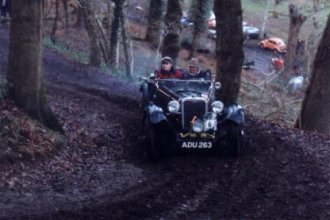
Web Community member and Singer Webmaster Kevin Barnes powers ADU around Fingles first hairpin on the Exeters anniversary run (picture by Jon Kelsey)
It sounds a bit monotonous but once again there was excellent Falcon entry with 16 crews in the program, plus a marshalling team on Clinton. We had a couple of non-starters on the day. Clive Booth and John Allsop were stricken with flu and Alan Bellamy didn’t get back from his overseas millennium trip in time to prepare the car. Verdun Webley had been all over his Marlin since it’s problems on the way to the Allen and had invested in rolling road time at NB Motors in attempt to sort the carb which was all over the place.
Peter Mountain and Mike Furse were entered in the anniversary run but Mike and Sheila were also struck by the bug and didn’t feel up to a long night in the open Buckler but they did drive down in the daylight to look in on how things were going. Most of the Falcon crews started from Cirencester and were able to find the venue this year as there were not only detailed directions in the final instructions but it was extremely well arrowed as well.
The run down to the Haynes motor museum was pretty uneventful for most people although Keith Pettit was struggling with a dodgy dynamo and resorted to following Peter Manning who had son David in the passengers seat for the first time. All was not well at Sparkford as the manager had confused the day and was not there to open up, shades of the Edinburgh! Fortunately the control was manned by a resourceful group of marshals, led by Jim Harvey of Dellow fame and including Steve Strutt. They quickly commandeered a nearby piece of land and stuck too, clearing a heap of tyres to accommodate the large number of competitors who had driven down at a reasonable speed in the belief they would be able to spend an hour browsing the bookshop!
Mike Pearson’s drama started immediately after the breakfast stop. The Dellow Rep started wandering all over the road and Mike found the bracket locating the panhard rod to the axle had broken. In his professional life Mike has learned to be resourceful in such situations and waited for the dawn to break to seek sought out a friendly welder to help him get underway again.
Gatcombe Lane provided it’s usual gentle introduction, always welcome to settle the nerves. Then it was into the woods at Bovey Downs where the battle would really begin. There was plenty of grip in there but the lower part of Normans Hump was very rutted. It looked truly horrifying but was relatively soft so didn’t do to much damage, although Neil Bray punctured. Tony Branson found far to much grip and didn’t have enough power to get over the hump following the restart. He got into problems reversing down in the dark, attacking a gorse bush at some speed and Sally Bolam collected some nasty cuts and scratches to her face.
Stuart Cairney was another one to suffer from excessive grip and couldn’t make the summit either. The top part of Norman’s is pretty steep. It’s essential to keep small, revvy engines on the cam, which on Norman’s needs a bit of wheel spin as its very difficult to build sufficient road speed because of the necessity to lift off a bit going over the cross track, even if you don’t have a re-start. In recent years the class eight’s have had a tougher affair higher up, but Ken Green was being generous this year and they restarted on the cross track along with the yellows. Our Red brethren weren’t let of the hook completely as they had to tackle Bovey bank, an extra section in the woods. This shattered their triple aspirations last year as only one car went clean. This year’s hill was a bit different and didn’t present the same challenge so most of them got up OK.
Falcon member’s hearts were in a bit of a flutter as they approached Clinton as they would have to strut their stuff in front of their teammates who were marshalling the hill. Simon Robson’s Skoda must have been very nervous as it gave a little flurry of protest, cutting out at low revs, necessitating a tune up in the queue for the section. I think all the Falcon’s got up OK, including a delighted Verdun Webley debuting his Marlin. Verdun was not without his troubles though as Lee Howells found his leg was getting a bit warm. Oil was pouring out the end of the pipe to the oil pressure gauge. Neil Bray was just behind and gave Verdun a hand to block it off.
Waterloo was it’s usual fun but was a little more than that for Michael Leete who failed immediately after the first right hander with a severe case of “operator error” and then had a puncture on the road section immediately afterwards. Stretes was pretty straightforward but the two Michael’s had to do a bit of PR work when a lady local approached them in the queue and asked them how many more hours they were going “round and round”. They tried to explain that there were several hundred competitors and that the field took five or six hours to go by. She departed home to the house on the corner where the route turned of the road leaving one or two choice and rather un-lady like words hanging in the air. She must have been out when the PR man called!
There was a long road section out to Greenslinch where the section finished before the slurry pit so this one didn’t trouble the score keeper to much, although Simon Robson still managed to ding the front wing of his Skoda on the exit onto the road.
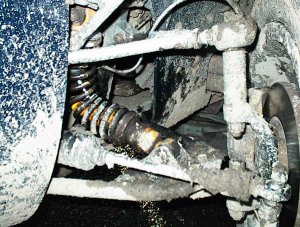
John Parsons suspension after a typical smooth, non-damaging section!
John Parsons arrived at Exeter services with one of the front wheels all awry with a coil over shock unit broken. JP decided this was a good test for the RAC. The actual shocker on the adjustable Spax unit had broken. The RAC man was a little surprised but rallied round and helped JP ring round to find a replacement. Not surprisingly they couldn’t locate a replacement competition unit, but the RAC man took JP off to a motor factor to see what they could find. Meanwhile Tom Goggin kindly stayed with Dot so she wouldn’t be on her own when the Falcons disappeared to do battle with the remaining sections.
They found something the right length and JP made up a couple of spring locators with some exhaust clamps. The man from the RAC was truly amazed at this, but before they parted thanked JP for giving him the most interesting morning in the job! Although the Westfield was mobile JP didn’t risk throwing the big car up the hills in its delicate state and he and Dot went directly down to the hotel in Torquay. While all this was going on news came through on the Mobile phone that Mike Pearson was underway again and was about to tackle Stretes although he was running some way down the field. Unfortunately the repair failed again later on and Mike was another addition to the retirement list.
Falcon members gather around the stricken Westfield. From left to right. Tom Goggin, Lee Howells, John Parsons, Verdun Webley, Pete Stafford, Fred Gregory and Dot Parsons.
Windout was the Exeter’s mandatory tarmac section and then it was on to Tillerton. The re-start was pretty rough and it was essential to put your car in exactly the right place. This caught out quite a few of the class sevens including Fred Gregory and Andrew Brown. Mike Furse was spectating here but was still suffering from the flu and Sheila wisely stayed in the warm of the car. Allen organiser Pete Hart got up at the expense of a damaged exhaust and was having a lot of problems with the Marlins fuel pump.
Fred Gregory on Windout and Mark Tooth on Fingle
There was a time control just before the bridge at Fingle. This was a new variation and caused a few problems later in the event when the Classic run competitors were on the same minute as competitors in the main event. This was very important to the Anniversary boys and girls as their award depended on them sticking to a strict time schedule. Those who attempted Fingle enjoyed the experience and it was great to see the period cars on this piece of MCC history. Neil Bray had to change another tyre before the special test which was pretty rough and wasn’t a pleasant experience for car competitors trying for a class win who had to throw their machines at a suspension breaking bump.
The second special test was just up the road on the approach road to Wooston and was a much smoother affair. It involved a bit of reversing which put paid to David Aldersons AH Trophy hopes when the clutch on the Troll shattered to smithereens. Conditions on Wooston were quite favourable and the class sixes has things easy as they were allowed to take the deviation to the left. I have to say this was a problem as I don’t thing either the route or instructions or section markings made it clear where the turn was. In pervious years there has been a map at the start and the deviation has been well signed. It was OK for regulars but Peter Manning went up the wrong bit and I’m sure there will have been other competitors who got lost on the hill. Fred Gregory and Pete Stafford were delighted to make the summit and reported that the higher reaches are even more horrendous than the bit you can see at the bottom.
There were only two sections remaining but they weren’t going to be easy. Simms was the first one, with a re-start for seven’s and eight’s but the sixes were allowed to have a uninterrupted run. The old hill was on form and broke it’s usual quota of hearts. Last year there were quite a few successful climbs up the right but not this year. The successful track was over to the left, halfway up the bank if possible according to a spectating John Sargeant. Falconwise I believe that David Thompson was our only successful climber and all of us in the lower classes came to a grinding halt. It was possible though as both Colin Perryman and Giles Greenslade got up OK in Skoda and Beetle respectively. Duncan Stephens was spectating here and said that the hill got more difficult as the day went on. It was relatively easy for the first 100 cars but then there was a few spots of rain, after which it was a real achievement to reach the A boards. Duncan didn’t see any class 1 or 5 cars reach the summit and witnessed a nasty accident when Barry Clarke rolled the Grotty Chummy.
There was only one section left now. Slippery Sam for the blues and whites and Higher Gabwell for the yellows and reds. The restart on Slippery Sam had been on the right-hand hairpin for many years, probably to slow people down after the Yugo overturned here back in 1991. This time it was back in the old place and a good position was absolutely crucial, as there was a huge step. Michael Leete was delighted to get it just right but many didn’t including Hazel Mac in JAZ who had to tackle the obstacle in the dark and Neil Bray and Marc Lawrence who didn’t stop at all.
Over on Higher Gabwell there was a real sting in the tail with a re-start spicing up a section that was pretty tough anyway. This cost David Thompson his gold and the other Falcons faired no better. This section really was a snorter and also claimed Classical Gas Web Community members Stuart Harrold, John Salter, Pete Hart and Sndrew Brown.
Back at the finish, we heard that Colin Stevens had retired with gearbox gremlins and Dave Nash had been fighting with a broken gearbox mounting and failed two hills. The sevens and eight’s reckoned this year’s Exeter was a pretty tough challenge, perhaps a bit more than necessary in an attempt to slow down the “super-stars”. It ran pretty smoothly though, the weather was good and the organisation and conditions ensured things finished in good time for the traditional club supper where John Aley presented a select group with their Triples, including Classical Gas Web community member John Lees to considerable applause.
We have been publishing stuff about Classic Trials on the Web since 1995 and always appreciate feedback. Comments, Corrections, Criticism & Concerns are all welcome. You can leave a comment to have your say here on this web site or our Social Media
Please help spread the word and share this on your Social Media:
We had a stranger in the camp at the Gill Morrell memorial Trial, in the form of JAB’s, James Alexander’s Sporting Trials car. He had a familiar face in the passenger’s seat, none other than John Boswell, who is more commonly seen driving his Dutton Phaeton with great gusto. A brief chat with John wetted my appetite and I could feel an article coming on!
John Boswell hangs on tight while James Alexander assaults Brickhill’s bank in Jab’s
In my ignorance, I thought that JAB’s was short for John Boswell and that he had built the car. However, John soon put me right, saying that he was about as useful with a toolkit as a chocolate teapot! The car was actually built by John Benson in the mid-seventies when the BMC “A” series was the motor to have. James’ father Robin Alexander acquired JAB’s and had a real crack at the National title in the early eighties. It was Robin who got John into trials back in 1983 when he passengered Robin. They never won, but came very close, occupying the number two spot in both 1983 and 1984.
All this wetted John’s appetite and they reversed roles when John started to drive in Classic’s, that he felt suited his committed driving style. Robin continued with JAB’s for another season before swapping it for a Cannon, which he soon sold on, reinvesting in a Kincraft. This was to get little use as sadly Robin died of cancer in 1988 at the young age of 44.
JAB’s passed through a couple of hands, ending up in the care of Martin Halliday, the custodian of several fine old trials cars, including one of Colin Chapman’s early Lotus’. By now, James Alexander was anxious to re-acquire his father’s old car. John put him in touch with Martin and JAB’s was soon back in the Alexander family. They went to a Peterborough Motor Club event but James couldn’t compete, as he didn’t have a licence. So his first event was the Robin Alexander memorial trial, held in honour of his late father, down in Cornwall. He found it pretty tough going and decided he needed a bit more practice. A quick call to JP saw Robin and John out at our Brickhill event, getting the feel of the car under easier conditions than are found on the flyweight circuit.
The car has been developed considerably since Robin owned it. It’s still A series powered, but the iron block 1275 Midget motor has now been bored out a bit. Things have changed in the transmission department too and the cogs are now courtesy of a certain Mr Hewland. It still has rather old fashioned mechanical fiddle brakes but John reckons these are an advantage as you can actually “feel” if a wheel is spinning. James has joined the 750 MC so he can get entries to Sporting Trial events and John hopes to do a bit of passengering in the old car.
John Boswell enjoying an Autotest in his MidgetJohn is a fierce competitor in his local PCT’s seen at Brickhill in the MidgetJohn passengering David Anderson’s TrollJohn in the Dutton
What about “Bossey” as he is known to some. Well, after Robin Alexander introduced him to Classics he competed quite regularly in his Midget, but got fed up with driving down to Cornwall and breaking the car on the first hill! After destroying thirteen diffs in a season he converted the back axle to take Ford components and then started breaking gearboxes! All this prompted John to acquire a Dellow from Jim Harvey. The only problem was it was in bits and it sat in a lock-up for several years before Steve Strutt bought it and John used money to buy his well known “wash and go” Dutton Phaeton.
John found this car very reliable and has had very few problems with it. It bought some success too, and John won the ACTC Crackington Trophy in 1990. It also achieved TV fame when the BBC used it as a camera car on the televised Lands End. John had to take things easy for a few years as he was having health problems with his heart. He was better in time to partner David Alderson in his assault on the ACTC Wheelspin series and they won the championship together in 1996. John then used both his Dutton and Midget in local PCT’s and Autotest’s but had an overwhelming desire to go Motor Racing. The only problem was that he needed to do it without spending a lot of money! Inspiration came one night in the pub during a chat with Mark Wilson from Milton Keynes Motor Club and they decided to get 2CV and take part in the Mondello 24 hour race, competing with such luminaries as TOCA’s Alan Gow and Marcos creator Jem Marsh.
They qualified 22nd and got up to 10th at the end of the first hour. Then the engine blew up. They had a spare but it took two hours to change it. After all that effort the team decided to drive for a finish, cutting back on the revs and short shifting to take care of the little 602cc motor. They succeeded, finishing in 22nd place, really enjoying themselves and vowing to return. John’s plans for the future include another crack at the Mondello 24 hours and competing in PCT’s with the Dutton, all with one objective, to have some fun!
We have been publishing stuff about Classic Trials on the Web since 1995 and always appreciate feedback. Comments, Corrections, Criticism & Concerns are all welcome. You can leave a comment to have your say here on this web site or our Social Media
Please help spread the word and share this on your Social Media:
The result of this years Allen was decided on the re-starts and Special Tests. There were seventeen clean sheets at the end, including at least one on every class.
Allen Tropy winner David Foreshew takes an unusual line while Teresa Middleton bounces the GVS Mk2 away from the re-start on Guys Hill (Picture by John Salter)
The Bristol club had their usual full entry, plus reserves, for their Allen Trial on 28th November. The week before Pete Hart and his team were getting worried, as everything was bone dry, and it looked as if the hills were going to be too easy. Fortunately the rain came down pretty hard on the Thursday and Friday so there was a bit of mud about on the Sunday, even though it was a dry day.
We had an excellent Falcon entry. Fifteen crews coming across from Beds, Herts and Bucks to do battle with the Bristol hills. Well, that’s not quite right. Robin Howard came a lot further, all the way from Bury St Edmunds, to take part in his first ACTC Classic Trial. There was drama, even at the start, for the Falcon contingent. Verdun Webley had set of in convoy with John Parsons. Both of them were solo as they were going to meet up with their passengers at the start. John was to be accompanied by Keith Harris, with Sarah Harris riding with Mike Pearson in his Dellow Replica. Arnold Lane traveled to Bristol in Mike’s passenger seat, and was due to ride with Verdun, taking part in his first trial in the Marlin he bought after last years Exeter. That was the plan, however it all fell apart on the outskirts of Buckingham when the B series motor shredded its fanbelt. Verdun had a spare but it was too long and the alternator bracket fouled the steering so he couldn’t make the start.
This left Arnold without a ride, and with no car to go spectating or marshalling. In the end he went round the route with Simon Robson, getting out to walk or run up the hills so not to burden the Skoda with the extra weight! Tog Hill was the usual introduction to the competitive stuff, nice and gentle since the bumps were smoothed out a few years ago, and it didn’t trouble the scorer. Simon Robson had given his Skoda quite a bit of welly and dented a rim badly enough to need removing for some gentle adjustment with a club hammer on the following road section.
Bitton Lane had its usual re-start on the corner. There was a little more grip on the slippery stones this year and only four cars were recorded as failing to get away. I say that as Mike Hayward was not one of them, but as his passenger I know we failed as we backed down a good ten yards to get a good run afterwards! Neil Bray got away OK, but picked up a puncture in the process. There were a lot of delays on Big Uplands last year when failures couldn’t get past cars queuing at the bottom. To avoid this happening again the route went down Little Uplands, with a holding control at the bottom to keep the failure route clear. The descent was quite interesting as it gave competitors the opportunity to see just how horrendous the step is at the top!
Big Uplands itself started to sort the results out a bit as around 40% of the entry failed the hill. The Blues and Whites had a clean run, with no re-start, but even so there were quite a few that didn’t make the summit, including Neil Bray and all of class five apart from Rob Cull. Simon Robson was in determined mood, and flew round the ninety left at full speed, using the bank and scattering marshals and spectators alike. The yellows and reds had their usual re-start on the ninety left. The approach to this was nice and smooth this year as the Bristol club had spent the year filling in the gullies, caused by water flowing down the hill, with over forty tons of stone! The majority of the yellows came to grief here. Dave Nash, Mike Hayward, Robin Howard and Tony Branson all failed to get off the re-start. Andrew Brown and Fred Gregory got away OK but couldn’t build up enough momentum to get over the rough stuff immediately afterwards and got fours.
The reds fared a little better but again there were quite a few failures including Falcon’s Mike Pearson, David Thompson, James Lindsay and Maureen Chattle. They were in distinguished company as neither Adrian Dommett, Duncan Welch or Anthony Young made it either. Going back to the Falcon’s James had Julian Robinson in the passengers “seat” of his Fugitive and I believe this was actually Maureen’s debut.
Guys Hill became famous because of the court case regarding the exit road. Unfortunately the case was lost and these days we have to stop at the top and come back down, rather than go straight out the top. This was academic for many of the yellows and reds, as they couldn’t get off their restart on some very greasy polished stones. David Thompson couldn’t get his VW Buggy off the line and neither could Maureen Chattle and Ross Neuten in their Dellow. Mike Pearson did well to get his Dellow away, but even he couldn’t get much beyond the four marker. Dave Nash had the Skeetles new type four motor cut out on the approach but fiddling with the battery got it away. Looking at the results it’s fascinating to see that with a few exceptions successful restarters on Guys had also succeeded on Big Uplands and visa versa. The exceptions included Falcon’s Ian Davis in his Buggy and Classical Gas Web Community member Stuart Harrold, both of whom lost their clean sheets here.
Sandy Lane wasn’t very difficult, despite a large amount of water on the approach, which was not very Sandy. The two Michael’s caused a minor delay when they found another flat tyre on the start line and had to change a wheel. The section at Strode was pretty simple but the special test was more complicated. After going forward around a corner you had to go all four wheels over line B, and reverse back round the corner to stop astride line C. Adrian Tucker-Peake set the fastest time in his Peugeot followed by David Foreshew, which was to be important by the end of the trial.
Travers was before the lunch break this year. It had a very tough restart for the yellows and reds with some horrible holes to get your front wheels stuck into. Very few of the yellows got away and a lot of the reds failed as well including Adrian Dommett and Anthony Young, neither of whom were having a very good day. Mike Hayward had another puncture and joined Fred and Pete at the top while they fixed their exhaust. They were enjoying the trial but were having a pretty torrid time results wise.
Dudley Sterry looking very worried as he approaches the re-start on Burledge. (Picture by John Salter)Rob Cull, pictured by John Salter on Guys Hill, on his way to winning class 5Clive bounces faster than the shutter on John Salters camera as Tommy Kalber eases his Dutton Melos away from the Guys Hill re-start.Simon and Matt Robson blasting up Burledge on their way to a class win.
The lunch halt was held in a windswept car park alongside Chew Valley Lake. The Falcon tyre-changing brigade was in full force and Mike Hayward, Neil Bray and Dave Nash were all fixing punctures. The ruts on Burledge were not as deep as in previous years, but they were deep enough to cause problems for the non-giraffes amongst the yellows and reds as their re-start prevented a full frontal assault. The Falcons were starting to fall at this stage. Through the wonders of the mobile phone we heard that John Parsons had retired with electronic Gremlins in his V8 motor. Dave Nash was in trouble with his electric’s again. He got to the start line on Burledge when the engine cut out and wouldn’t restart. Dave and Julie retired and eventually Dave found the problem was as simple as the wire coming of the starter solenoid.
Nanny Hurns was not quite as straightforward as usual with a bit of to and froing required before the assault on the bank. This meant the dip was not approached at quite the same speed as pervious years, reducing the time in the air for the successful climbers as they crested the hump. David Foreshew set the fastest time, which was to give him the overall win and The Allen Trophy, as there were to be 17 clean sheets at the end.
The water at the start of Mill Lane was as deep as usual and the section itself was as fun, but not one to trouble the scorer as they say. The gentleman at the top had his airline out for us to use, which was very nice of him. He was beavering away in his garage amongst his restoration projects and there was a restored Ford Consul and old Caravan outside as well as a very tidy looking Marlin, albeit one that had clearly never set a wheel on a trials hill!
The route now skirted the suburbs of Bath on its way to Stoney. I don’t know if it’s a new hill but it was certainly new to me. The slope was quite gentle but the restart was a nasty, slippery thing and quite a few people really struggled to get away, including David Thompson and Murray MacDonald who lost his clean sheet here.
John Walker was the final hill. Most people view this as a nice thrash but not one they are likely to fail. This year it was a real sting in the tail though. The ruts were very deep at the top, giving major problems to people who didn’t have a lot of ground clearance. There was an additional hazard in the form of big rock close to the track. Several of the early numbers gave this a fair clout, including a Dellow. This caused quite a queue to build up early on. I don’t know exactly what happened to Rich Welch but he got stuck on the upper reaches for at least ten or fifteen minutes.
The ford at the bottom took its toll among the Falcons and both Neil Bray and Mike Hayward drowned out here. This final hill was to be a real sting in the tail for Stuart Cairney as he lost his clean sheet here. This left Simon Robson and Giles Greenslade on zero in class four, Simon taking the class win by being faster on the special tests. That bought another excellent Allen trial to an end, for many of us the last event of the millennium.
Giles Greenslade had a different Beetle. The engine was the same but it was in a new shell. This had been built for trials and done a few events when the owner retired because of a bad back and Giles snapped it up.
After the event I asked Pete Hart what happened to Elwell, always one of my favorite hills. Apparently the local farmer planned to use it for access to his land and told the club he was going to surface the whole track. He has started from the bottom and completed about 25% of the job after which the work stopped some 18 months ago. Pete intends to have another look next year with a view to bringing it back. He always enjoyed blasting up when he was competing on the Allen, but, as an organiser is more circumspect because of the problems in clearing failures.
Tommy and Clive Kalber were giving their Dutton an outing. This is a really smart car. How do they manage to get all that ground clearance at the back?
Tim and Anne Whellock drove a VW Fugitive and Adrian Marfell was also competing in class eight.
Dennis Greenslade has won the historic rally championship, navigating the infamous oil-dropping Imp that achieved so much notoriety on last years RAC Rally.
We have been publishing stuff about Classic Trials on the Web since 1995 and always appreciate feedback. Comments, Corrections, Criticism & Concerns are all welcome. You can leave a comment to have your say here on this web site or our Social Media
Please help spread the word and share this on your Social Media:
An Edinburgh Montage, featuring Andrew Brown, Pete and Carlie Hart, Ken Green and Terry Ball in the only competing Class Six Beetle. The organisers are trying to clamp down on class 6 so they handicapped him by making him drag his spare wheels to the top.
A few comments from my Edinburgh. Peter Manning certainly whitewashed class five with the only clean sheet. The next best being a bronze. I’m particularly pleased for Gary Booth who has persevered with his old and rather delicate Buckler, which was built by his late father-in-law, and looks like winning the Buckler Register’s trophy for the most successful Buckler in 1999. (To be fair to the others he hasn’t really had a lot of competition this year!)
I should have got a bronze, but choose to park one front wheel against an outcrop on the restart at Calton, under the eye of Peter Mountain, who will, no doubt, remind me of the incident for some time to come! The other two hills I failed were a bit of a lottery. It rained as I approached Great Hucklow so a successful climb from a restart with 18 psi in the tyres was a bit much for me, and by the time we reached Pindale at the tail end of the trial it was rather dug out to say the least. Not a good excuse, that one, as Arthur Vowden climbed it just after me! Incidentally, I discovered before the start that my Racecorp does not comply with the ACTC Kitcar Spec. sheet, recently revised. I declared this at the start and put myself in Class 8. So, we had the rather strange situation of one Racecorp in Class 8 and the other in Class 7. No one at the A5 scruitineering point was interested at all and the results team didn’t pick it up. Because of the rather strange practice that the Edinburgh organisers have of making Classes 6, 7 and 8 do exactly the same things throughout the trial, it didn’t make a bit of difference, but I hope it can be sorted before I use the Racecorp on a Classic again.
I met Robin Howard at the breakfast halt. He had an alternator problem and was going to do a few hills before the battery gave up. Then he would go home! Another thing the results team didn’t pick up was that Col (Colin Stevens) used a Skoda instead of the Dutton Special. I suspect that if you don’t finish they don’t bother to check all the details! Alan Bellamy didn’t run after putting a screwdriver through his finger but was well enough to go up to marshal on Corkscrew, for which the club is suitably grateful! I’m told that when we next see the Brasilia, we should be prepared to be impressed….
Bill Bennet exiting Litton in his MG (picture by Ken Green
The cancellation of Putwell for the car classes was inevitable. We were badly let down by the filling station at Newhaven, who apparently couldn’t distinguish between Saturday and Sunday. As a result, the bikes had severe problems finding fuel, and hence got very late indeed. This was not helped by conditions at Excelsior, where a lot of the bikes had great difficulty. This caused such a delay that Dave Turner and Adrian Tucker-Peake established an adhoc control in the village. The villagers, bless them, did not appear to be upset. At one time, we had about 60 cars there and everyone behaved extremely well, although the running order got very distorted! Some competitors were dismayed at the amount of mud left on the main road leading out of the village and there is a looooong storey of how John Hayes dealt with this problem. Suffice to say that the duty policeman who took his call could not believe that the person who made the mess was actually reporting it and offering to pay to clean it up!
Looking back at the event as a whole, as a competitor I felt it went as well as could be expected, given the difficulties the organisers had. I certainly enjoyed it and have had many positive comments from other competitors. One of the most positive things that I felt about this event is that, at long last, we seem to be building up the popularity with the locals that the Exeter and, particularly, the Lands End have enjoyed for some time.
We have been publishing stuff about Classic Trials on the Web since 1995 and always appreciate feedback. Comments, Corrections, Criticism & Concerns are all welcome. You can leave a comment to have your say here on this web site or our Social Media
Please help spread the word and share this on your Social Media:
Simon Robson building speed for his successful assult on the bank at Great Hucklow.Neil Bray successfully re-starting on Calton under the watchful eye of Peter MontainClive Booth and John Allsop being advised of the horrors ahead by Gerry Woolcott.Problems for Robin Howard at Litton on his first MCC event.
It had been pretty wet in the days leading up to the Edinburgh so the hills were going to be in prime condition in Derbyshire. The rain poured down during the night run and the bikers got pretty wet as did drivers of open cars, at least those that didn’t stop under motorway bridges to put the hood up!
The common routes converged at the Elf service station on the A5 near Atherstone for eligibility scruitineering, which was pretty painless. It wasn’t so good for the ladies as the toilets were closed for the second year in succession! Then it was back into the night to battle with a rather in-accurate route card to find the first hill at Agnes Meadow near Ashbourne. The water was streaming down the section, so much that most of the mud was washed away making this a nice gentle start before the serious proceedings. There were gates to be closed here but runners at the back of the field found them open. This continued through the trial and it’s something the MCC will have to watch out for if we are to stay out of trouble with the local landowners.
Wigber Low was just up the road, which I believe is a new hill. It starts just off the busy B5056 so there was a holding control for the cars to stop them queuing in the main road. The hill was pretty straightforward but it was a bit rough in places and this was the downfall of Colin Stevens who had the sump-shield ripped off his Skoda Coupe and he retired. Breakfast was waiting a few miles up the road at the Bentley Brook Inn. They had a wonderful open fire going and the room steamed as wet clothes were dried out. The food was good quality but there wasn’t much room inside or in the car park and competitors missed that wonderful transport café atmosphere of the Salt Box.
The bikers hit big problems just up the road, as the New Haven garage wasn’t open. Most of them were in desperate straits as they were relying on filling up here. Some waited for the staff to turn up, some went searching around for a 24-hour garage and sadly, some gave up. All this caused a big delay for the bikes and they dribbled into Excelsior with a considerable delay. The rain had made the hill pretty muddy and this caused further delays, which affected the cars who backed up onto the main road. Travelling marshals created an impromptu holding control in Hartington village and competitors queued around the village pond. This mostly worked pretty well but some later numbers got pretty annoyed with queue jumpers and there were a few raised voices and frayed tempers. The wind got up a bit which dried the hill itself out and it was pretty near bone dry towards the end, causing few problems for later numbers although Jonathan Baggott retired his Marlin soon afterwards.
Then it was off to the A6, up the hill to the Monsal Head Hotel with the wonderful view across the valley to Putwell, down again to Cressbrook and up the steep climb to the track down to Litton and “the queue”. The hill was in pretty good condition this year but Laurie Knight had spiced things up with a restart for Terry Ball plus class seven and eight. Why Terry Ball? Well he was the only starter in class six! The box was just before the trees, preventing the yellows and reds getting a good run at the steep bit where the deep ruts start. This caught out many of the class sevens, including Robin Howard, Dave Nash, Mike Furse and ACTC rights of way officer Andrew Brown. Fred Gregory and Pete Stafford persuaded their Dutton Melos up to the top without to much difficulty as did Mike Pearson and David Thompson in class eight but Clive Booth and John Allsop weren’t so lucky in their lower powered Dellow replica. All the non-restarting Falcons made it to the top OK but former Falcon Adrian Tucker-Peake couldn’t get his Peugeot to the summit. Yes we know Litton is a difficult prospect for class 1 but David Haizleden climbed it in his Golf Adrian! Sadly Litton saw the end of Robin Howard and Barry Blofield’s Edinburgh and they were last seen under the bonnet of their Dutton Sierra after failing the hill.
Calton was next. It’s not so many years ago when this was the last hill, providing a real sting in the tail as many Triple aspirations sunk without trace in the deep ruts at the summit. They’ve been filled in now and the hill itself is a pretty gentle run. However, it had been made competitive by adding a re-start just before the summit, presided over by Falcon’s Peter Mountain. It was OK if you just nudged your front wheels into the box but if you went at all deep your front wheels came up against some fair sized rocks making getting away pretty problematical, trapping quite a few, including Peter Mountains near neighbour Mike Furse.
It was a beautiful morning as the route wound up the steep hills towards Bareleg. The sky was clear and the views magnificent, but all this was spoilt by a terrible accident as a BMW pulled out to pass Adrian Dommett on the approach to Bareleg and collided head on with an approaching car. There were several people hurt and at this stage it’s not known how they are. Bareleg was not used as a section this year, and Mike Hayward and Arnold Lane were able to see where they stood in the fog for seven hours two years ago! The blues and whites went straight down to the special test at Old Long Hill but the pleasures of Corkscrew awaited the reds and yellows. This used to be known as Jenkins Chapel and regular readers of my column should be experts on the hill, I have written so much about it lately! Apart from Clive all the Falcon’s cleaned the section but it was pretty rough, several drivers saying it was the roughest section they have ever seen. Clive was particularly unlucky, urged on by John he was going really well until the engine cut out just before the section ends board. It started again OK and Clive thinks he must have knocked the ignition off with his knee as the Dellow Rep lept over a rock.
Michael Leete and Mike Hayward storming Bamford Clough
The special test at Old Long Hill passed without any great drama, then it was a twenty mile run up and over the hills to The Marquis of Granby. Things weren’t too bad for the early numbers but the delay built up and towards the end there was quite a bit of queue jumping causing the usual un-happiness. A lot of work had been done to Bamford and it was nowhere near as rough as it has been in recent years. It’s still a formidable obstacle, especially with a bit of damp in the air making the concrete steps a bit greasy. The worst problem was the step right the top and it was here most of the failures came to grief, including Simon and Matt Robson who didn’t have enough momentum to get over the final hump. There had been doubts that the MCC would get permission to use Haggside as part of it is a bridleway and the local Forestry Commission guy was being a bit difficult. All was well on the day and we had the challenge of the usual re-start just out of sight round the first corner. It wasn’t too bad if you didn’t go in to deep but it still caught a few, including Clive and John.
After Haggside it was back by Ladybower reservoir, past the foot of Bamford and The Marquis, through Hope, past the cement works to Pindale. The approach was pretty rough and there was a rather strange special test before the Pindale section itself. A split route waited. For the Blues and Whites there was a rough stony track through a gully but for Yellows and Reds there was a steep mound to be climbed first which defeated quite a few including Fred Gregory, Dave Nash and Mike Furse. This was really one for the brave. If you didn’t hit it hard enough you didn’t get up but hit it to hard and you broke the car.
Hucklow was next. All classes had to deviate left up the bank and this was to sort the men from the boys. The bikes found it pretty rough, especially some of the older, heavier one. John Lees told me how his 1961 Triumph, weighing all of 500 lbs, leapt from rock to rock on its way up, but he made it and won the class A award. Duncan Stephens was spectating on Hucklow and witnessed David Haizelden’s magnificent climb, he made it look very easy and actually eased off half way up! Duncan was also impressed with Roger Ugaldes Allard, the big heavy car going up without any problems. Falcon cleans here were few and far between, only David Thompson, Mike Person and Peter Manning were successful. Simon Robson had a magnificent attempt, but bogged down about half way up and the car came to a stop with wheels spinning. It didn’t slip backwards and with much bouncing from Matt and sawing at the wheel from Simon they get the white Skoda going again and it came out of the top to much applause from the spectators. Everyone thought Simon had cleaned it but the provisional results showed the Skoda as a failure so it looks like the marshals noticed it stopped! Andrew Brown had the misfortune to clip the exposed rock at the deviation. This stopped the car dead, slewed at 90 degrees across the track.
The trial was drawing to a close now and Ballcross didn’ t present any problems for the Blues and Whites. The higher classes gave this one a miss and went south down the A6, through Bakewell and down to Darley Dale. Old Edinburgh hands had a sense of deja vu as they passed the DFS car park and Texaco Supreme service station before turning left up to Halldale. The section was approached by going up the drive to somebody’s house and it will be interesting to see if the MCC can get to use this one again. The section itself was quite a long stony affair but the gradient was pretty gentle and didn’t trouble the scorer. The early cars did Putwell, but Clerk of the Course Laurie Knight was worried about the trial running late and exercised his right to cancel the section. Later numbers were treated to the full scenic tour of Derbyshire on a twenty-five mile run in to the finish without any sections to disturb the view.
Despite all the early drama’s the trial wasn’t too late in finishing, last man Arthur Vowden arriving at Buxton around quarter to eight. As the pubs and bars filled with triallers reliving their day, the verdict was that the 1999 Edinburgh was an enjoyable trial. It was certainly full of drama. A wet night, searches for fuel in the early hours of the morning, delays, disputes over queue jumping, the excitement of Litton and Bamford and a particularly tough section at Hucklow. Yes a pretty good Edinburgh!
121 Stuart and Andrew Cairney (Imp) (4) – Did not start. Stuarts Imp was running very rough because of problems with the Dellorto carburettors. The problem couldn’t be sorted and Stuart decided not to start.
217 Robin Howard and Barry Blofield (Dutton Sierra) (7) – Retired after Litton Slack
222 Alan Bellamy and Jack Sheppard (VW Fastback) (6) – Did not start
223 Dave Nash and Julie (Skeetle) (7) – Failed Litton, Pindale and Hucklow
224 Colin and Mark Stevens (Skoda Coupe) (?) – Retired after Wigber Low when the sump guard came adrift
225 Clive Booth and John Allsop (Dellow Rep) (8) – Failed Litton and Haggside, Hucklow and probably failed Corkscrew as well when the engine cut out as they were about to pass the section end board, believed to be caused by Clives knee jogging the ignition switch!
227 David and Christine Manning (MG Midget) (5) – Gold and winner of class 5
241 Murray and Hazel MacDonald (VW 1302S) (4) – Silver, Failed Great Hucklow.
248 Mike Pearson and Arnold Lane (Dellow Rep) (8) – Gold
249 David Thompson and ? (VW Buggy) (8) – Gold
252 Mike and Shiela Furse (Racecorp) (7) Failed Calton, put front wheel against a rock, Pindale, couldn’t climb the steep bank, Hucklow.
253 Michael Leete and Mike Hayward (VW 1302S) (4) – Failed Great Hucklow
254 Neil Bray and Marc Lawrence (Skoda) (4) – Failed Great Hucklow
255 Simon and Matt Robson (Skoda) (4) – Failed Bamford Clough and Hucklow.
256 Fred Gregory and Peter Stafford (Dutton Melos) (7) – Failed Pindale and Hucklow
268 Jonathon Baggott and Ian Banton (Marlin) (7) – Retired after Excelsior
Some Others –
Barry Clarke retired his Austin 7 on the track after Hucklow with a dead battery. He was hoping to limp to his hotel using only dynamo power.
Derek Chatto (Cannon) Winner of JTP cup
Stuart Harrold (Troll) – Class 8
Andrew Brown (Marlin)- Failed Litton and Hucklow.
David Haizleden (Golf) won class 1 and went round clean – man how did he get a front wheel drive car up that bank at Hucklow with a re-start?
Adrian T-P (Peugeot) failed Litton and Bamford
W. J. Bennett (MG J2) won class 2
David Heale (Escort estate) won class 3
Bill Rosten (Imp) won class 4
Terry Ball won class 6 but then he was the only starter!
Roger Ugalde won class 7 in that wonderful Allard
Pete and Carlie Hart won a Gold in their Marlin
In the bikes John Lees won Class A
We have been publishing stuff about Classic Trials on the Web since 1995 and always appreciate feedback. Comments, Corrections, Criticism & Concerns are all welcome. You can leave a comment to have your say here on this web site or our Social Media
Please help spread the word and share this on your Social Media:
One of the nice things about the Web version of Classical Gas is the e-mails I get from all sorts of people, many of whom I have never met. Sometimes there is quite a bit of debate on some of the things I have published, none so much as about a picture I included in an article about Jenkins Chapel back in October 1997.
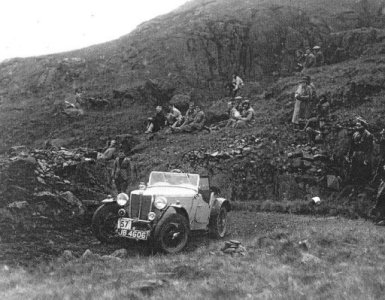
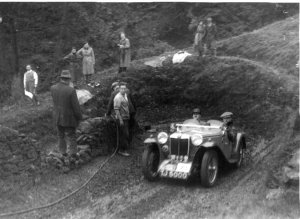
To recap this was a brief piece about the hill which was used under the name “Jenkins Chapel” back in the 30 and resurrected by the MCC as “Corkscrew” in 1993. It’s a rough, narrow hill with two hairpins, followed by some nasty steps. I published a couple of pictures which I reproduce here. The one of Dudley Sterry was taken by our own Mike Furse a few years ago and is definitely Jenkins. I scanned the other one out of a book and this is the image that caused the controversy, and really set the letters pages of Classical gas on the Net going with some most enjoyable correspondence, with many famous “trials families” participating.
The picture that started the debate
It was ACTC rights of way officer Andrew Brown who first smelt a rat. Then Tony Branson raised his doubts too”I share Andrews doubts that the old picture of the MG is really this hill. I too have spent some time with Jonathan Toulmin pouring over old trials photos trying to recognise which sections they are. It’s amazing how much the landscape changes over the years, trees move and cottages sprout or lose chimneys.
After the 1993 Edinburgh Jonathan, Pat, Derek and I walked the section and I bemoaned the fact that class 3 didn’t get a shot at it. I have since gone up it twice in the Marlin and my propshaft tunnel has the scars to prove it. I attach some photos I took that day. The first shows the section from across the valley, The second the infamous first corner with Derek having a little trouble on the restart and the other two the rocky steps in the upper reaches.”
Dudley Sterry pictured rounding the hairpin in 1997 by Mike FurseTony Branson’s pictures capture both how steep the corner is and the beauty of the setting.
A few days later Andrew Brown came back to me after some considerable research. “I don’t where you got the original photograph from, but it is on Page 34 of Roger Thomas’ excellent ‘M.G. Trials Cars’ book where it is captioned as “Lewis Welch in Athos on the 1935 M.C.C. One Day Sporting Trial in Derbyshire at the upper part of Jenkins Chapel”. The registration is clearly shown as JB 4606 and the competition number as 57. JB 4606 was one of the three MG NEs (1287cc) which ran in the 1934 TT, were converted to trials cars for a short period in 1935 when they ran as ‘The Three Musketeers’ team, and were then re-converted to race cars for the 1935 TT. According to Roger Thomas they entered only four trials (Lands End, Edinburgh, Abingdon, and Rushmere) and the Welsh Rally. Donald Cowbourne’s book lists Welch in a 1287cc MG Magnette in both the Lands End (No.399) and the Edinburgh (No.57), and in a 1408cc Magnette in the MCC Sporting (No.89). So, unless there is some amazing coincidence, I think it’s a pretty fair assumption that the picture was taken on the 1935 Edinburgh.
But where is it? Cowbourne lists only four Observed Hills for the 1935 Edinburgh – Park Rash and Summer Lodge in the Yorkshire Dales, Wrynose Pass and Hard Knott Pass in the Lake District. I’m not familiar with any of these hills but have seen enough photographs of Park Rash and Summer Lodge to be pretty sure that it’s neither of them unless the photographer stood at a particularly unusual location. There’s a picture on Page 256 of the Cowbourne book of an AC in the 1935 Edinburgh at a location that looks remarkably like the Welch MG picture. So, does anyone recognise either of these pictures as somewhere on Wrynose or Hard Knott Passes? My money’s on Wrynose Pass, but I’m not really a betting man.”
Things were really hotting up now and Pat Toulmin kindly delved into the family archives. “Further to the debate about Jenkins Chapel, the photo of Lewis Welch is not on Jenkins Chapel. Indeed it is not even of the 1935 Sporting Trial – in Donald Cowbourne’s excellent and well researched trials book, Lewis Welch was number 89 on the Sporting Trial (see page 463). In the photo you publish, he was number 75 (I think Pat meant to say 57) and this is the number he ran on the 1935 Edinburgh Trial, 7th and 8th June. This had 4 sections only – Park Rash, Summer Lodge, Wrynose and Hard Knott. The latter two are in the Lake District and it seems likely that the photo is on one of these. See pages 190, 256 and 283)
Pat Toulmin sent me this picture of works MG driver Maurice Toulmin on the real Jenkins
I attach two photos that Maurice Toulmin stated are Jenkins Chapel. Both photos are by W J Brunell. The one of JB 7521 we took with us on the walk with Tony and Derek and we were able to confirm that it is Jenkins, the building is still there and the approach road was very characteristic and exactly the correct shape. This photo was used as the basis of the drawing on the cover of Roger Thomas’s excellent book on pre war MG Trials Cars, published in 1995. We have other photos of Maurice on Jenkins Chapel. PS -The section which we use today on the MCC Edinburgh Trial known as Calton was called Taddington Moor in the 1930s.”
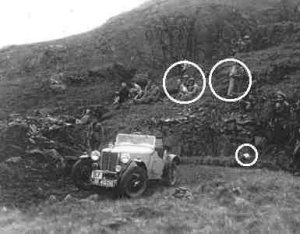
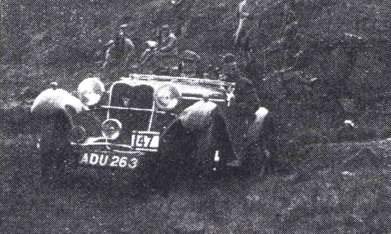
Then Kevin Barnes e-mailed me “Just seen the Jenkins Chapel debate and thought I would try and help. I think that (99% sure) the picture may actually be of Wrynose Pass on the London-Edinburgh. I enclose a picture of my grandfather J.D.Barnes on this section. (wrynose.jpg) It’s not as good quality as the MG picture but after studying it at high zoom levels I believe that some of the people and features in the background are the same as in the MG picture. I have highlighted them on the MG . I will have a look at the competition numbers for that trial to see if I am right when I get time.
The caption of the original picture says “J.D.Barnes entering the second loop of the tricky Wrynose Pass Climb in the London-Edinburgh”. I think the MG by the way is on the first corner just before this picture was taken. Hope this sheds some light/debate on the picture.
It was Kevin Barnes who finally put the seal on the mystery. The picture on the right is of his grandfather, J. D. Barnes on Wyrose in the Lake district. By blowing up my original picture Kevin saw the same people in the background of both. Proving that the MG was not pictured on Jenkins after all.
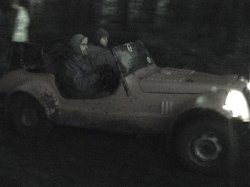
Then a few days later Kevin came back after yet more research “Back again with some more detail on Wrynose and another picture of the hill. MCC Edinburgh Trial 1935 – 182 cars entered, Singer 1.5 litre J.D. Barnes No.47, M.G. Magnette L.A. Welch No.57. This picture (wryn2.jpg) is taken in 1936 MCC Edinburgh, the picture I sent to you before of ADU 263 was 1935. The caption reads “Two Loops” were used on Wrynose Pass, off the normal track. Here is L.E.C. Halls Singer on the second loop. I’m not sure if this is the same area of the hill as the MG and previous Singer picture but the picture would obviously have been taken from the opposite direction to this on the second corner we can see so I suppose it could be. Wrynose Pass is located in the Lakes near Lake Windermere. “The route led to Wrynose Pass, a narrow hill with, on its lower stretches, a fearsome drop on one side. Wrynose Pass was included for the first time last year (1935), and this year it was approached by a different road leading over Blea Tarn, where a little corckscrew climb, quite steep provided interest.
On Wrynose itself there were two points of difficulty in 1936. First there was a test of the now common to and fro variety, and then competitors were diverted off the track proper round two loops. The 1936 trial saw an incident with an MG skidding over the steep bank and roll down the hill. Luckily, only broken bones resulted. The trial then moved on up the road to Hard Knotts Pass. Hopefully that has solved the identification of the picture/hill. Anyone with anymore unsolved trials mysteries?”
Many thanks to Kevin, Pat, Andrew and Tony for solving this mystery. Just shows you can’t believe everything you read, especially in Classical Gas!
We have been publishing stuff about Classic Trials on the Web since 1995 and always appreciate feedback. Comments, Corrections, Criticism & Concerns are all welcome. You can leave a comment to have your say here on this web site or our Social Media
Please help spread the word and share this on your Social Media:
Both Falcon and the MCC owe a lot to the Tucker-Peake family whose drive and energy has had a profound effect on both over the years. “Tucker” was perhaps the most prominent but he was not the only one. This article is a small appreciation.
H. W. Tuker-Peake
Like most organisations individuals heavily influence Motor Clubs and Falcon is no exception. In our case, and the MCC’s, one of our biggest influences has been the Tucker-Peake family who were the main stay of the club for many years
H. W. Tucker-Peake was born in Cornwall and christened Herbert, but was known as “Tucker” to most of us, or even “Tuck” if you were on very good terms. Tucker’s interest in Motorsport all started when he saw Lands End competitors passing by his Launceston home each Easter. When he left school, Tuck moved up to Hertfordshire as an apprentice at Sir Henry Birkin’s workshops at Welwyn. They prepared the famous 4.5 litre “blower” versions for the pre-war Bentley Le-Mans assaults. W.O. Bentley himself never approved of blowers. Believing that there was no substitute for litres W.O. left Sir Henry to finance the blower team by himself. He soon spent all his own money, then worked through his fathers before bankrupting him.
All was not over because the dashing “Tim” attracted the attention of a rich spinster, The Hon Dorothy Padgett. With her funding the team was able to continue and achieved Le Mans fame in 1930 with it’s battle with Carraciola’s vast 7 litre Mercedes. Birkin’s searing pace broke the Mercedes, which retired, but it had taken too much out of the Blower Bentley which had to give up itself soon afterwards, leaving one of W.O.’s 6.5 litre factory cars to take the chequered flag in the hands of Wolf Barnato and Glen Kidson. Birkin tried to continue with his team but when Miss Padgett’s money was all gone, he had to call it a day and close his Welwyn workshop, leaving Tucker out of a job.
Tucker was not out of work for long. He got on his bike and cycled North to Stevenage, where he persuaded HRD motorcycles to take up his apprenticeship. It was through Vincent’s that Tucker started his competition career, courtesy of the legendary Aussie, Phil Irving. Irving was anxious to prove the superiority of the new radial valved Python engine, and entered an outfit in the 1932 Lands End. Irving drove himself with his newly signed up apprentice, Tucker in the chair. In those days the Lands End only had one start and Irving and Tucker had a short run down to Virginia Water to get away just after 10 in the evening. They started off well but during the night run the Python developed an intermittent miss-fire. They arrived at the Taunton breakfast control just after 4am and despite being frozen to the marrow decided to change the contacts in the magneto. An official spotted them and said they would be disqualified, as there was to be no work done on the machinery in controls. However, they carried on and the bike went much better.
They went up Doverhay, like a rocket, the Python motor pulling like a train. Beggars Roost was next, in those days one of the most feared hills, but they cleaned this as well. Things were going well and thoughts of the publicity accruing from winning a Gold medal went through Irving’s mind. They were in Cornwall now, Tucker was back home. They made a steep winding descent through Burlone Eglos, through a small ford to the foot of Hustyn. It didn’t look to bad, it was pretty steep but there was a hard stone surface and they had cleaned harder hills already. Irving and Tucker attacked the hill with gusto, the Python singing like a bird. Irving saw a rock step ahead, eased the throttle as the front wheel went over it and gunned the motor, which promptly cut dead. The spectators helped the crestfallen pair to the summit and they managed to re-start the engine, which never missed another beat all the way through the trial.
Tucker and Betty (right) trialled an Anglia after the Tucker-MG was retired. Here seen with Derek Fleming and Ron Warren (picture from the Derek Fleming collection)
From then on Tucker took every opportunity to take part in Motorsport, riding bikes in trails, speed trials and races whenever and wherever he could. Work-wise Tuck had moved on, to ERA at Bourne, home of the famous predecessors to the BRM. After the war, Tucker and brother John set up “Shelford and Crowe” a garage business in Stevenage High Street. By now Tucker had move to four wheels for his Motorsport, trialling a much modified MG Magnette before building The “Tucker-MG”. Tuck was very successful in the “Tucker” which won circuit races and speed events as well as trials.
By now Tucker and his wife Betty had two daughters, Maralyn and Susan who were not allowed to miss out on the fun. When they became to big, to be crushed in behind the seats Tuck converted the “Tucker” to a four seater! Later on Tuck built them their own trials car called “The Tucker Nipper Special” which I have written about recently. Maralyn was the driver and sister Sue the bouncer. Maralyn won two triples with this car before retiring to become an RAC timekeeper! Today she is actively involved with producing the MCC magazine. Susan took to circuit racing with Anglia’s and Escorts before taking in a season of continental racing with the Skoda works team. These days Susan lives in Launceston and is Secretary of the Lands End Trial.
JTP with “The Bean” at the top of Blue Hills. also in the picture are Alan Davies and Neil Bray and Don MacIver with Primrose.
Brother John was Tuckers business partner in their garage in Stevenage High Street. A quiet, thoughtful man, John was a superb trials driver and car builder. Before the war John was apprenticed to the Riley Company, starting his trials career on a 250cc Villiers engined James. He moved up the scale with the cessation of hostilities, trialling a 1000cc Vincent Rapide twin, successfully!
Moving to four wheels John built a succession of very special cars. The first was a real fly-weight, “The Scarlett Runner” made up of all sorts of bits and pieces with fiddle brakes on the rear wheels. In the early sixties John built “The Olympic” this was a Morris Minor shell with a big Ford Consul engine and running gear. It was probably John’s least successful Trials Iron but was great at the traffic light Grand Prix! Finally came the “Runner Bean” which he built with his son Adrian. It was basically a Ford Capri with a Pop body and would climb anything “The Bean” is still competing in trials in the hands of Tom and Clive Kalber and will still climb anything as they demonstrated on the Mini Classic. Adrian was an early editor of Triple and is currently campaigning a front wheel drive Peugeot in Classic Trials, following in the family tradition by taking the kids in the back!
Ron Warren, Alan Preston, John Tucker-Peake, Maralyn Knight and Derek and Betty Fleming (Derek Fleming collection)The Runner Bean storming Crooked Mustard in the 70’s (picture Mike Furse)Falcon’s successful 1972 Quiz Team – “Mad Dog” Smith, Michael Leete and Tucker about to set of for the Birmingham final. I can see at least four other T-P’s in this picture and who is that handsome lad just behind Tucker?Susan and Maralyn with Tuckers Triple that they presented to Falcon for our Trials Trophy
Tucker was actively involved as an official and organiser for both the MCC and Falcon. He became an MCC committee member in 1954 and was involved with Falcon almost since it’s inception. He was the organiser of the Land s End for a very long time and Clerk of the Course at the Silverstone race meeting. He organised a great number of events for Falcon over the years, running the Guy Fawkes both as road trial and a PCT. Later he was the driving force behind the Knebworth Park autocross. Tucker was President of both clubs when he sadly passed away a few years ago. Always trying new things, and forever young at heart, Tucker was the inspiration for so many young Falcon members.
We have been publishing stuff about Classic Trials on the Web since 1995 and always appreciate feedback. Comments, Corrections, Criticism & Concerns are all welcome. You can leave a comment to have your say here on this web site or our Social Media
Please help spread the word and share this on your Social Media: