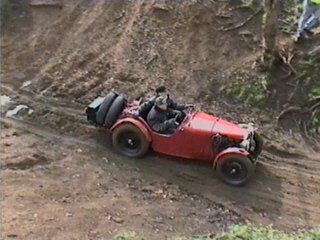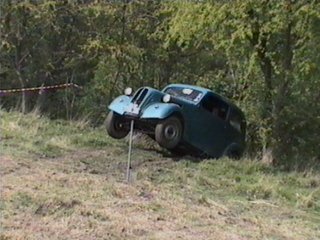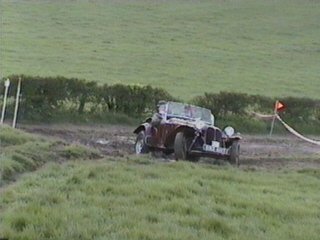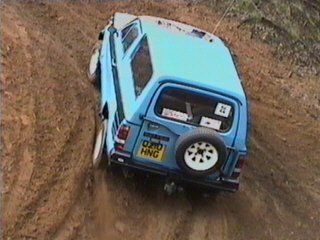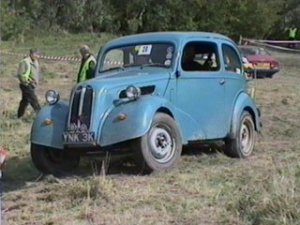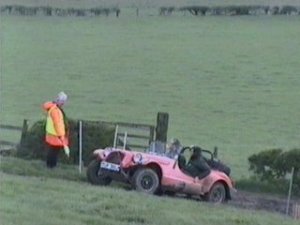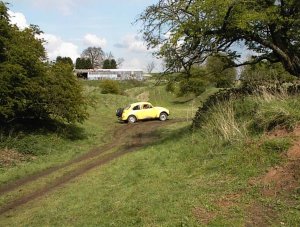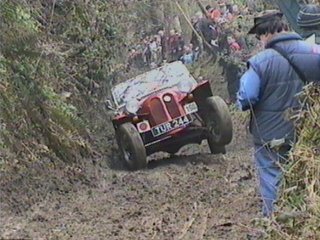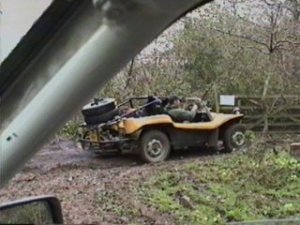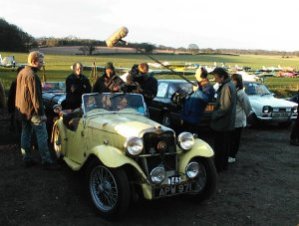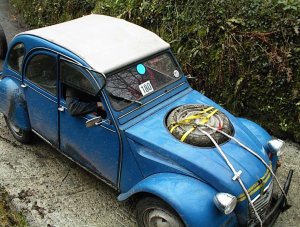
1999 Edinburgh Trial

It had been pretty wet in the days leading up to the Edinburgh so the hills were going to be in prime condition in Derbyshire. The rain poured down during the night run and the bikers got pretty wet as did drivers of open cars, at least those that didn’t stop under motorway bridges to put the hood up! 

The common routes converged at the Elf service station on the A5 near Atherstone for eligibility scruitineering, which was pretty painless. It wasn’t so good for the ladies as the toilets were closed for the second year in succession! Then it was back into the night to battle with a rather in-accurate route card to find the first hill at Agnes Meadow near Ashbourne. The water was streaming down the section, so much that most of the mud was washed away making this a nice gentle start before the serious proceedings. There were gates to be closed here but runners at the back of the field found them open. This continued through the trial and it’s something the MCC will have to watch out for if we are to stay out of trouble with the local landowners. 

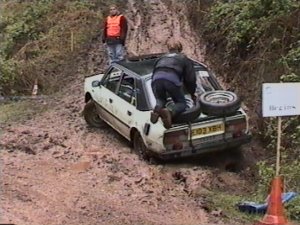
Wigber Low was just up the road, which I believe is a new hill. It starts just off the busy B5056 so there was a holding control for the cars to stop them queuing in the main road. The hill was pretty straightforward but it was a bit rough in places and this was the downfall of Colin Stevens who had the sump-shield ripped off his Skoda Coupe and he retired. Breakfast was waiting a few miles up the road at the Bentley Brook Inn. They had a wonderful open fire going and the room steamed as wet clothes were dried out. The food was good quality but there wasn’t much room inside or in the car park and competitors missed that wonderful transport café atmosphere of the Salt Box. 

The bikers hit big problems just up the road, as the New Haven garage wasn’t open. Most of them were in desperate straits as they were relying on filling up here. Some waited for the staff to turn up, some went searching around for a 24-hour garage and sadly, some gave up. All this caused a big delay for the bikes and they dribbled into Excelsior with a considerable delay. The rain had made the hill pretty muddy and this caused further delays, which affected the cars who backed up onto the main road. Travelling marshals created an impromptu holding control in Hartington village and competitors queued around the village pond. This mostly worked pretty well but some later numbers got pretty annoyed with queue jumpers and there were a few raised voices and frayed tempers. The wind got up a bit which dried the hill itself out and it was pretty near bone dry towards the end, causing few problems for later numbers although Jonathan Baggott retired his Marlin soon afterwards. 

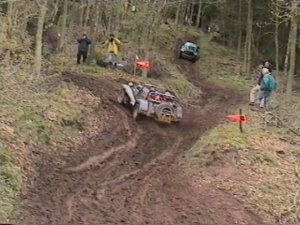
Then it was off to the A6, up the hill to the Monsal Head Hotel with the wonderful view across the valley to Putwell, down again to Cressbrook and up the steep climb to the track down to Litton and “the queue”. The hill was in pretty good condition this year but Laurie Knight had spiced things up with a restart for Terry Ball plus class seven and eight. Why Terry Ball? Well he was the only starter in class six! The box was just before the trees, preventing the yellows and reds getting a good run at the steep bit where the deep ruts start. This caught out many of the class sevens, including Robin Howard, Dave Nash, Mike Furse and ACTC rights of way officer Andrew Brown. Fred Gregory and Pete Stafford persuaded their Dutton Melos up to the top without to much difficulty as did Mike Pearson and David Thompson in class eight but Clive Booth and John Allsop weren’t so lucky in their lower powered Dellow replica. All the non-restarting Falcons made it to the top OK but former Falcon Adrian Tucker-Peake couldn’t get his Peugeot to the summit. Yes we know Litton is a difficult prospect for class 1 but David Haizleden climbed it in his Golf Adrian! Sadly Litton saw the end of Robin Howard and Barry Blofield’s Edinburgh and they were last seen under the bonnet of their Dutton Sierra after failing the hill. 

Calton was next. It’s not so many years ago when this was the last hill, providing a real sting in the tail as many Triple aspirations sunk without trace in the deep ruts at the summit. They’ve been filled in now and the hill itself is a pretty gentle run. However, it had been made competitive by adding a re-start just before the summit, presided over by Falcon’s Peter Mountain. It was OK if you just nudged your front wheels into the box but if you went at all deep your front wheels came up against some fair sized rocks making getting away pretty problematical, trapping quite a few, including Peter Mountains near neighbour Mike Furse. 

It was a beautiful morning as the route wound up the steep hills towards Bareleg. The sky was clear and the views magnificent, but all this was spoilt by a terrible accident as a BMW pulled out to pass Adrian Dommett on the approach to Bareleg and collided head on with an approaching car. There were several people hurt and at this stage it’s not known how they are. Bareleg was not used as a section this year, and Mike Hayward and Arnold Lane were able to see where they stood in the fog for seven hours two years ago! The blues and whites went straight down to the special test at Old Long Hill but the pleasures of Corkscrew awaited the reds and yellows. This used to be known as Jenkins Chapel and regular readers of my column should be experts on the hill, I have written so much about it lately! Apart from Clive all the Falcon’s cleaned the section but it was pretty rough, several drivers saying it was the roughest section they have ever seen. Clive was particularly unlucky, urged on by John he was going really well until the engine cut out just before the section ends board. It started again OK and Clive thinks he must have knocked the ignition off with his knee as the Dellow Rep lept over a rock.
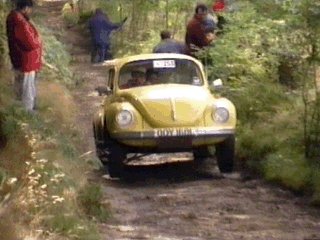
Michael Leete and Mike Hayward storming Bamford Clough

The special test at Old Long Hill passed without any great drama, then it was a twenty mile run up and over the hills to The Marquis of Granby. Things weren’t too bad for the early numbers but the delay built up and towards the end there was quite a bit of queue jumping causing the usual un-happiness. A lot of work had been done to Bamford and it was nowhere near as rough as it has been in recent years. It’s still a formidable obstacle, especially with a bit of damp in the air making the concrete steps a bit greasy. The worst problem was the step right the top and it was here most of the failures came to grief, including Simon and Matt Robson who didn’t have enough momentum to get over the final hump. There had been doubts that the MCC would get permission to use Haggside as part of it is a bridleway and the local Forestry Commission guy was being a bit difficult. All was well on the day and we had the challenge of the usual re-start just out of sight round the first corner. It wasn’t too bad if you didn’t go in to deep but it still caught a few, including Clive and John. 

After Haggside it was back by Ladybower reservoir, past the foot of Bamford and The Marquis, through Hope, past the cement works to Pindale. The approach was pretty rough and there was a rather strange special test before the Pindale section itself. A split route waited. For the Blues and Whites there was a rough stony track through a gully but for Yellows and Reds there was a steep mound to be climbed first which defeated quite a few including Fred Gregory, Dave Nash and Mike Furse. This was really one for the brave. If you didn’t hit it hard enough you didn’t get up but hit it to hard and you broke the car. 

Hucklow was next. All classes had to deviate left up the bank and this was to sort the men from the boys. The bikes found it pretty rough, especially some of the older, heavier one. John Lees told me how his 1961 Triumph, weighing all of 500 lbs, leapt from rock to rock on its way up, but he made it and won the class A award. Duncan Stephens was spectating on Hucklow and witnessed David Haizelden’s magnificent climb, he made it look very easy and actually eased off half way up! Duncan was also impressed with Roger Ugaldes Allard, the big heavy car going up without any problems. Falcon cleans here were few and far between, only David Thompson, Mike Person and Peter Manning were successful. Simon Robson had a magnificent attempt, but bogged down about half way up and the car came to a stop with wheels spinning. It didn’t slip backwards and with much bouncing from Matt and sawing at the wheel from Simon they get the white Skoda going again and it came out of the top to much applause from the spectators. Everyone thought Simon had cleaned it but the provisional results showed the Skoda as a failure so it looks like the marshals noticed it stopped! Andrew Brown had the misfortune to clip the exposed rock at the deviation. This stopped the car dead, slewed at 90 degrees across the track. 

The trial was drawing to a close now and Ballcross didn’ t present any problems for the Blues and Whites. The higher classes gave this one a miss and went south down the A6, through Bakewell and down to Darley Dale. Old Edinburgh hands had a sense of deja vu as they passed the DFS car park and Texaco Supreme service station before turning left up to Halldale. The section was approached by going up the drive to somebody’s house and it will be interesting to see if the MCC can get to use this one again. The section itself was quite a long stony affair but the gradient was pretty gentle and didn’t trouble the scorer. The early cars did Putwell, but Clerk of the Course Laurie Knight was worried about the trial running late and exercised his right to cancel the section. Later numbers were treated to the full scenic tour of Derbyshire on a twenty-five mile run in to the finish without any sections to disturb the view. 

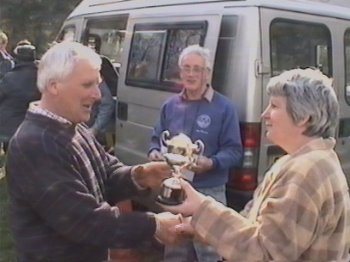
Despite all the early drama’s the trial wasn’t too late in finishing, last man Arthur Vowden arriving at Buxton around quarter to eight. As the pubs and bars filled with triallers reliving their day, the verdict was that the 1999 Edinburgh was an enjoyable trial. It was certainly full of drama. A wet night, searches for fuel in the early hours of the morning, delays, disputes over queue jumping, the excitement of Litton and Bamford and a particularly tough section at Hucklow. Yes a pretty good Edinburgh!

MCC Murmuring:-

Falcons –

121 Stuart and Andrew Cairney (Imp) (4) –  Did not start. Stuarts Imp was running very rough because of problems with the Dellorto carburettors. The problem couldn’t be sorted and Stuart decided not to start.

217 Robin Howard and Barry Blofield (Dutton Sierra) (7) – Retired after Litton Slack

222 Alan Bellamy and Jack Sheppard (VW Fastback) (6) – Did not start

223 Dave Nash and Julie (Skeetle) (7) – Failed Litton, Pindale and Hucklow

224 Colin and Mark Stevens (Skoda Coupe) (?) – Retired after Wigber Low when the sump guard came adrift

225 Clive Booth and John Allsop (Dellow Rep) (8) – Failed Litton and Haggside, Hucklow and probably failed Corkscrew as well when the engine cut out as they were about to pass the section end board, believed to be caused by Clives knee jogging the ignition switch!

227 David and Christine Manning (MG Midget) (5) – Gold and winner of class 5

241 Murray and Hazel MacDonald (VW 1302S) (4) – Silver, Failed Great Hucklow.

248 Mike Pearson and Arnold Lane (Dellow Rep) (8) – Gold

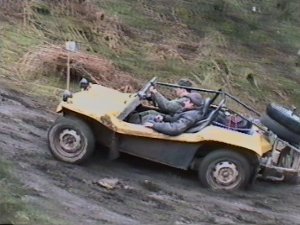
249 David Thompson and ? (VW Buggy) (8) – Gold

252 Mike and Shiela Furse (Racecorp) (7) Failed Calton, put front wheel against a rock, Pindale, couldn’t climb the steep bank, Hucklow.

253 Michael Leete and Mike Hayward (VW 1302S) (4) – Failed Great Hucklow

254 Neil Bray and Marc Lawrence (Skoda) (4) – Failed Great Hucklow

255 Simon and Matt Robson (Skoda) (4) – Failed Bamford Clough and Hucklow.

256 Fred Gregory and Peter Stafford (Dutton Melos) (7) – Failed Pindale and Hucklow

268 Jonathon Baggott and Ian Banton (Marlin) (7) – Retired after Excelsior

Some Others –

Barry Clarke retired his Austin 7 on the track after Hucklow with a dead battery. He was hoping to limp to his hotel using only dynamo power.

Derek Chatto (Cannon) Winner of JTP cup

Stuart Harrold (Troll) – Class 8

Andrew Brown (Marlin)- Failed Litton and Hucklow.

David Haizleden (Golf) won class 1 and went round clean – man how did he get a front wheel drive car up that bank at Hucklow with a re-start?

Adrian T-P (Peugeot) failed Litton and Bamford

W. J. Bennett (MG J2) won class 2

David Heale (Escort estate) won class 3

Bill Rosten (Imp) won class 4

Terry Ball won class 6 but then he was the only starter!

Roger Ugalde won class 7 in that wonderful Allard

Pete and Carlie Hart won a Gold in their Marlin

In the bikes John Lees won Class A


We have been publishing stuff about Classic Trials on the Web since 1995 and always appreciate feedback. Comments, Corrections, Criticism & Concerns are all welcome. You can leave a comment to have your say here on this web site or our Social Media
The Jenkins Debate

One of the nice things about the Web version of Classical Gas is the e-mails I get from all sorts of people, many of whom I have never met. Sometimes there is quite a bit of debate on some of the things I have published, none so much as about a picture I included in an article about Jenkins Chapel back in October 1997.

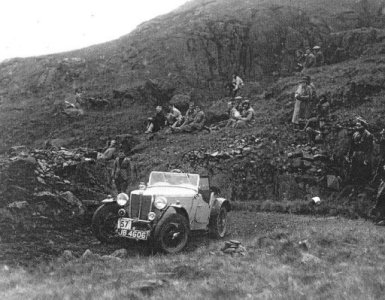
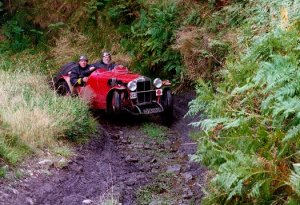
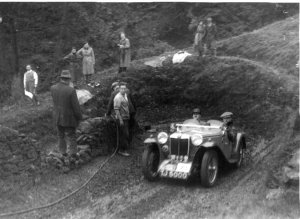
To recap this was a brief piece about the hill which was used under the name “Jenkins Chapel” back in the 30 and resurrected by the MCC as “Corkscrew” in 1993. It’s a rough, narrow hill with two hairpins, followed by some nasty steps. I published a couple of pictures which I reproduce here. The one of Dudley Sterry was taken by our own Mike Furse a few years ago and is definitely Jenkins. I scanned the other one out of a book and this is the image that caused the controversy, and really set the letters pages of Classical gas on the Net going with some most enjoyable correspondence, with many famous “trials families” participating.

It was ACTC rights of way officer Andrew Brown who first smelt a rat. Then Tony Branson raised his doubts too”I share Andrews doubts that the old picture of the MG is really this hill. I too have spent some time with Jonathan Toulmin pouring over old trials photos trying to recognise which sections they are. It’s amazing how much the landscape changes over the years, trees move and cottages sprout or lose chimneys.

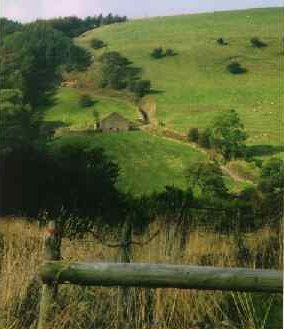
After the 1993 Edinburgh Jonathan, Pat, Derek and I walked the section and I bemoaned the fact that class 3 didn’t get a shot at it. I have since gone up it twice in the Marlin and my propshaft tunnel has the scars to prove it. I attach some photos I took that day. The first shows the section from across the valley, The second the infamous first corner with Derek having a little trouble on the restart and the other two the rocky steps in the upper reaches.”

A few days later Andrew Brown came back to me after some considerable research. “I don’t where you got the original photograph from, but it is on Page 34 of Roger Thomas’ excellent ‘M.G. Trials Cars’ book where it is captioned as “Lewis Welch in Athos on the 1935 M.C.C. One Day Sporting Trial in Derbyshire at the upper part of Jenkins Chapel”. The registration is clearly shown as JB 4606 and the competition number as 57. JB 4606 was one of the three MG NEs (1287cc) which ran in the 1934 TT, were converted to trials cars for a short period in 1935 when they ran as ‘The Three Musketeers’ team, and were then re-converted to race cars for the 1935 TT. According to Roger Thomas they entered only four trials (Lands End, Edinburgh, Abingdon, and Rushmere) and the Welsh Rally. Donald Cowbourne’s book lists Welch in a 1287cc MG Magnette in both the Lands End (No.399) and the Edinburgh (No.57), and in a 1408cc Magnette in the MCC Sporting (No.89). So, unless there is some amazing coincidence, I think it’s a pretty fair assumption that the picture was taken on the 1935 Edinburgh.

But where is it? Cowbourne lists only four Observed Hills for the 1935 Edinburgh – Park Rash and Summer Lodge in the Yorkshire Dales, Wrynose Pass and Hard Knott Pass in the Lake District. I’m not familiar with any of these hills but have seen enough photographs of Park Rash and Summer Lodge to be pretty sure that it’s neither of them unless the photographer stood at a particularly unusual location. There’s a picture on Page 256 of the Cowbourne book of an AC in the 1935 Edinburgh at a location that looks remarkably like the Welch MG picture. So, does anyone recognise either of these pictures as somewhere on Wrynose or Hard Knott Passes? My money’s on Wrynose Pass, but I’m not really a betting man.”

Things were really hotting up now and Pat Toulmin kindly delved into the family archives. “Further to the debate about Jenkins Chapel, the photo of Lewis Welch is not on Jenkins Chapel. Indeed it is not even of the 1935 Sporting Trial – in Donald Cowbourne’s excellent and well researched trials book, Lewis Welch was number 89 on the Sporting Trial (see page 463). In the photo you publish, he was number 75 (I think Pat meant to say 57) and this is the number he ran on the 1935 Edinburgh Trial, 7th and 8th June. This had 4 sections only – Park Rash, Summer Lodge, Wrynose and Hard Knott. The latter two are in the Lake District and it seems likely that the photo is on one of these. See pages 190, 256 and 283)

I attach two photos that Maurice Toulmin stated are Jenkins Chapel. Both photos are by W J Brunell. The one of JB 7521 we took with us on the walk with Tony and Derek and we were able to confirm that it is Jenkins, the building is still there and the approach road was very characteristic and exactly the correct shape. This photo was used as the basis of the drawing on the cover of Roger Thomas’s excellent book on pre war MG Trials Cars, published in 1995. We have other photos of Maurice on Jenkins Chapel. PS -The section which we use today on the MCC Edinburgh Trial known as Calton was called Taddington Moor in the 1930s.”

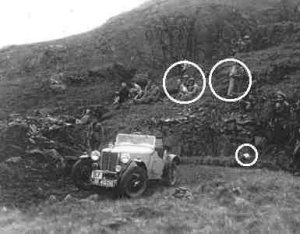
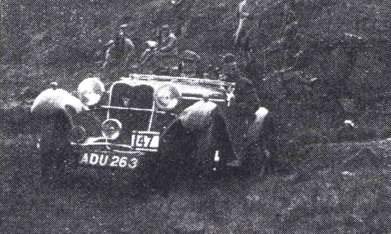
Then Kevin Barnes e-mailed me “Just seen the Jenkins Chapel debate and thought I would try and help. I think that (99% sure) the picture may actually be of Wrynose Pass on the London-Edinburgh. I enclose a picture of my grandfather J.D.Barnes on this section. (wrynose.jpg) It’s not as good quality as the MG picture but after studying it at high zoom levels I believe that some of the people and features in the background are the same as in the MG picture. I have highlighted them on the MG . I will have a look at the competition numbers for that trial to see if I am right when I get time.

The caption of the original picture says “J.D.Barnes entering the second loop of the tricky Wrynose Pass Climb in the London-Edinburgh”. I think the MG by the way is on the first corner just before this picture was taken. Hope this sheds some light/debate on the picture.

Then a few days later Kevin came back after yet more research “Back again with some more detail on Wrynose and another picture of the hill. MCC Edinburgh Trial 1935 – 182 cars entered, Singer 1.5 litre J.D. Barnes No.47, M.G. Magnette L.A. Welch No.57. This picture (wryn2.jpg) is taken in 1936 MCC Edinburgh, the picture I sent to you before of ADU 263 was 1935. The caption reads “Two Loops” were used on Wrynose Pass, off the normal track. Here is L.E.C. Halls Singer on the second loop. I’m not sure if this is the same area of the hill as the MG and previous Singer picture but the picture would obviously have been taken from the opposite direction to this on the second corner we can see so I suppose it could be. Wrynose Pass is located in the Lakes near Lake Windermere. “The route led to Wrynose Pass, a narrow hill with, on its lower stretches, a fearsome drop on one side. Wrynose Pass was included for the first time last year (1935), and this year it was approached by a different road leading over Blea Tarn, where a little corckscrew climb, quite steep provided interest.

On Wrynose itself there were two points of difficulty in 1936. First there was a test of the now common to and fro variety, and then competitors were diverted off the track proper round two loops. The 1936 trial saw an incident with an MG skidding over the steep bank and roll down the hill. Luckily, only broken bones resulted. The trial then moved on up the road to Hard Knotts Pass. Hopefully that has solved the identification of the picture/hill. Anyone with anymore unsolved trials mysteries?”

Many thanks to Kevin, Pat, Andrew and Tony for solving this mystery. Just shows you can’t believe everything you read, especially in Classical Gas!


We have been publishing stuff about Classic Trials on the Web since 1995 and always appreciate feedback. Comments, Corrections, Criticism & Concerns are all welcome. You can leave a comment to have your say here on this web site or our Social Media
The Tucker-Peakes

Both Falcon and the MCC owe a lot to the Tucker-Peake family whose drive and energy has had a profound effect on both over the years. “Tucker” was perhaps the most prominent but he was not the only one. This article is a small appreciation.

Like most organisations individuals heavily influence Motor Clubs and Falcon is no exception. In our case, and the MCC’s, one of our biggest influences has been the Tucker-Peake family who were the main stay of the club for many years

H. W. Tucker-Peake was born in Cornwall and christened Herbert, but was known as “Tucker” to most of us, or even “Tuck” if you were on very good terms. Tucker’s interest in Motorsport all started when he saw Lands End competitors passing by his Launceston home each Easter. When he left school, Tuck moved up to Hertfordshire as an apprentice at Sir Henry Birkin’s workshops at Welwyn. They prepared the famous 4.5 litre “blower” versions for the pre-war Bentley Le-Mans assaults. W.O. Bentley himself never approved of blowers. Believing that there was no substitute for litres W.O. left Sir Henry to finance the blower team by himself. He soon spent all his own money, then worked through his fathers before bankrupting him.

All was not over because the dashing “Tim” attracted the attention of a rich spinster, The Hon Dorothy Padgett. With her funding the team was able to continue and achieved Le Mans fame in 1930 with it’s battle with Carraciola’s vast 7 litre Mercedes. Birkin’s searing pace broke the Mercedes, which retired, but it had taken too much out of the Blower Bentley which had to give up itself soon afterwards, leaving one of W.O.’s 6.5 litre factory cars to take the chequered flag in the hands of Wolf Barnato and Glen Kidson. Birkin tried to continue with his team but when Miss Padgett’s money was all gone, he had to call it a day and close his Welwyn workshop, leaving Tucker out of a job.

Tucker was not out of work for long. He got on his bike and cycled North to Stevenage, where he persuaded HRD motorcycles to take up his apprenticeship. It was through Vincent’s that Tucker started his competition career, courtesy of the legendary Aussie, Phil Irving. Irving was anxious to prove the superiority of the new radial valved Python engine, and entered an outfit in the 1932 Lands End. Irving drove himself with his newly signed up apprentice, Tucker in the chair. In those days the Lands End only had one start and Irving and Tucker had a short run down to Virginia Water to get away just after 10 in the evening. They started off well but during the night run the Python developed an intermittent miss-fire. They arrived at the Taunton breakfast control just after 4am and despite being frozen to the marrow decided to change the contacts in the magneto. An official spotted them and said they would be disqualified, as there was to be no work done on the machinery in controls. However, they carried on and the bike went much better.

They went up Doverhay, like a rocket, the Python motor pulling like a train. Beggars Roost was next, in those days one of the most feared hills, but they cleaned this as well. Things were going well and thoughts of the publicity accruing from winning a Gold medal went through Irving’s mind. They were in Cornwall now, Tucker was back home. They made a steep winding descent through Burlone Eglos, through a small ford to the foot of Hustyn. It didn’t look to bad, it was pretty steep but there was a hard stone surface and they had cleaned harder hills already. Irving and Tucker attacked the hill with gusto, the Python singing like a bird. Irving saw a rock step ahead, eased the throttle as the front wheel went over it and gunned the motor, which promptly cut dead. The spectators helped the crestfallen pair to the summit and they managed to re-start the engine, which never missed another beat all the way through the trial.

Tucker and Betty (right) trialled an Anglia after the Tucker-MG was retired. Here seen with Derek Fleming and Ron Warren (picture from the Derek Fleming collection)

From then on Tucker took every opportunity to take part in Motorsport, riding bikes in trails, speed trials and races whenever and wherever he could. Work-wise Tuck had moved on, to ERA at Bourne, home of the famous predecessors to the BRM. After the war, Tucker and brother John set up “Shelford and Crowe” a garage business in Stevenage High Street. By now Tucker had move to four wheels for his Motorsport, trialling a much modified MG Magnette before building The “Tucker-MG”. Tuck was very successful in the “Tucker” which won circuit races and speed events as well as trials.

By now Tucker and his wife Betty had two daughters, Maralyn and Susan who were not allowed to miss out on the fun. When they became to big, to be crushed in behind the seats Tuck converted the “Tucker” to a four seater! Later on Tuck built them their own trials car called “The Tucker Nipper Special” which I have written about recently. Maralyn was the driver and sister Sue the bouncer. Maralyn won two triples with this car before retiring to become an RAC timekeeper! Today she is actively involved with producing the MCC magazine. Susan took to circuit racing with Anglia’s and Escorts before taking in a season of continental racing with the Skoda works team. These days Susan lives in Launceston and is Secretary of the Lands End Trial.

JTP with “The Bean” at the top of Blue Hills. also in the picture are Alan Davies and Neil Bray and Don MacIver with Primrose.

Brother John was Tuckers business partner in their garage in Stevenage High Street. A quiet, thoughtful man, John was a superb trials driver and car builder. Before the war John was apprenticed to the Riley Company, starting his trials career on a 250cc Villiers engined James. He moved up the scale with the cessation of hostilities, trialling a 1000cc Vincent Rapide twin, successfully!

Moving to four wheels John built a succession of very special cars. The first was a real fly-weight, “The Scarlett Runner” made up of all sorts of bits and pieces with fiddle brakes on the rear wheels. In the early sixties John built “The Olympic” this was a Morris Minor shell with a big Ford Consul engine and running gear. It was probably John’s least successful Trials Iron but was great at the traffic light Grand Prix! Finally came the “Runner Bean” which he built with his son Adrian. It was basically a Ford Capri with a Pop body and would climb anything “The Bean” is still competing in trials in the hands of Tom and Clive Kalber and will still climb anything as they demonstrated on the Mini Classic. Adrian was an early editor of Triple and is currently campaigning a front wheel drive Peugeot in Classic Trials, following in the family tradition by taking the kids in the back!

Ron Warren, Alan Preston, John Tucker-Peake, Maralyn Knight and Derek and Betty Fleming (Derek Fleming collection)
The Runner Bean storming Crooked Mustard in the 70’s (picture Mike Furse)
Falcon’s successful 1972 Quiz Team – “Mad Dog” Smith, Michael Leete and Tucker about to set of for the Birmingham final. I can see at least four other T-P’s in this picture and who is that handsome lad just behind Tucker?
Susan and Maralyn with Tuckers Triple that they presented to Falcon for our Trials Trophy

Tucker was actively involved as an official and organiser for both the MCC and Falcon. He became an MCC committee member in 1954 and was involved with Falcon almost since it’s inception. He was the organiser of the Land s End for a very long time and Clerk of the Course at the Silverstone race meeting. He organised a great number of events for Falcon over the years, running the Guy Fawkes both as road trial and a PCT. Later he was the driving force behind the Knebworth Park autocross. Tucker was President of both clubs when he sadly passed away a few years ago. Always trying new things, and forever young at heart, Tucker was the inspiration for so many young Falcon members.


We have been publishing stuff about Classic Trials on the Web since 1995 and always appreciate feedback. Comments, Corrections, Criticism & Concerns are all welcome. You can leave a comment to have your say here on this web site or our Social Media
Kyrle Trial

This year’s Kyrle lived up to its reputation as a rough, tough event. Rain the previous week had made the sections ultra-competitive and they certainly sorted out the men from the boys. Overall victory went to Peter Fear from the home club in his Dingo special who dropped 5 marks. Falcon’s Ian Davis chased hard for the lead all day, ending up losing 9 for 5th place overall and Neil Bray won a very competitive class four.

Ten Falcon crews ventured West to the Forest of Dean for the Ross club’s end of term classic, starting from the services at the end of the M50. Apart from the MCC Falcon tied with Stroud for providing the most entries, which shows how strong we are in the trials world these days. Two of our newer devotees were running near the front of the field in class eight. James Lindsay had his type 4-powered Fugitive, while Ross Nuten bought out his ex-Geoff Margetts Dellow.

At breakfast Falcon members were anxious to glean reactions to the previous weeks March Hare. They were pretty positive and Dudley Sterry and Anthony Young seemed pleased with their awards. Shame yours truly mixed them up! I was able to give March Hare event reports to the people had taken part and was pleasantly surprised to discover how many people had already seen it on the Web. I maybe need to be a little more careful what I write in the future!

Scruitineering was a little painful if you were un-lucky enough to draw the wrong person. John Sargent was OK but the other guy was a bit excruciating, wanting to see things like Beetle batteries which is a long job as it involves removing the complete rear seat. All this was soon forgotten as the field got away under threatening sky’s, for the long run down to the first group of sections. Old Down was certainly new variation. Normally it’s the uphill exit track from Jack and Jill. This time it was a downhill observed section. You went down the hill to stop astride a line, then you had to back up to clear the line before proceeding down again. It was an interesting change and one we could consider for our own classic.

Jack lay in wait at the bottom of the steep descent from Old Down. This is a fearsome ascent through the trees without any fancy stuff like corners to complicate life. There was a deep hole a few yards from the start line and this was the end of the road for over half the entry. Ian Davis was the only Falcon to register a clean but Ross Nuten, David Thompson and Clive Booth all did well to get to the four and James Lindsay and Neil Bray weren’t far behind.

Jean was next on the agenda for classes 6,7 and 8. Nobody climbed it and Peter Fear dropped five, the only marks he was to lose all day. Ian Davis did better in his VW Buggy, getting all the way to the two to take the lead. The hill is a similar affair to Jack, but the start was on the track and there was a steep right-hander before the main part of the section, so there was no possibility to build up speed. This trapped David Thompson who under-steered straight on.

The lower classes tackled Jackson. The slope on this one was much gentler, but it was quite slippery and the ruts were very deep. It was an exciting full throttle drive, but didn’t have much affect on the results as most people cleaned it. By now the rain was falling steadily and this made the first special test quite slippery. The fast times were set by people who were able to spin turn around the bollard in the lane. The three point turners were much slower but didn’t put their bodywork at so much risk! The diff test was just up the lane. It was the normal rollers but it was far from a formality for some half dozen competitors who gave the organisers “cause for concern” and they said so in the results. However, as they were unable to carry out any further testing the let things stand at that.

Pludds followed the diff test. This is one of the Kyrle’s feature hills. Steep, straight and stony. A longer Simms without the spectators? There was plenty of grip, too much if you let the tyres down to much. Neil Bray and Matthew Sharrattt were the only class fours to clean it and from then on indulged in their own private battle for the class, leaving the rest fighting for third place. The yellow and reds had a re-start to spice things up. This defeated John Parsons, who probably had too much power and Clive Booth who probably didn’t have enough!

There was another long road section before the next group of three hills, buried deep in the forest. The rain had started to ease off but they were very, very slippery. Snompers was pretty straight forward but claimed the scalps of Ross Nuten and Murray MacDonald, Murray announcing that he was not having a good day. Tomlins Splash had alternative routes for the different classes. The blues and whites had a gentle, but rough track, the yellows and reds a steep smooth one. There were very few casualties, but one of them was quite a distinguished one, Julian Dommett failing for a four. Cockshoot had not been used on a trial for some years. The bottom was very rutted and rough. A slippery grass hairpin followed the ruts and the rest of the hill was pretty straightforward. Most of the class eight’s got up, but Ian Davis was a noticeable exception as he couldn’t get round the hairpin, dropping three and letting Peter Fear, Mick Workman and Adrian Dommett catch him and tie for a four man equal lead. The lower classes found it pretty difficult . Only two class fours got up, Michael Leete and Matthew Sharratt, and they both suffered quit bad body damage as they scraped up the side of the deep rut. Lunch was next, taken in a nearby picnic area, giving Michael a chance to see how the impact on the front wing had pushed in the double skinned panel in front of the A post.

Bluebell lay just across the road. It started with a very steep, slippery bank, surmounted by only the best of the class eight’s, plus super hero’s Julian Dommett, Adrian Marfell and Giles Greenslade. Most of the others in the lower classes dropped eleven, including Neil Bray, allowing Giles to gain the lead in class four. Adrian Tucker-Peake was marshalling on Cuddleigh Bank which was a very strange section, consisting of a long straight run up a flat muddy track before assaulting an impossibly steep bank. Waterworks was another strange section, weaving through the trees on a slippery camber, always assuming you could get up the steep bank at the start, which most couldn’t. This was probably the toughest hill of the trial, only five people cleaning it, including the incredible Julian Dommett in his side valve Dellow. Ian Davis was one of the un-lucky ones, dropping him from overall contention.

The trial was starting to draw to a close now, but not before another gem of a section, Lane End. If Pludds is a long Simms then Lane End is Darracott with teeth. It starts with a series of hairpins, leading to a straight, rutted sunken lane, all very slippery and pretty rough. Once again most of the class eight’s didn’t have to much trouble, apart from James Lindsay who couldn’t coax the long Fugitive around the hairpins at the bottom, Neil Bray got up OK but Giles Greenslade didn’t, and this allowed Neil to regain the lead in class four. Unbelievably David Haizelden climbed out the top in his Golf, making some people wonder if this machine has four wheel drive! 

High Garlic lay at the top of Lane End, severely curtailed this year, emasculated as Anne Templeton used to say. This didn’t present any problems so it was on to the two Deep Dean sections to close the trial. This is the site of the famed “Robsons wall” but there was to be more entertainment this year as almost everyone had problems lower down. A few of the class eight’s cleaned it, but not Ian Davis who couldn’t get round the hairpin at Robson’s wall, dropping him back to fourth in his class. Outside of class eight there were only two cleans, the incredible Julian Dommett and David Haizelden who got up in his amazing Golf. For the rest it was a smoky end as they spun to a stop on the rocks, in full view of spectating competitors as they waited to watch before heading back to the finish at Ross on Wye.

1st OverallPeter FearDingo5 marks lost
Class 1 & 2David HaizeldenGolf Gti36
Class 3Paul BartlemanEscort36
2nd in Class 3David HealeEscort38
Class 4Neil Bray (Falcon)Skoda34
2nd in Class 4Matthew SharrattBeetle40
Class 6Nigel AllenBeetle18
Class 7Julian DommettDellow Mk 19
Class 8Mick WorkmanGVS Mk 17
2nd in class 8Adrian DommettFord Special s/c7
3rd in class 8Ian Davis (Falcon)VW Buggy9
4th in class 8David ForeshewGVS Mk II9

We have been publishing stuff about Classic Trials on the Web since 1995 and always appreciate feedback. Comments, Corrections, Criticism & Concerns are all welcome. You can leave a comment to have your say here on this web site or our Social Media
March Hare Mini Classic – Murray wins his Own Trial

Yes, sponsor Murray MacDonald won Falcon’s first road going Classic Trial after a daylong dice with Giles Greenslade, who resurrected his Sunbeam for the occasion. The class eight’s were handicapped with some tough re-starts, victory going to Dudley Sterry after a close battle with Anthony Young in his new Buggy.

The sun certainly shone on Falcon Motor Club for what was billed as a “Mini-Classic”. It wasn’t just the clerk of the weather that was on Falcon’s side. There was a handsome group of the trials elite to do battle with the Bedfordshire countryside. The organisers had hoped to have sections comprising some old tracks mixed in with visits to some of the clubs traditional PCT venues. Unfortunately the tracks had to be dropped in the rush to get a route approved, as they were all found to be adjacent to “black-spots” and although PR revealed no objection from the locals there wasn’t enough time to negotiate the use of the access roads. 

    The entry assembled bright and early at Brickhill where the first two sections were located. Anthony Young’s new VW Buggy was the main centre of attention. Its certainly some machine, the frame is made of light alloy, all plastic coated for protection. Most of the suspension comes from the States or is beautifully home-made. All drilled to reduce the un-sprung weight. A two-litre VW type one engine provides the motive power. The surprise is that it’s mid-engined, driving though a genuine Hewland trans-axle. Some tool! Nestling nearby was another formidable machine, no less spectacular, but a rather more familiar sight. Dudley Sterry had bought his MG J2 along, returning to do battle with the March Hare and try to regain the Falcon Trophy after an absence of some twenty-five years. There was another very welcome machine from way back then. Clive Kalber had come all the way up from Cornwall in the Runner Bean; the Capri based Ford Pop constructed by John Tucker-Peake in the early seventies. Other well known Classic drivers included John Bell in his Escort and Giles Greenslade, whose father Dennis was another March Hare competitor all those years ago. Giles wasn’t driving the familiar Greenslade orange Beetle. He was giving his old Sunbeam its first run in class three for many years. Giles dragged it out of the garage in the week, gave it a quick service and it was ready to go. He stepped back, took a look and didn’t like what he saw; the old car was far too tatty for such a special occasion. So it was down to the local DIY for a couple of cans of Dulux so it could look its best on the day! 

    The first Brickhill section started at the far end of the wood. It began with a straight slippery climb up to the tree line where it weaved around the trees before a re-start just before the hump at the top. This wasn’t the difficult bit. The problem was at the bottom. It needed a fair old bit of welly to get over the mud to the tree line where the grip started. A number of people were caught out here, including Robin Howard, giving his Dutton Sierra it’s first outing. Everyone survived this first hill and the field went on to the second Brickhill section. This started with a blast up the gully, turning left at the sandpit to climb the steep bank. The ruts in the gully were bread and butter to Classic regulars but a bit of a shock to the debutantes. They were the downfall of both Reliant Kittens. First Ken Martin put the fan through the radiator. He cleaned the section OK but the steam at he top indicated an early trip back to Farnborough for Ken. Along came Dave Smith, going like a good ‘un before “crack”, the axle case split in two and there was a second Kitten in the dead car park. But not for long, Dave sportingly offered Ken his radiator and they soon made one good Kitten out of the two broken ones. Ken continued with the trial, ending up second in class. 

    It was up with the tyres and out on the road for the run up to Edlesborough. There was quite a queue for the regularity section here, lucky for Giles Greenslade as it gave him time to fix a puncture. You had to drive at 7.5 miles an hour for 1,320 feet. The intellectuals, and those with schoolchildren as passengers, quickly worked out this should take two minutes and most of the entry crossed the line within a few seconds of this. However, the test did have another effect, it caused a bit of a queue and spread the entry out for the rest of the trial. There had been some rain the night before and grip was at its usual premium at Edlesborough. The first problem was getting to the start of observed section three and Dennis the landowner was there with his tractor to give a helping tow where needed. There was a tricky re-start at the end and only Murray MacDonald and Giles Greenslade, running at the back of the field, emerged with clean sheets. The next section had a sharp turn in the bomb hole. Murray and Giles cleaned this as well but this time they were joined by Simon Robson, John Bell and Ken Martin, making up for lost time in his repaired Kitten. 

    Cliff Morrell was waiting at Kensworth. There had been last minute problems when the hills had to be changed to preserve the grass in the far field. However, Cliff laid out a couple of good sections with his trademark of a tricky turn just where the gradient steepens. The first hill went up the side of the fence. It was very slippery, defeating everyone but Dudley Sterry and Clive Kalber, who both made superb climbs, Dudley’s blower howling in joy as he crested the summit. Clive wasn’t so fortunate on the next section, which went up the track behind the old barn, turning sharp right through the gate with a re-start in the cross ruts. These caught out quite a few people, including Clive and Neil Bray. 

    Mile Tree Farm was new to many people although it is the home of the CSMA’s annual trial. This was a long roller coaster section with many up’s and downs. Over half the entry failed to climb the final bank, including Giles Greenslade, which put Murray MacDonald into a three-point lead before heading out on the second circuit, which led back to Edlesborough. The two sections here had not been changed much since the morning, but the surface was much drier and grip was easier to find so the only failures were those who made silly mistakes, like Simon Robson, Fred Gregory and Colin Stevens. Sorry boys! 

    Back at Kensworth Cliff Morrell had made a few subtle changes, not many, but just enough for half the entry to fail the first hill again, although the second one was much easier. John Bell didn’t get this far as he was stopped at the side of the road with a hole in his diff casing. He wasn’t very pleased as he had broken his second “un-breakable” Fack on the Cotswold Clouds and it looked as if the damage on this third one had come from within. The second visit to Kensworth had also affected the leader board. Murray MacDonald had spun to a halt on the first section, dropping three and putting him back to equal first with Giles. He was to regain it back at Mile Tree though as Giles was one of many to be penalised nine when he bellied out on one of the humps, putting Murray into an unassailable lead. These humps were a bit of a handful for some of the lower slung cars and John Yorke did a bit of damage to the front of his Skoda. 

    Later numbers returned to Brickhill to do their thing in front of the early finishers. The penultimate section was a very long weave through the trees. It was pretty tight but still on for most people, except James Lindsay who wedged his Fugitive on one of the bends. The final section was another trip up the gully, followed by a nice blast round the sandpit, to finish off a really super day. Murray MacDonald was the worthy winner, although he acknowledged the class eight’s were handicapped with some tough re-starts and a high tyre pressure limit in the morning. Giles Greenslade had put up a good fight in the Sunbeam but the day had a final twist for him as the diff on the Sunbeam cried enough just half a mile up the road on the way home.

st OverallMurray MacDonaldVW 13026 marks lost
Best FalconClive BoothDellow Rep36
Best NoviceKeith OakesDutton51
Class 2/5Rob CullMG Midget33
Class 3Giles GreensladeSunbeam9
2nd in Class 3Ken MartinReliant Kitten33
Class 4Simon RobsonSkoda39
Class 7Clive KalberFord Pop “The Runner Bean”21
2nd in Class 7Mike FurseRacecorp27
Class 8Dudley SterryMG J215
2nd in Class 8Anthony YoungBuggy18

We have been publishing stuff about Classic Trials on the Web since 1995 and always appreciate feedback. Comments, Corrections, Criticism & Concerns are all welcome. You can leave a comment to have your say here on this web site or our Social Media
Murray’s March hare

by David Alderson

Having tested the waters with a successful single venue ‘classic’ regulations trial last year, Falcon Motor Club ventured forth again on the 18th of April extending the event to four sites just south of Milton Keynes linked by a pleasant 65 mile road route. Generous event sponsorship from Murray’s Independent VW-Audi Discount Store enabled the club to put together a tidy little trial. Add the cancellation of Silverton MC’s Championship Exe Valley trial, and Falcon was able to assemble a star-studded entry of thirty-two for their first serious attempt at a road trial for many a long year. Assembling for the start at Home Farm, Great Brickhill, competitors and marshals alike were able to enjoy sizzling bacon butties dispensed with a smile from the club’s own catering caravan whilst scrutineering and signing on formalities were completed.

Mike Furse in his Racecorp led of into the first two sections amongst the trees and gullies of the sandy Home Farm site. Surprisingly enough, despite the available grip, Section 1 took maximum penalties from eleven of the entry whilst Section 2 also contrived to extract marks from seven hapless souls. Out onto the public highway for the start of the day, the route meandered along the back lanes to Leighton Buzzard and then on to Edlesborough for the first special test and second pair of sections. For those unfamiliar with the Herts, Beds, Bucks area let me explain that it is not particularly hilly but is blessed with an assortment of sand pits and clay pits. The sand is extracted for various commercial uses whilst the clay is used to feed the areas traditional brick making industry. Situated on the lower plain below the Dunstable Downs escarpment, Edlesborough is a knob of chalky clay covered in patchy scrub and gorse bushes. The site is notorious for its complete lack of grip when wet and that is how competitors found it on the morning of the March Hare after the previous afternoons heavy rain!

Special Test 1 took the form of a quarter mile regularity set at 7.5 mph all on a loose slippery track incorporating both a ninety-degree right and ninety-degree left turns. Despite the notorious inaccuracy of trials car speedos five competitors managed to drop only one second penalties, the most distant attempt being some 34 seconds adrift of target. Straight into Section 3 on the aforementioned grass covered clay hillside. The Alderson Troll made the first attempt but brain fade caused an embarrassing failure when the Troll attempted to mount a bank, which could easily have been circumvented in the early part of the section. John Bell, another ACTC expert, followed suit in his Escort a few cars later. The section was sub divided at 12 – 9 – 6 – and 3. For a long time it looked as if three was going to be the best score. But right at the end of the entry both Giles Greenslade in his Sunbeam and event sponsor Murray MacDonald in his 1300 Beetle mastered the hill. Section 4, a little further over, had a restart for classes 7 and 8 followed by a steep bank, which proved impossible to climb from such a short approach. The other classes were more fortunate and John Bell made up for his previous faux pas by cleaning the section. Greenslade, MacDonald and Rob Cull, Midget, joined him.

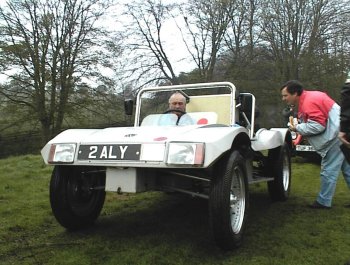
Back out on to the highway, the route made its way round the back of Whipsnade Zoo to Kensworth, just south of Dunstable, for the third pair of sections on the steep grassy bank used so often for PCTs. A traditional climb up, drop down, then U-turn back up section was laid out with a restart on the last uphill leg. Only Dud Sterry’s MG and Clive Kalber’s ‘Runner Bean’ Pop managed cleans here although Ken Martin managed a three with his PCT prepared Reliant Kitten, as did Anthony Young in his new ‘Aly 2’ VW Special. The Macdonald/Greenslade duo joined them. Section 6 featured a hairpin back right obscured from the driver’s view behind a barn, followed by a restart. Both Clive Kalber and Neil Bray in the Skoda were caught out here along with George Francis in his very pretty Lancia Volumex powered Marlin running in class 8. 

A short drive through Dunstable and Hockliffe, back towards Leighton Buzzard brought the entry to the old worked out pits of Mile Tree Farm for Section 7 and the second special test. As the locomotives built up steam on the local narrow gauge railway adjacent to the site, trials cars were bounced and corkscrewed over and through the mounds and gullies of Mile Tree Farm. There were ten cleans on section 7 including the very smart Dutton Phaeton of Keith Oakes and Simon Robson’s Skoda. The traditional battle between the Falcon Skoda crews now leaning very much in Simon’s favour. James Lindsey also managed to persuade his long chassis Fugitive round for a clean but Giles Greenslade bottomed out the Sunbeam dropping three. The special test was a corker, more a timed section in the style of the MCC testing trial. Andy Curtis made the best time at 27 seconds in his Buggy but Simon Robson was on the same second. The next fastest were two seconds off the pace.

With the morning’s overcast clouds clearing and a drying wind lifting the gliders high above Dunstable Downs, the trial returned to Edlesborough for another crack at the previously slippery pair of sections. Joint Clerks of course, John Parsons and Mike Pearson decided to drop the mornings tyre pressure limits, 15psi for class 8 and 12 psi for class 7, allowing free pressures. Sadly this proved totally unnecessary as the site had dried out in double quick time, the result was a string of cleans on Section 8, only Simon Robson going wrong, with just Fred Gregory and Colin Stevens Duttons failing to get away from the restart on Section 9. The day’s second visit to Kensworth produced seven cleans from the up and down section with Mike Furse applying his intimate knowledge of the site to make the first clean climb. Mike has been PCT C of C here many times in the past and knew exactly where the grip would be on the restart. The Alderson Troll dropped another goolie here when the pilot lost his way amongst the marker posts! Everyone knew about the hairpin right on section eleven this time around so the organisers only managed to extract marks from Brian Sarney in his attractive class 2 Ford Y type tourer. Back to Mile Tree Farm for another roller coaster ride around the pits and the third special test, test two in the reverse direction. Making up for a lacklustre day on the hills, the Troll snapped round in 23 seconds for fastest time with Andy Curtis again following close on the same second.

And finally the trial returned to Great Brickhill for Sections 13 and 14 amongst the trees and sandy gullies. Despite double restarts for classes 7 and 8 on the last section almost everyone made it in to the finish with no further losses. As the Falcon catering caravan dispensed burgers, tea and coffee the results team beavered away in the club’s second caravan. Within an hour of finishing results were declared and awards presented. Class winners were Giles Greenslade, Simon Robson, Clive Kalber, Dud Sterry and Rob Cull. Best Falcon MC member was Clive Booth. The overall winner? None other than event sponsor Murray MacDonald! Well done Falcon MC, a pleasant day out which all competitors seemed to enjoy, already there are murmurings within the club for an even more ambitious route next year, perhaps some of the old, more traditional, Conquest trial sections can be resurrected?


We have been publishing stuff about Classic Trials on the Web since 1995 and always appreciate feedback. Comments, Corrections, Criticism & Concerns are all welcome. You can leave a comment to have your say here on this web site or our Social Media
78th Lands End Trial

Easter saw another excellent Lands End Trial, the MCC’s 78th. Conditions were pretty near ideal. A little sun, a little rain, some dry sections, some wet ones and a sting in the tail at Bluehills.

As usual there was plenty of Falcon support, with some interesting crew variations. Hazel was driving the MacDonald Beetle again, but with Veronica otherwise engaged; she had to be on her best behaviour as Murray was alongside in the passenger seat.  Mike Hayward was driving his hybrid Escort in its second classic, and first MCC event, with Michael Leete entwining himself around the roll bar in the back. In class one our RAC PCT champion, Matt Clarke, was enjoying his first MCC outing, passengering Ken Payne in his Golf. Ken is the owner of the Golf Nick Pollitt campaigns although I am not sure if this is the same car.

There should have been another debutante, but Verdun Webley non-started when he couldn’t get his Marlin ready in time, discovering the motor had two head gaskets. Closer examination revealed the head was warped quite badly and Verdun wisely decided to delay things until the car was right. Stuart and Andrew Cairney had a nice restful Good Friday, fitting new pistons and rings to their Imp. Firing it up just in time to drive to the start!

Is it imagination or does the Lands End start earlier every year? Anyway, it was still light when most of the Popham starters got away, ideal for the film crew from Merdian Television who were interviewing Geoff and Reg! The revellers were out at Sugg Lane, cheering and waving at the competitors, who were just praying that they wouldn’t throw the beer bottles they were holding. The route instructions for the exit route were very specific. There was to be no stopping until the main road. No fear of that as the track was lined with a new age traveller encampment. You got the feeling they would have the dogs on you for disturbing their beauty sleep.

The holes on Felons Oak are getting deeper and caused quite a bit of trouble on the re-start for a few people, including Neil Bray who had his first puncture and Tony Branson who had come all the way down from Hexham in his 1300 Marlin. Stuart failed as well, after a struggle to stay awake on the long preceding road section. Minehead Rugby Club gave a twenty-minute rest for some but it was all go for Neil Bray as he adjusted Mikes timing. The Escort had lost all its low down power after its pre-event tune-up and Mike was having a real struggle to get it away on the re-starts. 

Stoney Street came and went without drama and Beggars Roost wasn’t too much of a problem as the re-start was on a straight bit. Mike Hayward cleaned the section OK, at the cost of a puncture, but will probably be penalised for rolling back as the handbrake was slipping very badly. As always there are some amusing MCC organisational sub-issues. The road book stated that you had to deflate your tyres on the main road and threatened exclusion if you stopped on the entry track to let them down. The problem was that the main road was lined with parked cars and you had to pull off a long way before to find a space to stop. This meant a long drive on flat tyres and we all know this is a road traffic offence!

The mist came down for the fifty-mile drive over Exmoor to Simonsbath and on to the Hartland peninsula. Sutcombe and Darracott were both up to form. Classic hills in beautiful surroundings but not ones to cost anyone a triple.  That was to change on the third Hartland hill, Cutliffe Lane. This is not too difficult in the dry but it’s a different story in the wet, and for this 78th Lands End wet it was. The section starts on a gentle slope, and then it’s a sharp right hander through a gate. The gradient gets steeper and the hill rises sharply up a gully cut into the side of a wooded slope A combination of things make it difficult. Rocks, mud, gradient, they all contribute. This was a hill for the brave and the super-hero’s. Dudley climbed it of course but things were not so easy for mere mortals. You needed plenty of momentum when you got to the straight bit, which meant maximum speed through the gate. This caused problems for some. Dave Turner got his BMW off the line in fine style only to loose traction. He snicked it into second, the tyres bit and the Beemer under-steered straight into one of the gate posts, uprooting it and leaving the BMW in need of a helping hand from the recovery tractor to pull the body-work of the front wheels. The same gatepost was the downfall of Lee and Dani Dove who gave it a mighty blow with their Troll, leaving them with the task of getting the wreckage all the way back to Perth.

The trial returned to Bude for the first special test. A wiggle woggle around the cones of a deserted car park after a fight to get through the centre of town crowded with Saturday shoppers. David Heale was voted one of the most spectacular, lifting the front wheel of his Escort a foot of the ground before slowing when the passengers clip-board got stuck under the pedals. The lady concerned was Mark Hobb’s wife who complained hadn’t let her finish making a phone call! Near neighbours Stuart and Andrew were in trouble again, wrong slotting and going the wrong way around the final bollard.

The MCC had threatened to cancel Crackington if the locals doctored it too much. They responded by dumping one tractor load of slurry on the upper surface instead of the usual two. It seemed to do the trick and the hill was competitive without being impossible. It was reckoned to be rougher though and took its toll on the Falcon contingent. Geoff Jackson had a half shaft go and although Mike Pearson had a spare it was the wrong sort. He managed to find one out the back of a local garage and get down to Newquay nice and early for dinner. He was joined by Tom Goggin who retired when his clutch wouldn’t disengage.  Punctures were pretty prevalent. Matt Clarke experienced the joys of being winched up a section when Ken Payne’s Golf lost a tyre and Neil Bray had a similar fate. Mike Hayward got out of the top OK, a great achievement, as he had to do a re-start in what is far from the most suitable car. Pumping the tyres up, whilst the other Michael ran back to do some videoing, Mike found a puncture on one of the rears. Unfortunately the remaining spare was flat, leaving Michael to demonstrate his skills as a tyre mechanic before they could continue.

After Treworld competitors were promised an improvement in facilities at the rest halt. Only to find the cold, barren, windy St Kitts had been replaced by a cold, barren, windy, dirty and smelly cattle market, where you would be excluded if you were caught answering a call of nature behind the shed! The usual frenetic activity was taking place in the car park to repair some of the damage wrought by the event so far. Many competitors were repairing tyres and a local entrepreneur was trying to sell instant repair gel. Mike Hayward had found the problem with his flat spare. Mr Colway had moulded a nail in his “new” remould.

Soon the call of the West beckoned and it was onto the A30 down to Hoskin, deep in Cardinham Woods. This is another doctored section, with a mud bath halfway up, complete with yellow and red re-start. Simon Robson made a successful ascent in his Skoda but Neil Bray wasn’t so lucky. A CV joint had been growling away since Minehead and now it let go in a big way. Coasting down to the bottom Neil got Fred Gregory to tow him out of the woods so he could fit the spare. Unfortunately the special tool needed to loosen the screws was at home so Fred kindly nipped into Bude to buy him a new one. By the time he came back David Thompson had stopped and lent Neil his, so he and Marc had one each!   Suitably equipped they managed to fix the Skoda and they were soon on their way back on the A30 towards Bluehills.

The mist had gone by now and the sun was shinning on the spectators that thronged the cliffs at Bluehills. “One” seems to be getting trickier and was catching out quite a few people, including Stuart Cairney and Peter Manning who had to be saved from toppling over as he tried to wall of death his way around the corner at the top. The failures were pulled out by a bunch of marshals tugging on a rope, they included none other than MSA head honcho John Quenby, marshalling at grass roots level. The second Bluehills section had been “improved” by creating an artificial corner just after the start. This certainly spiced things up, especially for the yellow and red re-starters, as the new bit was both rough and steep. It’s sure to attract plenty of comment in Triple! Things looked a bit grim at the beginning as none of the first dozen cars got up. Then along came Mrs MacDonald to show how it should be done. The first person to climb the new hill. Mike Hayward punctured a front tyre on the track linking the two sections and then the long-suffering clutch cried enough. It was just about drivable on the road and Verdun Webley shepherded the two Michael’s to their hotel in Newquay, giving them a friendly tow up the last hill.

The survivors only had a few sections remaining. Trungle Mill was pretty easy but Flambards was quite competitive and provided a sting in the tail for many. There just remained the final special test and signing off at Penzance where there was a major disaster at the finishing hotel. They ran out of beer!


We have been publishing stuff about Classic Trials on the Web since 1995 and always appreciate feedback. Comments, Corrections, Criticism & Concerns are all welcome. You can leave a comment to have your say here on this web site or our Social Media
My Torbay Trial

by Neil Bray

Neil Bray and Marc Lawrence of to a flying start on Lower Dean (picture by Derek Hibbert)

This was to be my first Torbay Trial. The main reason for participating was two goes at the famous Simms Hill, which we use on the MCC Exeter Trial. To my horror the event was held on 28th February, which happens to coincide with a family birthday, my youngest daughter would reach the ripe old age of three.

Permission to go was obtained from Allison, the entry form was filled in and Marc and I started to prepare the car. This included fitting an in-line device that would allow the Skoda to run on un-leaded petrol. I will revert to this 
later. Not having “Supermacs” stamina we chickened out and travelled down the afternoon before, stopping off down the A303 to visit Marc’s brother in Aldershot and in Exeter to see Jade, my eldest daughter and have a nice cup of tea. Then it was on to the B&B at Bovey Tracey for a nice meal and a good nights sleep.

The next morning we had a leisurely breakfast and then it was a gentle drive two miles down the road for scruitineering and signing on. Hill One was the first run at Simms. We had a different approach to the old hill to the one we use on the Exeter. We didn’t go through the village, but came at the summit from the exit road and then descended to the bottom via the escape road. We let the tyres down and off we went. We had decided to go to the left and got to the tree on the sub-divided hill. So it was the well-practised reverse down and ascent of the escape road.

Lower Dean was next on the agenda. It looked pretty rough and it certainly was. Rocks, ruts, it had the lot. We punctured the left rear just after the start and although I tried to keep going we failed to traverse the smooth grassy bit at the top and stopped within touching distance of the section ends board. We tried to change the tyre only to find our jack wouldn’t work and caused a bit of a delay while we borrowed another one.

Baddaford Lane was hill three. Remember this one? It was the hill Falcon marshalled for the MCC three years ago, when it was only used for class seven and eight. This is a super section, it goes up a rough, muddy gully and is nice and long. We cleaned it and gave ourselves three cheers at the top before moving up the track to the special test which we thankfully performed OK, ST’s being a bit of a bogey of mine recently. The next section was called Richards Rise. It was a very steep short slope in a field, marked out PCT style. I fired up the motor, put the maximum revs on the clock. The Skoda jumped up the hill but spun to a stop just before the summit for a one. I started to reverse down when the front wheels slipped sideways and the Skoda slid down sideways, hopping from bump to bump. There was nothing Marc and I could do, we just sat there waiting for it to dig in and roll over. Unbelievably it didn’t but we had to sit there for a few minutes to compose ourselves, as did Mark Hobbs who was marshalling at the bottom.

Fortunately Grants Lane wasn’t so hairy. It was another long lane, smooth at the start but getting rougher at the top where there was a re-start. We blasted off this OK, but at the expense of another puncture. I kept my foot down and manage to clear the summit even on the flat. Fortunately the jack worked OK this time and we were away within five minutes. There was quite a long delay at the start of the next section as a Land Rover was stuck and it was eventually cancelled. Marc and I used the time to put a new tube on one of the flats. We had a couple of good long hills which we cleaned OK before arriving at the foot of Slippery Sam, another familiar Exeter Hill, complete with tricky re-start which, unlike the Exeter, we performed OK.

By now we were heading back towards Simms but we had a couple of challenges first. Tipley was hill 10. Remember how rocky it was the last time it was used on the Exeter? It hasn’t got any smoother. We had another puncture on the approach road and the jack played up again. In consequence we were very conservative with the time pressures, which was fortunate as if we had gone low we would have destroyed the rims on the rocks. We failed and it took us a long time to get out of the section, as there was no tow wagon. After Tipley there was another special test and relatively easy observed section before a return to Simms.

We went to the right this time, the “Simon Robson route”. We hugged the bank hard, so hard we were up against the trees and the spectators had to jump for their lives. Sadly it was to no avail and it was another trip up the escape road for YEG. I was disappointed but the results showed the other Skoda’s didn’t get up either so I don’t feel to bad! Murray and Giles Greenslade got a clean in their Beetles and so did the Imps of Jim Scott and David Heale. Then it was back to the finish for signing off and the long drive home.

Marc and I reflected on our day on the long drive home. Yes it’s a long way to go west of Exeter for a one-day trial but it was worth it. There were some super hills with around seventy road miles and Marc and I plan to do the Torbay again next year. Earlier I mentioned I had fitted one of those in-line devises to allow older cars to run on un-leaded. I ran the Skoda on the garages rolling road before the event. Then I fitted the unit and tested again after doing the event and about 600 road miles on leaded petrol. There was no power loss and I have now started running the Skoda on un-leaded without altering the timing or carb settings. I will check it on the rolling road again after giving it a good try and let you know how it performs.

Overall Nigel Moss Cannon 0
Class 1 David Hazleden Golf 10
2 Peter Trelving Austin 7 19
3 Paul Bartleman Ford Escort 0
4 David Heale Imp 4
5 A. Wordsman MRG Midget 31
6 A. Andrew VW Beetle 9
7 Arthur Vowden Marlin 0
8 Dudley Sterry MG J2 0


We have been publishing stuff about Classic Trials on the Web since 1995 and always appreciate feedback. Comments, Corrections, Criticism & Concerns are all welcome. You can leave a comment to have your say here on this web site or our Social Media
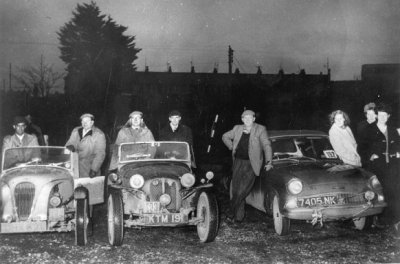
Arthur Vowden won The Cotswold Clouds

This was a tough ‘Clouds, the mud from the Clee Hills seemed to have travelled down to the Cotswolds to make this a very competitive trial. Organised with the usual laid back efficiency by the Stroud Club. Arthur Vowden was best overall in his class seven Marlin. The class eights being defeated by their tough re-starts on Merves Swerve and Highwood 1. Bad luck to Adrian Marfell who would have won if he had not failed both Bulls Bank re-starts.

This was a tough ‘Clouds. The mud from the Clee Hills had made the journey from Shropshire to the Cotswolds to make this a very competitive trial. Organised with the usual laid back efficiency by the Stroud club. Arthur Vowden was best overall in his class seven Marlin. The class eight’s being defeated by their tough re-starts on Merves Swerve and Highwood 1. Bad luck to Adrian Marfell who would have won if he had not failed both Bulls Bank re-starts. 

Murray MacDonald achieved the best Falcon result, winning class four by a large margin. However, all the Falcons enjoyed the event immensely, save perhaps for Simon and Matt Robson who broke their diff on one of the Bulls Bank re-starts. The results show them competing for second in class at this point having cleaned Axe and Ham Mill, both of which they actually failed! Like-wise Jim Scott is shown as cleaning Sandfords, but I’m sure he told me he failed it. However, he would still have come second in class. 

Interesting that there were seventeen retirements, including six of the ten starters in class three and the entire class five entry either non-started or retired! 

James Lindsay made his classic début in his ex Owen Briggs type four engined Fugative, getting the long chassis out of the gully on Mackhouse 2 and achieving one of the best scores on the very muddy Station Lane.

Overall – Arthur Vowden (Marlin) 29 marks lost
Class 1 – Terry Coventry (Citeron AX) 46
Class 2 – S. G. White (Riley) 53
Class 3 – Edwin Hayward (Escort) 71
Class 4 – Murray MacDonald (VW 1302) 37
Class 5 – No finishers
Class 6 – Mark Smith (VW Beetle) 42
Class 7 – Adrian Marfell (VW-Alfa) 33
Class 8 – Mick Workman (GVS) 31

We have been publishing stuff about Classic Trials on the Web since 1995 and always appreciate feedback. Comments, Corrections, Criticism & Concerns are all welcome. You can leave a comment to have your say here on this web site or our Social Media
24 January 1999 – Adrian Dommett wins Muddy Clee

Adrian Dommett won a very muddy Clee Hills Trial on 21st February, his climb of Bradburys Bank putting him into a commanding lead that he was not to loose all day. David Alderson and Adrian Marfell headed the chasing group although Adrian was aided by the class eight’s having to do more hills! The organisation was very professional. Superb documentation, plenty of marshals and recovery. In fact everything we have come to expect from Jonathan and Pat Toulmin. It was needed because the conditions were pretty dire. The heavy mud caused some appreciable delays and the field was well spread out at the end.

There was another strong Falcon contingent on the Midland Automobile Clubs Clee Hills Trial. Neil Bray had Allison reading the route card as Marc Lawrence was hosting an Escort owners club meeting back on the ranch. Murray MacDonald was our other class four competitor, delighted that Hazel let him have a drive in her Beetle. PCT specialists, but not (yet) Falcon members, Mike and Duncan Stephens in a 1300 Beetle followed them.

David Thompson was driving in his first one day ACTC classic in his VW Buggy, running with Mike Pearson and Arnold Lane in Mikes Dellow Replica. Falcon’s trio of class eight’s was completed by ACTC Chairman David Alderson with Emma in the passengers seat. This was David’s first run in his Troll since last years Kyrle.

Mike Hayward was our only class seven competitor, driving in his first Classic trial in his highly modified Mk3 Escort. Finally there was another rather distinguished local driver, although he is not yet a Falcon member. John Quenby, the chief executive of the MSA, was giving his MG TC a run in the green sticker MAC closed to club event. I may be wrong but I believe, that as MSA head honcho, John is not allowed to hold a competition licence himself, so can only compete in closed to club events, like the MCC classics and this rare Clee MAC only class.

Competitors assembled for the start at The Boyne Arms, on the fringe of the Boyne Estate. With their usual professionalism Jonathan and Pat Toulmin had arranged for Lady Rosemary Boyne, mother of the present Lord Boyne, to present the awards at the finish. They did have some last minute problems. BT had dug large hole at bottom of Boynes Bouncer. It had been filled in but was to cause problems later as very heavy rain over last week had made this, and many of the other sections, very claggy.

FARLOW was the first section. Classes 2 to 8 went up the muddy track that cuts across a hairpin bend. The other classes had a re-start on the tarmac. The track became softer and more rutted the higher you went. The hill was covered in mud when the early numbers arrived and this played a significant role in the results in class four, which was running at the front of the field. Neil Bray was first to arrive and stopped at the ten. Each competitor got a little further as his predecessor ploughed a little more mud from the surface. Murray MacDonald was running half way through the class and dropped seven but the wily Giles Greenslade had his go last and got as far as the four.

In class eight both David’s Alderson and Thomson came out of the top for a clean but Mike Pearson stopped at the four. Farlow was Mike Haywards first ever classic trials hill and like most debutantes he didn’t give it enough welly off the line. The Kent motor coughed and spluttered in protest and by the time it had recovered the Escort had lost that all-important momentum and stopped at the seven.

The route returned to the Boyne estate for a group of sections. BRADBURYS BANK was more or less going to decide the trial. It’s a soft muddy track through the woods. After a gentle start there’s a sharp right hand bend up a very steep bank. All but one of the entry either under-steered straight on at the corner or floundered on the bank. Adrian Dommett was the hero who made it to the summit. The next best score was a seven, giving Adrian a substantial lead that he hung onto all day.

A note in the route card said BOYNES BOUNCER has never been climbed and it wasn’t going to be today either. It’s a steep muddy path and BT work had turned the bottom into a quagmire. Too far to the right down into a ditch. Too far left into a bottomless pit of goo. After the first couple of class two’s got well and truly stuck in the mud it was called of for everyone except class eight. Adrian Dommmett, David Alderson and Adrian Linecor were the three super-men who at least saw the top of the hill, even if they didn’t actually get there. Getting through the goo at the bottom was enough achievement for most people.

HILLSIDE was another section that got easier as the day went on. It’s a long, straight muddy affair, traversing across the slope of a wooded hill. There were some big bumps half way up just before Red & Yellow restart and David Alderson was the only Falcon to get through this difficult part of the section although Neil gave it a real good go.

BEAMFORD was approached via a track with a  “we object” sign outside the only house along its length. Apparently the householder maintained the byway himself and thought the competitors would mess up the surface. Some post event work by Jonathan Toulmin managed to turn him into a possible supporter rather than an objector! The section started on the bank of a small river and went along its course for ten yards or so before coming out along a very muddy track. David Thompson dropped three here and both Murray and Neil had problems when they both hit the same boulder on the exit road the impact bending Neil’s suspension a bit.
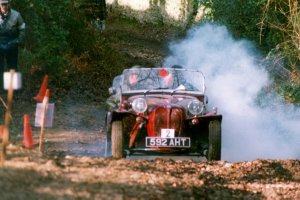
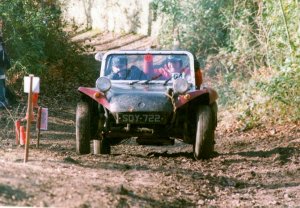
There was more drama a mile up the road at HUNGERFORD. This is a great section. It starts on the road and turns right up the track. The section begins twenty yards up hill but you are allowed to start on the run. Murray and Hazel remembered this as a rough section and didn’t drop the pressures much. The wheel’s started spinning as soon as they hit the rough and they passed “section begins” at a crawl. They managed to continue until the big hump at the top, but by now they were going so slowly they couldn’t coax JAZ over. Mike Hayward experienced a similar problem. He was going much faster but his Escort is much lower and he grounded out. Mike Pearson and Arnold Lane didn’t get that far. They rocketed up the track but the side-wall blew out of a tyre with a tremendous bang just after section begins and they had to reverse back down.

HARTON WOOD was a nice blast up a tree lined rack and came with protesting local at the top for some. Sections nine and ten were the LONGVILLE Special Test and Section.  Not too difficult unless you were yellow or red when you had one of those horrible restarts on polished stones to get back on the main road.

IPKINS ROCK looked nice and easy from the bottom, but there was a very sharp hairpin right near the top where the reds had to do a restart. In a way this was a blessing in disguise as it forced them to slow. A few of the non restarting lower classes had too much speed on and went over the side, including Greenslade’s senior and junior, costing Giles a class win.

THE JENNY WIND is a long straight blast up an old cable tramway, without very much grip. This was worse for the later numbers as it had started to rain, but at least this compensated for their easy run up Farlow.  HARLEY BANK was a few yards up the track. It started with easy gradient but got a bit rutted near the summit where Mike Hayward ran out of ground clearance and stopped

MEADOWLEY was only for yellows and reds. It was particularly slimy and evil with deep ruts and tree routs to complete the challenge. Nobody came out of the top and it was the on-form Adrian Dommett who got the furthest to re-enforce his overall win, aided considerably by those huge wheels. The LOUGHTON SPECIAL TEST finished off the day. This was a dive down a muddy track, hairpin round a cone and back. All in the dark for the later numbers

Back at the Boyne Arms it was Adrian Dommett who was declared the winner, dropping only ten marks. This was despite having to do two more hills than most of the other classes. David Alderson was the best Falcon, winning class eight. Competitors were pretty spread out at the end. Running towards the front of the field Murray finished by three and was back home in Welwyn Garden City by six, while Mike Hayward had only just got to the finish.

The end of the event wasn’t the end of the excitement for Neil and Allison. They had a good run back to Bedfordshire but just a few miles from home the transmission gave up the ghost when Neil was changing down for a roundabout. Looking at the car afterwards Neil also found more water and dirt in the fuel system, lets hope he can get it fixed in time for the Cotswold Clouds.

  • Best Overall – Adrian Dommett – Ford Special – 10 marks
  • Class 0 for MAC members – Jeremy Nightingale (Dellow) 28
  • Class 1 – Adrian Tucker-Peake (Peugeot 205 GTi) 28
  • Class 2 – Barry Clarke (Grotty Chummy) 38
  • Class 3 and 5 combined Paul Bartleman (Ford Escort) 18
  • Class 4 Dave Sargeant (VW Beetle) 34
  • Class 6 – Mark Smith (VW Beetle) 17
  • Class 7 Adrian Marfell (VW-Alfa) 16
  • Class 8 David Alderson (Troll T6E) 22

We have been publishing stuff about Classic Trials on the Web since 1995 and always appreciate feedback. Comments, Corrections, Criticism & Concerns are all welcome. You can leave a comment to have your say here on this web site or our Social Media