Lands End 2003

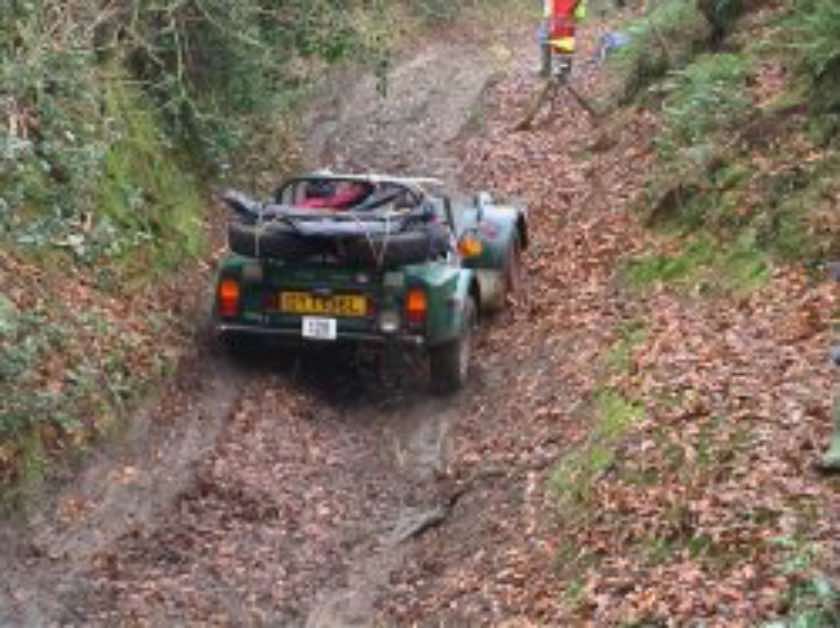
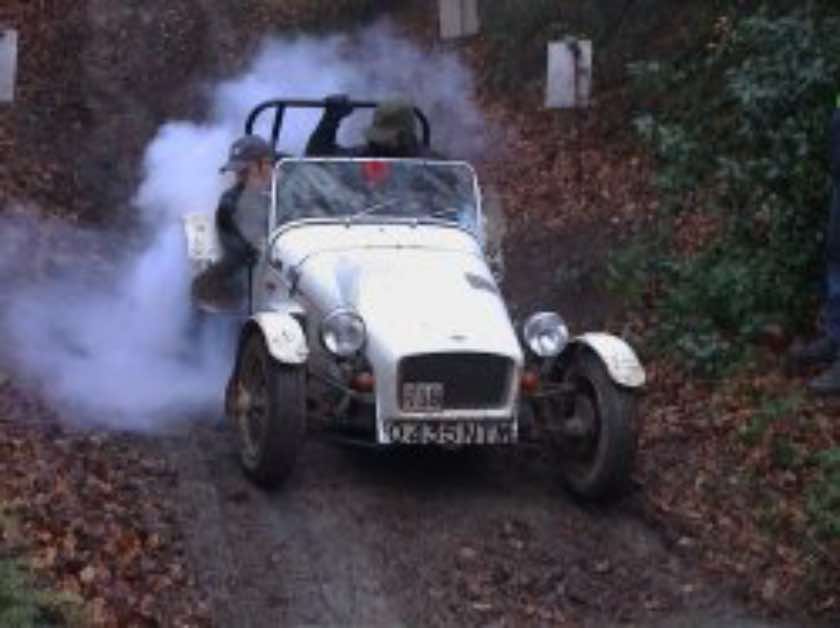
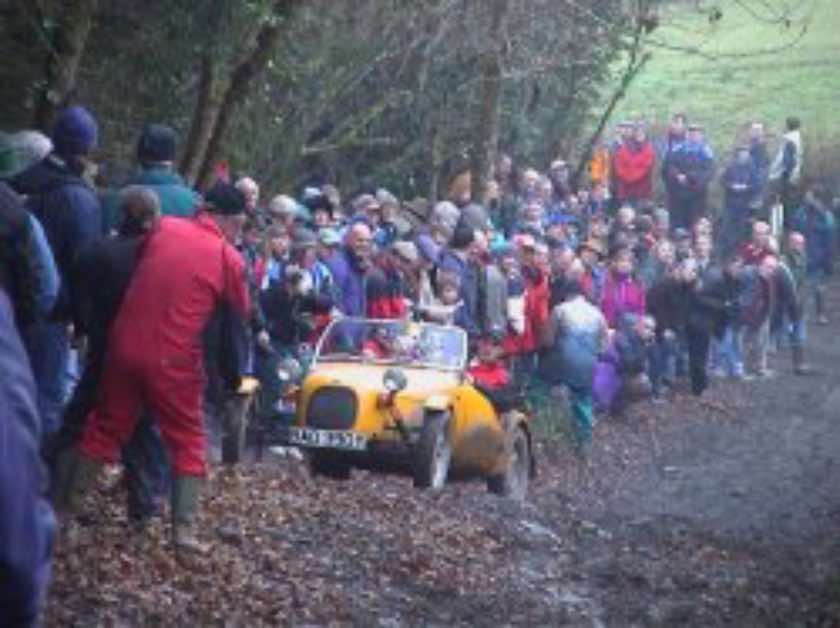
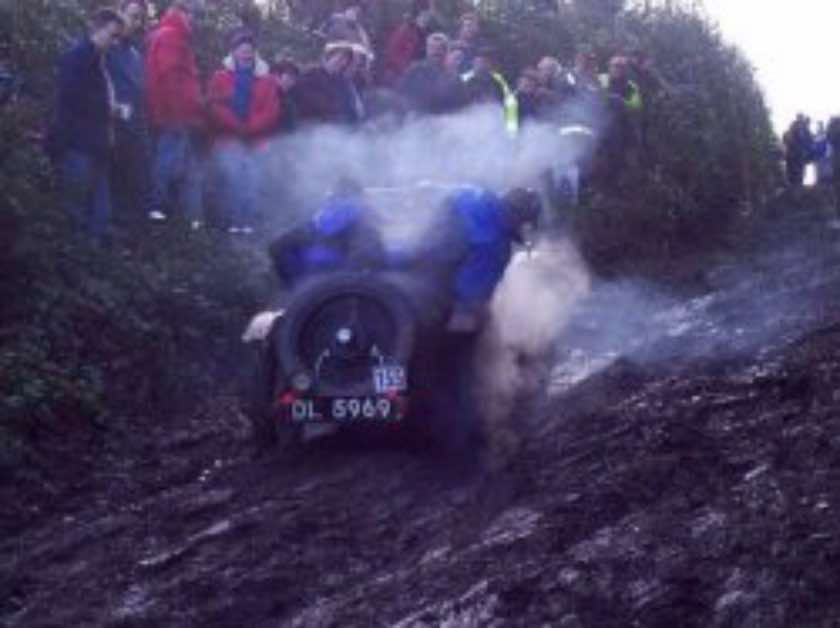
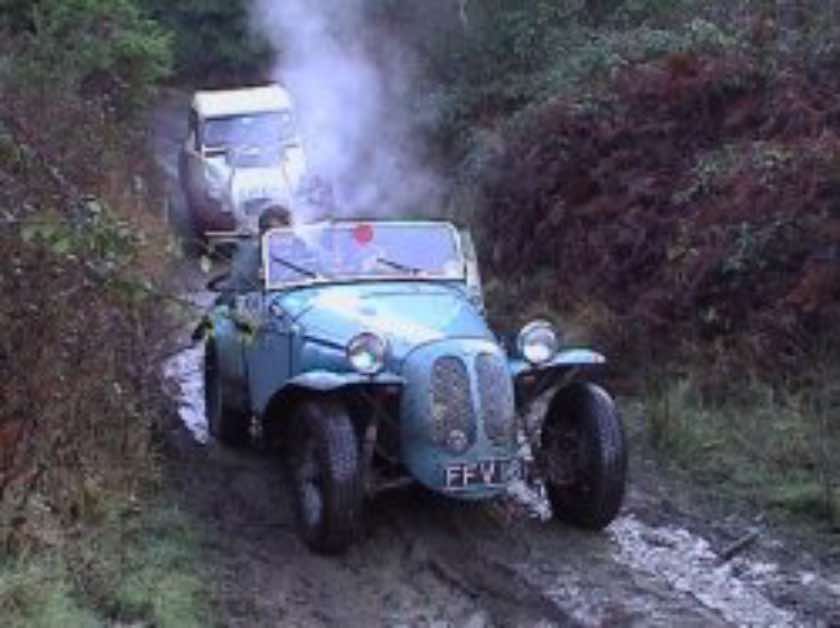
It was a dry Lands End this year and dust was a big problem on some of the sections. It certainly wasn’t a Falcon friendly event with many members falling by the wayside and retiring.

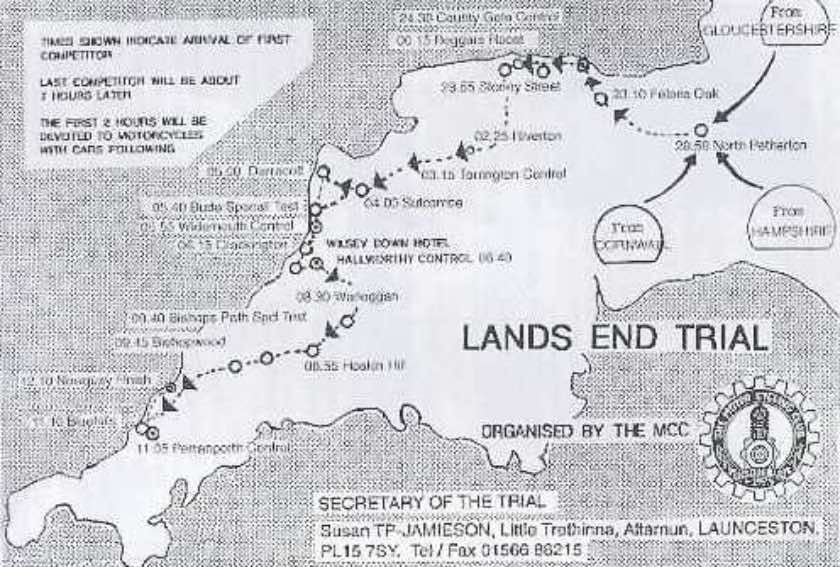
This years Lands End Trial was really two separate trials following a roughly parallel course. The “normal” trial (shown in blue) and “Class 0” (shown in Green).

It had been very dry in the West Country prior to the Lands End. In fact it was reckoned to be some five weeks since it rained. As a result there was a lot of dust about and some of the sections were pretty rough. 

The start had been bought forward as part of the organiser’s efforts to get the event to finish at an earlier time and all the Popham starters left in daylight. Clive Booth didn’t join them as he decided not to start after a horrible vibration on the way down from Hatfield. Closer investigation revealed that the pivot bearing on the rear A frame was completely worn away, allowing the axle to move about, so Clive decided not to start, taking the Dellow Rep home to pick up the daily driver and head back West to spectate on Beggars, Crackington and Blue Hills. Clive had better luck than Peter Mountain who didn’t even make the start in his newly re-built Dellow! 

There was plenty of room at the North Petherton grouping control, where the Liege’s were all parked together, including the “old number one” machine of Peter Davis, loaned to MCC Committee man Alan Foster for the occasion. It didn’t quite have the grunt of the Foster Morgan +8, especially as the promised blower didn’t materialise and the two SU’s weren’t in the greatest tune! 

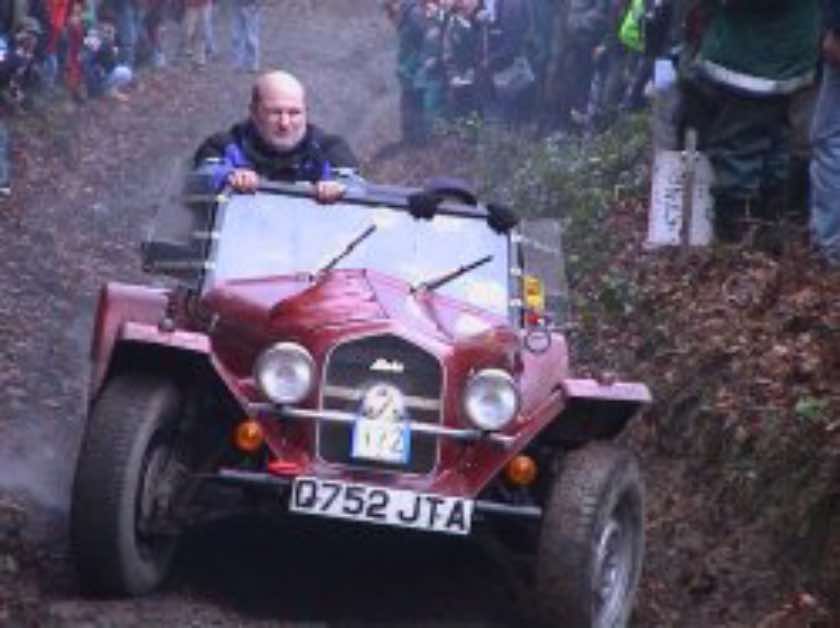
The approach road to Felon’s Oak was very dusty, a sign of things to come. There was plenty of grip, and the section wasn’t on the doctoring list, so it didn’t present to many problems. The road to Minehead wasn’t an easy one for John Parsons as the steering started to go a “bit funny” on the corners. By the time the Buggy got to Minehead it was almost un-drivable and there was a horrible noise coming from somewhere at the back. Leaving the town JP pulled into the nearest lay-by, got the jack out, and soon found that one of the inner rear wheel bearings had completely disintegrated. There was no way this could be repaired so John and Dot limped back to Minehead and were on a recovery truck back to Stoke Hammond by 4am. 

Stoney Street was very rough in the dry. It didn’t present to many problems for the cars, but all was not well for one of the crews as Mike Hayward had started to feel really poorly. Michael Leete found a convenient lay-by to stop for a while and they continued, but Mike felt worse and worse and the Beetle turned for home when the route crossed the A361, but not before failing the Beggars re-start when Michael stopped far to low in the box. 

There was a holding control at The Culbone Inn where there was some frantic work amongst the Liege community, with various clutches being adjusted. Simon Robson had to get his handbrake working before Beggars after having to hold the car on the clutch at Felon’s Oak. Simon wasn’t the only one grovelling under the car trying to fix his hand-brake in the dark as he was soon joined by Andrew Brown whose had given up on the Stoney Street startline but unlike Simon he couldn’t get his fixed and had to do the rest of his re-starts “on-the-clutch”. 

Beggars was pretty rough in the dry, with a lot of loose rocks, especially in the re-start area. Colin Perryman got a pucture here but still got away OK and went on to claim a gold. Ross Nuten was in trouble as his Dellow was using-up more brake fluid than petrol. Verdun Webley donated a litre can but this was soon used up and Ross became yet another Falcon turning for home for an early bath. 

Daylight was starting to break as the cars arrived at Riverton which didn’t present to many problems for the cars, although some of the bikes found the ruts at the top a bit deep and John Lees got a foot knocked of the peg. Simon Robson was able to dive underneath his Liege again to check the back axle, which had been leaking earlier in the trial. All was well and the crew carried on but began to slip further and further back down the field as they kept stopping to check the car. 

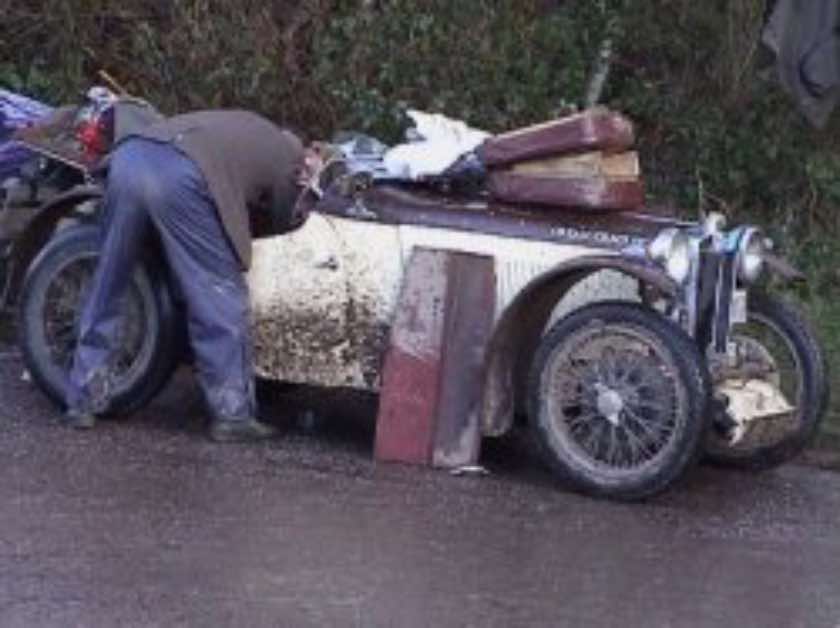
Sutcombe saw the end of Verdun Webley’s Lands End. The axle twisted on it’s mountings, ripping the UJ out of it’s lugs, breaking one of them in the process. Verdun and Mike Pearson dived under the car to assess the damage and it was soon apparent that it wasn’t repairable without new parts. An Easter holiday with the ladies was planned so they had to go on down to Cornwall. Phoning home Dorinda and Frances were just on their way so they diverted to pick up the stranded crew, leaving the Marlin at Sutcombe. Over the weekend Verdun made a tour of the Cornish scrap-yards and managed to find the necessary parts, stopping back at Sutcombe on the way home on Tuesday to fix the car and drive it home.
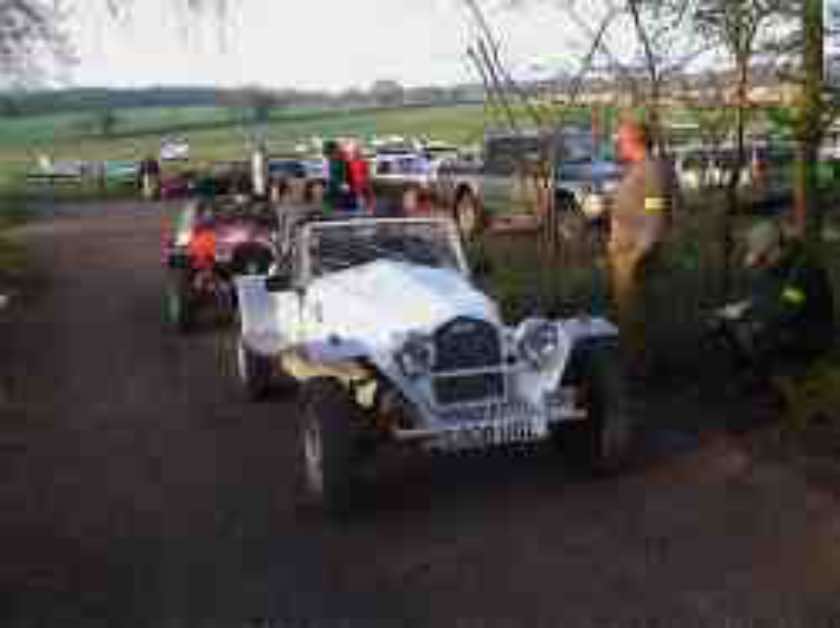
Up until now Patrick Osbourne had been going well in his nicely prepared Skoda, complete with children asleep in the back! Unfortunately the clutch suffered a bit on the Sutcombe re-start. They continued but there was another re-start to come at Darrcott and this finished the clutch completely. They managed to limp out of the section and telephoned Britannia Rescue to take them down to St Ives for their family holiday. 

Crackington had been doctored as usual, but only the class eights had to re-start. It wasn’t a formality though and Dave Nash and Neil Bray spun to a stop in the doctored bit. Team Liege had some problems here when Chris Sewell sputtered to a halt. The fuel tank outlet had fractured, but they continued with the bouncer holding things together by hand until they found a shop that sold super-glue and fixed everything back together! 

Class Eight competitors arrived at the foot of Treworld to be greeted by a friendly marshal asking them if they had read their route card! Closer examination revealed that only the yellows had to stop here, so the class eights were able to blast up without any difficulty, although at the expense of a ruined rear tyre for Dudley Sterry. 

Warleggan wasn’t too much of a problem, and neither was Hoskin, where the yellows had a much easier re-start than usual and were able to blast up. There were quite a few clean sheets when the cars arrived at Bishops Wood but this was to change on the Yellow and Red re-start. Like last year it was on the steep bank after crossing the track, but this time it was right on the steep slope, positioned so that even if cars stopped just in the box the rear wheels were still on a steep slope, which seemed to have experienced an extremely local shower of rain! This was where the MCC slimmed out the Triple list and only the real Supermen retained their clean sheets. For the record the following are now allowed to call themselves Clarke Kent :- Dudley Sterry, Tony Young, Eric Wall, Tim Whellock, Roger Bricknell and Tommy Kalber.

Action on Bluehills 2 by John Salter & John Lees
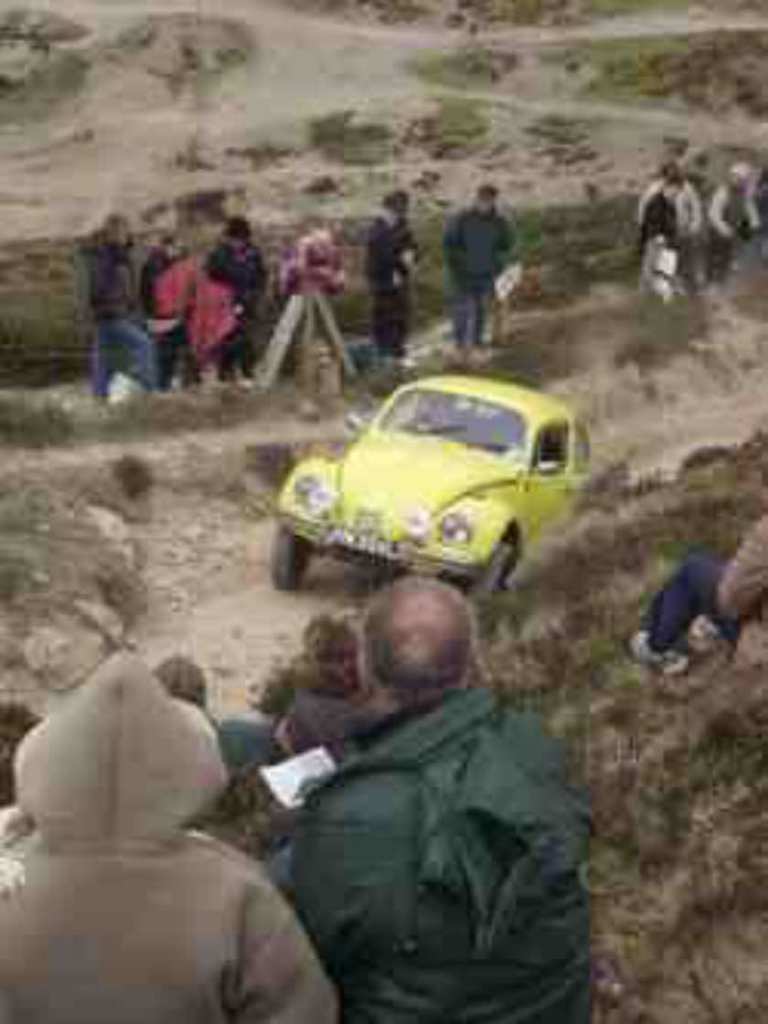
The route wound it’s way towards the coast, an ever-increasing dust cloud announcing the approach to Bluehills. No problem on “One” but “Two” was a different issue. There was an enormous amount of loose dust, rock and stone on the re-start area making it very difficult for the restarters to get away. Even if they did their problems were not over as the spinning wheels threw up huge clouds of dust that the tail wind blew past the cars so the drivers couldn’t see the corners at the top properly! 

In consequence the banks relieved a fair amount of bashing, and early runners Mike Relf (Opel Manta) and John Bennett in the immaculate class 4 Renault, did quite a bit of damage to their cars. Clive Booth was spectating here and thought the Liege’s went really well, being nimble enough to negotiate the deviation with ease. Dave Nash and Neil Bray weren’t so lucky and were unable to get away on the restart. As the cars went through so much of the loose material was blown away, but then they started to dig holes, and by the time Dave Haizelden came through as the last car it looked as though the section had been cluster bombed! 

With the dry weather and the earlier start time the event finished pretty much on time and competitors were able to “enjoy” the delights of their Newquay Hotel! Or not as the case may be as both Dave Nash/Neil Bray and Simon/Matt Robson were so disgusted by theirs they refused to stay there. Dave drove home and Simon managed to take over Brian Osbourne’s room as the MGB had broken it’s back axle. Popular opinion is that the trial itself was enjoyable and well organised. All it needs next year is some rain in the weeks before the event and to move the finish back further West!


We have been publishing stuff about Classic Trials on the Web since 1995 and always appreciate feedback. Comments, Corrections, Criticism & Concerns are all welcome. You can leave a comment to have your say here on this web site or our Social Media
Exeter 2003

The 2003 Exeter ran very smoothly, despite all the rain the week before and being very cold on the night. However, some of the hills were very rough and will surely generate more debate on damaging sections. It was a very different trial depending what class you were in. The sevens and eights with high power to weight ratios thought it was easy, the lower classes thought it was hard!

Even on the journey to the start it was clearly going to be a cold night. Mike Pearson had bike competitor Richard Nixon in the passengers seat so he should be hardy enough! It was really nice to see David Alderson at the start. He was well wrapped up, as it was a bit cooler than Turkey! David was driving Peter James’s Troll. The plan was for Peter to navigate, but unfortunately he hasn’t been very well recently, so David had another passenger. Ed Nikel didn’t start as the Imp had a bad water leak that he couldn’t fix in time. Neil Bray appeared with Dave Nash in a very smart Skoda Fastback. It looked really super but why was it in class seven? The answer came with a peak under the bonnet where three point something litres of Mr Rovers V8 resided under the hood. It’s a very neat installation. All the external trim and bumpers are in place and everything fits neatly under the original silhouette. The suspension was raised quite a bit, although not as much as Neil’s normal “YEG” and he was soon to find lack of ground clearance to be a big problem.

The run down to the Haynes Motor Museum in Sparkford was classed as a Touring Assembly. This meant that competitors were free to devise their own route to the start. There were quicker ways to get to the start of the Trial proper than specified in the Route card and quite a few took advantage of this to get to Haynes early, fitting in some extra rest rather than go round the museum in the middle of the night. It was un-eventful for most, but not Clive Booth who hit a deer to the detriment of his Dellow Replica’s nose cone. Later numbers taking the official route regretted it when they arrived to find all the hot food had all gone!

Windmill Hill – The first hill may have had an unfamiliar name to many, but Lands End competitors recognised it when the got there, as it was the lane normally used to exit from Sugg Lane. It was dry and well surfaced so didn’t present any problems. Sugg Lane was different though, muddy with a lot of water running down the descent. This certainly kept the bikers alert, as did the cold on the forty-mile down to Bovey Woods.

Normans Hump – This was the usual hill, with the start line facing straight at the gradient, so there was no confusing stuff, like steering, to complicate life. That was for the cars, which could stay in the ruts. Life was different for the bikes. John Lees managed to stay in the middle for a clean climb, but this was easier said than done and most ended up in one of the ruts, whether they wanted to or not. Brian Sussex was one of many to fail this way although he cleaned everything else to gain Silver.

It was tough for the cars as well. The bottom part of the hill had very deep ruts with huge holes and a lot of loose rock. There was plenty of grip, it was just a case of how confident you were that your car would hold together if you went up at any speed while the underside was abraded away! Added to this classes six, seven and eight had their usual restart at the cross track. This reduced the possibility to attack the steep bit immediately after and this bought both Fred Gregory (Rickman Ranger) and Neil Bray (Skoda V8) to a halt. Ross Nuten had problems as well, he found his diff had locked up and he decided to limp home while the Dellow was still mobile.

Normans wasn’t kind to Imps and both Richard Tompkins and Stuart Cairney stopped when they ran our of ground clearance. It was possible to get up in one of Linwood’s little marvels, as Ian Moss proved when he flew up in his smart new yellow Imp. In class seven Simon Robson was the only Liege to get to the top. Most of the Marlins made successful climbs, but Verdun Webley fluffed to a halt with fuel starvation at high revs, a problem that was to bedevil him through most of the event and even riding mechanic Arnold Lane couldn’t cure the problem.

Clinton Bottom – Frankly I am not sure what version of Clinton this was, although it wasn’t the longest one as we started at least part way up the hill. There was no restart and after Normans Hump it was as smooth as a Billiard Table! It was still a problem though and Stuart Cairney was one of many failures. After Normans Stuart decided to pump the tyres up to 25 lbs and took off at maximum revs. He still found too much grip the car dropped into one of the many holes, practically stalling the motor and loosing so much momentum that Stuart stopped soon after.

Leaving the woods Stuart noticed an ominous clunking noise from the rear. Stuart checked the car over by jacking each rear wheel in turn and running it under load by applying the handbrake. The clunking noise could clearly be heard as soon as the handbrake was applied. Consensus was that one of the crown wheel teeth was damaged so he sadly retired from the event and went down to Simms as a spectator.

Waterloo – A few words of explanation for those that don’t know this hill. It starts on a gentle gradient with an open gate a few yards ahead. The only thing is that you don’t go through the gate, there’s a 90 right immediately before. Once round this blind corner a steep slope immediately confronts competitors. This was a real problem this year as there was a lot of loose material on the surface and grip was at a premium. It was the downfall of many of the cars, including Neil Bray and Fred Gregory, who to add insult to injury picked up a puncture on the escape road!

The initial slope also defeated the West Country class one trio of Michael Collins and David Haizelden in their Golf’s and Paul Allaway in his Astra. Along came Adrian Tuker-Peake a few cars later and he stormed up. It will be interesting to see if a second FWD cleaned the hill to make it count for the class.

Stretes – This was a nice simple hill with a special test at the top, which provided a welcome “rest” before the unknown quantity of the next hill.

Higher Rill (Sandy Lane) was only a few yards up the road from Stretes. It has not been used on the Exeter for some time. Tucker’s notes in the MCC book say it was “In use in 1931 for stop-and-restart (9 failed). Approaches too bad for 1965 event”. In 2003 the approach was interesting but the hill itself presented few problems.

Bulverton Steep – The route passed through Sidford for the second time on the way to the woods at Bulverton Hill for two sections. Bulverton Steep started with a sharp ninety-left on a steep gradient. This was muddy and slippery and it was very easy to under-steer off into the trees, as John Bennett in his smart Renault Gordini was to prove.

Passaford Lane – There was quite a run along the forestry tracks to reach the next section at Passaford Lane where there was delay for mid-field runners while David Spraggetts stricken Morgan was removed from the section. The hill itself wasn’t too difficult, even though it started to rut up at the top as the event went on.

Exeter Services – There was a nice run to the rest halt, with a marvellous view out to the sea at Sidmouth. There were dire threats of exclusion if anyone as much as looked at a spanner at Exeter Services, so many nipped out on the road outside, or went down to the lorry park, to check over the mechanicals, or in Fred Gregory’s case get some help changing a tube. There were problems for some as a Midget had gone up the bank and overturned just before the halt. It looked terrible as the car had no roll cage and the screen was flattened, but the crew appear to have survived with only a few scratches so the main damage will be to the blood pressure of the MCC committee!

Tillerton Steep – Classes seven and eight had it easy here, they had to restart! The lower classes had a clear run and could drive over the terribly rough and rocky middle section as fast as they liked, or their car would stand! Most had sufficient speed to get through but Richard Tompkins took things easy to spare the car and paid for his lack of speed with a stop. Fred Gregory, Neil Bray and Verdun Webley were among the re-starters to fail the hill and in Neil’s case he wasn’t to go much further. The car was handling really strangely after the hill. Neil found the nearside rear suspension-mounting bolt was half out, allowing the wheel to move back and forth.

By this time Michael Leete and Mike Hayward had stopped to help and with a lot of heaving, shoving and hammering helped Neil and Dave Nash get the bolt back in against the tension of the suspension rubber. A quick run up the road revealed the car still had a problem; the offside wheel was very badly buckled. Jacking the wheel up revealed a broken driveshaft and the V8 Skoda was added to the retirement list.

Fingle – There was a diff test just before the section. The old hill itself wasn’t a problem but the corners were noticeably cut-up compared to usual.

Wooston Steep – Only seven and eight had to go up the steep bit this year. The problem appeared to be the slippery bit just after the re-start and this stopped quite a few. It’s a delicate balance between grip and bogging down and sadly Andrew Brown didn’t get it quite right on his new tyres. Stuart Harrold and Chris Phillips had plenty of grunt and plenty of grip in their Troll and accelerated all the way up to the hairpin right. Falcon’s Ian Davis, Mike Pearson and John Parsons all had successful climbs as well, but in class seven neither Simon Robson, Verdun Webley or Fred Gregory could get past the slippery section on the lower slopes. The lower classes had it easy of course, turning left and finishing just before the gradient really started.

Simms – Competitors had a chance to mentally prepare themselves for Simms with a 25 mile run onto Dartmoor. The old hill was in fine form again. It’s all about momentum here. Cars with a high power to weight ratio were able to build enough speed to blast over the step but those without enough speed found there was very little grip on the slimy, slippery rock. There were plenty of triallers here to watch the fun, including Duncan Stephens and Ed Nikel and retirees Stuart Cairney and Mike Furse. They saw a spirited and successful climb by Stuart Harrold, re-starting very high on the left, flooring the throttle and driving straight up the middle. There was a lot of leaping and banging before Stuart had to brake the Troll at the stop board. John Parsons in the VW Buggy gave it some of the same treatment but Mike Pearson’s more considered approach in his Dellow Replica wasn’t successful and he spun to a stop. This was annoying as Nick Wollett had a successful climb just before in his Dellow and Tim Wellock immediately afterwards in the Fugitive.

Ian Davis was on song and set for a clean climb when his throttle cable broke on the restart. He tried to get up on tick-over but this wasn’t possible so Ian had to slide down back to the bottom to fix it. When all was well mechanically he persuaded the marshals to let him have a go up the hill itself “for fun” and he drove up easily. None of the class Seven Falcon’s were successful, Simon Robson, Fred Gregory and Verdun Webley all spun to a stop and so did ACTC rights of way officer Andrew Brown in his Marlin. The saloon car classes’ struggled and Michael Leete stopped on the slab. It was certainly possible to clean the hill in class four as Ian Moss proved in his “new” car. He stormed up at a time when there was very little grip. Ian’s Imp was immaculate at the start but by Simms was showing some battle scars with stress-induced ripples around the rear wheel arches.

Tipley – After Simms it was left at the crossroads at the top and down the track to Tipley. The gradient isn’t too severe here and there aren’t any corners, this hill is all about its rocks. There weren’t any loose ones and although it was very rough it was possible to ease off and pick your way around the bad bits.

Slippery Sam – It looked innocuous at the bottom and the restart was pretty easy but boy were the corners at the top rough. They had really cut-up on the inside and there was a lot of loose rock as well. Unlike Tipley it wasn’t easy to select your own line and cars cleaned the hill to the accompaniment of crashing and banging as the rocks tried to hammer their way through the floor-pan! There was worst to come. Competitors are well used to the lakes of red clay on the exit road. However, the big problem this year was overhanging branches. Goodness knows what it was like on a bike, especially a chair with the bike on the right. Even cars running at the end of the field had to fend of the overhanging briars, which was very unpleasant in an open car.

So that was Exeter 2003. There was of course a Class 0, which is an excellent idea, taking in some of the less damaging sections of the main event, together with some unique sections, including the escape roads on Waterloo, Simms and Wooston. The whole thing was rounded off by the usual evening at The Trecarn Hotel, a very nice finish to the event where the sections were re-run over a glass or two


We have been publishing stuff about Classic Trials on the Web since 1995 and always appreciate feedback. Comments, Corrections, Criticism & Concerns are all welcome. You can leave a comment to have your say here on this web site or our Social Media
Edinburgh 2002

Start at Moto Services Tamworth

There was plenty of room at the official start, perhaps too much room, too spread out, because it was completely devoid of atmosphere! Scrutineering was rather cursory, MOT certificate and reversing light and that was that! John Parsons was in a bit of trouble with his ex David Thompson VW Buggy and he had to rewire the feed on his to get it to work. JP has completely re-vamped his car, modifying the rear end to reduce the overhang and fitting a 2.1 Litre Type 4 engine from Jim Calvert of Stateside Tuning. To go back to the reversing lights the scrut was clearly aware, that many competitors would be reversing back down Bamford Clough in the dark!

Agnes Meadow

The run to Agnes Meadow was about 50 miles, punctuated by the steady flash of the many speed cameras on the main roads! Competitors reckon this section is a pretty gentle warm-up but Peter Mountain greeted yellow and red car competitors with the news that they had a muddy deviation off to the right immediately after the start. This sent everyone scurrying for their tyre pressure gauges as the route and surface were un-known. It was certainly a shock but I don’t think it was too difficult apart from the danger of getting cross-rutted on re-joining the main track. It did catch out a few though, including Pete hart and poor old Reg Taylor.

The run out of Agnes Meadow is a nice long green lane. There appeared to be a little local trouble at the exit onto the tarmac road by the “repaired barn” as there was a very irate local woman running around with a torch, writing down car numbers.

Wigber Low

Cars had the usual holding control before to prevent queuing on the main road. It was a nice still night and the quietness was punctuated by the occasional music of British single’s as the bikes passed the foot of the section on their way from breakfast to Clough Wood. The section is a nice one for the night, interesting but not too difficult, although the loose rocks may have been a bit of a shock to the low slung class 0 competitors.

Bentley Brook Inn

The car park was as cramped as ever but the breakfast was good and the service friendly, shame about the toilet! It started to drizzle here making competitors a little fearful about Litton in the early morning.

Clough Wood

No real problems here as everything was nice and dry. It was a bit rocky but class 0 were spared their under-sides on this one.

Ballcross

Marshal John Blakeley reported that things went pretty smoothly apart from the Renault Meganne Scenic (unbelievable) in class 0 and even the Mini got up.

Litton Slack

Ian Davis was marshalling here with family and friends. As a car driver Ian doesn’t get to watch the bikes very often and was impressed by the different techniques employed by he riders. However, it was John Beaumont in the rear engined, A series Reliant, that was the most spectacular, clearing the hill going from one lock to the other to the applause of the crowd. It was pretty moist for the bikes and there was a lot of grass, which they didn’t clear away.

This made things pretty difficult for the first 50 or so cars and nobody got up, including aces like Arthur Vowden, Brian Partridge and Dean Partington, until John Parsons blasted his type 4 Buggy to the top. John was soon followed by Jeff Buchanan in the ex-Greenslade Reliant and Stuart Harrold and ACTC Championship Secretary Chris Phillips. Suddenly the grass and mud was gone and the rest of the entry mostly sailed serenely to the summit! Quite a few of the early cars failed within 50 yards, mostly because they didn’t build enough speed of the start. Dave Nash and Neil Bray were one of the many to stutter a stop on the lower reaches.

Amongst the early numbers Pete Hart made a a spirited attempt, storming past the A boards, but didn’t quite have enough momentum after jumping out of the ruts at the tricky part next to the tree on the left. Sadly this caused problems and Pete and Carlie had to retire. This part of the hill caused problems  for quite a few others, including Simon Robson in his Liege and John Bennett in his smart class 4 Renault. Both David Turner and Philip Mitchell stormed up in their blown Beemers. Tony Branson was running near the back of the field and reported that the section had really dried out and Tony had a trouble free assent in the Marlin he had driven down from Northumberland to the start.

Putwell 1

There was certainly a bite on this normally easy section as there was a huge hole just after the start and the re-start was strategically positioned just before. David Turner was spectacular here with daylight under all four wheels as he went over the bump. It certainly put a load on transmissions and Ed Nikel had something break, shattering the case of his Imp, leaving Ed and his brother the worry of getting back to his trailer at Tamworth. Simon Robson had problems here as well as bouncer Matt couldn’t avoid his feet knocking off the battery cut-out switch in the passenger’s foot-well.

Richard Tompkins got away OK but stopped before the section end boards. This was Richards first event with a new engine in his Imp which was fluffing a bit on it’s twin 40’s as Richard hadn’t had enough time to tune them properly.  Another to have trouble was Michael Leete whose brakes completely disappeared in the queue. They came back again but this was to be a worry on the road sections for the rest of the day. In class three Peter Thompson couldn’t get the Opel away but he dropped back a little, still within the box and pulled away without any problems.

Putwell 2

Class 4 drivers Jim Scott, Colin Perryman and Stuart Cairney were marshalling here. The re-start wasn’t too difficult but quite a few car drivers ran out of steam on the rocks above it as they got slipperier as the day went on. David Childs struggled here in his Pop and was pushed up by Stuart Cairney who was his passenger more that 30 years ago. Even the class eight’s found the re-start area was rough this year and Stuart Harrold was one amongst many who thinks major repairs are needed.

Haydale

Nothing to report on this one.

Highcliffe

Nice hill with no particular problems.

Great Hucklow

On the start line the hill looked innocuous enough. The route instructions said there was a re-start for all classes but made no reference to whether the section was going straight out onto the road or deviate left up the bank. Most people guessed correctly, up the bank it was. In recent years this steep little deviation has been very muddy, a little bit rough and not much grip and the only way to get up has been to storm it. This year it was very rough, bone dry and loads and loads of grip. The only problem was that by the time you found this out you were at full tilt on the storming technique! This causes loads of damage to the four-wheeled brigade.

Dave Haizelden suffered major damage to his offside front suspension and waved goodbye to his Triple. Dave Nash didn’t get over the hump as he was just not going fast enough but at least he didn’t damage the car. Simon Robson’s Liege hiccuped and he didn’t make it either . The top of the hill rang to the sound of club hammer against wheel rim as many drivers tried to straighten out the damage, including Michael Leete, Fred Gregory and even Stuart Harrold with 18 psi in the tyres. Sadly, Derek Reynolds and Fred Mills had more serious trouble, when the transmission on their Volvo failed and they were faced with the problem of getting the car all the way back to Cramlington in Northumberland.

Bradwell Edge Holding Control

After Hucklow the wreckage wound it’s way up onto the moor the Bamford holding control at Bradwell Edge. The wait here got longer and longer as the day went on and at the end was more than two hours. At least it was one long straight crocodile so there wasn’t all the hassle of queue jumping at the defunct Marquis of Granby. The problem at Bamford was not only that there were a lot of failures, they were mostly right at the top. This meant a long delay while competitors reversed down to the lay-by. With the high failure rate the marshals were reluctant to let more than one car on the hill at a time. All this meant that on average cars were taking an average of two or three minutes on the hill with the inevitable delay.

Elmore Special test

There was a nice simple special test on the descent down to civilisation, followed one of the roughest tracks I have ever been seen on a Classic Trial. Ruts, boulders it had the lot. Pity any low slung cars coming down here!

Shatton Moor Special test

This was a Class 0 only affair. Presumably, so they didn’t have to go down the track following The Elmore Special Test?

Bamford Clough

The old hill was in fine form, stopping loads of people and causing the inevitable delays. However, Bamford is worth all that for the challenge. For those of you who have never seen it I will explain. The section starts at the end of a tarmac road and goes up a gentle dirt track, overhung by trees. There is a 45-degree right hand corner, then the trees peter out and the majesty of Bamford lays before you, provided you look up to the sky thast is! It’s now straight as an arrow, very long and gets steeper and steeper till when you get near the top you can hardly stand up. It’s also pretty rough, mainly where over the years the MCC have repaired the holed with concrete. The problem is that spinning wheels and the weather keep eroding the bits immediately before and after, causing even more holes. The challenge this year was such a big hole just where the gradient starts to steepen. All but the most foolhardy backed off to some degree here, loosing momentum and as Bamford is all about momentum that’s where the trouble started. Yes they kept going, but not at enough speed to crest the steep humps at the top, where many failed with “wheels a spinning”.

Light cars were at an advantage as they could slowly build some momentum after the horror and Mike Pearson trickled for a clean, Simon Robson did to. Dave Nash stopped and got going but the marshals gave him a clean. John Parsons stopped as well, when his feet slipped of the pedals, but the marshals obviously preferred Skoda’s to VW’s and gave John a fail. Stuart Harrold thought Bamford was very rough but had the right power to weight ratio so could re-build his speed after lifting off for the bumps. David Haizelden was right at the back of the field, limping along in the dark after the damage suffered on Great Hucklow. Sadly the lights failed and Dave didn’t see how deep the holes were at the top, finishing off  the nearside wishbone, shock absorber. The impact also removed the steering rack from the bulkhead and pushed the chassis leg back; leaving Dave with a major job to get the Golf repaired in time for the Ebworth Chase. When Dave got the car home he found the near-side chassis had moved back by 30mm and both the inner sills had moved upwards and been crushed. Dave also reported that the near-side door wouldn’t open and the offside door “you can reach inside without it being open”. All this was to no avail really as no cars in classes one or four cleaned Bamford so it didn’t count in the results for them!

Both Great Hucklow and Bamford were pretty rough for the bikers and even John Lees found them a bit of a strain on his arms. John reports that they kept catching up with class 0 and were allowed to jump in front of them at he foot of Bamford.

Haggside

Haggside was a bit of an anti-climax after Bamford, although enjoyable none the less. It had the usual re-start, just after the first corner, marshalled by Peter and David Manning and George Nixon. They didn’t have to many victims this year (remember when David Alderson lost his triple) as you could stop well before the step and take a run at it. They had company for much of the event, one of the Rangers. As an individual he was very pro-motorsport but he was along to observe and submit a written report to the hierarchy on the event and in particular how much damage was being caused to the track. Apparently, as pro-motorsport as he was, it was going to be difficult for him to turn a blind eye to the holes being dug on the re-start and the powers-that-be are likely to deny us the use of Haggside in the future.

Poachers Arms Hope

The hours “lunch halt” was at the end of the trial and it was supper time for the late runners as they arrived here in the drizzle as they were more than four hours behind their scheduled time. Fortunately the marshals showed a little pity and cut the hour down a bit for later numbers, who then missed the excellent food in the pub!

Peak Pasture

Class 0 only section

Hassop Common Special Test

After a road run through Grindleford it was up into the hills for a special test, with the start, marshalled by fellow Gasser Jonathan Laver, amongst the quarries. This was where the trial ended for the cars as the remaining sections were cancelled.

Black Harry

Only the bikes had a go at this one which probably disappointed the marshal’s who apparently “doctored” the section with material from an adjoining wall, incurring the wrath of the “powers that be” Goodness what will happen to the perpetrators. I believe that when this happened on Clinton a few years ago the guilty parties (who if memory serves me correctly included Graham Marshall) were banned for a while. Now looking at my program the Chief Official is down as, no I better not say, take a look for yourself!!!

Overwheal

Calton

Bull L’Th Thorn Inn, Flagg Moor

The finish was moved away from Buxton this year so there could be a club supper which appeared to go down well with participants, although because there was no accommodation available many gave it a miss and enjoyed the Buxton nightlife. There wasn’t much time for the later numbers to dress for dinner though, as it was well past 8 o’clock when they staggered home.

Popular opinion after the event was that the event was far to rough and that Bamford, Hucklow and Putwell all need major repairs before they can be used again and this may well be beyond the resources of the MCC. Haggside should be included in this list but it looks as though we might not be allowed to use it anyway.

The Next Day

Erratum:-

After publishing this I had an interesting e-mail from Stuart Cairney ….Enjoyed reading the Edinburgh report, one minor correction – on this occasion David Child was driving his Pop based special (the one that looks like an estate car, reg DMP 10 I think, ex Mike Furse? (Note from Michael – Yes this is right. Mike did own this car which he affectionately called “Dump” I wrote about this in the Falcon version of Classical Gas and it’s on my list of stuff to publish on the web when I get the time). I believe he still owns the Pop which, I assume, was being driven by one of his mates. Incidentally the guy I used to bounce for was the late John Simmons-Hodge who owned the Pop prior to David Child.


We have been publishing stuff about Classic Trials on the Web since 1995 and always appreciate feedback. Comments, Corrections, Criticism & Concerns are all welcome. You can leave a comment to have your say here on this web site or our Social Media

MCC Brooklands

The Brooklands manifestation was held to celebrate the centenary of both the MCC and the MAC. The celebrations kicked off with a Supper on the evening of Saturday 4th May with a gathering of member’s machinery in front of the clubhouse the following day. Some of this was much too polished and shinny for my liking so I will ignore that side of the proceedings and concentrate on the competitive event, which was called “The Banking Trial”.

Dudley Sterry and Dick Peachey had laid out a series of tests on the remaining section of the Members banking. These were of the “special test” variety, involving reversing and wiggle, woggling on the historic concrete.

Competition started with an assault on The Test Hill, albeit with dire warnings of a severe penalty of wheels were sent “a-spinning” in the process. Digging into my first edition of Boddy I see that “on November 24th, R. G. J. Nash persuaded his Frazer-Nash “The Terror” to break the Test Hill record, setting it at 32.44 mph. It was estimated that Nash’s car, which used twin rear tyres, breasted the hill at some 50mph, and certainly, it was air-bourne for about 30 ft after reaching the summit, a truly hair-raising experience in view of the many trees. Nash’s time of 7.45 seconds has never been beaten.” Unfortunately, the MCC were to be killjoys, making competitors come to a stop at liner B at the top! So, the 1932 record remained safe. The fastest time in 2002 was set by John Lees who ascended in fifteen seconds, followed by Richard Nixon who “bombed” his 250cc Can Am up in 19.1 seconds. The fastest car was Duncan Welch in 25.3, illustrating that it was the power to weight ratio that was all-important.

John Lees on his 1961 Triumph Twin, who was consistently fastest on all the tests, dominated the Solo competition. Richard Nixon on his Can-Am Bombardier was doing well and fighting for second place with John Young’s very noisy 1938 Triumph when he incurred a maximum on the last test of round two to drop him out of the awards.

There were only three starters in Class B for Sidecars and three-wheelers, and only had two finishers, when Terry Wright retired his delightful 1926 Morgan Standard after the first round leaving Arthur Walton with an easy victory.

The car classes were well supported and competition was quite fierce, with only a handful actually trying to win the regularity award! Adrian Tucker-Peake was the easy winner in the Closed Car class, in his Peugeot 205 Gti, a combination of driver skill and a well set-up car giving him an early lead which he was not to lose all day. Bryan Bradbeer set some early fast times in his Skoda before a drive shaft popped out. He managed to get it back in and continue but it happened again later in the day and he had to retire. Peter Thompson and Alan Bellamy both went well, but had to give best to Adrian’s more nimble FWD machine. I should mention that Adrian’s uncle “Tucker” actually competed on the Outer Circuit on a motorcycle before the war.

Class D for Open Cars was a real battle between Mike Pearson (Dellow Replica), Duncan Welch (Austin Healey SS) and Keith Pettit (AH Sprite). It was Duncan who took the early lead, diving down and back up the muddy slope on the first test 0.1 seconds ahead of Mike. Onto the Members banking for test two and Duncan was fastest as well, but then on the third test Duncan dropped a massive ten seconds, letting Mike into a lead he was not to relinquish all day. Simon and Matt Robson started well before incurring a huge penalty on test four during the first round, which put them completely out of contention.

Bill Bennett was the easy winner in the pre-141 class driving his 1933 MG J2. The overall regularity winner came from this class. Neil Bray setting an overall regularity difference of 5.2 according to a formula, which I don’t understand, but I do know that Neil was more surprised than anyone to win this award! Primrose ran like a pig all the morning, breaking down with monotonous “regularity” on the way down and popping and banging all the morning. Mike Pearson lent Neil his spare at lunchtime after which Primrose behaved impeccably for the rest of the day.

Unfortunately John Aley had been feeling un-well and went home early, so the awards were presented by Alan Foster and Jonathan Toulmin to round off an enchanting day.

Mike Fowler1997 KTM EGS/ERegularity Award for Motorcycles
Don Friend1994 Enfield BulletRegularity Class A
John Lees1961 Triumph TR6FTD Motorcycles
John Young1938 Triumph T70FTD Class A
Steve Hancock/Tim Stoffel1938 Ariel VBRegularity Class B
Arthur Walton/TBA1949 Ariel VHFTD Class B
Peter Chantler/Geoff Pickett 1965 Hillman ImpRegularity Class C
Adrian & Liz Tucker-Peake1985 Peugeot 205 GTiFTD Class C
Hilary Foster/Charlotte Blight1973 Morgan +8Regularity Class D
Mike Pearson/Arnold Lane1954 Dellow Replica Mk2FTD Cars
Duncan & Eleanor Welch1960 Austin Healey SSFTD Class D
Bill & Liz Bennett1933 MG J2FTD Class E
Neil Bray/Dave Nash1936 Ford PrimroseRegularity Award for Cars
Stephen & Madeleine Dear1927 Wolseley 16/45Regularity Class E

We have been publishing stuff about Classic Trials on the Web since 1995 and always appreciate feedback. Comments, Corrections, Criticism & Concerns are all welcome. You can leave a comment to have your say here on this web site or our Social Media
Lands End 2002

The first “new look” Lands End was an enjoyable event, helped by very nice weather. This made the sections dry, minimising delays, so everything ran pretty smoothly. The downside was that the sections were rougher and dust was a problem on some of them

With Easter being early this year the clocks hadn’t changed, so it was dark as most of the competitors left the three starts, for the night run to the collecting control at the lorry park at North Petherton near Bridgewater. The thirty something competitors in Class 0 started from here for their trial which ended in the same place as the Lands End, but apart from the Bude Special Test, and some of the controls, it went its own way and followed its own route with its own sections. There was a diverse collection of machinery, mostly driven by familiar names. The MCC seems committed to the class which is a good thing for the sport as it allows newcomers to have a relatively easy introduction to Classic Trialling and old stagers to dust down some of those nice old cars lurking in the depths of their garages.

With no Sugg Lane this year (will the Exeter now be able to use this?) the first section was Felons Oak, a nice easy section that nobody can fail! Well that’s the theory but a few did, including Michael Leete and Verdun Webley. Then it was down to the A39, but sadly bypassing that delightful green lane with the rocky descent past the farm. Another place we missed was Minehead Rugby Club, which was cold and dark as we went by on the way to Stoney Street, where the approach lane was dry and the dust was still hanging in the air.

The section is not too steep, but it is long and rocky, with a horrendous drop on the left-hand side. There are no little lay-bys on the way up, so recovery is difficult if anyone has any problems. John Lees had his before the section even started when his lights suddenly went dead while waiting in the queue and smoke started to rise from under the seat of his Triumph Twin. Investigation revealed the main wire from the battery to the ammeter had shorted out and burned through. While getting things repaired John managed to lose the screw to the battery compartment cover so there was no way the battery would stay in place. John decided to leave the battery behind, which of course meant he had no lights. By this time the cars had come along, so John went up the section behind Duncan Welch with the aid of a torch, following Duncan and Dudley Sterry on the following road section to the halt at The County Gate Control where he waited for daylight to carry on.

Chris Sharrod had problems with his Skoda, causing a delay and a bit of confusion when there were problems with the radio and suddenly there were three cars and a bike on the hill, causing Neil Bray to claim a balk. With such a long hill it’s necessary to have more than one car on the hill at a time and the MCC has to rely on competitors being sensible in such circumstances. The dramas weren’t over yet as Stuart and Andrew Cairney were struggling with their clutch and stopped on the following road section to let things cool down. Unfortunately it didn’t get any better and Stuart decided to turn for home while he was still mobile. Everything was going fine until he got on the Motorway when the gearbox packed in and the remainder of the journey back to Reading was on the back of a Brittania Rescue recovery truck! With two nights booked at the “official” hotel Stuart didn’t want to waste his money so he and Andrew drove down to the West Country in their Peugeot daily driver to do some spectating.

There was the first of many re-grouping controls at The Culbone Inn, up on the hills, where Dennis Greenslade worked very hard to get all the cars into a small car park. These controls certainly kept the trial together and provided a nice opportunity to socialise. Pete Crawford was enjoying his ride with Clive Booth in the Dellow Replica after John Allsop had to stay at home. Pete was particularly looking forward to Bluehills which he last visited back in the 70’s. PCT expert Barrie Parker was another Falcon trying an MCC event, driving his Citroen in class one and enjoying the experience. Colin Perryman was struggling a bit in an un-familiar Skoda, having gone and out bought a car for the event after he ran out of time trying to repair his trials car after The March Hare.

Beggars Roost is a bit tame compared to the old days, now the council doesn’t dump a couple of lorry load of shingle from the beach on the hill anymore! However, the restart can always catch you out and it was certainly a bit rough this year. Neither Neil Bray nor Peter Thompson could get away cleanly. Michael Leete/Mike Hayward got away this time but at the expense of a puncture on the exit road. Tony Branson had a puncture here as well, which prevented him getting of the re-start. Lands End débutantes Ed Nikel and Richard Tompkins were running right at the back of the field having taken their trailers down to Cornwall and started down there.

Riverton was bought into play on this “New Lands End” to break up the long road run to Sutcombe. There had been quite a bit of discussion on The Web Community about the hill, which was reported as pretty rough when used on The Exmoor Trial. However, the MCC road gang had been at work and it was fine on the day. The hill starts off a bit rough, then it zig zags up the slope with a couple of tight hairpins. These caused problems for some of the bikes that ran out of lock. The early cars had quite a wait here as a number of the bikes had problems. Then Peter Faxon stopped in his Reliant and there was considerable delay while the recovery Land Rover made a bit of a pigs ear pulling him out, causing a lot of damage to the car and Peter had to retire and head for home. The section didn’t cause to many problems for the cars and Riverton got the thumbs up from most four-wheeled competitors.

Sutcombe somehow epitomises all that is wonderful about The Lands End. The approach down to the river is picturesque, with primroses gracing the bank. It has a ford at the bottom, with Peter Mountain checking tyre pressures, and there’s such a warm welcome at the top with the ladies of the village dispensing tea and refreshments from their back door! The hill itself is quite gentle but competitors had to tackle a rocky re-start, under the eagle eye of Jim Travers. This stopped quite a few competitors including Michael Leete and Ed Nikel.

The route ventured out onto The Hartland peninsula as usual to tackle a nice gentle Darracott but missing out Cutliffe Lane, denying many competitors the chance to clean this hill in the dry conditions. There was quite a delay at the Bude special test, probably caused by the class 0 competitors feeding back into the route and jumping to the head of the queue. Triple Editor Charlotte Blight was given a real white knuckle ride round the cones by Dave Turner who really had his BMW on the bump stops as he took the corners. There was another holding control on the crowded beach car park just before Widmouth Bay where car competitors rather got in the way of the surfers.

Crackington hadn’t been doctored too much this year and only the red cars had to re-start, so the famous old hill didn’t claim as many victims as usual. You can’t take it for granted though as Peter Thompson found out in his Opel, which ground to a halt despite the urges and shouts of the spectators. The same happened for Ed Nikel who was finding that the ruts get deeper when you run at the back of the field.

It was warm and sunny at the Wilsey Down rest halt and competitors were able to really relax instead of shivering in the cold which seems to be the norm here! It was soon time to be off, to tackle Warleggan, absent for a few years. This turned out to be the roughest hill of the trial, which was probably why it was dropped in the first place!

Anyone that was clear so far approached Hoskin with some trepidation. It’s deep inside Cardinham Woods and has a steep gradient, a bit of doctoring and a re-start for the yellows and reds. It lived up to it’s reputation and competitors in the queue watched car after car reverse back down. It was possible to get up though, as Bill Rosten proved, although he had a puncture in the process. Joe Caudle was delighted to get the Torum away from the re-start for a clean and was having a good run apart from a broken wing stay which John Turner tie wrapped into place after the Wilsey Down halt. Class sevens struggled a bit with their restart and neither Tony Branson nor Simon Robson got away under the eye of a spectating Duncan Stephens. Neil Bray didn’t have a restart but failed when he punctured near the top. This was the start of a real drama as a wheel nut rounded off when Neil tried to remove it and nothing he or his Falcon team-mates did could remove it. Finally they decided to change the tube with the wheel in-situ. This became complicated when they found the tyre was wrecked so they had to remove one from one of the spare wheels. Then they found the aluminium rim was split. By now there was nothing to lose so it was beaten into place, taped up, a new wheel and tyre fitted and off they went.

There was a very nice special test at Bishops path, once the horses had got out of the way of the motorbikes! This was a new hill for many competitors who didn’t know what was coming. The section was in two parts , divided by a track. Once this was crossed competitors were faced by a steep bank and the yellow and red cars had to re-start just before it which caused problems for many including Simon Robson. So did Tony Branson but like everyone else he was enjoying his trial.

After another route check the route followed the familiar path down to Bluehills with spectators thronging the hillside beside the track across the valley. But the “silly little horseshoe” of Bluehills One had to be tackled first. Always ready to catch the un-wary, tired, driver if they cut the corner back onto the track too tightly. Most managed it OK although Chris Sharrod’s Skoda did something dreadful to its rotor arm causing a bit of a hold up.

Then it was up the track to tackle Bluehills 2. Not a forgone conclusion since then MCC put in it’s artificial chicanes. The blue classes were allowed a straight run through but the rest had to negotiate the artificial hazards causing all the usual problems. Joe Caudle lost his gold here when he parked in a hole on the re-start and couldn’t get away. Brian Sussex was another Classical Gas fan who lost Gold here when he had to put his foot down as he negotiated the MCC’s hazards on his Yamaha.

The competitive part of the trial ended here and despite the threats in the routecard most competitors lingered for a few minutes to relax and catch up with how everyone else was doing. Stuart Cairney and Jim Scott were here looking for Bill Rosten who hadn’t appeared. Neither had Verdun Webley and Mike Pearson. They had problems during the night with Silicon in the fuel lines. They fixed this but later on they had electrical gremlins and had to call it a day.

There was a new finish at The Bay Hotel in Newquay with a club supper in store for those who were staying ‘there. The only problem was that you had to stay two nights which isn’t conducive to family life for everyone but seemed to go down well with those who availed themselves of the facility. So ended the first “New lands End”. There were very few delays, although that could have been very different had it been wet, especially on a hill like Bishop’s Path. There are different opinions about The Lands End. Many people feel it should finish at Lands End but there are also Newquay fans who loved the new arrangements. However, whatever your opinion on that everyone voted this “new” Lands End a great success.

Lands End Results for some Falcons & Friends
Alan Bellamy
VW Brasillia
132 – Class 6
Failed 3 hills, officially retired as did not sign off
Ross Nuten
Dellow
134 – Class 8
Failed HoskinSilver Medal
Nick Woolett
Dellow
148 – Class 8
Failed Hoskin, Bishops Wood & Blue Hills 2
Stuart Cairney
Imp
164 – Class 4
Retired with slipping clutch after Stoney Street
Neil Bray
Skoda
170 – Class 4
Failes Beggars Roost & Hoskin, Bronze Medal
Michael Leete
VW 1302S
171 – Class 4
Failed Sutcombe and Hoskin, Bronze Medal
Simon Robson
Liege
172 – Class 7
Failed Hoskin, Bishops Wood and Blue Hills 2
Clive Booth
Dellow Replica
178 – Class 8
Failed Hoskin, Bishops Wood and Blue Hills 2
Barrie Parker
Citroen
181 – Class 1
Failed Crackington, Warleggan, Hoskin & BH2
Peter Thompson
Ope
l184 – Class 3
Failed Crackington, Hoskin and Blue Hills 2
Nick Iken
Citroen 2CV
194 – Class 1
Failed Crackington, Warleggan & Blue Hills 2
Owen Briggs
Winney
196 – Class 8
Failed Bude Special Test, Hoskin & Bishops Wood
Verdun Webley
Marlin
204 – Class 7
Retired after Hoskin
Adrian Tucker-Peake, Peugeot
284 – Class 1
Failed Hoskin, Silver Medal
Ed Nikel
Imp
341 – Class 4
Failed six hills
Richard Thompkins
Imp
342 – Class 4
Failed seven hills
Reg Taylor
RDT Special
356 – Class 8
Failed Felons Oak and Bude ST, Bronze Medal

We have been publishing stuff about Classic Trials on the Web since 1995 and always appreciate feedback. Comments, Corrections, Criticism & Concerns are all welcome. You can leave a comment to have your say here on this web site or our Social Media

Splendid Exeter

With Foot and Mouth out of the way the MCC started the New Year with a splendid Exeter Trial. The conditions were near perfect, the hills were in good condition and Simms was in fine form to shatter the hopes of many Triple aspirants!

It had been very cold during the week leading up to the trial, but come the Friday the temperature rose above freezing and fog rather than frost was the main enemy on the run town to Tintinhull. Gatcombe Lane was first the first section on the agenda, despite fears that it may fall victim to F&M. A gentle cruise for the old timers but important for some of the class 0 competitors as it was their first ever trials hill.

Then it was into Bovey Woods for Normans Hump and Clinton. Norman’s Hump is my sort of trials hill, round the corner, trotter down and point at the sky! The re-start was quite high up for the yellows this year, but there was plenty of grip, so it wasn’t too much trouble. The problem was lower down where it was pretty rough and the ruts got deeper with each car, even trapping David Thompson in his Troll. John Parsons was running near the front of the field in his ex Graham Marshall, ex David Thompson Buggy but disaster struck on Clinton when something broke in the front end and one of the wheels folded back, leaving John and Dot with the problem of getting a three wheeler out of the woods to seek a recovery truck. Richard Tompkins, who had engine problems before the event and was running a new motor, was having his troubles and failed both of the Bovey sections.

Keith Pettit and Peter Manning were running towards the back of the field in Sprite and Midget respectively, reporting both sections were pretty rough by the time they arrived. Keith had a puncture on Normans Hump and Peter followed suite on Clinton. Both had more problems later. Keith with both the electric’s and more punctures and Peter had a rear shocker-mounting break but apart from Simms cleared everything.

Waterloo can always catch the unwary and Neil Bray didn’t get the first corner right and spun to a stop. Fred Gregory was going well in his Rickman Ranger, finding the soft suspension really allowed the back end to dig in and find plenty of grip. They were clean so far but the worry was they didn’t think they had signed in at the start!

Everyone tackled Stretes. No problem for full trials prepared machinery but a challenge for some of the class 0’s. This was the end of the road for Tony and Stephanie Boyle’s 1200 Beetle when the clutch gave out. They left the VW in a car park at Otterley St Mary and went to the finish for an early bath. Stretes also saw the end of Kevin Barnes when his Singer Le Mans stopped running properly and they decided to retire. As so often happens it then cleared up all on it’s own but they were too far on the way home to continue. Falcon’s Dave Nash was going well in his Skeetle, which now has a Type Four engine. This had been for an expensive re-build and Dave was still running it, so had transferred to Class 0, finding it easier than battling with all those Marlin’s! 

It was into the woods again for Bulverton Steep and Passaford lane. Ed Nikel was having problems with his fuel pump and stopped to fix it, arriving quite late at Exeter. The corner at the top of Passaford Lane caused problems for many but it was the bend at the bottom that was the downfall of Richard Tompkins. Last year he didn’t go fast enough and stalled out on the slope. This year he had too much speed and understeered into the trees.

Photos from Tillerton

The early numbers arrived at Exeter Services well ahead of time as there had been no delays and they were soon off to Windout, which is tarmac and didn’t present any problems. They came soon enough when the field arrived at Tillerton. It was smoother than usual. The restart moved had been moved lower down the hill. This should have allowed a good run at the big step but it was very slippery and caught out quite a few of the aces. These included Tim “Triple” Wellock and Dudley Sterry, neither of who stopped in the right place. It could be done though. Ian Davis got it exactly right, driving off the re-start in his Buggy without spinning the wheels at all. Most of the cleans weren’t so elegant. Mal Allen made it with a lot of smoke and so did Keith Oakes, after a really determined attempt. Tony Rothin’s face looked pretty grim when his Cannon didn’t move, but he kept his trotter to the floor, sawing at the steering wheel. The little car slid sideways back and forth, wheels spinning until the wheels dug down to something solid and it inched up the hill.

Ed Nikel stopped to fix some carb problems but his had luck just got worse and worse when someone side-swiped his car doing tremendous damage to all the panels on one side. Ed continued only to be forced to retire with a slipping clutch caused by problems with the release mechanism.

Fingle was the usual blast, which was a bit too much for Colin Perryman’s Skoda, blowing its engine in protest. Wooston Steep was a challenge for quite a few of the yellows as usual. There were cars going everywhere around here with an extra route for class 0 in addition to the two normal ones. Pepperdon was cancelled for class 0 so they just drove up the tarmac road.

The field regrouped at Islington Village and down the lane to the bottom of Simms. Class 0 branched off to the right here to tackle Penhale’s Plantation. The majority of the other classes were to traverse this track as well, as it is the Simms escape road! It was too much for Richard Hoskins Morgan F4, which lost bottom gear and needed a tow from a friendly Escort.

Photos from Simms

Simms was on fine form this year and most car competitors floundered on the slippery step half way up. It was all about momentum. Unless you hit the step at a decent speed you just spun to a stop. There were some impressive ascents though. None more than Dave Turner whose BMW, blower whistling, stormed the summit at great speed. Pete and Carlie Hart were one of the few Marlins’ to succeed, much to the crew’s delight. Mal Allen got his Ford engined Marlin past the A boards but despite some very energetic bouncing couldn’t repeat his success on Tillerton. In class eight some of the famous names failed, including Ian Davis in his Buggy, Duncan Welch and most of the Dellow’s. Dudley stormed up in his MG and so did Simon Woodhall in his Buggy. Tim Wellock slowed and struggled in the ex John Parsons Fugative but kept his foot down and inched past the section ends board.

Bill Rosten and Terry Ball both got to the top OK but most cars in classes 4 and 6 didn’t. The Trolls didn’t have much success and the Leige’s didn’t fare any better. Simon Robson was faithful to the old John T-P doctrine of heading for the right hand side, over by where the spectators stand, but the gradient was too much for his fire pump engine. Interestingly Adrian T-P took the same line, one of the few cars to go that way. The Pop Asylum team, running in class seven, re-start and all, had a 100% record on Simms and went onto Gold, although Clive Kalber was driving Tommy’s Melos as his ex Tucker-Peake Pop was languishing at home with engine problems.

There were a lot of people spectating on Simms this year. They saw plenty of action with a chair turning end over end and a Dellow plunging down backwards with brake failure. One spectator got a bit more involved than he planned when Ken Payne lost control of his Golf and ploughed into the spectators on the right, running over someone’s foot, the poor unfortunate was helped away afterwards, presumably for medical attention.

Only Tipley was left now, a hill that had not been used on the Exeter for many years. It was just as rough as ever but competitors were spared the Torbay re-start. It ended Verdun Webley’s trial when his growling prop shaft finally broke and he had to be towed the final few miles to The Trecarn. The general talk at the bar was that the 2002 Exeter was a thoroughly enjoyable trial with a couple of very difficult sections in the form of Tillerton and Simms. In summary it was great to be back!


We have been publishing stuff about Classic Trials on the Web since 1995 and always appreciate feedback. Comments, Corrections, Criticism & Concerns are all welcome. You can leave a comment to have your say here on this web site or our Social Media

Exeter 2001

The MCC ran a truly excellent Exeter Trial over the first weekend in January. There were two new early morning sections and the weather was just right and all the hills were in prime condition, although one or two were a bit on the rough side!

With all the bad weather between Christmas and New Year the Exeter organisers had an anxious Christmas. But by the Friday the snow had gone and the hills were in prime condition.

DRAMA BEFORE THE START

There were a few notable non-starters. Ian Blackburn had been under the weather for a while and wasn’t able to get his Singer ready, or help Kevin Barnes prepare his, for what would have been Kevin’s first competitive MCC event. As it happens with Tillerton and Slippery Sam being so rough this may have been no bad thing!

We were also deprived of seeing Alan Bellamy’s unique Brasilia. Alan decided not to start with only 10 psi in his new dry sumped motor. David Alderson sold his ACTC championship winning Troll just before Christmas, but didn’t want to miss out, so he and John Boswell wheeled out son Liam’s ex Graham Brasier 1303 Beetle, complete with type 4 motor. Unfortunately the car had been the victim of some dodgy preparation in the past and one of the wheels parted company with it’s hub on the way to Cirencester, so they were relegated to spectating.

Fred Gregory made it to Popham, but not without drama. One of the sealed beam light units went on the blink on the way to the start. Not to worry, as Fred and Pete Stafford were carrying a complete spare. However, when they put it in that wasn’t working either! Thinking there was a problem with the wiring they swapped the good one over and it worked fine so the trouble was clearly with the units themselves. The predicament was that it was going to be pretty difficult to find a sealed beam unit at half past nine on a Friday night. But Fred and Pete didn’t intend to miss their weekend. Calling in at a garage they managed to convince the cashier behind a locked grille that they wanted a headlight bulb. Pete then carefully knocked the back of the sealed beam unit and our intrepid pair tank taped their precious bulb in place to make the start, albeit a bit late.

In class 7 both Pete Hart and John Salter had problems even before the action started. Neither car had been used for a while, and both played up in protest. John’s Vincent refused to run properly whatever he did to it. Finally, having to decided to give the trial a miss, he just threw it back together and gave one last turn of the key to drive it back in the garage. Low and behold, it purred sweetly into action, although as things were to transpire it was only lulling him into a false sense of security!

MORE DRAMA BEFORE BREAKFAST

Pete and Carlie hadn’t used their Marlin in anger since last years Lands End. All was well on the way to the start but the problems started once they had left Popham. The engine died in the middle of a roundabout and the crew had to push it some way to work on it safety. They managed to get going and limp to the Haynes museum. En-Route Carlie realised her handbag wasn’t in the car. They were about to retrace their steps when Pete decided to stop and ring Carlies mobile. It was answered by Patrick Osbourne’s passenger, as the Citeron 2CV crew had found it in the middle of the road and reunited it with it’s rightful owner at the Tintinhull breakfast halt. Who says trials are no longer an adventure!

Verdun Webley made the start OK but the Scruitineer at Tintinhull took exception to his new tyres and the Marlin continued under the threat of the MCC version of a Stewards enquiry. Barry Topgood’s Burlington Arrow was another car to spend a lot of time in the scruitineering bay, presumably it’s huge six bolt wheels infringed some rule or other.

THE ACTION BEGINS IN BOVEY WOODS

The field finally arrived at Gatcombe Lane on a clear dry night. With very limited gradient this opening hill didn’t pose any problems, so it was on into Bovey woods for the start of the real action. Normans Hump is long and dead straight. The recent wet weather had made nice and muddy but there was plenty of grip underneath. Class 8’s had it easy this year, as their restart was on the cross track along with the yellows, allowing them a nice run at the hump itself. This is defiantly not Stuart Cairney’s favourite hill as once again the Imp bogged down on the steep bit just before the section ends board. This is certainly a deceptive hill, it looks pretty slippy but there is usually bags of grip, and the penalty for going too low on the tyre pressures is to come off the cam if you loose momentum, which spells disaster for those of us with peaky engines.

Clinton, marshalled by Falcon Motor Club, whose crew included Barrie Parker the RAC/MSA PCT Champion, was the long version, with the re-start situated in the same place as the start was located last year. This years start was further down the hill, which meant competitors failing on the lower reaches had to be hauled up to the first cross track. When the long hill was used a couple of years ago Falcon had a super four wheel drive tractor allocated to them which made mince meat of the job. This year they were given an old two-wheel drive affair, over thirty years old, with a dodgy gearbox. This made life pretty difficult for the driver, who I believe is one of the Flay family, and with around a third of the entry having to be towed up he couldn’t avoid digging some pretty deep ruts. This made life more difficult for competitors causing even more to fail as time went on.

Neil Bray came out of the top, but with a puncture, the first of many as usual! Stuart Cairney wasn’t so lucky as the Imp just didn’t have the power to get up the gradient on the lower slope. The Pop team lost their leader here when Tommy Kalber broke his half shaft just after the restart. He had a spare but wasn’t able to get the broken bit out of the Fack Diff and retired.

THE BATTLE OF WATERLOO

Waterloo had a lot of loose stuff on the hill this year, causing problems for David Haizelden who failed on the lower reaches. Neil Bray got up OK but at the expense of another puncture. Verdun Webley was having problems with his lights and stopped in a garage forecourt to fix them. Neil Bray also stopped there to change his two ruined tubes and Dave Nash had to remind him that it was still night time and attacking the bent wheel rims with a club hammer was likely to disturb the neighbours!

At Stretes there was a long climb up the old section to a special test that started just as the hill flattens out at the top. It was a nice simple special test. Just flat out and stop aside line B. No taxing of the brain cells so early in the morning!

NEW SECTIONS AT SIDMOUTH

Normally the route goes north up to Honiton after Stretes but not this year. It was south down the A375, to loop back through Sidford and into the woods just West of Sidmouth, for two super new hills, Bulverton Steep and Passaford Lane. They were both similar in character. Start on the level with a blind ninety right immediately after the start, after which came the gradient, although you couldn’t see it from the line! There was a solid surface somewhere deep down but a fair old layer of mud covered it. Some ruts developed but basically nothing too damaging.

Just like Clinton and Waterloo the blind bends caught out a few competitors including Richard Tompkins and John Salter both of whom approached the corner with too much caution and didn’t have enough momentum to cope with the gradient. 

Passaford Lane had a relatively gentle re-start for the yellows and Reds just before a final hillock at the top. Although they didn’t have to stop this hillock caused a few heart-stopping moments for some of the front wheel drive brigade as there was no recovery in sight and it was an awful long way if they had to reverse back down! Dudley Sterry had problems of a different kind on Passaford Lane when his bonnet strap got caught on a protruding branch and ripped right away, necessitating Darren Baker making a fair old hike to retrieve it once the MG got to the top.

RETIREMENTS AT EXETER SERVICES

There was no fettling allowed at Exeter Services and early entries got there well ahead of schedule. Plenty of time to catch up on all the gossip for some. But not for Tony Branson. The Marlin was becoming increasingly difficult to start, so he nipped off to the local Industrial Estate to work on the car. All seemed well and Tony and Sally Bolam continued, only to have to retire on the M5 slip road. Stuart Cairney had also run out of sparks and retired. The distributor was red hot, the advance/retard had seized and the electronic ignition cooked its goose. It ran after a fashion once it cooled down and Stuart went down to spectate on Simms.

TILLERTON ROCKS TEST TRANSMISSIONS AND SUMP-GUARDS

There was the usual queue on the approach road to Tillerton, even for the early numbers. The hill itself was pretty rough, as all the loose material had been washed away, leaving some large, awfully solid rock steps. The yellows and reds had it easy in a way as they had to stop here. The lower powered brigade were allowed to go straight through and had the dilemma of whether they should go through gently and risk bogging down or loosing grip, or building momentum and risk damaging the underside of the car.

David Heale chose the momentum way, necessitating a bit of club hammer work on the rear wings at the top where the body had distorted. There were a few broken transmissions as well. Alan Grassham broke the axle on his MG PB and was last seen taking the floor out trying to fix it. Richard Tompkins had his transaxle let go in a big way and with no way to fix it left his Imp at the foot of the hill till the next day so he could join his Falcon clubmates for the club supper in the evening.

While most of the competitive blues and whites could, blast their way over the boulders if they were brave, or stupid, enough things weren’t so clear cut for the restarting yellows and reds. It was very critical where you stopped. Tillerton has always been Fred Gregory’s problem hill, but this year he and Pete Stafford positioned the Melos in exactly the right place and pulled smoothly away. Clive Booth had been having a good run up until now. There was an unfamiliar face in the passenger seat. Regular bouncer John Allsop was not available for family reasons, so James (VW Fugitive) Lindsay was substituting. Young and energetic he may be, but James couldn’t bounce the Dellow Rep off the re-start. Clive dropped back six inches, still within the box and just drove away. Yes it was all to do with positioning and quite a few were to be caught out, including David Thompson and Mike Pearson.

WOOSTONS STEEP!

After Fingle came Wooston Steep, where Mike Pearson made up for his disappointment on Tillerton and was first out the top, closely followed by David Thompson. Pete and Carlies Marlin was running like a train and they romped to the top, the first class seven car to clean the section. John Salters Vincent had been running a bit rough ever since Tillerton and gave up the ghost here when it lost most of its power in a cloud of smoke just after the restart. John carried onto to get a finish by voluntarily stopping just after the start line on the remaining hills. Keith Sanders was a bit luckier and came out of the top in his Rickman Ranger. However, a few miles up the road he lost drive when the prop came out of the gearbox when one of the “U” bolts securing the back axle broke. Several competitors stopped to help, notably Mike Warnes, Clive Kalber and Harvey (jump the queue on Hoskin) Waters. They got the Ranger mobile, but Keith was another who decided to retire and do some spectating on Simms.

SHATTERED DREAMS AT SIMMS

The trial was drawing to a close now, but there were still some formidable obstacles to come. A tremendous crowd of spectators greeted competitors and they were not to be disappointed. The old hill was in fine form, climbable, but certainly not suffering fools gladly. There were two elements in a successful climb. Momentum and going up the right track, which popular opinion reckoned was the middle this year.

The Dellow Reps of Clive Booth and Mike Pearson both failed but David Thompson and Ian Davies crested the summit with ease in their VW Buggies, in front of some distinguished spectators. These included PCT ace Mike Stephens and MSA head honcho John Quenby, who is still putting his MG back together after it’s trip across Houndkirk Moor on the Edinburgh. Simms was to break its usual quota of hearts though and Michael Leete and Pete Hart were among those that lost their clean sheets here.

A couple of the three wheelers had problems. Clive Cooke broke the transmission of The Old Spot Piglett and Sue and Paul Davey had a double roll in their Citeron Special when they lost control reversing back down. A spectating Stuart Cairney was impressed by the class eights of Stuart Harrold and Dudley Sterry, both for the noise they made on full throttle and the height they flew over the bumps on their way to clean climbs. He makes special award to Clive Booth who managed to slip backwards at least fifteen feet while the wheels wee still driving forward! However, the unanimous vote for “best entertainer” was Bill Foreshew, who managed to get three feet up the left bank, then three foot up the right bank, without lifting off, to clean the section while the spectators fled for their lives!

STING IN THE TAIL

All to soon the field arrived at the final Hill on the outskirts of Torquay. Higher Gabwell for the Boys and Slippery Sam for the Girls. Actually Slippery Sam was pretty rough this year. It had been resurfaced some time in the last few months. It wasn’t to bad at the bottom but the loose material became bigger and bigger as the summit beckoned and the contractor had dumped a load of dinosaur eggs art the top where the restart was positioned adjacent to a deep washed out gully. Most competitors choose the eggs, which reeked havoc on their undersides. 

Over on Higher Gabwell the yellows were allowed a clean run but the poor old reds had to restart and again it was very critical where you stopped. Clive Booth got it right but Mike Pearson was among the many who failed.

At the Torquay finish, popular opinion was that it was a good Exeter. OK Tillerton and the last hill were a bit rough, probably far to rough for newcomers but just about acceptable to the regulars. The two new hills were great, filling a normally boring middle section of the trial.


We have been publishing stuff about Classic Trials on the Web since 1995 and always appreciate feedback. Comments, Corrections, Criticism & Concerns are all welcome. You can leave a comment to have your say here on this web site or our Social Media
Classical Gassers report on their Edinburgh Trial

John Lees was competing in Class A on his Triumph Twin

I finally got onto the communities site through IE instead of my usual Netscape only to find that, as you say, I could not post a message. Three of us Mike Robinson, Tom Beckerleg and myself all failed to spot the last sentence of the final instructions because at the breakfast stop they were papier mache. The next day we managed to read the bit that casually mentions that class A follow route to Corkscrew. We did not have this on our route as we cut out the bits that don’t apply and this year we were not to do Corkscrew or so we thought! So there we are exclusion we presume.

We had got behind after leaving the first time control, we waited 50 mins until time to go in to discover that early arrival did not matter! We left after quickly reading the bits abouts local councils and rights of way not realizing the punch line for us at the bottom. Well thats enough for us and the Edinburgh only possible on a specialized machine, Goatscliff was near impossible and stupid. I came across two riders on road tyres struggling half way up. I had to stop as well but could not stop at the marshal to claim a bulk as this was the last thing in my mind until I got to the top, too late I did not have the energy to go back down and complain.

A very miserable trial made worse by an important route change, our last Edinburgh as we feel at the moment, no point in doing it if exclusion is so easy. We take a lot of trouble in checking the route and annotating the various instructions regarding restarts etc. before the event if a section is deleted that is OK but to add one in for a motorcycle makes life very difficult. We even laquer our route sheets after photocopying them at 120%. No we can do without last minute changes !

Editors Note – John was writing this before the results came out. They show him failing Goatscliffe but marked as not having to do Corkscrew! John was best in Class A as noboddy in his class climbed every hill. I have read and re-read the original route card and the ammendment and like John I am confused!

Stuart Cairney was driving his Imp

First drama of the trial for me was at my local filling station when I couldn’t open the bonnet to access the filler cap! As you can imagine I was reluctant to butcher it open with a lever and wondering what the heck to do when Andrew managed to slide a screwdriver in and jiggle the catch – subsequently we discovered that slight pressure on the front edge of the bonnet wwould release it. All this was a legacy of fitting a repair section to the bottom of the front panel. It had been working fine but I hadn’t strapped in the spare wheel until the last minute and this must have caused slight distortion.

Anyway as far as the trial is concerned I failed Litton – I had deliberately left the engine in PCT spec to see how it would go and but the conditions there were such that I could have done with the extra revs. At least I got to the start line at the first attempt! For much the same reason the only other failure was Bamford although I must admit to lifting for one of the concrete troughs which left us on the final relatively smooth bit of concrete before the end with only about 1200 -1500 revs and it just petered out.

We encountered a problem on the first green lane across the moors due to a BMW parked right in front of the gate – not sure whether it was deliberate or just inconsiderate; the sun roof had been left open (tilted) in the rain so maybe they were just plain stupid… However we discovered that the small pedestrian gate alongside was just wide enough for an Imp, literally by about half an inch, so we were able to continue; albeit pretty slowly as it was so rough. We saw a police car in the village at the foot of Jacobs Ladder and there was talk of protesters organising a sponsored walk to deliberatley co-inside with the trial – lets hope this is not the sign of things to come…. 

Jim Scott heard something go on Hucklow but couldn’t see anything amiss but by the time he’d cleaned Bamford the diff was graunching and he called it a day in the hope of restricting the damage. Final point of satisfaction for me was trickling off the Old Longhill restart with no wheelspin whatsoever, whilst the final mistake was a slight   caused by missing slots when we were running on our own and getting tired near the end – the electric woodpecker in the back signalling that we were out of fuel. Fortunately we were able to coast down the hill into Buxton which left a brisk walk to Safeway’s petrol station with the can…  All in all a good trial – shame about the rain.


We have been publishing stuff about Classic Trials on the Web since 1995 and always appreciate feedback. Comments, Corrections, Criticism & Concerns are all welcome. You can leave a comment to have your say here on this web site or our Social Media

Wet and Windy Edinburgh

The weather was truly wonderful on Friday for final preparations, and on Sunday for the drive home, but the Saturday was another storey. It rained, it drizzled, poured cats and dogs and when it wasn’t doing any of those things it was wet because we were up in the clouds! Despite all that it was a good event, with Litton sorting the men from the boys before it was cancelled for the lower classes.

All the Falcon’s started from Toddington, although there were a few notable no-shows. Alan Bellamy was marshalling at the start, along with John and Dot Parsons, David Alderson, Dave Nash and Lee Howells. JAZ wasn’t ready for the fray as it hadn’t recovered from the stresses and strains incurred when Murray took it Green Laning with the local Land Rover boys, so Hazel missed her drive and Mike Furse was another Falcon who marshalled rather than drove on the day.

We had a few new cars to see. Richard Tompkins was making his MCC debut in his smart turquoise Imp, but may have doubted the wisdom of this with his clubmate’s telling him hair raising stories about Bamford and Litton Slack! Stuart Cairney made the start, but only just, when he found that last minute welding prevented the bonnet opening to access the petrol filler cap! Fred Gregory had been studying the weather forecast and decided to treat Peter Stafford to a bit of luxury, forsaking his usual Dutton Melos for a Citroen BX, complete with suspension height adjustment. Last, but not least, Simon and Matt Robson were the centre of attention with their new Liege.

JP and his team showed no mercy to their clubmate’s, sending Michael Leete off to get his stoplights working and Mike Pearson to locate his MOT certificate. This was all soon sorted and it was off up the A5 on a fine October evening to the joys of eligibility scruitineering at the Elf service station, just south of Atherstone, where Alan Foster was conducting operations in the car wash bay, quite appropriate as it turned out. Tyres seemed the major concern of the day and Scrut Foster was soliciting opinions from other Skoda drivers about the acceptability of 14 inch rubber on the ex Simon Robson Czech wonder machine.

The rain had started by the time the field reached Agnes Meadow and this was to continue all day. This first section was not one to trouble the scorer as they say. But just up the road Wigber Low was to prove a bit tricky for one or two people, including Fred Gregory and Pete Stafford who couldn’t get their Citroen BX away from the start.

They has a roaring log fire going at The Bentley Brook Inn and bikers and the crews of open cars were already drying out their sodden gear. These included Mike Pearson who can’t get into his Dellow Rep with the hood on and Simon and Matt Robson who haven’t got one yet as the guy making it had left out the fasteners! Simon had been quite busy since the Testing Trial. Rather than fix the troublesome Reliant back axle he had replaced it with a modified “A” series component. This had to be narrowed by removing some of the axle tubes and re-welding and shortening the half shafts. RAC supremo John Quenby was another eschewing a roof, claiming he has never owned one for his TC ex-racer.

Fred Gregory was in further trouble at Clough Wood when the Citroen stalled and refused to re-start on the exit road. Neil Bray stopped to help but tinkering under the bonnet didn’t do any good and they decided to tow the fuel-injected machine to the nearest surfaced road. The Citroen took one look at the tow rope and started immediately!

Litton Slack soon beckoned, but first came that hairy descent down the muddy track that barely clings to the side of the hill. Peter Thompson scared himself, and those following, when he got his Opel sideways and was only inches from plunging to oblivion when he managed to regain control.

The old hill was in fine form in the rain and drizzle. The first challenge was of course actually getting to the start line. You certainly weren’t going to do it by following the instructions in the route card, which directed you to go around the telegraph pole and approach the start line from the direction of Litton Mill. With the grass an absolute quagmire the only way was to take a run down the approach track, aiming for the gateposts and backing down the section to the line if you were fortunate enough to reach them. Even then quite a few couldn’t get to the start and one really pitied the poor class ones. All credit then to Mike Relf, who not only got his Mitsubishi to the line, but got a fair way up the hill as well. A much better effort than Brian Partridge who made a right pigs ear of things, sliding down towards Litton Mill with spinning wheels in a crescendo of revs. Duncan Walsh made the first clean climb in his special and Steve Austin was the first saloon clear in his 1641 Baja, which unfortunately broke its diff later in the trial. There were only two Volvo’s in the trial and they both played football with large rocks. Rob Wells dislodged the boulder up by the bush at the top, creating a chicane for those following. Later Tony Branson got a bit out of shape coming down the escape route, dislodging bits from a stone wall in the process. Stuart Harrold was also in trouble coming down the escape road, scaring the life out of driver and passenger as the Troll slipped sideways (writers note – I can remember doing the same on the White Peaks once).

The field split after Litton. The Solo’s went through Stoney Middleton on the A623, turning left onto the B6001 before diving through the hedge and up a bank to Goatscliffe, a section known as Excelsior on the White Peaks, a name used for a hill near Hartington, many miles to the east, on the Edinburgh. Cars and Three Wheelers turned off in the village of Stony Middleton, to tackle Jacobs Ladder, amidst an organised protest against the trial, arranged by a woman in the village in the form of a “sponsored walk”. Fortunately the Clerk of the Course had the courage to run the hill, even though the competitive bit was barely twenty yards, so competitors could make their runs in between the bedraggled protestors. The section itself wasn’t too bad, but the bits before and after were a bit rough. Fred Gregory’s Citroen had to be towed out by a Land Rover when Fred thought his clutch had gone, although it turned out to be a flat with the wheel spinning inside the tyre.

The bikes went directly to Great Hucklow, a mere two miles away, missing out a twelve mile loop tackled by the three and four wheelers. This traversed the old road across Houndkirk Moor and then went almost into the suburbs of Sheffield before going up what I believe was the Bassett section on a recent Edinburgh, looping back to Gridleford to bring competitors a few hundred yards from whence they had come! It appears the organisers were trying out this route in the hope that some of it could be used as sections in the future. However, without any form of route check it was a little galling to some drivers of open cars who got wet and cold when they could have short cut the loop without any penalty!

All classes had to restart on Great Hucklow before diverting up the bank to the left. In the past this has been very tricky, muddy with a terrible camber dropping away to the right. However, it seems the MCC road gang had been at work as the surface was pretty solid, with little or no adverse camber. It was rough though, catching out quite a few people, including Richard Tompkins who didn’t give his Imp enough welly. The trial saw the end of Fred Gregory here, when he and Pete Stafford gave up the struggle to keep the fuel injected motor on the Citroen running properly. Jim Scott was another one to experience problems, but continued with funny noises coming from the back of his Imp.

Then it was past the Gliding Club, before some more green laning, up and over Bradwell Edge to a cold and desolate holding control for Bamford. This was manned by a guy whose name I can’t remember, but he was the one who incurred the wrath of the MCC committee by painting a funny face on the front of his Beetle when he was told off for having a scruffy car!

There were no loose stones on Bamford itself which was not too difficult this year, if you had the engine characteristics and good sense to trickle, or the courage to give it some gun. If you took the middle course you were in trouble and it certainly wasn’t an Imp hill. Richard Tompkins was surprised by the roughness, backed off and lost too much momentum. Old campaigner Stuart Cairney ran out of puff on the last step with his PCT spec engine and Jim Scott’s Stiletto finally broke the diff that had been growling away for some time. The Haggside re-start was OK if you stopped in the right place, which was either just in or almost out. You were in trouble though if you stopped in the middle!

Recrossing the Ladybower reservoir, which is pretty full these days, there was a well organised half hour meal break at The Marquis of Granby. A special test at Pindale was next on the agenda. It was another of those stop on line B and restart in your own time jobs. The problem was that line B was on a horrible greasy bit of raw cement and a lot of people couldn’t get away. The route card was very clear about this. Rolling back on the restart constitutes a fail. Lets hope this doesn’t cost too many triples!

Dirtlow Rake was scheduled to immediately follow the special test, but the deviation was in very bad condition so it was cancelled making Putwell next on the agenda. There was only one section again this year. The long one with the re-start on the rock slab at the top. John Beaumont was in trouble on the lower slopes when his Reliant, which has a Mini engine in the back, punctured. The marshals wouldn’t let John change a wheel on the section and insisted on dragging the three-wheeler to the top behind a Land Rover which ripped one side off the rear suspension. Keith Pettit blew his clean sheet here when he couldn’t get the venerable Frogeye away on the re-sart.

Calton is coming back into condition, with a nice deep hole developing on the re-start. John Parsons, who was leading the Falcon marshalling team, explained that the ploy for the early numbers was to just put the front wheels into the box. However, as the day went on a big hole developed and the trick was to drive further in. Mike Furse was watching here and said Dave Turner was the only driver to park his rear wheels in the hole and drive out. For the yellows and reds the holes on Calton were a mere warm up for the monsters on Corkscrew, which was rated mega-rough by most competitors. It was easily on though, provided you got the re-start right. You had to keep your rear wheels on the hard stuff. Go a bit to one side and get a bit on the grass and you were in trouble, as Simon Robson, making his Corkscrew début in the pretty Liege, discovered!

John Beaumont had limped to a garage and fixed the suspension on his Reliant by the time he got to Old Long Hill. John was now running with the cars, well down the field, and showed the four wheelers how to do the tricky re-start on slippery grass. There was only Haydale left now. The muddy approach is quite tricky and fools you into using very low pressures on what turns out to be a very rocky climb. No problems for Ross Neuten or Mike Perason here though and they both reported clean sheets for the trail, and a toolbox fill of water in Mike’s case.

So it was back to Buxton to dry out and chew things over. Rain aside it was reckoned a pretty good event by most people. Shame about Litton but at least most people had the chance to pit their skill against the old hill ,even if it didn’t figure in the results. Wonder who got a triple?


We have been publishing stuff about Classic Trials on the Web since 1995 and always appreciate feedback. Comments, Corrections, Criticism & Concerns are all welcome. You can leave a comment to have your say here on this web site or our Social Media

Testing Trial 2000

The sun didn’t shine kindly on the MCC’s summer jolly on 9th July. Never-less 70 odd boys and girls, of many ages, wound their way down their beloved A303 to Cucklington near Wincanton for their fun day. John Aley’s baby is a one-off, neither a trial nor an autotest, but a mixture of the two. Perhaps you could describe it as a series of short speed hill climbs on grass with a risk of not getting up the hill!
by Michael Leete with lots of help and pictures from John Salter, Chris Phillips and Stuart Cairney

The class structure is pretty simple. A is for Solo Bikes, B chairs and three wheelers, C closed cars and D open cars. The solo’s are by far the quickest at this game so the overall winner is awarded The John Aley trophy on an index system related to the class performances from the previous year.

Competitors did four rounds of nine or ten sections which were both timed and observed. They became greasier as the day went on and Clerk of the Course Dick Peachey had to simplify things during the day as the conditions deteriorated and in the end had to leave a couple of sections out entirely for the final round.

Geoff Hilton dominated the proceedings on his 1976 Yamaha XT500, setting fastest time of the day overall, fastest time on three of the four rounds and winning on index, so he was definitely the winner which ever way you look at things! Geoff was chased home by Trevor Hughes on a Honda L185S and Neil Browne on a 37 year old 650 Triumph twin, a varied selection of machinery!

Geoff Westcott and Robert Vivlan led the three wheeled contingent home on their Triumph chair. It was interesting to see that the chairs were faster than the three wheelers by a considerable order of magnitude.

Clive Kalber was the fastest car by a country mile in his Mk1 Escort, resplendent in it’s new body shell. David Haizelden won the FWD in his Golf ahead of some interesting competition including a supercharged 2CV and Colin and Michael Weeks in their familiar PCT Mini.

John Ludford was fastest open car in his Marlin ahead of Tony Rothin in his Cannon which now sports an Alfa Romeo engine! It was great to see Rhona Boswell’s Buckler Mk 6 finish third in this class in the hands of it’s fettler Gary Booth.

Solo’s
Geoff HiltonYamaha XT500539.2Index andJohn Aley 
Challenge Trophy
Trevor HughesHonda XL 185S581.2First
Neil BrowneTriumph Metisse595.5Second
Dave MasonYamaha Serrow630.8Third
Chairs and Three Wheelers
Geoff Westcott/Robert VivlanTriumph TR7616.2First and Jack Pouncy
Trophy
John Grimshaw/George CookTriumph 635.5Second
Michael Crocker/Trvor GriffithsYamaha XS637.1Third
Closed Cars
Clive and Tommy KalberFord Escort Mk1638.9First
Martin and Tom JonesVW Variation Special798.7Second
Steve and Les AustinVW Baja821.6Third
David and Aaron HaizeldenVW Golf846.4FWD Trophy
Open Cars
John and Sue LudfordMarlin809.5First
Tony and Anne RothinCannon Alfa Romeo823.5Second
Gary Booth/TBABuckler Mk 6879.5Third
Steve and Joanne WhiteRiley 2/4 ST Tourer985.3Veteran’s award

We have been publishing stuff about Classic Trials on the Web since 1995 and always appreciate feedback. Comments, Corrections, Criticism & Concerns are all welcome. You can leave a comment to have your say here on this web site or our Social Media