You have stumbled on a delightful box of tricks, Classic Trials & other perverse stuff from Michael Leete. MCC ACTC and other trials. VW Beetles, Dellows, Marlins, or even Suzuki X90's
an Davis put in the best performance on the Mini Classic at Edlesborough on 8 March. Ian was one of three drivers still clean when the rain came down. This made conditions so bad that the event was cut back to only two rounds. The result being decided on the special test times.
We had two Racecorp LA’s taking part. Including this one driven by Martin and Henry AllenIan Davis jumped at the chance to drive in Falcons Mini Classic at EdlesboroughPeter Mountain showing us a clean pair of heels on the re-start
ohn Parsons and Mike Pearson chose Edlesborough for their mini-classic, only two weeks after the same team had run the RAC/BTRDA qualifier at Brickhill. The event was to some extent experimental, the idea being to create a “Classic” trial feel to a single venue trial, escaping all the complications of insurance and route authorisation. They were rewarded with an entry of 27, including quite a few cars we had not seen before.
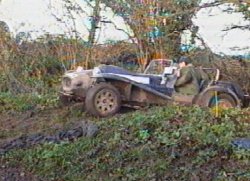
Ian Davis bought along his VW Buggy. Yes, this is the same Ian Davis that was featured in Classical Gas a few months ago. Martin and Henry Allen were sharing a familiar car, the Mike Young built Racecorp, the brother to the Steve Boakes constructed car now owned by Mike Furse. I think Mike must have been instrumental in the next two entries. Keith and Margaret Oakes in their Buckler and Gary and Lucy Booth in their Buckler Mk 6. It was also nice to see Keith Pettit in his Austin A35 with 1275’s of BMC engine under the lid.
Quite a few of the cars were to be double driven, casing a problem if you were not able to see the sections in advance. This was solved by making the cars normal driver run first. The theory being that the “guest” had the handicap of an unfamiliar vehicle. The first section started in the field, twisting through the gate before going up the nearest path through the trees. Simon Robson was the first car, attacking the hill in his usual style, despite a having a very heavy cold. Simon got half way up before slipping back into the trees to the detriment of one of the rear door panels. This caused JP to re-route the section, giving Simon another run. It was still tricky and only eight cars went clean.
Hill two was not too difficult if you could follow the route, which was confusing, despite Mark Chilver’s efforts on point duty. It was nice of Mark to marshal while Sharon passengerd Robin Howard in his familiar Marlin. It was here that Sharon and Mark rolled their Imp while reversing down a hill a few years ago.
The next section gave us a taste of re-starts. Placed in different positions according to the class. By now the dew had gone and there was plenty of grip, although the line had been cunningly positioned and could catch the unwary. Then it was back down the hill to the start of the marathon hill four, twisting its way through the wood at the bottom before going up the gully and descending into the trees for a final assault on one of the steep banks. This was a nice section, not difficult, just fun to drive.
Finally came a special test where Chris Bonnett’s Peugeot expired when some of the front suspension came adrift, causing the drive shaft to pull out. Chris retired but was able to get the car mobile so he could drive it home.
At the end of the first round there were three clean sheets. Ian Davis in the Buggy, Fred Gregory with his Dutton Melos, sporting a new engine since its outing on the Cotswold Clouds and Henry Allen in the Racecorp. There were quite a few clean sheets on the second round, especially as we now knew where to go on hill two.
During lunch JP and Mike Pearson changed the hills ready for a planned three rounds in the afternoon. It was not to be, as no sooner had we started than the rain came down, making conditions so hairy that John had to bring proceedings to a premature halt. The special test times were used to resolve things between the three clean sheets. Overall honours going to Ian Davis. Fred Gregory, Murray MacDonald and Tom Goggin won their classes and Henry Allen came second in the well-supported class seven.
It was a shame about the rain but that’s always a risk, especially at Edlesborough. Lets hope the club perseveres and develops the concept.
We have been publishing stuff about Classic Trials on the Web since 1995 and always appreciate feedback. Comments, Corrections, Criticism & Concerns are all welcome. You can leave a comment to have your say here on this web site or our Social Media
Please help spread the word and share this on your Social Media:
Stuart Cairney flys round the bottom corner so he can get a run at Simms
We had three Falcon crews at the Finlake Holiday complex near Chudleigh on 1st March for the start of this years Torbay. With two runs up Simms on the agenda it had lot’s of promise, and what an event it tuned out to be! Starting with a special test a few yards from the start. This consisted of a short blast along a straight bumpy track, followed by about 200 yards on tarmac, which included a couple of sharp turns. It was here that Murray MacDonald put down his marker, recording fastest overall time. Beating some Escort drivers who were indulging in some exuberant sideways motoring (and were risking exclusion if they went on the grass)! It was an amazing special test, more of a special stage really.
The first observed section was Simms. At this point it was Simms 2 Murray 2 for the Mac’s, but afterwards it was Simms 2 Murray 3. The others weren’t so fortunate. Brain Alexander got a two, while Stuart Cairney took a bad line and ground to a halt below the three marker.
From here it was on to Lower Dean. The lower part of this hill looks a bit like a moonscape with lots of bumps, all out of phase. Then there are some horrendous gullies near the top, after the class 6-8 restart. Brian retired after this hill, which caught a few people out. Baddaford Lane followed, but was not too bad this year, only class 8 had a restart, but nearly half the 16 motorcycles scored a 6 here.
The next hill was scheduled to be Middle Rocombe, which is the hill that the ‘men’ tackle on the Exeter, whilst the girls in their tin tops fail the restart on Slippery Sam!! However, a last minute re-route denied competitors a look at what Fred Gregory calls ‘The hill from hell’ and they went straight to Higher Rocombe (Slippery Sam). In the daylight he restart, which was in the usual place, was starting to look well cut up. No Falcon fails today and Stuart even found the tight right hand slot afterwards! Higher Shells followed, just a mile down the road and was cleaned by most. From here it was back to Finlake for another special test and the lunch halt. Murray was clean and leading the class at this point with Stuart on three.
After lunch came Finlake sections 7, 8 and 9. You drove up the hill a few yards and pulled into a lay by affair. On the marshals’ instructions competitors tackled the first hill, quickly followed by the second and then a third, through heavily rutted clay. It was 6,000 all the way for the Mac’s and JAZ powered it’s way through. Not so for Stuart who was swallowed up by an enormous crater on “three” and had to be towed out, but with aces like Paul Bartlemann stuck as well he didn’t feel to bad! Hero of the Day award must go to the guy who had the job of getting down in the mud to attach the tow rope – he was absolutely covered in it!
There were some ambiguities in the route card now and the next road section saw groups of cars parked at road junctions, having a conference to decide the correct route, with a lengthy detour up the dual carriageway and back for those who got it wrong. Eventually everyone found Northwood, which was no problem with all the Falcons clear. However, section 10, Pitt Farm (Waterless Lane) was a problem for a lot of people. Stuart’s Imp didn’t have enough ground clearance and needed a push to clear the deep muddy ruts. Murray provided excellent entertainment as he went sideways, scuffed the wing and filled the bumper with mud.
Tipley was next and stopped all of class 4. Stopping astride a restart line, rather than in a box, does not allow much room for manoeuvre. When, by what ever means, competitors did finally get clear of the restart there was no time to gain momentum before arriving at the class 6,7 & 8 restart. Murray kept saying “I hate that Tipley” and after a great deal of effort, especially from Hazel, they got away from the line, only to get stuck on the re-start designed for the other classes. A lot of cars wrecked tyres here, Stuart amongst them.
Lenda Lane was the next section. It was supposed to be sub divided 12 – 0, but instead they had put a restart in a deep crater half way up, which defeated all class 3 and all but Nathan Mitchell and Giles Greenslade in class 4. Murray’s class lead going out the window at this point. If you were in an Imp the problems started before the section. Two drainage pipes had been laid across the entrance track with just enough gap in between for an Imp wheel to drop in. Stuart and Jim Scott had to throw their passenger’s out in order to increase the ground clearance!
Then it was back to Simms, now pretty slippery, with two restart lines on the steep bit, one for classes 6&7 and one for class 8. Only Nathan and Murray went clean in class 4, Stuart managing another three. All that remained now was an 8 mile run back to Finlake and the final section, a PCT like climb of a mound. It had a slippery camber on the right. You had to keep as straight as possible, maintain speed and try not to slide across to the right. Murray floored it (I think this is the correct expression) and it worked.
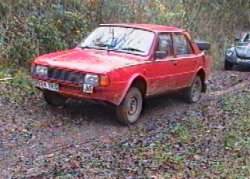
Murray came third in class behind Giles Greenslade and Nathan Mitchell who won the class. Giles got a two on each attempt at Simms and failed the Tipley re-start but managed to clean Lenda Lane. Leaving Murray with12 and those two with 10 each. First position in the class was decided on special test times and it went to Nathan Mitchell in his Skoda.
A challenging trial, tough on the cars but well organised. The overall win went to “Super Dud” who went round clean.
We have been publishing stuff about Classic Trials on the Web since 1995 and always appreciate feedback. Comments, Corrections, Criticism & Concerns are all welcome. You can leave a comment to have your say here on this web site or our Social Media
Please help spread the word and share this on your Social Media:
Six Falcon crews took part in a suburb Cotswold Clouds on 1st February. We won two awards, Murray and Hazel MacDonald won class four after a day long battle with Neil Bray and Marc Lawrence. Overall victory went to Dudley Sterry in his MG J2, pictured here on Nailsworth Ladder.
Stroud and Districts Cotswold Clouds stands alone. It is not part of any championship and there is no triple or anything linking it to other events. It’s to be enjoyed for itself and it’s over subscribed entry stands testimony to its popularity. It has some good sections in a very nice part of the country. But to me it’s the organisation that stands it apart from the rest. It has a very relaxed and informal atmosphere, but it’s very well run. The Stroud boys (and girls) certainly know how to run a trial and the list of officials reads like the top half of the ACTC championship table. It’s not just the main official’s. Nearly every hill had well-known competitors marshalling. No shortage of experience here.
A quartet of Falcon crews gathered at the Stonehouse Little Chef for breakfast before the off. The New Falconers were joined by Clive Booth and John Allsop with Clive’s Dellow Rep. Neil Bray had a puncture on the way down so departed early in order to use the Garages bead breaker so he could fit a new tube.
The approach to Sandfords was frosty and hard. Perhaps the soft ground at the bottom of the section would be easy to traverse. There have been years when even getting to the section was difficult. The first bit was OK, but just before the gate it got really boggy and Michael Leete had difficulty getting through. Fred’s troubles started on the line when the Dutton coughed and stalled. A turn of the key saw Fred and Pete away and they were delighted to hear the marshals had taken sympathy and given them a clear.
Crooked Mustard was on form. None of the Falcons made it out of the top but Neil Bray got to the three to get the furthest. This is definitely one of the stiffest challenges in the trials calendar. Rushmire didn’t present any problems, despite the re-start but Fred’s Melos had fluffed badly and team Falcon descended on it with the spanners at the holding control for Axe. The points had closed up and the timing was way out. This was put right and the Melos went better, but the motor was clearly on the way out, and at times it was hard to know if the smoke came from the oil or the tyres! Axe is a nice long hill, but it’s not too difficult, and all the Falcons made successful climbs, at the cost of a puncture for Neil and Marc.
Martyn Harry and Julia Guilietti won class seven in their 2 litre Pinto engined Imp.Falcons Clive Booth and John Allsop in their Dellow Rep on Nailsworth Ladder.
Nailsworth Ladder was next on the agenda. Six, sevens and eight’s had a restart just before the step. This made things very tricky. Fred and Pete couldn’t get the Melos away from the re-start. Michael struggled in the Beetle but Mike stepped up the bouncing and got the wheels to grip. They got over the step but didn’t have enough speed and spun to a stop just after. Clive and John struggled to get away but once they started to move they rocketed up. Our class fours didn’t have this hindrance and were able to blast straight through in front of a spectating Stuart and Andrew Cairney. They reckoned Murray hit it the step hardest, the 1302’s suspension soaking up the blow and gliding serenely over. However, Neil was the most spectacular, getting the Skoda’s rear wheels right up in the air.
Neil Bray and Marc Lawrence storming the bank on Mackhouse 1
Mackhouse two was a shock. It started as a straight muddy track with very little gradient. You had to be careful though and it caught out Simon Robson who didn’t have enough speed and got bogged down. The muddy bit went on for some time then opened out as the section followed the edge of a field before diving into a rocky gully which Fred reckoned was filled with Dinosaur eggs! After a short while the section turned right out of the gully over a rocky steep lip. It was a question of how brave you were on the last bit. It needed plenty of power. Michael didn’t give it enough welly and needed a pull from a Land Rover to get out of the section into the field above. There he saw Neil Bray changing his third wheel of the day. The drama wasn’t over as the exit road was just as exciting as the section!
The lunch-time break was taken at the Stroud Tesco’s as usual. The club must have some influence to let us trapse into the coffee shop in our muddy boots! There was no rest for Neil, he had to flats on the back while the rest of us ate our lunch he was of in search of a tyre depot.
Fred on his Folly!
After the first special test came Fred’s Folly. A nice blast up through the trees. I wonder how the hill got it’s name? Was it because our Fred had some of his rear glass pop out when competing in his first Cloud’s in a FWD Renault? Merves Swerve was it’s usual slippery self, with differential start lines and re-starts to handicap the higher classes. And we had to perform in front of a spectating Mike Furse and Ken Green. Neil was the only Falcon to get out of the top with Murray and Simon stopping just short of the one.
The Highwood sections were up to standard. Although they are right next to each other in the same complex they have a completely different character. The main feature of “One” is a fearsomely steep slope, dead straight, and slippery today now the ground had thawed out. “Two” doesn’t have much gradient but is muddy without a lot of bottom, so it needs a good blast. Murray, Simon and Neil were allowed a clear run at “one” but the slippery gradient defeated them all. Michael, Fred and Clive had a re-start just before the steep bit so couldn’t take a run at it. They all failed on the lower reaches so were spared the fearsome reverse back down and the omni present threat of the plunge to oblivion!
Simon Robson exiting Climperwell.
“Two” consisted of a blast through the tree to a muddy chicane with a re-start immediately afterwards. This wasn’t too difficult if you could get that far,which Michael couldn’t. Clive got to the restart but couldn’t get away and the others cleared the section OK. Climperwell is a muddy meander through the trees up a gently rising muddy track with ruts so deep you needn’t worry about steering as they act as railway lines. The excitement is provided by a restart with two huge holes for your wheels to fall into!
Fred Gregory has shares in both Castrol Oil and Colway Tyres!
Bull Banks one and two provided the finale. They are both about restarts on polished pebbles. As one of the Stroud boys said “don’t lift off!” Murray, Neil and Simon cleaned them both, Michael and Clive failed both and Fred failed one. The challenge was definitely the first section as we had to perform in front of Stuart and Andrew! That was the last of sections. It just remained to drive a few miles back to the finish at the Ragged Cot Inn at Hyde to sign off. Another great “Clouds”.
We have been publishing stuff about Classic Trials on the Web since 1995 and always appreciate feedback. Comments, Corrections, Criticism & Concerns are all welcome. You can leave a comment to have your say here on this web site or our Social Media
Please help spread the word and share this on your Social Media:
We had another great Falcon turnout on the Exeter. It was an ultra-competitive event though. A combination of conditions, tough re-starts, alternative routes for the higher classes and perhaps a little hill doctoring, all combined to rob Falcons of Golds. This piece is being written before the results come out but it looks as if Neil Bray and Murray MacDonald achieved the best results with Silvers.
Clive Booth and John Allsop waiting to tackle Normans Hump in Clives’s Dellow Rep. Clive has joined Falcon for 98.Fred Gregory and Pete Stafford cleaning Clinton in their Dutton Meloseam Falcon rally to fix Fred’s carAfter Fingle came Wooston Steep. Classes’ one to four weren’t to bad, they could go up the easy bit. But Wooston was a real stopper for the yellows and reds. They had to go straight up the steep track that makes the North face of the Eiger look like a flat road. To make it even harder for the red’s they had a re-start as well. Fred, Michael and Alan all ran out of power and grip above the class eight re-start. This was on some horrible tree roots and defeated all our boys. This Exeter was certainly proving to be a tough one.Matt Clarke and David Thompson marshalling on the Upper slopes of ClintonNeil Bray and Martin Sheppard cleaning Clinton in their Skoda.
It had been raining hard in the week preceding the event and the news told of storms, floods and high winds in the West Country, to worry Exeter competitors and perhaps the marshals as well! We needn’t have worried. By Thursday it had become calmer and milder and by the weekend it was quite warm. However all the water had made the sections pretty competitive, this Exeter was to be no picnic! There were no Falcon’s starting from Bude, so it was Peter Mountain that led us away from the Cirencester start. Peter had entered his Dellow but business pressure prevented it being finished in time so his faithful maroon Skoda was drafted into service again. There was little time to do much to the car so Peter and James just checked the oil and adjusted the brakes. It was this that was to cause problems later!. Normally Peter runs the car back and forth to work for a few days before an event, just to make sure everything is working OK. He didn’t do it this time and it was only on the run out to Cirencester that he noticed the back brakes were binding. Now on a Skoda you have to remove the hubs to adjust the brakes, this needs a special puller and this was at home. Peter continued, but with the brakes rubbing badly was severely down on power.
Tom Goggin had Veronica Caspari in his Escort as usual. Tom had re-shelled his car before Christmas. The new one is very smart indeed, one of the tidiest Escorts I have seen for a long time. Colin Stevens came next, with Kevin Roberts reading the route card. Dave Nash had attended to his engine mountings and was hoping the Skeetle would stay in gear on the tough Exeter hills. Alan Bellamy had entered his ex Andy Clarke Brasilia but the car wasn’t ready so Alan used his faithful Fastback instead.
John Parsons and Mike Pearson ran together and to the best of my knowledge there was nothing different in the mechanical department, although presumably John had attended to his clunking diff since the Allen. Further down the field we should have seen Mike and Shiela Furse in their Racecorp LA. However, the Furse family were striken with flu and decided to spectate and help out rather than compete. A few cars later came a famous name from the past, although not currently a Falcon member. Adrian Tucker-Peake was driving his newly prepared Peugot. In Tucker-Peake tradition the car was four up as Adrian and Liz had bought the kids along.
There was nothing new with the Skoda’s of Neil Bray and Simon Robson, Michael Leete’s VW or Fred Gregory’s Dutton Melos. They were followed by a Dutton Sierra driven by the daughter of Motor Sports Bill Boddy. Then came Falcons only class one entry, Chris Bonnett in his Peugot Diesel. There was no David Alderson as he was busy finalising the preparations of his Beetle for the historic Monte Carlo Rally. Stuart and Andrew Cairney started from Popham in their familiar Imp, and so did Murray and Hazel MacDonald, embarking on their quest for a second consecutive triple in JAZ. The red lantern of the Falcon train was Reg Taylor and Bill Rule in Reg’s RDT special, running number 313, last car on the road.
The weather was kind on the run down to eligibility scruitineering at Chard. Pretty unexciting stuff, perhaps that’s why so many of us had problems staying awake! Then it was breakfast at Cricket St Thomas, the dinning room resplendent with it’s Christmas decorations. Now, assuming they were not really early for 1998 they were a bad omen because they should have been down by twelfth night which is the sixth of January. Unfortunately the normally excellent Cricket St Thomas breakfast was spoilt by some very stringy bacon!
It was dark for most of us when we got to Gatcombe Lane, a nice easy starter hill. I know some people think these sort of sections are a waste of time. Not me, I don’t want to fail the first hill. Then it was little more than a mile of tarmac before crossing the A 3052 at Hangmans Stone to go down into the Forest containing Normans Hump and Clinton to join the queue! The early Falcon runners waited an hour, those running later were in the line for over an hour and a half and by then it stretched out of the forest and onto the road. Normans Hump was the problem. Some say it had been doctored, others that logging operations had dragged a lot of mud onto the track. Either way it was tricky. The lower part of the section wasn’t too bad, although it is getting rougher every year. The big problem came on the steep part, after the cross track, where the class eight’s do their restart. This was very muddy and needed grip. power and momentum to get through.
It was just getting light as Peter Mountain came to the line. The section was being marshalled by some of the Cambridge boys and he was greeted at the start line by Falcon member Geoff Jackson. Peter managed to get reasonable speed as he crossed the track but with a binding brake it was not enough and he bogged down in the muddy section. Our other two Skoda’s got out of the top OK but not without drama. Neil Bray punctured and had to change a wheel and Simon could hear the first signs of diff problems, but carried on regardless. Stuart and Andrew Cairney didn’t have any car difficulties but his 915 cc’s wouldn’t pull the Imp through the clag. Classes’ six and seven had to restart on the cross track. This slowed down their charge into the mud but it didn’t prevent Alan Bellamy and Fred Gregory getting to the top. Michael Leete wasn’t so lucky, or perhaps I should say skilful, and lost grip in the muddy bit. The class eight’s had to re-start right in the middle of the muddy bit and none of the Falcons could get away. JP got to the top and found his cooling fan wasn’t working. He stopped at the bottom of Clinton to hot-wire it so he could continue.
Everyone was anxious to do well on Clinton under the eyes of their clubmate’s. With a level restart on the cross-track, instead of on the gradient it wasn’t so difficult as last year, provided you could get round the difficult corner at the bottom. There’s a sharp ninety right just after the start and you can’t see the steep gradient that comes immediately afterwards. Most of us made it OK but with front wheel drive it defeated Chris Bonnett in his Peugeot. This was certainly going to be tough trial for front wheel drives. Simon Robson provided the drama for the Falcon marshals. He got the Skoda around the corner and up to the restart. Simon let the clutch out and Arnold and Andy were greeted to a tinkling sound as the diff finally cried enough a few feet further on. Simon and Matt managed to limp out of the woods but the car wasn’t going to go much further. They weren’t the only ones. By the time Murray and Hazel arrived there were eight disabled cars waiting for recovery.
After all the carnage in the woods Waterloo and Stretes were relatively uneventful for most. Falcon interest was maintained with John York marshalling with the Woolbridge club at the top of Stretes. Then we had a long run north to the special test at Greenslinch Barton. Many competitors had problems finding the route. There had been an amendment at Cricket St Thomas but the route card still didn’t bear much resemblance to the road and there were cars going in every direction. Fortunately the route marking was correct otherwise there could have been major problems. The special test itself was a downhill blind through Grenslinches’s huge puddle (it’s more like a lake). This was great if you had a waterproof car, like a Beetle, but was a bit daunting if your electric’s were vulnerable.
Exeter services saw a lot of mechanical work. John Parsons managed to buy an override switch for his fan and fitted that. Tom and Dave both had petrol pump problems but they couldn’t do anything to fix them. Neil and Martin were planning to change the tube in their punctured tyre but were held up on the road when their petrol pump stopped working but a swift hammer blow soon fixed things. With no bead breaker and no Dave Nash Neil resorted to Michael Leete’s bit of fence post bolted to the brake drum of the Beetle. Don’t laugh, it worked!
Windout was a tarmac hill, a feature of recent Exeter’s. Marshalled by Mrs Troll (Anne Templeton) it had a liberal coating of mud to catch you if you were too complacent. Tillerton is getting rough again, with a tricky re-start on some huge rock steps for the six, seven and eight’s. This caught out Fred and Michael. The steps were probably a real shock to Chris in his relatively low slung Peugeot. He didn’t get up this one but was clearing quite a few of the hills in only his second classic trial. Fred Gregory’s Dutton Melos had started to fluff at any sort of rev’s and he, Pete Stafford and Neil stripped the carb and petrol pump at the foot of Fingle. It went better but only if Fred gave it a bit of choke. Fred continued to fiddle, finally finding the problem was the coil. It was a 9 volt unit and the Dutton was feeding it with 12 volts. When it got hot the motor missed at high revs. Fred had a spare and carried on by swapping between the two.
It was to get worse at Simms. Simon and Matt Robson had left their Skoda at Seaton and had got a lift to Simms where they met up with a spectating, flu ridden, Mike and Sheila Furse. They saw some of the early cars get up, including Dennis (our hero) Greenslade in his Reliant and Philip Mitchell in his Skoda. There was quite a lot of mud on the hill. It got harder as the day went on and by the time Peter Mountain arrived very few people were cleaning the section. Peter’s brakes were easing off but he couldn’t get the Skoda up for the second year in succession. Last year the car jumped out of gear but before that he had always cleaned Simms.
Peter was in good company as all the other Falcon’s failed, including Murray and Hazel who said goodbye to their triple. They certainly gave it a good try, giving it everything, but to no avail, although they got a good cheer from the spectators for their efforts. John Parsons was another to give the spectators good value. The smoke still lingering several cars later! The final hill was a sting in the tail for some. The route divided. One to six tackling Slippery Sam while seven and eight went to Higher Gabwell.
Chris Bonnett enjoyed Slippery Sam, cleaning the rough section to get a finish in his Peugeot. Things didn’t go very well for Stuart and Andrew. First they failed the re-start, then they missed the obscure right turn at the top and failed to find the Gabwell passage control. Neither Mike nor John faired very well on Higher Gabwell. They had a re-start and this was situated on a huge hole that defeated them. So it was on to Torquay to the finish at the Oswalds and Trecarn Hotels. A lot of members were staying there and we had a dozen or more Falcons around the dinner table to chew over the day’s events. Some people believe that some of the MCC events have been too easy recently and the MCC have been concerned about the financial burden of awarding so many triples. It doesn’t look to have a problem this year!
We have been publishing stuff about Classic Trials on the Web since 1995 and always appreciate feedback. Comments, Corrections, Criticism & Concerns are all welcome. You can leave a comment to have your say here on this web site or our Social Media
Please help spread the word and share this on your Social Media:
John Parsons and Keith Harris emerge from the sump on Nanny Hurns. They finished third in class eight.Neil Bray waiting for the off with Graham Bazier behindGuys Hill stretches in front of Simon and Matt Robson in their Skoda
We had super trialing conditions for the Allen. It had rained quite a bit in the week preceding the trial, so the ground was nice and muddy. However, it was dry on the day and the sun even came out for a while, so Arnold Lane was spared the soaking he received on last years wet event.
Arnold was alongside Mike Pearson in the Dellow Rep that was trailered down the M4 to the start, just off Junction 17. Mindful of the fearsome ruts on Burledge Mike was trying some different tyres with a higher profile in an attempt to generate precious ground clearance. John Parsons was our other class eight competitor in the familiar Westfield, with Keith Harris in charge of the bouncing department.
There were a whole gaggle of Falcons running line astern earlier in the field, headed by Triple winner, and Crackington cup contender, Murray MacDonald. The now familiar Red Beetle is not short of ground clearance, even though Murray has lowered and ballasted the front a little after some scary moments when the car threatened to turn base over apex when reversing down some of the horror hills on the Kyrle and Exmoor Clouds.
Both Falcon Skodas were running well after their successful Edinburgh. I don’t believe they had any mechanical changes but Simon seemed a bit reticent to talk about his carburettor so you never know. Matt had returned from his American trip and was alongside Simon while Martin Sheppard was bouncing for Neil. Team Falcon was completed by Fred Gregory/Pete Stafford (Dutton Melos) and Michael Leete/Mike Hayward (VW 1302 S).
The sections started with Tog Hill, presenting no problems since the fearsome bump was levelled a few years ago. That was more than can be said for Bitton Lane. The hill would be easy enough if it wasn’t for the re-start. A tricky affair, positioned on a corner with a noticeable increase in gradient. The surface is really tricky, consisting of compacted pebbles that become more and more polished with the passage of cars. It’s quite muddy just before the re-start line and it’s quite difficult to position your car. You tend to lose all traction when slowing as you approach the line. Then you are so busy trying to get to the line itself that you don’t have a chance to position the car. That’s what happened to most of us. J.P. got away OK and Fred took time to find some traction and thought he may have slipped back in the process, but the marshals couldn’t see through the smoke enough to notice! Neil came up to the line pretty fast, looked at the polished stones and decided the mud on the right was a better bet. The only problem was that’s where the marshals were standing. Fortunately they moved in time, Neil’s wheel’s bit into the rock underneath the mud and the Skoda pulled away easily.
Big Uplands was next on the agenda. This has been used on the Allen for many years. Most hills get rougher over the years but Big Uplands is an exception. The deep rut on the right of the lower slopes is nothing like as fearsome as it was a few years ago. It’s quite a straightforward hill for the girls in classes’ one to five, but us men have to re-start just before the 90 left. After this there’s a rough bit before the hill exits on the main road.. JP got away OK and so did Michael Leete, the first time in the five times he has competed in this event. Poor Mike Pearson was not so lucky when the Dellow Rep slipped back as he let the clutch out.
Guys Hill came next. This is the one that Mike Pearson was telling us about in his article about the legal status of trials hills in the November magazine. The girls didn’t have to re-start so they all cleaned it OK. Things were different in the mens classes. They had an extremely difficult re-start on the polished stones between the tree roots and all the Falcons in six, seven and eight failed to get away. This was the norm, most six, sevens and eight’s couldn’t restart and only a select few achieved a clean. In class six Graham Brasier went clear in his 130 hp VW based Bitza and so did Nigel Allen in his Beetle. (By the way I think Graham Brasier is a nice, friendly guy. I just don’t think his car should be in class six. I have heard through the grapevine he is now selling this machine and migrating to class four). All but one class seven failed. The exception being Julian Dommett in his 1172 cc, sidevalve engined Dellow Mk1. Is that man a good driver or what. In class eight it was only Antony Young who went clear in his buggy. All the Cannons, Trolls and GVS’s either failing to re-start or grinding to an immediate halt. The Mill Lane special test was nothing special but the approach lane was decidedly interesting with some very deep ruts cut out by either tractors or four wheel drives. They were OK in a properly prepared trials car but pity the poor beginner driving a standard car in his first event.
Elwell was the final offering before lunch. Everyone remembers last year when it was very wet and muddy and it was so difficult to get across the field at the end. The surprise was at the bottom this year. The farmer had built a concrete hump just before the water splash. It’s hard to know why, maybe it’s a culvert or something. Anyway it was a challenge for anyone without plenty of ground clearance. The Falcons had become split up by now. Murray and Neil were together, Simon was a few cars back, followed some way behind by Michael and Fred who had stopped for petrol. There was quite a queue when they arrived, waiting for Philip Roberts and his dead Escort to be towed out. The halfshaft had moved on the bearing and they had lost drive. Later on Mike Hayward saw Philip and told him about the autocross trick of putting a blob of weld just behind the bearing. Murray and Neil got away OK but there was another delay when Simon got his Skoda stuck firmly on the hump and had to be towed off. The marshal at the foot of the hill had warned Simon about the severity of the hump. He tried to ease the Czech wonder climber over slowly, fearful of damaging the petrol tank. Unfortunately it bottomed out with all four wheels in the air Next time Simon go faster and fly over it like the rest of us!
Then it was off to Chew Valley lake for a rest halt beside the reservoir. Unfortunately the cafe was closed this year so it was sandwiches from home rather than Cumberland sausages. Strode was next, approached up a watery lane. The hill is all about a re-start that I thought was easy, but caught Fred Gregory unawares, the other Falcons going clear. Travers was pretty straightforward for the girls and they all went clear. Some of the men had problems on the usual tree rooty re-start, supervised by Jim Travers himself, and both Mike Pearson and Michael Leete failed. They got off the line OK but couldn’t build enough speed and spun to a halt on the roots a few yards further on.
Up until now Mike had not been having a good day but that was to change on Burledge. This is one of the Allens guaranteed “stoppers”. It starts on a rocky track, with a huge bump a few yards from the line where a water pipe has been culveted. After a 45 degree right hand bend the horror of Burledge comes into view, a dead straight rutted track about a hundred yards long. And when I say ruts I mean r-u-t-s. They really are deep and it takes a combination of ground clearance and momentum to get you through.
Mike had searched around at home to find some really high profile KUMO rubberware which he pumped up really hard. He eased the Dellow over the culvert and around the corner to the class eight re-start. Pulling away Mike applied the power just right and with Arnold’s assistance found the grip to cruise out the top. JP had a re-start as well but frankly stood no chance in the low slung Westfield and failed at the two.
Fred and Michael joined the girls on this section and were allowed a straight climb. Michael was pleased with his two but Fred had started to experience problems a few hills earlier and had to drop back from the start line to tinker with the electric’s. (This took a bit of time because although he is a really nice guy Fred is to automobile electric’s what the late Cyril Smith is to hang-gliding). Once Pete Stafford and Fred got going they did quite well, but with the Dutton on comparatively small wheels they ran out of ground clearance at the three. Our two giraffes in class four did well. Neil got a one and Murray stormed out of the top wondering what all the fuss was about, but the low slung Robson Skoda stopped at four.
Murray’s triumph was short lived as he failed to get out of the sump on the infamous Nanny Hurns special test. It was pretty greasy this year and if you applied the power too soon you understeered into the tress. Neil Bray and Michael Leete experienced the same fate but Fred, Mike and JP all popped out without any problems. Simon did very well to come out with the Skoda. Competitors are allowed to inspect Nanny Hurns before making their runs and Simon had seen a few abortive attempts. So it was right down on pressures at the back and the front wheel that would be on the outside round the tricky corner. Then gently, but not to slow, into the sump. Get the front wheels onto the slope and half straightened, then apply the power. It worked!
Mill Lane, Little Uplands and John Walker concluded the trial. None of them were very difficult but boy were they good fun. Long, wet and rough enough without being car breakers. The Allen certainly boasts some enjoyable hills, there isn’t a make-weight amongst them. So it was back to the finish to conclude an enjoyable day and compare notes.
Murray and Michael had trouble free runs in their Beetles and so did Neil. Simon had the misfortune to damage a front wing when he had a collision with a car in a passing place on a single track road. Fred had to keep fiddling with his electric’s to keep the Dutton going. Mike Pearson had a puncture on the road section before John Walker. Finally JP’s Westfield started to make clunking noises from the diff after the Elwell Hump. John carried on but thinks he may have chipped a tooth on the crown wheel. Results wise John was our only award winner, coming third in a well-supported class eight. But I think I can speak for everybody in saying what a great day we all had. Roll on the next Allen Trial.
We have been publishing stuff about Classic Trials on the Web since 1995 and always appreciate feedback. Comments, Corrections, Criticism & Concerns are all welcome. You can leave a comment to have your say here on this web site or our Social Media
Please help spread the word and share this on your Social Media:
I gave the Exmoor Clouds a miss this year in favour of Falcons Brickhill Trial. However, Falcon were represented by Murray MacDonald – This is how he got on……………..
We managed to win our class despite errors on Luccott and Druids. But for these we believe our score could have been two, or even less. Owen (Briggs) was a non-starter as he had the flu. David Alderson didn’t have such a good day this year and was particularly unlucky to be docked two on Port Lane.
Incidentally, now we’ve reached the top, having failed on the lower reaches last year, we can see Port Lane is a Mega Hill. It has the lot! It’s steep, rough, loose in places, has gullies cambers, and rock steps. Not many saloons reached the top. Even Paul Bartleman dropped his only score on this one (2). We of course were the only class four to the top!
Glenthorne , the hill by the sea, was cancelled again this year. After a very long wait, during which the entire field had arrived, it was called-off for all except seven and eight. This meant an about turn, so we ended up one of the first cars on the road, just the same as last year. But we still didn’t finish ‘till 6.45 pm. My guess is that the late runners probably finished around 9pm.. The last pair of hills was cancelled due to the event running late. The Minehead club and it’s officials certainly have a laid-back approach! With all the stories regarding the drop from the section I’m glad we didn’t have to attempt it.
When we arrived at Vinegar hill, where we had our incident last year, we were greeted like old friends. Yes, it was the same crew of official’s who immediately recognised us. The start line marshal (who was not present last year) said he had been told all about our problem. It’s strange how things change year to year. The hill was nothing like we remembered it, and we powered our way up.
Luccott caught us unawares. The hill started on the level, went up a gradual incline to a tight ninety left, halfway round which appeared to be an almost vertical rock slab. I failed to go wide enough to get round the corner. Most class four’s made it. Oh! I forgot the punctures. We had one on the motorway on the way, which left us with one spare. So we had to proceed with considerable caution. We had another puncture on Steep Lane, so now I had no spares. Then we had another one on Ewarts Pickle. Luckily Adrian Marfell was kind enough to lend us his last spare, having had two punctures himself, to get home on. Paul Bartleman had three punctures on the first four hills and a total of four by the end. Dennis Greenslade (our hero) told me he has only retired from two classics when driving Beetles. Once when he bent a strut on his 1302 and once when he had three punctures on the Exmoor Clouds! Since then he ha generally carried three spares.
We also won a special award on Ewarts Pickle (Slade Lane). A hill difficult to describe. It has ruts, cambers, is steep and has PCT content. Quite an achievement to clean it. Because of my second puncture I darn’t go too low on pressures from Steep Lane on. Druids was a very greasy grass track (I know now but didn’t at the time). In my opinion the Beetle needed 8 psi. Perhaps next year! There was the normal enormous green lane mileage, a feature of this event. It really was a great adventure again, can’t wait till next year. But Hazel and I think we would stay down for the Saturday and Sunday night (we didn’t get home ‘till midnight).
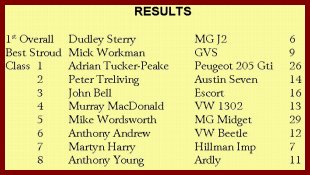
Best Overall – Mick Workman (Golden Valley Special) 0
Class 1 – David Hazelden (Golf) 34
Class 2 – The WW’s 31
Class 3 – Paul Bartleman (Escort) 2 (This man is amazing)
We have been publishing stuff about Classic Trials on the Web since 1995 and always appreciate feedback. Comments, Corrections, Criticism & Concerns are all welcome. You can leave a comment to have your say here on this web site or our Social Media
Please help spread the word and share this on your Social Media:
From a Falcon Perspective. Murray MacDonald won his triple on a dry Edinburgh Trial. Falcon was present in strength. Tom Goggin was assistant clerk of the course. We ran one of the sections and seventeen crews were competing. This must have made Falcon the most represented local club.
Triple winner Murray MacDonaldMurray and Hazel MacDonald storming Bamford Clough en-route to their triple
This year’s event was run to a familiar pattern. There were two starts, at Upton-on-Severn and Toddington, a ninety mile night run to breakfast near Derby and some familiar competitive sections before the Buxton finish. All the Falcons started from Toddington and we were led away at 03.09 by Mike and Sheila Furse in the Racecorp.
Scrutineering didn’t begin until about half an hour before the first car was due to start. There were no problems for the Falcons, even Neil Brays Skoda getting Alan Fosters nod of approval, without any discussion. Neil has rebuilt his engine during the summer and it now sports a rather magnificent Dellorto twin choke.
Simon Robson had Martin Sheppard in the passengers seat as Matt was away on holiday. Simon had replaced the rear suspension arms on the hard working Skoda since the last Autotest. He still plans to increase the ground clearance with some demon tweaks copied from Philip Mitchell, but ran out of time. Michael Leete had fitted a new transmission with a low diff over the summer. However, there was more interest in his passenger than the car, Natalie Rowland taking over the hot seat at the last minute when Simon Elves cried off again.
Geoff and Christine Jackson were giving their new Sprint special it’s first run on a Classic.
The other Falcon VW’s had something new in the transmission department as well. Alan Bellamy and Murray MacDonald also had low diffs with an 4.87 to 1 final drive ratio. All three had also fitted four planet “super diffs and/or a heavy duty side plate. This prevents flexing and keeps the crown-wheel and pinion properly in mesh.
Dave Nash was trialling the Skeetle for the first time. It was running in class eight. This seems a shame as in my opinion it could run in class seven as a Beetle with a modified body. No such quandary for Geoff Jackson’s Sprint, entered in class eight for its trials debut. Geoff was running in company with Reg Taylor in his RDT special. They looked very smart running together. Further down the field Mike Pearson and Clive Booth had their Geoff and Reg constructed Dellow Replicas. Clive’s now reconstructed after last years coming together with a Porsche on the Welwyn by-pass. Mike Pearson had Andrea Lane reading the route card in her classic debut.
Chris Bonnett was driving his Peugeot diesel in class one, despite the doubts I expressed in last months Classical Gas! However, he had cured the sagging rear suspension by fitting new torsion bars since the last autotest. John Parsons was another member who had been working on his car over the summer. Regular readers will remember that a suspension mounting pulled out of the chassis at the Stanbridge autotest. John had repaired and strengthened this and had clearly done something else as well as the car is riding a lot higher now.
Mike and Sheila Furse racecorping their way up Litton. Unfortunately they were one of the old hills victims this year.
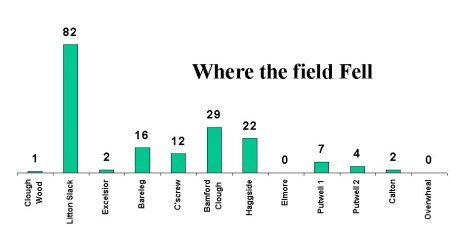
Clough Wood was the first section. It was bone dry and presented no problems at all, was the whole trial going to be like this? Through Bakewell we went, turning off the A6 at Ashford for the run up to the Monsail Head Hotel, with its magnificent view of Putwell over the valley. Shortly we turned left, onto the track down to Litton Slack and a big queue, maybe it wasn’t going to so easy after all!
Mike Furse was the first Falcon to go, just as a fine drizzle started. He struggled for grip on the start line, but with some determined bouncing from Sheila they got the tyres to bite and built up speed. Past the A boards they went, then as the hill got steeper they started to lose grip, loosing momentum and coming to a halt before the corner.
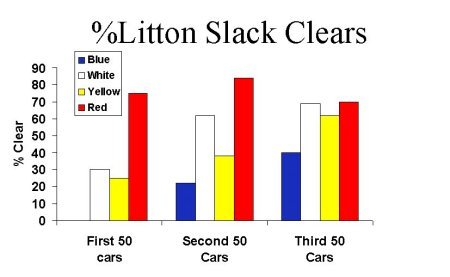
The tactics were now clear. You needed plenty of power to get away from the line and never mind the wheelspin. Then you had to ease off, kill the wheel-spin and build maximum speed on the lower reaches to have sufficient momentum for where the gradient increased before the corner. The problem came just after the A boards where there was a little jink around a tree. This could throw you out of the ruts with disastrous consequences. However, lift off to much and you would lose your speed and certainly fail.
John Parsons had all this in mind when he dropped the clutch and used all the Westfield’s power to storm the hill. As Litton is a public road it’s a good job the constabulary weren’t out with their radar gun! Mike Pearson didn’t have any problems, neither did Neil Bray once he got to the start line. However, in the queue he saw one of the rear tyres had punctured so a quick change was necessary before he attempted the hill. Fred Gregory was next. He let the clutch out gently. The Dutton’s wheels started to spin but the car didn’t move. Fred gave it more welly and smoke started to pour off the tyres but the Dutton stayed put. Pete Stafford bounced frantically and away she crawled, slowly but surely building speed. By the A boards they were going like a rocket and Fred and Pete stormed easily out of the top.
A normally standing Pete Stafford helps Fred Gregory burn his Dutton Melos off the line on Litton.
Simon Robson and Martin Sheppard recorded a clean but Michael Leete ran out of steam before the summit and so did Geoff Jackson. Peter Mountain and Eric Prichard got away OK in their Skoda (which is for sale). By the A boards the motor was really on the cam and they flew out of the top, as did Stuart Cairney and Reg Taylor. By now it had started to rain and triple contender Murray MacDonald was cursing his luck, having purposely asked for a late number in the hope that the morning dew would have gone from Litton by the time he arrived. There was a very long queue and Murray and Hazel had plenty of time to admire the new fence between the approach road and drop to oblivion! It’s certainly comforting as you ease your way down the slippery slope. Having watched several other attempts Murray decided that just driving off the line wouldn’t work. So he dumped the clutch with five thousand on the clock and up he went.
Allan Bellamy, Colin Stevens and Owen Briggs all made it OK. I would have loved to have seen Owen’s type 4 engined Fugative storm the hill. Better still I would like to have had a go in it myself! Dave Nash was not so lucky. He got away OK but half way up there was a loud bang as he went over a bump and the Skeetle ground to a halt. Dave thought he had broken the diff, but quickly remembered the Skeetle was a Beetle not a Skoda, groped around and found it had jumped out of gear.
Michael Leete and Natalie Rowland on Excelsior
Then came a long road section, south down the A515, past the Moneystones section, to Excelsior. This was a real problem in the wet a few years ago but didn’t present any difficulty to Falcons in the dry, although Morgan expert Rob Wells, who was running with Peter Mountain, lost the sumpguard on his class three Volvo. After Excelsior the route climbed upwards towards the A53. You could see the top of the hills were actually in the clouds and that’s where classes 1 to 6 found Bareleg and Alan Davies. Further up the section Mike Hayward and Arnold Lane were running the re-start and they were all getting a little chilly after some five hours in the mist. At times it was so bad that Alan on the start lost site of the re-start and had to rely on his ears to know when to let competitors away.
Bareleg was not too difficult, but Corkscrew was more of a challenge for classes seven and eight. Clerk of the Course Lawrie Knight had positioned the re-start on a camber just before one of the hairpins. All the Falcons got to the top of the hill and enjoyed the experience even though they thought it very rough. Owen Briggs found the Fugative a real handful around the hairpins and Mike Furse was judged to have run back on the re-start.
Simon Robson pulls away from the re-start on Bareleg under the eagle eye of Arnold Lane and Mike Hayward.
The sun came out as soon as the route left Bareleg and it was another very long road section, via a special test at Old Long Hill, to the Marquis of Granby holding control. Most competitors were at least an hour and a half early here but the usual two hour wait soon got them back on schedule! Neil Bray found another puncture and didn’t have any spares left but decided to carry on. The Marquis was quite chaotic this year and there was a lot of pushing and shoving by determined queue jumpers. It would be nice to see some extra organisation here next year. However, all this was soon forgotten when Gerry Woolcott released the field in small groups for their attempt on Bamford.
Thankfully the startline wasn’t too difficult this year. Simon Woodall informed Murray that the Marquis delay was because each competitor was taking a minute and a quarter on the hill, plus time to clear the failures. The section was quite rough this year, especially in front of some of the concrete patches. But there was plenty of grip and most Falcons made it OK. Dave Nash was one of the unlucky ones, when the Skeetle jumped out of gear again. Alan Bellamy was enjoying his low ratio diff and made the climb on half throttle. Michael Leete enjoyed a similar experience, but had to stop before the top when he came across Brian Alexander stationary on the section, stuck behind an MG with a broken diff. Ken Green crediting both with a clean rather than a balk. Murray MacDonald was confident his Beetle would trickle up as well but with a triple at stake wasn’t taking any chances so gave it a good blast.
All the Skoda’s made the top OK but Peter Mountain was taking things gently, having twice broken his transmission on Bamford, once on his Morgan and once on the Skoda. Like everyone else he didn’t let the tyres down much but the motor came off the cam, when he slowed for one of the bumps, and he had to slip the clutch for the rest of the climb. Geoff Jackson’s Sprint had been going well up to now but he hit one of the bumps a bit to hard and the fan hit the radiator, piercing it and breaking two of the fans’ blades. He tried to get it going but even two cans of Radweld couldn’t fix it and he had to retire.
Neil Bray had electrical problems on Haggside but went on to gold.
Then it was off to Haggside. Michael Leete was telling Natalie Rowland how the real trial was over now and that Haggside was just a blast and a piece of fun, when he remembered how David Alderson had lost his triple on the restart last year. So, it was down to 12 psi. Michael took the Beetle deep into the box and pulled gently away. It didn’t move. He floored the throttle and they bounced furiously. The car filled with the acrid stench of rubber smoke but stayed firmly in place. Backing down a few feet, with the front wheels still in the box, it pulled away easily. Such is experience! Along came Colin Stevens and did exactly the same thing. So did Alan Bellamy, who was told by marshal Ian Bates that everyone who put their back wheels in the box failed!
The other Falcons were all front wheels only men and got away OK. Including Dave Nash, although the Skeetle was becoming increasingly reluctant to pull from low revs. Neil Bray was pulling away from the restart when the rev counter stopped working, a few yards later the Skoda started to cough and the crew realised the petrol pump wasn’t working properly. Neil pumped away at the throttle and miraculously the accelerator pump drew enough fuel into the carb for the Skoda to stagger over the finish line. All captured on the forthcoming Classical Gas video. The problem lay in the fuse box and from then on it ate over a dozen fuses on the way to the finish.
Peter Mountain re-starting on Putwell. The car went well on the trial but broke down on the way home!
That was it really. We still had Elmore, the two Putwell’s, Calton and Over Wheal but none of these presented any problems. Rowlands was cancelled because of some problems with a land owner but this would have been simple in the dry. Owen Briggs had difficulties with the hairpin on the Deep Rake special test in the long wheelbase Fugative and had to stop and reverse, which sadly cost him his gold.
Now it was back to Buxton for the finish and to congratulate Murray on his triple. There was quite a party atmosphere in the evening, many of the Falcons meeting up for an informal club dinner. Sadly this didn’t include Colin as his passenger discovered his house had been burgled so they drove straight home, as did John and Dot Parsons who were attending a dinner in Milton Keynes. Things were not simple for Peter Mountain either as his coil packed up when he drove home the next day.
So ended another super Edinburgh. It would have been better if there had been a bit more mud, but trialling in Derbyshire is fantastic whatever the weather. I’m waiting for the results to come through before listing all the Falcon medals, but lets congratulate Murray and Hazel MacDonald on a certain Triple.
Colin Stevens tweaks the handbrake and manages to stop the wheels spinning enough to get over the kerb at the top of Litton. It was Haggside that stopped him getting a gold. (pic by Tom Goggin) Litton was the big one this year but most of the Falcons went clear.Was it because we were all running towards the back of the field. Apart from the class eights it seemed to matter.Alan Bellamy stormed up Litton in his type three Fastback. However he was another victim of a cunningly placed re-start on Haggside. (pic by Tom Goggin)
We have been publishing stuff about Classic Trials on the Web since 1995 and always appreciate feedback. Comments, Corrections, Criticism & Concerns are all welcome. You can leave a comment to have your say here on this web site or our Social Media
Please help spread the word and share this on your Social Media:
One of the hills in this years Edinburgh is listed as Corkscrew. If you look through the magazines you may think this a relatively recent addition, dating from 1993, but it has a much longer history. The hill was originally known as Jenkins Chapel and was first used in the 1930’s.
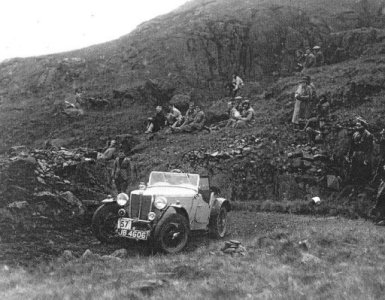
Dudley Sterry rounds the famous hairpin on Corkscrew in his “MG J2” on a recent Edinburgh. You can read more about this fascinating machine later in Classical Gas (Picture by Mike Furse).The undergrowth had not appeared when Lewis Welch rounded the same bend in his MG Magnette during the 1935 MCC One Day Sporting Trial. In those days the hill was called Jenkins Chapel.
The hill continued to be used under this name, pre war and post war, for many years, but fell out of use for several interesting reasons. There was a problem with the neighbouring farmers who were conducting a feud. One was strongly in favour of the trial so his neighbour objected as a matter of principal. PR is especially important with this hill as the access road has a rather peculiar status. A plate at the bottom saying that the local council has closed it to all but visitors to the house at the bottom and the MCC! These days there is also a gate across the bottom to inhibit access by the cowboys.
The section itself is not very smooth! There are two hairpins followed by some nasty steps. They are not particularly steep but are pretty rough, and it would be very easy to damage the car if you went to quickly. There have been problems on Jenkins over the years, even though the famous right hand hairpin is said to be nothing like as severe as it was in the 30’s. One dry autumn a Fiat 600 (fitted with two litres of Uncle Henrys V4) jumped out of gear and caught fire in the gully. The walls were so close the occupants couldn’t get out at first and it was quite scary for a while, although it ended up all right, and they eventually emerged unscathed.
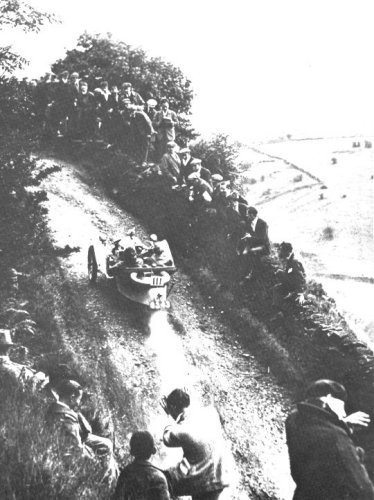
Ron Horton storms Jenkins Chapel in the ’30’s in his Morgan three wheeler.
20 June 1999 – All may not be as it seems. I have received a couple of E-Mails that throw doubt on the authenticity of the old photograph’s.
Andrew Brown says “Re: Your page on Jenkins Chapel.”
Although I’m familiar with the picture that you show of the MG (and I too have seen it categorically captioned as being taken on Jenkins Chapel), I’ve never been entirely sure that this is correct. I’ve never been to the hill except when competing, and one never has time to look at the view from that point(!), but my recollection of waiting at the start line is that the backdrop (now of trees) is much lower and further away than shown in the MG picture. Any comments?
Jonathan Toulmin and I have a whole ‘catalogue’ of mis-captioned or un-captioned photographs in various books but I haven’t tackled him on this one – I’m still on a ‘mission’ to track down the various ‘Kinetons’ and ‘Guitings’ used in 1930s before venturing further afield.”
Tony Branson adds
“Reference Andrew Brown’s letter about Jenkins Chapel/Corkscrew, I share his doubts that the old picture of the MG is really this hill. I too have spent some time with Jonathan Toulmin poring over old trials photos trying to recognise which section they are. It’s amazing how much the landscape changes over the years, trees move and cottages sprout or lose chimneys.
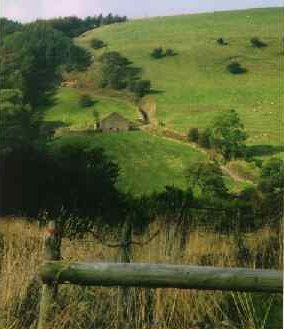
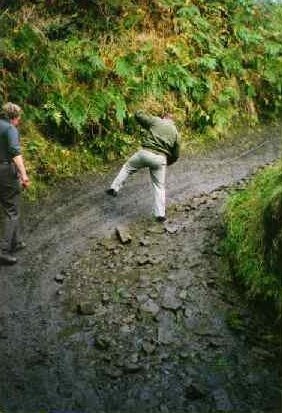
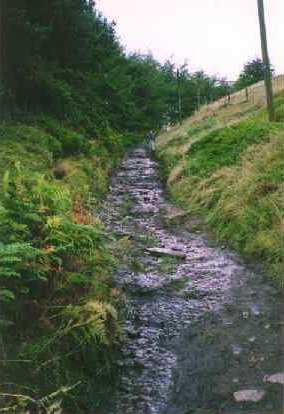
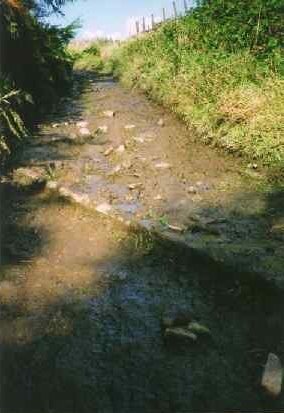
After the 1993 Edinburgh Jonathan, Pat, Derek and I walked the section and I bemoaned the fact that class 3 didn’t get a shot at it. I have since gone up it twice in the Marlin and my propshaft tunnel has the scars to prove it. I attach 4 photos I took that day. The first shows the section from across the valley, The second the infamous first corner with Derek having a little trouble on the restart and the other two the rocky steps in the upper reaches. Hope they are of interest.”
Dudley cresting the summit of Litton on the 97 Edinburgh. Note the absence of weather protection and dig that blower man!
I started to marvel at the amazing exploits of car and driver, competing, and often beating, the Trolls and Cannons that mostly travelled to and from events on trailers. No such namby pamby stuff for Dudley. He always drives his trials car to and from events, rain or shine, with no hood, toneau cover or even a proper windscreen. Now clearly something was a little non-standard about this machine. For a start it says 1,466 cc’s on the entry list. Now all my books on MG history say that the J2 was 847cc and had a two bearing crankshaft! Then there is the enormous belt driven blower sticking out the side. MG did produce a few blown J3’s, but the Powerplus supercharger was mounted under the front apron and driven direct from the crankshaft.
All this set me thinking and I wanted to know more about this fascinating car. But “super-Dud” is not the sort of person the likes of me slide up to, poke a tape recorder under his nose, and ask all about his motor for Classical Gas. The solution came when Brian Butler gave me a bundle of “Wheelspin” magazines. In the April ’87 edition I found an article about Dudley and his car by our own David Alderson. From this I learned that Dudley acquired his car as a box of bits in 1964. When he put them together he had an MG J2 with an 1172 sidevalve Ford engine! Anyway Dudley started trialling his machine, gaining his first triple in 1968.
Then the car was involved in a road accident near Carlisle on the Edinburgh. (Yes I did say Carlisle, the Edinburgh actually went to Edinburgh in those days). Dudley rebuilt the car on a new chassis and it emerged with a 1250cc T series engine. Over the years Dudley developed his car, acquiring first a supercharger, then a 1466cc block from a TF in the late 1970’s. These days the “J2” is a very special machine, but mostly uses MG parts, including an axle from an MGB an a self made four planet diff.
Now the purists may be appalled at this “bastard” machine, but don’t blame Dudley, it wasn’t a proper MG J2 when he bought his box of bits all those years ago.
We have been publishing stuff about Classic Trials on the Web since 1995 and always appreciate feedback. Comments, Corrections, Criticism & Concerns are all welcome. You can leave a comment to have your say here on this web site or our Social Media
Please help spread the word and share this on your Social Media:
Jack Williams is a familiar face at our trials, always doing well in his smart red Tempest. I knew he had been trialling for a long time and after a brief chat on the phone he agreed to be the subject of my second “cars I have owned” feature. Jack let me borrow some pictures from his collection and in the lunch break at our Edlesborough trial we sat on his trailer and talked.
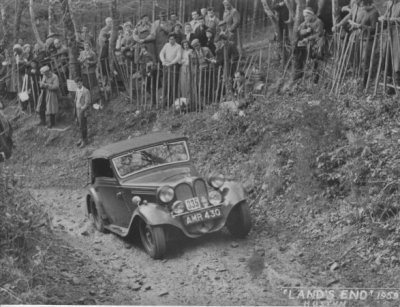
Jack chose a 1934 BMW 316 for his first Lands End in 1959, seen here on Hustyn
Jack was born and bred in Cornwall and his first recollection of motorsport was being taken to Bluehills on Easter Saturdays. This was in the mid 30’s and Jack remembers that the old hill was still used. There was no Bluehills One in those days. Competitors hairpined left up what is now the surfaced road.
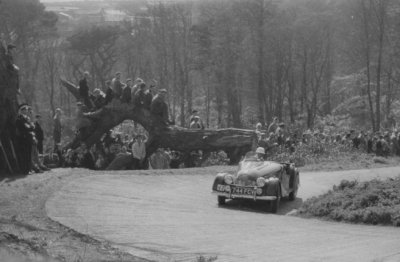
After the war Jack passengered a few times before driving his first Lands End in 1959. In those days you could drive a genuine road car and Jack used his special bodied 1934 BMW 316. It had a six cylinder, 12hp engine and had two Solex updraft carburettors, sucking up like an Austin 7. So there’s nothing new about doing Classic Trials in old cars!
Jack driving the Morgan at the Trenwainton hillclimb on Easter Sunday 1961. He had just finished the Lands End!
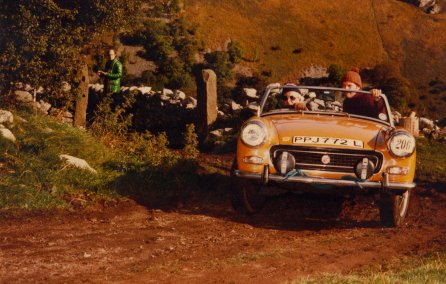
By now the bug had really started to bite. Jack was managing a specialist sports car garage just outside Truro. They were the Morgan distributors for Cornwall so Jack naturally took one trialling and it wasn’t your standard car either. In conjunction with Peter Morgan Jack specified an alloy body and bucket seats. The car was also unique as the first Morgan to have its sidelights mounted on the wings. Originally a special for Jacks car Peter Morgan liked the idea so much it became standard.
The Morgan looked superb in British Racing Green and was registered FCV 444. It had a Standard Vanguard Engine because although Triumph’s Sir John Black was an ex-Morgan apprentice he wouldn’t give Morgan the TR engine. However, Jack persuaded Chris Lawrence, the Morgan wizard of the day, to tune the Standard Vanguard engine. By the time he had finished the car went jolly well and the motor looked just the business with it’s twin Strombergs.
Jack competed with the Morgan for a while. The car had to work for it’s living as it doubled as the business’s demonstrator. On the sporting front the Morgan wasn’t only trialled. Jack used to do the Lands End, stay in Penzance and then drive in the Speed Hill climb at Trenwainton on the Sunday.
After the Morgan Jack trialled a spate of Triumph Heralds. Starting with a 1200 Duo Tone in 1961. Then a customer, who was also a member of the local Motor Club, bought a 1200 and fitted it with a Shorrocks super-charger. Another member had an original 948 Herald with twin SU’s. Not to be outdone Jack’s partner got hold of a convertible and had it fitted with a Brabham conversion, complete with a 1200 Coventry Climax motor. The three entered a team in the ’61Lands End and won the team award, beating the Morgan works team when Sid Margullis blew his diff!
Jack rounding the bottom bend on Putwell 2 in one of the unloved Midgets in 1980
Next Jack dabbled with rear engined machinery when he bought a 750cc Renault CV4, the predecessor to the Renault Dauphine. This was a pretty little car but it was a bit short on power so Jack fitted a bigger engine from a Dauphine and souped it up with a Gordini head. They entered the Lands End but only got as far as Beggars where a drive shaft broke.
Then came a trials sabbatical as Jack moved up to Surrey and was out of action from 1963 to ’68/9. He came back with a couple of Midgets but wasn’t impressed with them. Then the garage took a BMW 2002 in part-exchange. Jack thought it would do the business on the hills but it blew its diff somewhere in darkest Devon. Jack was so disgusted he left it there!
It’s getting dark as the AMI mounts the concrete slab on Bluehills 2.
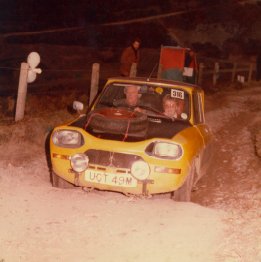
By now Jack’s garage was a Citroen distributor and he decided to take the marque trialling. However, they weren’t standard cars. There was a nice AMI Super. This came with an 1015cc motor. Jack swapped it for an 1,220 engine from a GSA and promptly won his class on the Exeter in 1983.
Jack negotiating Slippery Sam in 1983 when he won his class in the Mehari, one of his favourite cars.
The Mehari was a utility vehicle originally designed for the French army. It was a tough car, built strong enough to travel slung underneath a helicopter before being dropped the last few feet to the ground. The design was based on the AMI platform chassis. Jack really liked the Mehari and had it for some time, but the chassis on his car wasn’t very good. He had an AMI that he wasn’t using, so he wiped the body of that and put the Mehari “top” in its place, even though it was designed for a twin rather than 4 cyl engine. The only problem was the necessity to remove the headlights to change the spark plugs!
Next came a couple of 2CV’s. Jack got on well with these on PCT’’s, finding they would outclimb practically any other front wheel drive car, even though they had a very restricted lock with a 40 ft turning circle. This was because of the swinging arm front suspension. The larger engined 602cc cars were pretty low geared, but the original 425cc machines had an incredibly low diff, something like 8:1, so Jack naturally fitted his larger engined car with the ‘box from the smaller engine.
The Mazda had a hard life but was very reliable
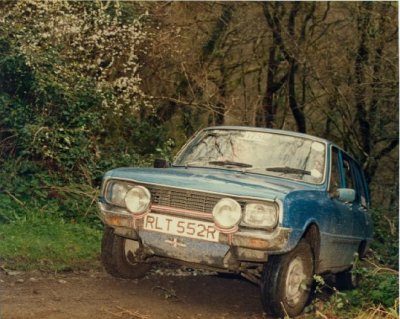
Then came the famous Mazda that Jack used for many years. There weren’t many of this model imported. It was very narrow and short to suit the Japanese tax system. It was actually smaller than a Hillman Imp, ideal for trials, especially after Jack replaced the 1300 motor with a with a 1400 and fitted the ultra low diff from a 1000cc car. Jack won several MCC awards with the Mazda and competed in hundreds of PCT’s. Before Jack got hold of it the Mazda had been owned by the actress Prunella Scales, who loved it dearly. Jack’s business took it in part exchange but Ms Scales kept track of it and was horrified to hear about the ordeals it experienced in its new career!
The Mazda is still going strong and was last seen running around as a shopping car. It never failed to get Jack home, even when the pin came out of the diff in Derbyshire. However, because the crownwheel overlapped the pin it couldn’t come out completely although it got quite beaten up.
These days Jack Williams enjoys open air motoring in his Tempest
Finally comes the Tempest, Jacks current trial’s machine. This was selected as it could be used for trials and as an occasional second car for road use. Like me Jack believes that most cars specifically built for trialling are not really suitable for a trip down to the pub. However, Jack doesn’t believe the Tempest is man enough for classics, although a couple have been seen out with some success. So that’s the story so far. Jack is concentrating on PCT’s these days, very successfully, and has been in contention for the RAC title for the last couple of years.
Going back to classics we talked about how the events have changed. Immediately after the war entry lists were dominated by the E93A Ford Pop, complete with family, kids and suitcase on back! They did very well, often better than the specials. This was because in those days production cars could use Town and Country tyres. The Dellows had to use road pattern cross plies and a Pop with a decent driver could outclimb them. So it was hardly surprising that most of the entry comprised standard production cars. Jack feels very sad that these days production cars are in the minority and those that do compete have to be so heavily modified in order to cope with the rough conditions now the hills have deteriorated so much.
Apart from trials Jack competed in one or two speed events, remembering an “autotest” at Perranporth airdrome in 1962. It consisted of a third mile sprint down the runway. Round a pylon and back again. Very enjoyable, especially when Jack’s Morgan beat the TR’s.
We started to talk about some of the things Jack had seen over the years. Like when Sydney Allard charged around the Exeter on his new J2 Allard, only to find it was too wide for the bridge at Fingle! Then there was time for no more. Lunch was over and there was trialling to be done.
We have been publishing stuff about Classic Trials on the Web since 1995 and always appreciate feedback. Comments, Corrections, Criticism & Concerns are all welcome. You can leave a comment to have your say here on this web site or our Social Media
Please help spread the word and share this on your Social Media:
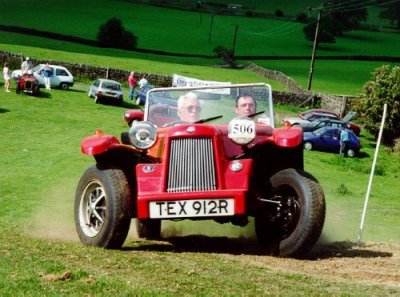
If there was a prize for the smartest car at the July Autotest it would have been won by Geoff Jacksons new trials car the “Sprint”. Geoff has all the qualifications for the job. My first recollection of him was on the 1971 Guy Fawkes when he was driving a Morris. Latterly he has campaigned a class eight Dellow on MCC events. (Kindly towing me out of a mud hole on the muddy exit from Calton a few years ago).
Geoff started to build his new car about five years ago. He started by putting a melamine “surface plate” on a couple of trestles and laying out the chassis tubes on that. The Sprint uses a Ford back axle located by twin trailing arms. A mark 4 Cortina provided the front hubs and the suspension owes a lot to Westfield and the Ford Transit, while a friendly Escort donated it’s steering rack!
Geoff resisted the temptation to fit a Ford Kent engine and the Sprint is powered by a 1500 lump from a Triumph Spitfire, running a single SU. The mechanics are finished off by a very well made body, nicely painted in Red. It’s a super car and did very well at Upper Caldecote in the hands of Geoff’s two sons. Watch out for the Sprint on the Edinburgh.
We have been publishing stuff about Classic Trials on the Web since 1995 and always appreciate feedback. Comments, Corrections, Criticism & Concerns are all welcome. You can leave a comment to have your say here on this web site or our Social Media
Please help spread the word and share this on your Social Media:






 Classical Gas