Exeter 2007

Mud and Gold

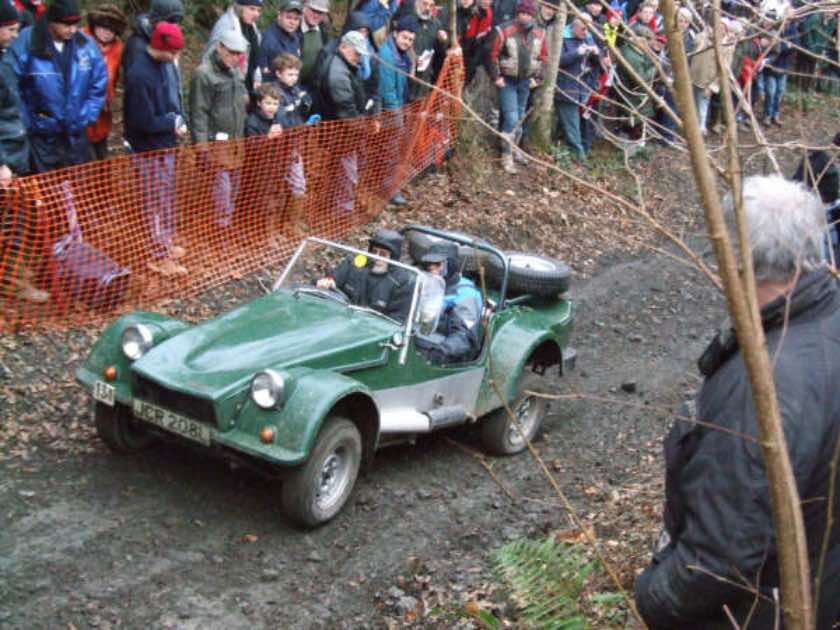
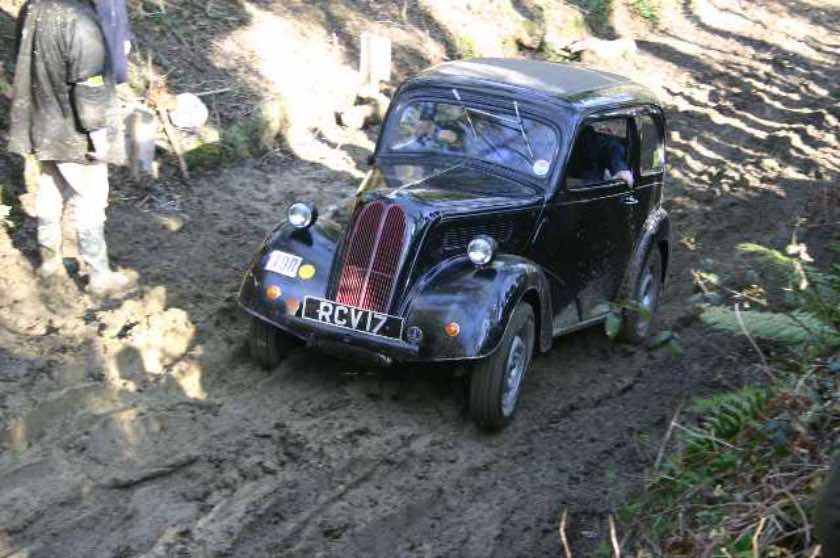
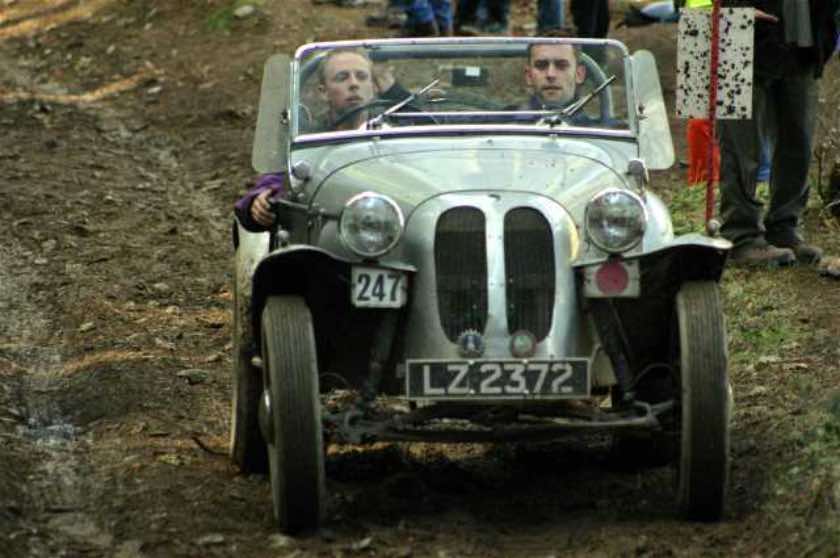
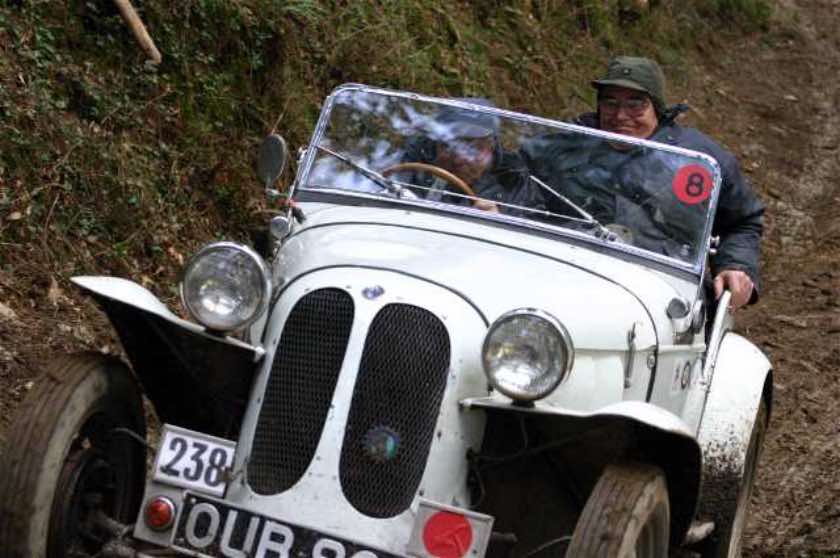
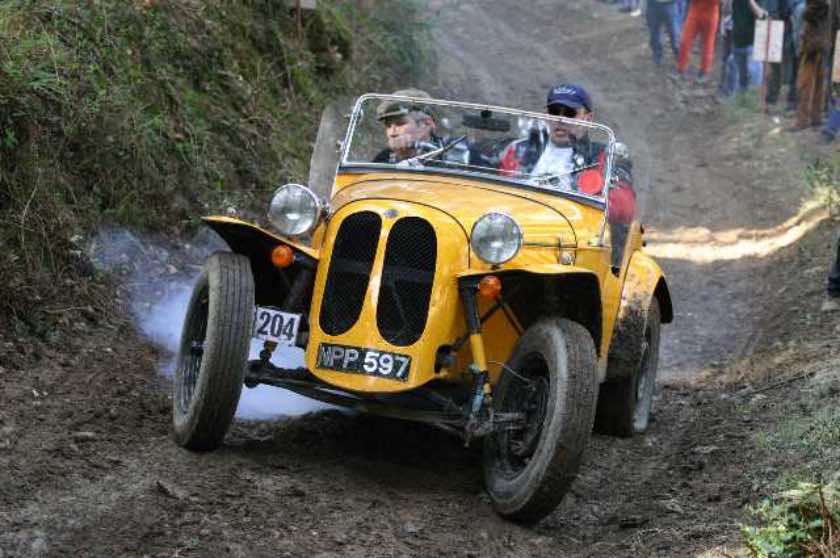
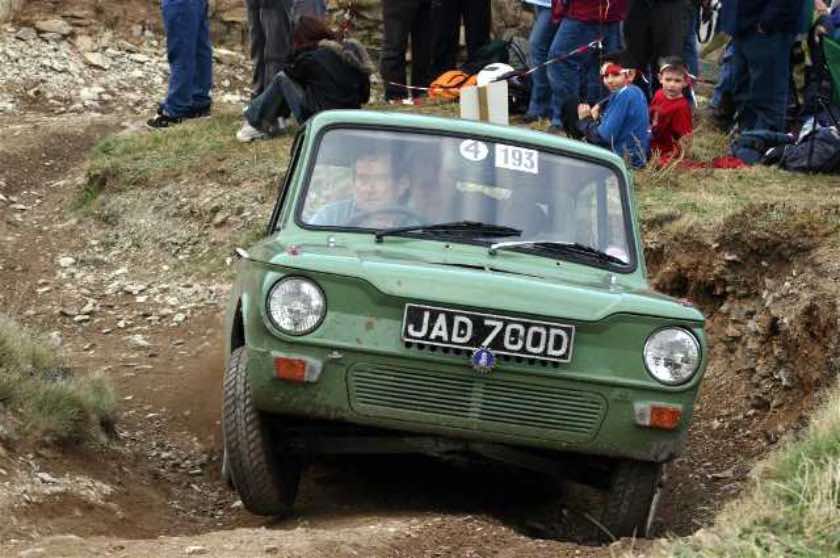
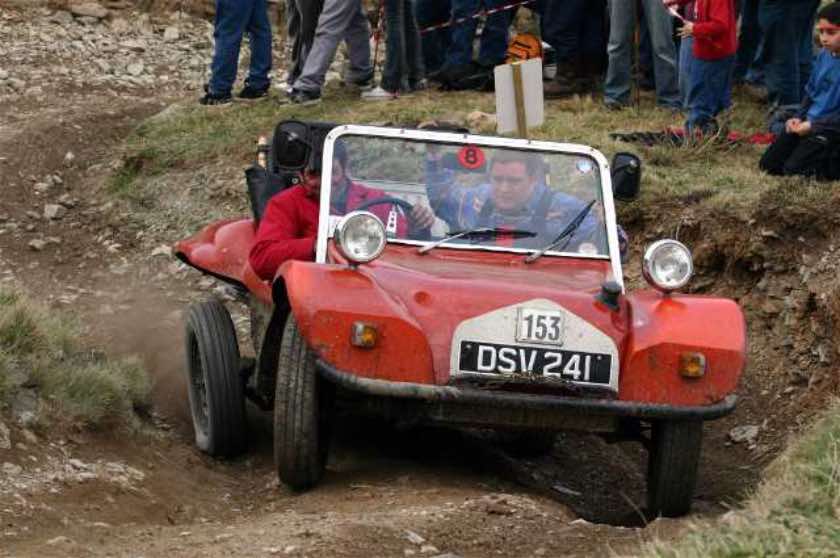
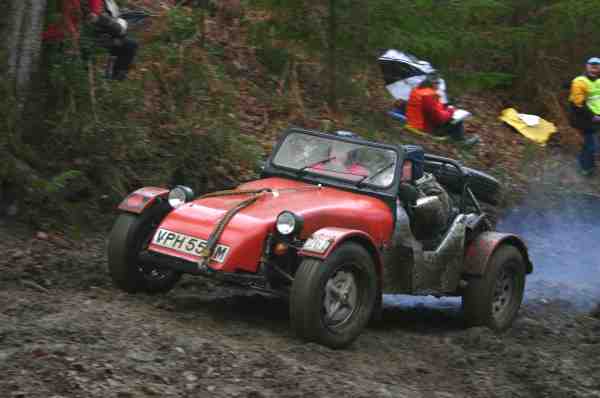
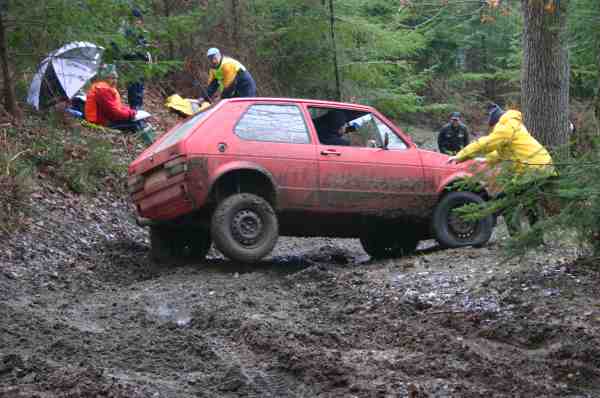
The forecast predicted a wet Exeter and the weather god did not disappoint. The rain started just before dawn and continued through the morning, making many of the sections pretty slippy. Simms wasn’t as challenging as it can be and there were more than sixty clean sheets between the bikes and cars.
There were a few notable non-starters. Both Peter Manning and Keith Pettit had medical problems and in class 0 Kevin Barnes found his Singers fuel tank leaking just before the start. There were some problems on the way to the start too. Ed Nikel had cooling problems with his Dellow and decided to remove the thermostat. Meanwhile Keith Oakes was hearing horrible noises from his rear end and was worried about the diff. 

Meerhay was first on the agenda. It only stopped three cars, including Trevor Hardcastle and Nick Wollett in Marlin and Dellow respectively, both of whom were to retire later in the event. This is a long hill and its hard to recover any time lost through delays. Later numbers experienced up to an hours wait, just as the rain was starting! 

After the very straightforward Gatcombe Lane, where even class 0 had a go, came the infamous woods at Bovey Downs. Unfortunately, Clerk of the Course Tim Whellock had to cancel Normans Hump on the eve of the trial as logging operations had made the section too much of a quagmire for the section to be used. 

Clinton waited just up the track. This is normally regarded as easier than Normans Hump, but a tricky restart for class eight caught out Ross Nuten and both the Reg Taylor and Geoff Jacksons Dellow re-creations of Ed Nikel and Mike Pearson. From the same stable Geoff Hodge got away cleanly in the RDT, after earlier dramas when the horn failed at scruitineering and the bouncer knocked off the cut-out switch on the approach to Gatcombe Lane. Clinton didn’t prove to much of a problem to the non-restarters but it stop some of the Lieges. Bill Rosten was given a fail but this was corrected later so he’s still on for a triple.

Coming out of Bovey Woods Waterloo waited just across the road, but not before Simon Groves had to fix his first puncture of the day. This is one of those hills that is easy to fail unless you get everything just right. Barrie Parker had problems getting the big Audi 80 around the tight right hander which was shame as it was his only fail of the day. John Sawle retired here with gearbox failure, the Achilles heel on a Liege. Perhaps it didn’t take to kindly to the extra power from the supercharger. 

Neither Plyford or Higher Rill claimed many scalps, but those damn Indians are cunning and laid in wait in Otterton Woods for Colin Sumner (VW) and Ross Nuten who were ambushed on the Bulverton restart. 

The breakfast stop at Exeter Services came next on the agenda. But not for Owen Ingram and Tim Williams who were still trying to extract their Class 0 V8 Marlin from the trees after the Stretes special test where it had slipped way off the road down a bank. 

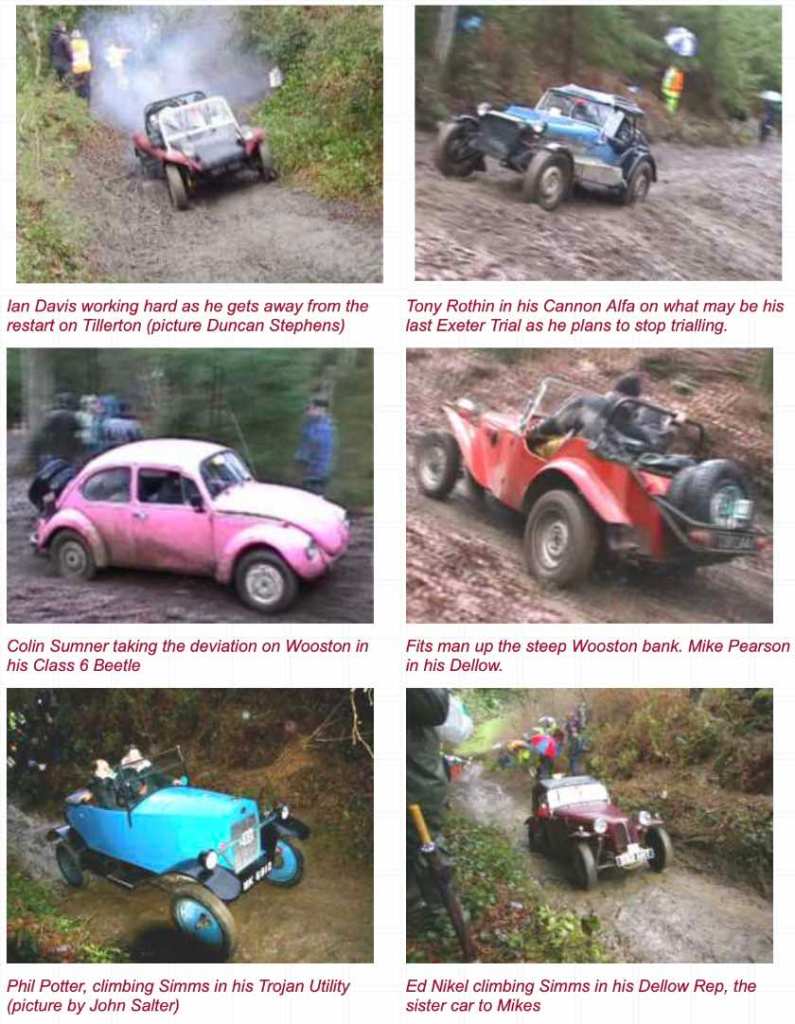
Tillerton was to provide Ian Davis’s toughest moment on the trial when he had to work hard to get off the class 7 and 8 restart and the marshals gave Ross a fail here for allegedly over running the line. 

The speed Hill Climb at Fingle was enjoyed by all, but not so the battle ground that awaited for many at Wooston Steep. New charges for the traditional access track had forced Tim W to use a new approach, involving a steep and slippery descent. All competitors, including the class 0’s, even though they had a separate section, used this. It proved pretty hairy and finally Wendy Wood’s Class 0 Subaru Justy slipped over, fortunately without serious injury to the occupants. After this officials re-routed competitors down the normal exit road for blues and whites. There was two-way traffic until the approach went straight past the bank where the blues and whites emerged from their section, down the Class 0 section the wrong way to the normal starting area. 

Classes one to six had their normal deviation to the left before the steep bank. Their section wasn’t too challenging, provided you took the correct route! A number of competitors didn’t, including the experienced Michael Collins in his Golf, who tried to go straight on up the steep bit before realising his error, exactly the same mistake as two years before! Falcon’s Ross Nuten also went wrong here, turning left instead of going straight on up the bank. These two were some of several, and although the instructions in the route card were clear it wasn’t so obvious where to go when you got there, so perhaps there should be arrows in the future. 

The restart itself wasn’t difficult to get away from, the challenge was the steep bank after the deviation. The ruts were full of leaves and mud and the early numbers couldn’t find any grip. Each car went a bit further cleaning things out for those following, until finally Mike Pearson, a master at finding grip where there isn’t any, got through the difficult bit and reached the summit. It became easier and towards the end of the field, many in 7 and 8 cruised up like it was a motorway, although the Lieges with their comparatively low powered engines all failed. Had they not already retired it would have been interesting to see how John Sawle or Mark Worsfeld would have faired in their more powerful versions or Simon Robson if he had been running at the back of the field instead of towards the front. 

Simms has definitely become easier after the repair work by Roger Ugalde and his team and it didn’t claim its usual crop of failures. The biggest cheer of the day went to Steve Potter who coaxed his Trojan to the summit. It is absolutely amazing what Steve and John Wilton do in their fantastic cars. 

Only the rather rough sections at Tipley and Slippery Sam were left now. Both were easily on provided you had a suitable vehicle and took care but could still catch the unwary as Geoff Hodge discovered on Tipley when he misjudged the restart and wheel spin set in.


We have been publishing stuff about Classic Trials on the Web since 1995 and always appreciate feedback. Comments, Corrections, Criticism & Concerns are all welcome. You can leave a comment to have your say here on this web site or our Social Media

Chris Clarkes Edinburgh

Edinburgh Trial – Take Two
By Chris Clarke

Once again, circumstances had rather restricted the planned transformation of the VW, but we had been able to improve the tyre pumping arrangements (my work colleagues are convinced that this is the main competitive element of Classic trialling) and had decided to use smaller wheels to reduce the gear ratio. 

On the day, the arrangements at the start worked as smoothly as usual and we were soon on our way, making good time until just before the first section at Haven Hill where we were following a small group of cars and suddenly realised that we had covered more than the specified mileage to the turn off. By the time we had sorted ourselves out we had lost about 10 minutes which was a large slice of the time between us and the last competitor. Anyway the section itself was not a problem and we continued to Clough Wood where there was a long queue, giving us a chance to break out the coffee and biscuits. Again no problems on this or the following Deep Rake, where we showed an improved grasp of the essentials of the sport by remembering to close the tailgate before arriving at the start line. 

Last year we nearly slid off the slippery track at the start of Litton Slack so took it very steadily on the approach and still nearly slid off it again. Whether it’s some combination of camber and the surface; or a force field left behind by visitors from another planet, you cannot be too careful crossing that field. It’s a pleasant place for a wait, though, with a bit of sunshine, more coffee and a chance to watch the action below; with a real treat for Golf drivers as Dave Haizeldean stormed the section. Then it was our turn and, just like last year, it started to rain, but fortunately only a passing shower so we made it to the start line without serious embarrassment (unlike last year) but only about 50 yards up the section, not that good, but 50 yards more than our first attempt so we were not too disappointed. 

Beyond Carlton was the breakfast stop, and we were now very late, so that it was more like lunch and in fact closed about 2 minutes after we were served, which could have been our first major problem. At Haydale, feeling well fed and perhaps rather complacent we failed to heed the various warning signs including the erratic progress of other competitors across the first part of the section, set off with the tyres too low (worrying about getting going at the restart, which wasn’t a problem at all) and suffered a puncture, loosing more time as we fixed it.

At Haggside we were excused the restart which nearly destroyed the clutch last year but the section was very rough and the drivers side wheel was badly damaged by the time we reached the top. On the way down we met a lot of walkers who were very friendly, some of the younger ones seemed impressed by the car, or do they have a better grasp of irony nowadays than we did? 

Onto Bamford Clough where again we made more progress than last year and really enjoyed the “cliffhanger” feel of the climb, but still did not get to the top of the first part and put some more dents in the same front wheel. At this point some strains began to show as the navigator accused me of “not looking after your wheel” which had suffered all the damage, in contrast to the passengers which still looked pretty tidy. It was the rough bit at the top of the restart area at Great Hucklow which finished my wheel completely; leaving it almost square. Of course that wasn’t the end of it as the escape route here also contains a couple of wheel smashing rocks on the navigators side which, of course, he remembered and directed me around. 

Up on the road we were debating the best thing to do with the remaining one good wheel when we were passed by the course closing car. At this point it seemed too difficult to sort out the wheels, do the remaining sections, make it to the club supper (we were still a bit shaken by how close we had come to missing brunch) and get home the next day and so we wimped out and retired at that point. We were both disappointed to have failed to complete the Edinburgh for the second time and returned to our Hotel in rather a gloomy mood. However there was still the supper and after a couple of beers, a bottle of wine and some good company our enthusiasm for Classic Trialling (or at least dissecting it afterwards over a drink) had returned and we were able to think more about doing it better. In particular; paying more attention to the route instructions and improving our puncture repair capabilities. 

Once again a big thank-you to the organisers and all those who stood out in the weather for a lot longer than they had expected to see us through (or back down) the sections.


We have been publishing stuff about Classic Trials on the Web since 1995 and always appreciate feedback. Comments, Corrections, Criticism & Concerns are all welcome. You can leave a comment to have your say here on this web site or our Social Media
Edinburgh Trial

Tough for Triples

It was a good Edinburgh Trial. Nice weather, wonderful views and some good sections. It wasn’t all plain sailing though. Litton was at its magnificent best, changing minute by minute with the weather.

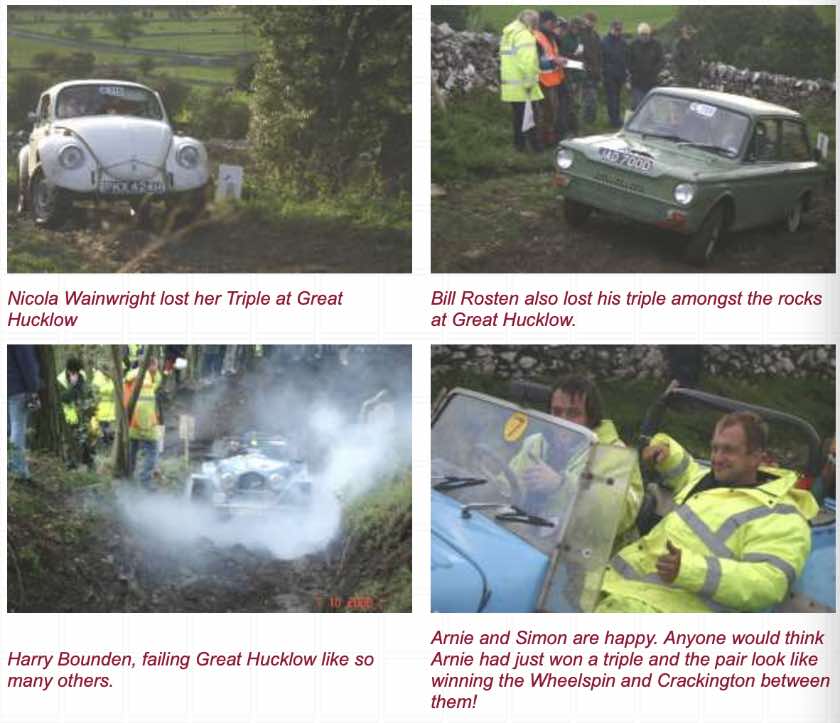
There was some criticism of roughness, especially Great Hucklow which was a real car breaker and Nicola Wainwright and Bill Rosten lost their triples there.

Video Playlist

The weather was mild and didn’t present any problems for the run from Tamworth Services up to Derbyshire. Haven Hill passed without incident, but the same couldn’t be said for Clough Wood where there were long delays because of radio problems and the marshals were only letting cars go every two minutes. The section was wet and a bit rough but didn’t trouble the scorer a great deal.  

Ed Nikel was having electrical problems with his Buggy. Neil Bray and Dave Nash stopped to help and Ed only finally got away when they ran a feed direct from the battery to the coil. Neither Dave or Neil’s cars were running right either, but were cured by changing the coil on the MGeetle and tightening up the manifold nuts on Primrose. That wasn’t the end of the problems though, as Neil also found a hole in the exhaust, which had to be bodged up to enable him to continue.  

Deep Rake was next, with no problems for the main trial. The same couldn’t be said for Litton Slack, which was just up the road. The higher classes had a restart and there were A boards beyond. It was very damp when the first Motorcycle competitors arrived, just after 5.30. The hill was quite difficult and the bikes really struggled for the first hour, only two of the first ten going clear. It got easier as time went on but at the hint of rain the challenge soon returned.  

The first cars arrived at Litton around 8.45 and immediately found problems. Alistair Queen (Skoda), Mac Taylor and Ian Ramsay (Marlins) all failing. It wasn’t until Brian Partridge came along in his Cannon and Stuart Harrold in his Troll that the marshals saw their first clean. Like most of the early runners in class seven Keith and Claire Oakes didn’t succeed. It wasn’t until triple contender Andrew Martin (with Simon Groves in the hot seat) came along that a “seven” went up. Fellow triple hunter Clive Kalber was also clean, proving it was possible to climb the old hill in class three. Sitting in the queue Bill Rosten was wondering if it was possible for a class 4 to make it. In front of him Pete Barr made a great effort to get to the A boards but Bill went one better and came out the top of the section, although he didn’t change into second like Colin Perryman in his smart BMW! Just behind Neil Bray coaxed Primrose to the summit after an amazing re-start.

Both Nick Wollett and Mike Pearson got to the top in their Dellows. Mike must have pinched a tube as he had a slow puncture for the rest of the day. John Parsons had a successful climb as well and so did Nicola Wainwright (Beetle), David Haizelden (Golf) and Paul Bartleman (Troll), so all three were still on for a triple. The section was quite dry by the time it closed in the late morning and most cars were able to get up, quite a change from earlier!  

Again, there were delays a Litton, and at times car competitors stretched back almost to the road. This time the problem was with Class 0 who tackled a different hill but used the same approach track. Unfortunately many of the Class 0’s had problems getting off the line, delaying proceedings not only for their class but also the main trial who were stacked up behind and couldn’t get down to their section.   

Calton, breakfast, Haydale and Haggside came before the challenge of Bamford. It looked quite rough, but it was more a roller coaster before the steps than big holes and there was plenty of grip. The Red and Yellow categories had a restart right near the summit but failures from those that arrived here were limited to the odd bod who forgot to use their handbrake and a few who didn’t read their route card and stopped at the A boards just before. John Sawle was one who had handbrake trouble, which was a shame, as his supercharged Liege sounded really nice. Now he has more power John is able to solve the Liege tyre problem by running taxi tyres on 16-inch rims. Amongst the other Liege’s only Steve Kenny and Mark Worsfeld were running the newly permitted 15 inch rims. Mark was in class eight anyway because of his Fiat 1200 engine.

The problems at Bamford were down before the seat, on the steepest bit, and on the start itself, which was situated on the left hand bend and was quite slippery. Peter Thompson (Opel Manta), Dave Nash (MGeetle) and Myke Pocock were amongst those failed on the lower reaches. Northern Trial organiser Myke had had problems with his Skoda on the way to the start, but it was running fine now. Maureen Chattle and Ross Nuten didn’t attack the bottom part with enough verve and failed. Earlier they had also failed Litton when a bolt securing the distributor fell out.  

Great Hucklow was next and was truly horrible. Peter Manning described the rocks as Dragon’s Teeth. It was very, very rough, especially for the later runners. There was very little solid material between the rocks and huge holes developed. It was hard to decide who was worse off. The higher classes who had to find a place to restart amongst the boulders or the lower classes that were allowed to go straight through and hit them at whatever speed they choose! Mike Pearson thought it was the most difficult hill of the trial. He stopped in the lower half of the box and managed to spin his way to the top and a Gold! Neil Bray broke his diff here, which was inconvenient, but not as heartbreaking as for Bill Rosten and Nicola Wainwright, both of whose Triple hopes sunk into the huge holes. Their only hope was that none in class four would come out the top, but there is always at least one and Arron Homewood succeeded in his Skoda Estelle. The other four wheeled Triple contenders all went clean with only a couple of sections to go! 

Jim Mountain, driving Peter’s Dellow Mk1, was doing very well until Great Hucklow when the engine died after the restart. They discovered the problem was a loose King lead which must have caused the stalling, then made contact enough to start the engine again. They got a puncture there as well. The lead finally dropped off on the corner on the road before the tea halt. The engine went much better after the offending lead was put back firmly in its hole! After a nice run up King Sterndale, competitors had a break for tea and cakes at Hollinsclough Village Hall before Rakes Head, which dives left just up the road. There was a restart for the higher classes to catch the unwary but most succeeded OK.  

There were a few anxious people on the approach to Excelsior, where there would be a restart on polished stones on the final bend. Quite a few failed to get away but all the remaining triple contenders were successful. Including David Haizelden who lost his here last year. This was the last section for the main trial. Only the Moneystones special test coming before the finish.  

The Club supper was a nice end to the day. Competitors especially appreciated a working PA, the first time many had actually heard the presidential speech. Delivered in an appropriate fashion by Ron Butcher. Can the equipment be transported to Exeter in January!


We have been publishing stuff about Classic Trials on the Web since 1995 and always appreciate feedback. Comments, Corrections, Criticism & Concerns are all welcome. You can leave a comment to have your say here on this web site or our Social Media

Lands End 2006

Tough Event for Class Eight

Good weather, big delays at Riverton, Hoskin very tough for class 8

Dave Cooks Photos

Start – Falcons Ed Nikel didn’t make the Plusha start as the dynamo on his VW Buggy failed on the way down. Ted Holloway wasn’t a great deal luckier. Ted made it to the start OK but didn’t get very far as he had a hub collapse on his Mini Special only 50 yards up the road.

Felons Oak – This short little “hill” is all about the restart, which is reckoned to be getting trickier as it gets dug out. Although it claimed quite a few casualties, all the Falcon’s got away successfully.

Stoney Street – The section, which bypasses Porlock, was reckoned to be very rough this year. Peter Mountain would certainly agree. Peter retired when the rear axle-locating pivot broke on his Dellow Mk1. This was not a Dellow friendly hill as Richard Shirley also retired here with back axle problems.

Beggars Roost – Strangely there was no restart for Class 8. Simon Groves lost his triple here when he failed to get away. Keith Oakes is down in the results as stopping but as you will see from Claire’s report he didn’t. Tony Smith didn’t get this far in his first Land End in his Austin Big 7. The engine went bang crossing Exmoor and he needed a tow from Roger Teagle in his Beetle to reach civilisation at The Culbourne Inn. We also lost Mike Telford in the night when he had to retire the “Tucker Nipper Special”, built by former clerk-of-the-course H. W. Tucker-Peake for his daughters who won a triple with this famous old car.

Riverton – There were big problems for the bikes again this year. A number of riders hit the deck and it took a lot of time for them to remount and get going. Things didn’t improve much when the cars came along and some had to wait very nearly three hours in the queue, which came close to blocking the road. 

After the debacle with the bikes the field became split when Tony Divey got stuck and there were big problems in towing the Tiking three wheeler out of the section. The thinning Dellow ranks were further depleted when Mark Worsfeld broke a half shaft on the section. Then Neil Bray claimed a baulk when he was stuck behind a car with a puncture. It had to be fixed on the hill because the recovery vehicle was down stream of the incident. This took a lot of time as the car kept rolling off the jack.

While all this was going on the lady of the manor from nearby Riverton Mill decided to walk her dog up and down the section, dishing out a verbal assault on passing competitors as she did so, claiming they were hooligans damaging her back garden and that she know nothing about the trial. The delay at Riverton was good for one competitor. Ian Moss had been having problems with his Escort sliding all over the road ever since Stoney Street. The delay gave him time to get underneath, finding a broken U bolt, which he was able to replace with the help of some of his fellow competitors.

Cutliffe Lane – The hill was reasonably dry this year but it is pretty steep and defeated.Simon Robson’s Liege. Likewise most of the class one’s and five’s failed, including Peter Manning and Barrie Parker.

Sutcombe & Darracott – Neither of these wonderful old hills were to cause many problems this year.

Crackington – Not to difficult this year.  It was pretty dry and there had been little or no doctoring. The field was really spread out by now and after the bikes came there were only four cars in an hour, presumably because of the Riverton problems. Dudley Sterry recorded a fail when he over-ran the restart line. This was to cost him The Field Trophy as he was faster than Paul Bartleman on the special tests.

Ross Nuten cleaned the restart here but suffered from fuel feed problems thereafter and finished up failing four hills. Earlier Ross was one of many to get fed up waiting in the queue for Riverton and skipped the section. Andrew Brown had been suffering from engine problems during the night and his Marlin stuttered to a brief halt before Andrew gathered everything together and did a special class 7 restart to “clean” the hill.

Warleggan – Passed without incident.

Hoskin – This fearsome Camel Vale Hill was true to form. The blues and whites had a clear run but only the best built up sufficient momentum to carry themselves up the slippery higher reaches. The problem is in the area of the class 8 re-start. The groove in the ruts is extremely slippery and polished and a lot of momentum is required to get through this area.

The poor old class 8’s really struggled and only the supermen succeeded. I witnessed both Paul Bartleman and Dudley Sterry clean the hill. They stopped way over to the left, one wheel between the ruts and the other up the bank. Some people tried the same technique the other side but the camber drew them back into the ruts and wheel spinning failure. Eric Wall got the technique right but even he slipped back into the groove and spun to a halt. The results also show that Robert Williams (Buggy) and Geoff May (Dellow) also succeeded. Falcons Neil Bray incurred his only fail of the day here and the results show Neil as winning class 8. However, this is a mistake as Dudley was faster on the special tests.

The yellows had a restart lower down. It was easier to get away, but even if you did get going it was necessary to build a lot of speed to get through the difficult area higher up. Few succeeded but some did and Roger Bricknell and Andrew Martin made it look positively easy! Mark Tooth (Beetle) and Mal Allen (Marlin) both trickled away beautifully from the yellow restart, building speed without any wheel spin. Unfortunately, both of them decided to boot it just when they reached the slippery bit, they didn’t have enough momentum to get away with it and spun to a halt.

The Front Wheel Drive Cars didn’t have a restart but this was nerveless a tough hill for them. The amazing David Haizelden just flew up, no wheel spin and the car just floating over the bumps. Paul Allaway made it as well, not so elegant and the poor little Astra was on the rev limiter but still a clean. Mike Collins tried the same but lost traction and failed just after the class 8 restart. Unluckiest crew were Alan and Ian Cundy who got almost, but not quite to the top in their Golf and failed just inches from the section ends board.

Bishops Wood

Again, this had the nasty restart where the section crosses the track. Good positioning was required. Neil Bray was delighted to get away in Primrose after his passenger, daughter Jade, shouted to him to stop high in the box. Following instructions Neil got as far forward as possible. His back wheels were almost on the line but most importantly the front ones were on the flat bit and he pulled away without any problems. Simon passenger son Matt shouted a similar instruction but Dad knew best, Simon stopped low and failed.

Blue Hills 1

There was a restart on the cobbles for all classes except 1, 2 and 5. This caused a lot of problems and even those who succeeded had a struggle. Frankly, the results are a bit doubtful here. Most people really struggled and there appears to be different interpretations of who was clean and who wasn’t. Both Neil Bray and Simon Groves were credited with success, even though its doubtful they maintained forward motion as they climbed over a huge rock! While Simon Robson had a fail when he appeared to be clean.

Blue Hills 2

The section is very short now and it’s all about the artificial bit through the cutting. Unfortunately, the bank on the outside proved to be a launching ramp and a couple of people turned over. These included Anne Whellock (Austin 7), Mark Hayward (Dellow Mk2) and a couple of chairs. Fortunately, there was no serious injury to the crews concerned but the motorcars may take a bit longer to repair. Although Anne’s Austin 7 was quite badly knocked about, she set out to drive it home on the Sunday but was defeated when it started to overheat quite badly and had to summon the recovery truck. Sadly, the preliminary results for the hill looked very strange and the MCC have gone back to the drawing board to re-look at them, which will affect the awards.

Wrap Up

On balance a good Lands End. Yes, there were the problems at Riverton and criticisms of “Mickey Mouse” restarts at Bishops Wood and Blue Hills 1. It was also a shame about the results. However, the Lands End is not an event for pot hunters, its about the experience, the emotional ups and downs as you ride or drive through the night. The children waving as you go through the villages. The satisfaction the next day when you realise what you accomplished. The organisers did a good job and we should all be grateful for their work.


We have been publishing stuff about Classic Trials on the Web since 1995 and always appreciate feedback. Comments, Corrections, Criticism & Concerns are all welcome. You can leave a comment to have your say here on this web site or our Social Media
Exeter 2006

Before Start

As usual, there were dramas even before the start, for some.

Simon Robson had replaced the new gearbox that broke on Bamford with one re-built from various bits and pieces that were laying around the garage. He also replaced the CWP and all the brake slave cylinders, finishing all this just hours before he had to leave for the start.

Peter Mountain had lots of trouble with his Dellow Mk1 during the week. The diff was very noisy and ne of the cylinders was running very rich. Fortunately Peter managed to get everything fixed, with lots of help from various experts.

Start

Fred Gregory was the first car in Class 0 to leave the Cirencester start, after drama on the journey from home when he had a puncture. With three spare wheels, it shouldn’t have been a problem, but his Rickman Ranger has locking wheel nuts and the key broke during the change. So Fred couldn’t afford any punctures in the other three wheels! 

Simon Robson had found oil leaking from his newly replaced gearbox and had to borrow Simon Groves diff oil.

Haynes

Most competitors arrived early and many had taken the direct route permitted in the road book. Scruitineering was very efficient, but it was very dark in the car park and John Parsons had the misfortune to fall over a kerb, breaking a tooth amongst other things in the process. 

Colin Sumner was having electrical problems with his Beetle. Despite changing almost everything it wouldn’t run properly. Colin limped around the first few sections, but running at the back of the field, he was in constant danger of being overtaken by the back marker and he retired.

Meerhay 

It was nice to see Meerhay re-introduced as the first hill after being rested since 1992. It’s a long climb, prone to developing a queue, necessitating a holding control on the approach. Ross Nuten and some of the other Falcons were delayed here as a Reliant Scimitar was stuck on the hill. No, it wasn’t Dave Nash’s new car, but the standard V6 machine driven by Reliant restoration expert David Womack who retired soon afterwards. Ross has replaced the notoriously smoky engine in his Mk2 Dellow with a super new lump he sourced on Ebay. Bill Rosten stormed up but had to stop at the top to change a fan belt. The Imp was soon fixed and Bill went on to a gold.

Gatcombe Lane 

Used even by Class 0, there were no problems.

Normans Hump

Into Bovey Woods for the usual two well known sections. Normans Hump was first. Classes 1, 2 and 5 only did the first bit, diverting left in the restart area where classes 7 and 8 had to stop, just before the steep bit starts. The others had to do the full hill but without a stop. 

Pete Barr struggled in his class 4 Beetle but went on to clean the hill for gold. The upper reaches were a problem for many of the class 7’s, who couldn’t build enough speed after their re-start. None of the Liege’s had enough power here, even the supercharged version of John Sawle. Simon Robson was one of many who came so close to the top but couldn’t quire reach it. Neil Bray was penalised for a run-back which didn’t please him and fellow Falcon Ian Davis broke a driveshaft, which he managed to change, while observing a number of Marlins fail the hill through not building enough momentum after their re-start.

Clinton Bottom

Tim Whellock had chosen the shorter version of Clinton this year, with a restart for the higher classes, positioned on a steepish slope. MCC secretary Peter Lawley was delighted to clean the section in the ex-Ron Butcher Beetle as was Simon Robson in his Liege. Neil Bray failed and while Ross Nuten got away from the restart OK he lost grip a few yards up the hill. 

Martin Allen had the misfortune to break the diff on the ex Mike Young Racecorp and wasn’t carrying a spare. Unbelievably a friendly local farmer not only towed him to his house but also leant him a diff and helped him change it. 

Most of the non restarters got up without to many problems although Tristan White failed when his engine cut out. Clinton also saw the end of Dennis Greenslades Exeter when he retired the NSU 1000.

Waterloo 

After last years problems when the class 0’s used the escape road as their section they were diverted elsewhere. For the main trial the bottom corner was there as ever to trap the un-wary and multiple National PCT champion Barrie Parker lost his clean sheet in the big Audi 80. 

Neil Bray cleaned the section at the expense of a puncture and blocked the exit road as he didn’t have a club hammer for knock off wheels and had to adjust the brakes before he could get Primrose going.

Plyford and Higher Rill

These were both smooth easy climbs, even class 0. They saw the end of Greg Warren’s Exeter when he retired whis Ford Anglia Estate with mechanical problems.

Bulverton Steep

The only restart for the lower classes was in this wooded complex near Sidmouth. Adrian Dommett failed when he didn’t stop. Hopefully he didn’t blame a very cold looking Michael Collins making his debut as a trials passenger in the Wolesley Hornet. Ian Moss was reported as not getting off the start line in 3 attempts but was shown cleaning the hill for gold in the results.

Exeter

The compulsory rest halt gave the opportunity for competitors to catch up with each other and compare results. Derek Reynolds was still going after fixing a broken throttle cable, two punctures and a broken exhaust. Stuart Harrold and Chris Phillips were finding their Trolls engine down on power. They got off both Clinton and Normans Hump restarts but couldn’t come out the top of either. Pete Barr reported charging problems but went on to gold

Tillerton Steep

The lower classes had their first run at Clinton for a couple of years. They found the hill pretty much as before with some big rocky bumps that needed a lot of care to avoid damaging the car. There was no tyre pressure check here which was a shame as it was to be a crucial hill for the higher classes. 

John Parsons and Keith Oakes had been going well but both lost their clean sheets on the restart, which is all about positioning. Neil Bray and Dave Nash stopped as well. Peter Mountain struggled, got going but was given a runback and David Foreshew retired with transmission problems 

The problem for the lower classes was that not having to stop they could attack the fearsome rocks in the restart area as fast as they wanted or their cars would stand. It was to much for Colin Perryman’s lovely BMW when the rear suspension turrets collapsed and it looks as if the shell is a write-off. Simon Groves took things uncharacteristically easy but still incurred some damage when he scrapped the Escorts wings against the rocks.

Fingle

Peter Manning and Keith Pettit had lucky escapes after failing to go into the car park to let the tyres down, but still stormed up on 20 psi. Although the hill itself wasn’t too difficult the spectacular setting meant there were many photographers in evidence, to inspire the competitors who got to the top. When they got there they found snow in the hedgerows.

Wooston Steep

Stuart Tucker and Classical Gas Contributor John Salter were the first car, in the Billy Goat Gruff and couldn’t get off the restart as it was very slippery with loose stuff. The restart was to cause problems and Simon Robson was one of many not to get away. Mike Pearson had been clean until Wooston. They restarted OK, but with low revs, and failed on the steep slope. David Bache was just behind in his similar car on the same pressures. He gave it more revs and cleaned the hill.

The lower classes didn’t have too many problems with their route apart from a very overgrown exit track.

Simms

There was some snow on the route from Wooston to Simms but it had changed to rain by the time the mid runners arrived at the famous old hill. 

As usual the section was thronged with spectators who saw a fair selection of the non-restarting lower classes get to the top. A spectating Mark Rosten-Edwards said the Cornish Escorts just flew up like it was the A30 but in class 7 the Liege’s didn’t have enough puff to cope with the restart, although John Sawle’s blown one clearly had more grunt than the rest. John Parsons route up the right made the crowd step back but Mark thought the class 8’s should have their own restart higher up. Certainly Simms wasn’t class 7 friendly this year and both Andrew Brown and Keith Oakes failed above the A boards. 

Neil and Jade Bray were delighted to go clean in Primrose but Simms was to be unkind to Falcons Dellows and Mike Pearson, Ross Nuten and Peter Mountain all stopped just short of section ends. In class Five Peter Manning choose the right hand of Simms and believed this strategy paid off even though he failed a cars length from the top. Keith Pettit did exactly the same thing but Mike Warnes showed it was possible for a sports car and went on to gold in his TR7. 

Wheelspin Champion Ian Davis compounded his Bovey Woods problems when a petrol pipe failed on Simms and he had his first retirement since 1991.

Tipley

There was no rest for competitors as Tipley waited just across the road with a very tough restart for the higher classes. This proved a tough proposition and a queue soon developed as car after car couldn’t get away. Simon Robson proved it was possible when he succeeded in getting his Liege off the restart, crediting his success to bouncer Matt. Fellow Class 7 driver Keith Oakes also went clean but at the expense of a puncture on the following road section. Barrie Parker got the big Audi well stuck on a section he considered to be very rough and choose to back out rather than try to go to the top.

Slippery Sam

There was a restart for Class 8 only on the final hill. Other than that class 7 had the same sections as the reds. Ross failed the restart and fellow Dellow driver Mark Worsfeld had the ex-Potter super-charged car seized its 1172 motor and he retired.  Interestingly Mark had his cars set up by David Thomas who races a Capri in the same championship as Neil Bray. It’s a very small world.

Afterwards

Most competitors enjoyed the evening manifestation at the Trecarn, although President Ron Butcher lost his battle with the PA and some thought the new owners had taken portion control to far. The trial wasn’t over for Ross Nuten. Leaving the Trecarn on the Sunday Ross discovered a major weld on the rear A frame had broken. He and Maureen managed to bodge a repair for the drive home to Hertfordshire.


We have been publishing stuff about Classic Trials on the Web since 1995 and always appreciate feedback. Comments, Corrections, Criticism & Concerns are all welcome. You can leave a comment to have your say here on this web site or our Social Media
Chris Clarkes Edinburgh

After competing in Class 0 on The Lands end Chris Clarke took on the main event for the Edinburgh

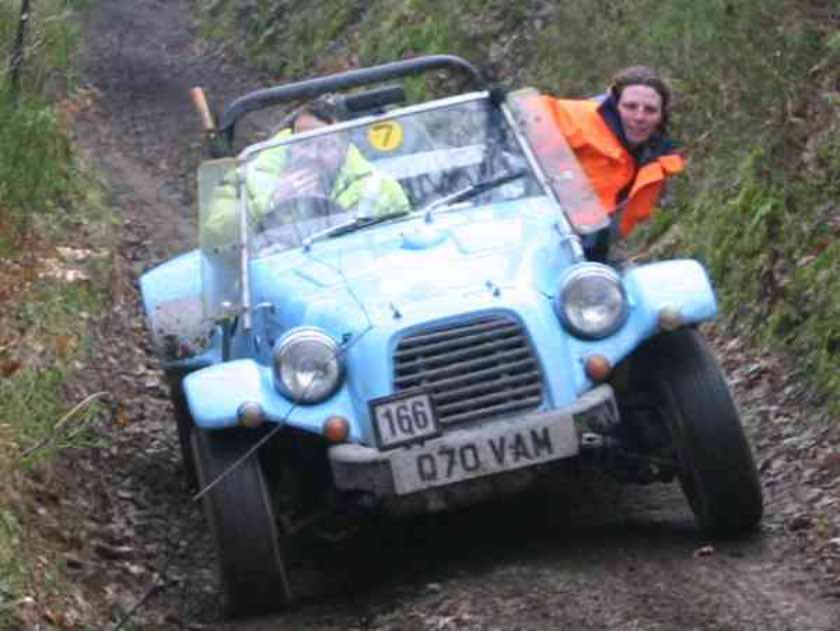
After gaining a coveted tin medal in the Lands End at Easter, it was time to move on to the “grown-up” stuff in Class 1 and given that we had already attempted some of the main route hills on the Edinburgh, it seemed a good event to make the step. Unfortunately work commitments had rather curtailed the summer maintenance season, but we had been able to raise the front suspension some more (courtesy of Fourtune engineering) and repaired the reverse gear selector (no more excuses for special test foul-ups), so we felt well equipped to tackle the usual challenges.

At the start we carefully took notice of the published breakfast arrangements and some other technical stuff about tyre pressures, but fortunately, in view of the problems the organisers had faced prior to the event no route changes. From the start we made good time to Haven Hill, which was a nice warm up for the hills ahead. There was a queue at Clough Wood, so we took advantage of this for a quick nap. Both this and the following Deeprake were enjoyable climbs, unlike the descent to the start at Litton Slack, where I foolishly went too fast and scared both of us silly – lesson learned! You get a good view of the hill from the approach and we had some good ideas about how to play it after passing the telegraph pole. As it was, just reaching the start was tricky (more like the 5 minute rule?), but we got going well and then ground to a stop after about 15 feet – so much for the plan. It had started raining heavily while we were waiting, whether that actually had any effect I don’t know, but that’s my excuse (I had previously commented favourably on the sunny weather –some people never learn). 

After Carlton it was time for an excellent breakfast at the Bull I’th Thorn. For reasons I can’t really understand we had been dropping back steadily all day, and were now running with cars that started 30-40 mins behind us, more of this later. 

At Haggside we had our first serious problem, the Golf’s clutch (of unknown vintage) has been suffering from the hammering it gets since the big wheels raised the gear ratio and at the restart I finished with the engine going flat out, clutch fully engaged and wheels not turning, lots of very expensive smoke and a fail. Because of this we approached Bamford Clough with some trepidation, not helped by the steady stream of failures returning through the village. In fact, although we didn’t get much past the parking space half way up, it was a real laugh, full throttle, lots of wheelspin, and that feeling that you’re hanging onto the hill by your fingertips. We even had the bonus of watching Colin Perryman power his way past us as we waited to return. At Great Hucklow, the cheer we got showed that the spirit was there, but unfortunately we stopped perfectly in the restart box. On the exit via the class ‘O’ route I was extremely annoyed to hit the same rock that I hit last year and write off another wheel. Judging by the number of people changing wheels at the end of the section and the state of the rock, we were not alone, does anyone know of a source of suitable explosives? 

On to the village hall at Hollingsclough, where the tea and scones were very welcome, although when we left it was starting to get dark and we were even further behind schedule. We couldn’t get up the steep bit at the start of Rakes Head and failed the restart at Excelsior, although it was good to see how much better the car went on this section than last year.

The combination of night and brain fade cost us some time as we got lost on the way to Wigber Low and Moneystones and we arrived very late at the finish, hence were declared as retired in the results. What did we learn? It’s a big but not impossible step up from class ‘O’ (We both feel that the class has real value as an introduction) and the schedule with more sections and distance to cover means you have to really work at it all the time. I’m not sure I stopped at the right place in the restart boxes and the question of tyre pressure was as imponderable as ever. We’re not sure why we seem to loose so much time, the tyre pumps we use are probably a bit slow, but that’s the only thing we can think of. 

Did we enjoy ourselves – most definitely. It’s really exciting just to be a part of such of a large event, even as an also ran, it’s a genuinely challenging competition, the people are friendly, the foods good,…. Once again a big thank-you to the organisers; and marshals for standing waiting for us in the very wet conditions and we look forward to next year.


We have been publishing stuff about Classic Trials on the Web since 1995 and always appreciate feedback. Comments, Corrections, Criticism & Concerns are all welcome. You can leave a comment to have your say here on this web site or our Social Media
Edinburgh 2005

It was a very competitive Edinburgh. Litton, Great Hucklow and the restart on Excelsior really shaking up the results. It certainly thinned out the triples. Only five cars and five bikes gaining the MCC’s premier award. The trial was well supported by Falcons, with 18 entries in the main trial and 2 in class 0. Colin Sumner put in the best performance, gaining Silver.

Ian Bates and his team organised a very different route with some interesting “new” hills. After a nice easy introduction at the tree lined Haven Hill the entry soon found itself at the foot of a rather rough Clough Wood, and an hours delay, even for the early cars, as some of the bikers were falling off. With a long section and a tricky restart for the higher classes the delay built up, so later numbers were waiting for the best part of two and a half hours, although having arrived an hour early they were not so far behind scheduled time.

The section was quite rough and the restart caught out both Keith Oakes and Maureen Chattle/Ross Neuton. Ted Holloway had problems with the ruts at the bottom and got his very special rear engined Mini wedged sideways across the track on the lower reaches. Barrie Parker was another Falcon to fail in the big Audi 80. 

Deep Rake was another very easy section, followed by a special test before the run to Litton. The descent was as hairy as ever, especially when the skies opened every now and again and the rain came down. The old hill was in fine form and only 15 cars made it to the summit. None of the cars in 1, 4, 5 or 6 got to the A boards, so the section didn’t count in the results. Brian Partridge was the first car to be shown it could be done in his Cannon and Pete Hart made a fine ascent to go clear. Waiting in the queue I saw Ray Goodright make a flawless climb in his Arkley MG and then Adrian Dommett and Julie Phillips fight and bounce their way to the summit after so nearly stopping just past the tree. I also saw Tim Whellock grind to a halt and loose his triple in the ex-John Parsons Fugitive. This was a real shame because Tim is taking over as Clerk of the Course for the Exeter and won’t get another chance for a while. 

Calton is starting to get ruttier again at the summit but there was plenty of grip and it only stopped one car, unfortunately Maureen and Ross in their Mk2 Dellow. There was an excellent breakfast waiting at The Bull I’th Thorn before going off to Haydale, with a very muddy and rutted approach to where the gradient and hard surface starts. The section defeated Barrie Parker and Ted Holloway who had to retire afterwards. 

The trial started to toughen up now, as the route wound its way down Winnats Pass and across the Ladybower reservoir to Haggside. This section was under threat a few years ago; full marks to the MCC for managing to keep it in the trial. As usual the main test was the restart just after the hairpin, right after the start. It can be very tricky if you don’t know its there, or position the car in the wrong place and it wasn’t that long ago it cost Falconry Editor David a triple. Most made it OK, although a few newcomers drove through before they realised it was there! It did stop a few though, including Colin Perryman in his lovely BMW and Falcons Peter Manning and Barrie Parker. 

After a holding control came Bamford, a true prince amongst trials sections. OK, Litton can be more challenging but Bamford brings out the brave! It was much smoother than in previous years, thanks to the MCC road gang. Class eight had to restart as well, just to stop them getting complacent. Running at the front of the field Dave Nash and Julie Fleet stormed up in the MGeetle. Neil Bray and Mike Hayward had problems getting away from the restart but a kindly marshal took pity on them and gave them a clear. Simon Robson cleaned the section in his Liege but to the sounds of tinkling from his transmission. Driving away from the hill it was clear all was not well with the ‘box and Simon and Matt retired. Peter Thompson was delighted to go clear but Bamford wasn’t kind to rear engined cars and Colin Sumner and Brian Alexander had their first counting stops of the trial. Earlier Clive Booth had struggled to get away from the restart, floored the throttle, spinning the wheels which fortunately dropped into a hole with plenty of grip and went on to clear.

Great Hucklow was its evil self with the rocky deviation up to the left for all but class 0. The yellows and reds had to restart amongst the rocks. John Parsons was amongst many who couldn’t get away from the restart which some would say was just s he was one of the team who created the deviation back in the days of the SODC Conquest Trial!

Kings Stearndale was not to create to many problems but after the tea stop at Hollingsclough came a couple of horrors. Rakes Head was only just up the road. It was short but quite tricky. It started on the road before a sharp 90 left and a severe rise in gradient, with a restart for yellows and reds. Clive Booth was defeated by the combination of restart and harsh camber and didn’t get away, although he backed down and got up with a run. Colin Sumner was delighted to get the Beetle away from the restart but Geoff Hodge had his first failure since Litton. At the front of the field Neil Bray got away but Dave Nash in the MGeetle couldn’t make it. 

Excelsior was the penultimate hill and was to prove a real sting in the tail. The problem was the restart, sited on polished stones just before a 90 left. Only 30 cars succeeded in getting away and none of these were Falcons! Class 0 tackled this one, although without a restart, and this was Verdun Webleys only failure. Verdun using the shopping Seat as the GTM wasn’t ready in time. Reg Taylor was more successful in his Anglia and went on to claim a class 0 award. Running at the back of the field the results show Simon Groves/Michael Leete as clear but they failed just like the rest. The “RB” was shown against Rakes Head (which they cleaned) and not Excelsior. 

The route then went away from Buxton towards Ashbourne and quite a few of the late runners at the tail of the field decided to skip the section and call it a day as the trial was running quite late at this time. Chief Official Mike Pearson greeted those that did the hill. It was none other than Wigber Low, normally tackled at the start of the trial but at the end this time and still in the dark for some! The restart was to trap the unwary, including Brian Alexander whose diminutive Fiat wasn’t running too well by now. 

After a final special test it was back to sign off at the Bull I’th thorn before most went back to Buxton for a nice club supper. It was a shame later runners were so late but this is what happens when the Edinburgh is run as a competitive trial and most competitors were willing to accept that. Well-done Ian Bates and his team. 


We have been publishing stuff about Classic Trials on the Web since 1995 and always appreciate feedback. Comments, Corrections, Criticism & Concerns are all welcome. You can leave a comment to have your say here on this web site or our Social Media
Lands End Class 0

Chris Clarke competed in Class 0 on the Lands End in his Golf. Here is his report.

When we first discussed the Lands End with experienced competitors; for some reason the impression we gained was one of a series of off and on road driving sections interspersed with meal stops – or was it the other way round? We like our food (the VW suspension is up-rated for good reasons) so it seemed a good idea to give it a go. Unfortunately at our first attempt the car ran out of energy (alternator failure) after only the third refreshment stop, so that was the end of it for 2004. 

For 2005 we set off in good time for the start to allow plenty of time for our evening meal, plus signing on etc. Suitably fortified we set off on the first road section, taking advantage of the holding control to fine tune the headlights, and then into Catsash, which we climbed without event. Whilst pumping up the tyres, we remarked on how difficult even the simplest task becomes at night, what with fiddling about with torches and if you drop anything small it’s gone for ever. 

On to Up Ewey and Grabhurst where it was noticeable how much more traction and control the new tyres gave over last year. What was more remarkable was how bright the moon had become; it was almost possible to drive without lights, although I suspect our navigator was not impressed by my practical demonstration of this. 

We left the Culborne Inn (bacon sandwich) and drove down Countisbury and up Porlock Hill, these are challenging in a modern car so it’s hard to imagine what they must have been like on an early c20th motorcycle.

The restart on Barton Steep was the first serious challenge, as the larger wheels on the Golf have raised the gear ratio and it took a lot of clutch slipping and some burning smells to ensure a fool-proof getaway. We were promised more of the same at Upper Molland and the feeling of trepidation was heightened by the optical illusion, as you descend into the clearing at the start, that the hill is steeper than it actually is. A VW beetle looked remarkably like its namesake as it climbed the track opposite. In fact the restart on loose surface was a lot easier on the clutch (obvious when you think about it) and we climbed it with only some wheel twirling on the corner.

Beyond this we were further than 2004, but no mention was made of this at the time for fear of “Murray Walkering” our chances until we reached the services at Roundswell (coffee & chocolate bars). Wargery and Roly Poly passed without incident and we continued to the café (control point) at Wilsey Down – ham, egg and chips with a mug of tea – excellent – and a chance for a nap in the sunshine. At Petherwin it was nice to see our first spectators there, but there was a scary moment as we rounded the first corner by Ruses Mill, trying to build up speed for an unknown gradient ahead and just missing a large stone covered with about 400 years worth of scrape marks.

We arrived at the Lady Vale test to a pressure building combination of spectators and the distant sound of a car struggling up something like the North face of the Eiger. In fact this test had one huge advantage, it was not necessary to engage reverse gear (refer to previous March Hare articles for an explanation of this), and we completed the test in what seemed a reasonable time, although I haven’t seen the results when writing this so may have to eat those words. The subsequent Mays Hill was very enjoyable and we approached Adrian’s Way with mounting confidence. 

The section was a bit slippery at the start, then a nice few yards to build up speed round the corner and a steepish climb to something I can’t tell you about because we never made it. There were two routes round the corner. I took the left hand one and avoided the rut, but unfortunately hit a large lump of earth on the inside which killed our momentum and we just did not have enough grip to make it to the top. At this point our navigator, quite out of character, suggested a more gung-ho approach which involved dropping a wheel into the rut (wall of death), thus firing the car round the corner and up the hill to certain success. At the time I was too surprised to challenge this view, but subsequently we concluded that you would have probably have either grounded with the wheel in free space or dented the (newly repaired) wing on the bank. 

We opted to do only the first part of Bishops path, a wise decision looking at what followed and stopped for a few minutes (sorry) to watch a Skoda literally fly over the top of the rock slope on the way to a clean. We’ve got a digital film of this if anyone is would like a copy. 

At Perranporth car park we could have spent the rest of the day explaining why we were driving around Cornwall in a car covered in mud, but had to move on the final section at Blue Hills. My apologies to all those who tried to encourage us to give the big one a go, but having spent the previous Saturday panel beating and with a good chance of making it home in one piece I didn’t want to take any chances and took the soft option. This took us safely to the finish control at the Crossroads Motel (yes that really is its name) where we relaxed and reflected on a very enjoyable event over a pasty and pint. It really is a pleasure to take part in an event on this scale and our thanks to the (literally) hundreds of organisers and marshals who make it possible. This particularly applies to those who cover the class O sections, where I imagine the smaller number of competitors makes it a bit quiet, but we really appreciate the chance to get used to these events in stages.


We have been publishing stuff about Classic Trials on the Web since 1995 and always appreciate feedback. Comments, Corrections, Criticism & Concerns are all welcome. You can leave a comment to have your say here on this web site or our Social Media

Lands End 2005

83rd Lands End Trial – It was a competitive Lands End despite the dry weather leading up to the event. The reintroduction of Cutliffe Lane and tricky restarts on Hoskins and Blue Hills One mean the MCC will not be paying out much for triples this year.

It was a nice dry night for the run in to eligibility scruitineering at North Petherton. 

Felons Oak – The restart box was very short, some of the competitors described it as almost a line but the boards were in fact about 6 feet apart, but there was limited scope for careful positioning in what is becoming an increasingly “competitive” restart.. This caught out around 50 competitors including the cars of Keith Oakes, Ted Holloway, Geoff Hodge, Peter Mountain, Brian Alexander and Bill Rosten for what was to be his only fail of the day. Simon Groves was judged to have failed to stop for the restart which was not a good start to his trial. 

Stoney Street – This long , rocky hill didn’t present to many problems although both Ross Nuten and Colin Sumner were delayed by other competitors and credited with baulks. 

Beggars Roost – The section had to be cancelled when Ian Bates in the course opening Land Rover found the track blocked by a vehicle. It soon became clear that this was put there deliberately by one of the local farmers. He became more than a little aggressive when Ian tried to reason with him and it was prudent to pull the hill rather than cause trouble in the middle of the night. 

Riverton – There was a lot of mud for the bikes and delays built up when a number of riders hit the deck. It’s a long section so the delays continued to build and by the final cars came along they were stacked up, not just on the approach track but well down the road as well. It wasn’t to challenging for the four wheeled brigade and PCT expert Nick Politt was one of the few to fail in his Nissan Micra. 

Cutliffe Lane – Another section with a lot of mud and clay that caused a lot of problems for the bikers to stay upright and stopped around half the cars, especially those running towards the end of the field. 

Sutcombe – The hill was used from a different direction this year. It wasn’t to difficult although it caught out both Brian Alexander in his Fiat and Giles Greenslade in his 1835 beetle which was starting to get a bit hot now the chill of the night had passed. 

Darracott – With the previous delays there wasn’t too long to wait at the Goosenham holding control. Just long enough for Simon Robson to adjust his clutch. Ed Nikel had been having problems with the front suspension on his buggy and on investigation found one of the shock absorber mountings had collapsed. Fortunately he wasn’t far from a friends place and diverted there for repairs that kept him in the trial, even though he slipped down the field. Ted Holloway had problems here as well and retired. 

Crackington

There was still evidence of the devastation caused by the flash flood last summer, although the bridge at the bottom of the hill had been rebuilt, saving some wet feet. The hill itself didn’t appear to have been doctored as much as usual, although there had been the usual localised rain shower in the restart area. There was a little aggravation here when one of the marshals in the restart area stood on the dry part of the track for a while, forcing competitors into the deepest part of the mire where some of them failed. There was some heated “discussion” with his fellow officials, in front of a sizable crowd, which didn’t do a lot of good to the image of the sport. 

Most of the bikes were able to cope quite well, although some of those who weren’t going fast enough lost momentum through the mire, lost “steerage way” and either had to foot or fell off. Those that were brave enough to go up at some speed had no problem. None faster than Chris Beare on his 350 Suzuki but goodness knows how much damage he would have done to himself if he had fallen off. 

Tony Young was the first car to arrive and had an unhurried climb. Then came another dozen bikes before the cars arrived in earnest. Mike Warnes was the first failure of the day in his very smart Triumph TR7. Former “Old Spot Piglet” driver Clive Cook was taking things very easily and stopped before the mire to become the second candidate for the very efficient recovery crews winch. Then came Richard Shirley in his Class Seven Dellow, who stopped and restarted, as did quite a few more class sevens who came a long later. It appears that some drivers were confused because although the route card said they didn’t have a restart the boards were yellow with a black R, indicating they should stop. Class eight only restarts being shown in the route card as red with a black R. 

In Class 1 Paul Allaway made a very impressive full throttle climb, neither slowing, nor deviating from his line through the tricky stuff. They were followed by David Symons who was equally impressive in his Citroen AX. Most of the cars in class 2 made clean climbs although neither Steve Potter nor John Wilton’s Trojans had enough power. It will be interesting to see if John Turner is shown as cleaning the hill. His Austin Seven stopped in the restart area before getting going again with a shove from the controversial marshal.

Giles Greenslade retired at the foot of Crackington with a very hot Beetle. It had been getting more and more overheated as the trial went on until Giles finally decided to retire rather than cause permanent damage.

After the hours break at The Wilsey Down at Hallworthy came Warleggan by which time Brian Alexander had to retire. 

Hoskin

Competitors with clean sheets approached Cardinham Woods with some trepidation as Hoskin was lying in wait. They weren’t to be disappointed. Hoskin is steep and under a layer of loose stuff there is a solid, polished stone surface. 

The lower classes weren’t to badly off as they were allowed a straight run through, but even so the hill couldn’t be taken for granted as its so steep. Lower powered engines can easily bog down unless they generate a bit of wheel-spin, but too much and you are in trouble on the slippery surface. In class four Dave Sargeant and Bill Rosten got it just right and flew up but Terry Ball had too much wheelspin, lost momentum and came to a stop in the class eight re-start area. Most of the powerful Escorts in class three and stormed to the summit, Simon Groves managing to wag his tail from side to side in the process.

In Class 2 Bill Bennett had no difficulty but the other members of his team didn’t do so well and Ian Williamson got well and truly stuck in his attempts to turn and go back down. 

Classes six and Seven had a restart on a more gentle part of the gradient but even if they got away it was difficult for them to build enough speed to get over the lumps and bumps in the class eight restart area. All credit to those that were successful, including Andrew Martin in his Dutton Melos and Roger Bricknell who had the audacity to change into second before the summit! In class six Mark Tooth did everything right and trickled away from the restart but was just unable to build enough speed and spun to a stop after a good attempt. 

If it was difficult for the lower classes it was really tough for class eight. Their restart was on the steepest part of the hill and there were lots of little steps and little rocks to trap the unwary. The main line was very slippery as the polished rock was exposed and no one, not even Dudley, could get away on this surface. The trick was to go either to the right or left and trickle away on the loose stuff, before putting the power down when it became a case of controlling the wheel spin as the track narrowed and the car forced onto the polished surface. Mike Chatwin got it right in his Troll and so did Ross Norman in his Deere Special who had no problems. David Bache managed to trickle off the line just right and although it was a struggle powered the Mk1 Dellow to the summit. Climb of the day though went to Tim Whellock. Wheelspin set in almost as soon as he left the line but he kept his foot down and he and Anne bounced and bounced and finally the Fugitive edged forward only to stop again as one of the front wheels came up against a rock. They repeated the process several times until finally the tyres gripped properly and the car flew to the summit. 

In the nearly, but not quite, category came Peter Mountain who went well to the right off the slippery stuff and pulled away nicely, but the camber dragged the Mk1 Dellow down onto the polished stone and that was that. Emma Flay went well to the left and trickled away from the line really nicely, keeping her wheels off those polished centre tramlines. It looked as if Emma would trickle her way to the summit but a front wheel came up against a rock, the Troll slowed, Emma blasted but didn’t have enough momentum and in the end had to give best to the hill. 

Bishopswood – There was a tricky restart for the Yellows and Reds, situated on the bump over the cross track as usual. It was far from straightforward and caught out Stuart Harrold who was running towards the front of the field. There was some unhappiness about the restart and many competitors thought that it was impossible for lower powered cars and a lottery for the others. 

Blue Hills 1 – Although this is a tricky section it hardly counts as a hill and this year the restart was a very narrow box right on the stone surface back on to the road. Unusually this was for Yellows Reds and Class Three! Car after car failed to get the necessary grip and failed. Ed Nikel had his throttle go over centre and shot out at an enormous speed, just avoiding the bank the other side. Fellow Falcon Colin Sumner had the reverse problem as his throttle became disconnected and he stopped without any power. This certainly wasn’t a Falcon friendly hill and only Keith Oakes and Ross Nuten were judged to be clean. 

Blue Hills 2

The hillside surrounding Bluehills 2 was thronged with spectators who had glorious weather for their afternoons entertainment. There was restart for yellows and reds in the middle of the artificial deviation. Most of the Sevens and Eights didn’t have a problem but the Beetles in class six struggled and neither John Sargeant nor Mark Tooth could pull away. Then along came Dave Sergeant who didn’t have to restart in his 1300 Beetle but failed anyway. He was followed by Terry ball who made up for his debacle on Hoskin and stormed up in his smart orange car. 

The outside bank on the artificial deviation claimed quite a few causalities as it acted as a magnet for Escorts and Midgets, many of which damaged their bodywork in the process. 

There was a new finish at The Crossroads Lodge at Scorrier where competitors reckoned it was an enjoyable and competitive Lands End.


We have been publishing stuff about Classic Trials on the Web since 1995 and always appreciate feedback. Comments, Corrections, Criticism & Concerns are all welcome. You can leave a comment to have your say here on this web site or our Social Media
Exeter 2005

This years Exeter benefited from a lot of work on the sections, making them more palatable for many and Simms achievable for the mortal. Normans Hump was difficult but there were still 67 gold’s awarded.

Dudley Sterry MG J2

It was a stormy night for the run down to Haynes museum. Rain and gusts of wind making driving conditions difficult and a tough night for bikers and drivers of open cars. A couple of the Falcons were lucky to make the start. John Parsons had found problems with the lights on his buggy, discovering that mice had gnawed their way though the wires and had a go at a CV joint gaiter as well! Neil Bray ran Primrose back and forth to work for a few days before the event to make sure everything worked OK. It was a good job he did, as the engine coughed and died. Neil eventually found the problem was with the Rotor arm and had problems finding a replacement for the special distributor that has to be used with side draft Webers. 

Scriutineering generated a bit of excitement, with numerous competitors given tickets because their rear lights couldn’t be seen from one side, obscured by the spare wheel carrier. The first competitive section was Windmill Hill, which is of course the exit road from Sugg Lane, which in turn became the exit road from Windmill Hill this time. This didn’t present any problems and neither did the next section. 

After Gatcombe Lane it was into Bovey Woods for Normans Hump and Clinton. Normans was challenging this year, especially for the higher classes who had to restart, as the box was positioned on the gradient after the cross track. This caused severe problems, either with getting going at all or failing to build up enough momentum to carry the car over the steep bit at the end. 

This fate befell a number of people, including Ed Nikel, who got within half a length of the section ends board. Peter Thompson didn’t have a restart in his Opel but was another to come to a stop within sight of his objective. It was certainly possible though. Peter Mountain and Mike Pearson both got cleans in class eight but Ian Davis didn’t get to the summit and John Pasons was given a run back on the restart. 

Class 5’s were denied the challenge of the upper reaches and deviated off with the ones and twos. Colin Sumner probably wished he was back in his Morgan. He had to do the full hill in his class four Beetle and couldn’t get out the top. Clinton was easier, with only the upper part of the section being used and the restart on the level so it didn’t trouble the scorer too much. 

Across the road was Waterloo, where there was a long delay, even for the early numbers in the main trial, as the class 0’s were having problems with their section, known as Rockenhayne, which is the failure route for the main trial. One of the Mini’s had got stuck broadside across the hairpin and by the time it was extricated a long queue had developed. Then a car over-turned. Even when the class 0’s had gone there was still a problem as classes one, two and five were using the escape road as their section, and every time one came along the recovery Landrover had to reposition from one section to another, causing the minutes to tick by. When the queue got all the way back to the road the marshals sent some of the cars up the escape road to keep things moving and the section had to be scrubbed from the results. 

Plyford didn’t stop anyone but there were more delays at Stretes, again caused by the Class 0’s who had difficulty with the leaf mould at the top and a few of them got well and truly stuck, a Beetle broke its transmission and a car turned on its side reversing back down. Things weren’t a lot better for the early runners in the main trial and the chief official soon cancelled the restart in order to get things flowing. 

The first cars were over an hour late at Exeter services, but still had to have the full 60 minutes rest break, time enough for many to pop to the local supermarket for petrol rather than pay motorway prices. In Fred Gregory’s case he and Pete Stafford tried to insert a spare leaf into the nearside rear suspension of their Rickman Ranger as it was sagging and the exhaust was banging on the prop-shaft. The delays built up and running down the field Stuart Harrold and Chris Phillips were two hours late for their breakfast. 

Tillerton was smoother than in recent years, but its still a difficult one and Peter Mountain ran back on the restart to loose his clean sheet. Fingle was its normal glorious self. A super blast round the hairpins with little chance of failing. Unless you had a puncture that is, like Dave Nash who had to resort to a tow from the rescue Land Rover when the wheel started to spin inside the tyre. Ian Bovill also had problems with his magnificent ISOC Sport, not surprising he had problems with the hairpins when you consider the wheelbase! 

Fingle was the scene of Nick Ikin’s first MCC retirement in 14 years of competition. Halfway up the car started making horrible noises and then it stopped steering. Nick kept going but after a couple more bends the car ground to a halt, lying on its belly. A critical eye-bolt had broken and it took considerable manhandling to get it onto a side track. Nick managed to rob a similar eye-bolt from the rear and block that corner up with a block of wood. This enabled the car to roll back down the hill to await the RAC.

The MCC had been concerned they would be able to use Wooston because of PR problems with the exit road. Fortunately these problems were solved and classes seven and eight were able to tackle the steep hill after the fork. Michael Collins had a go at this route as well in his Golf and was well on his way to getting up the hill when he realised his mistake and had to back down. This was a shame as his fail cost him a gold and probably the FWD All-Stars the team award as both Paul Allaway and Dave Haizelden went round clean. 

The restart caused problems for the early numbers and apart from Ian Davis the Falcons either failed to get away or couldn’t build enough momentum to keep going when the gradient was at its steepest. John Parsons made a valiant attempt but his wheels were spinning as he came away from the restart, he tried to back-off but lost speed on the steep bit and finally stopped. Ed Nikel made a good climb but again his wheels were spinning too much and he stopped on the upper reaches, high enough for the marshals to push him out the top. 

Running further down the field Mike Pearson made his climb when there was more grip but there was little doubt he would have cleaned the section anyway with his smooth driving style. Peter Mountain was smooth as well in his Mk1 Dellow and cleaned the section. The climb of the day was made by David Wall in the family Dellow. He pulled smoothly away from the restart, accelerated away and was still increasing his speed as he passed the section ends board. 

The lower classes were denied an assault on the main track and deviated off to the right as usual, with only class six having to restart. It wasn’t too much of a problem for most but neither of the Trojans had the momentum to get to the fork and nor did Derek Reynolds in the DAF who came to a halt with an un-believable scream of the drive belts. Ted Holloway had to retire his rear engined Mini here after failing the restart. 

The MCC road gang had spent done a lot of work on Simms during the summer, including bringing a Ready Mix truck along the exit track to the top of the section. So the organisers were concerned when a couple of weeks before the trial they heard their work had been damaged by a 4×4 invasion. Roger Uglade visited the week before and pronounced the section OK to use and on the day most competitors thought it was much smoother than the late few years. 

The old hill is a tough one, even though the restart for the higher classes gave them more of a run at the gradient than usual. Stuart Cairney was spectating on Simms, reporting that the results showed a number of failures as clearing the section! These included Dave Nash who’s MGeetle couldn’t make the gradient and neither could Fred Gregory. Barrie Parker also came to grief here with the big Audi 80. This was shame as Falcons multiple PCT champion was otherwise clean. There were organisational problems as the summit marshal didn’t record who got to the top of the section un-aided. So anyone who got to the A boards was given a clean. 

In class 5 Peter Manning didn’t clean the section but got past the A boards in his Midget to win class five. Keith Pettit wasn’t so lucky in his venerable Frogeye Sprite which was a pity as he had faster special test times. Like Dave Nash Keith had no less than three punctures during the event. Ed Nikel and Peter Thompson were both thrilled to clean Simms. It’s a tough section though and both Peter Mountain and Simon Groves had to retire with broken cars. Simon’s half shafts snapped as he bounced over the step, captured on video by Stuart Cairney, as was Dick Bolt who suffered a similar fate. Peter Mountain had the A frame sheer off the axle on his Mk1 Dellow. This damaged the rear of the gearbox and the prop-shaft and was glad to have a steel transmission tunnel to keep the flailing UJ away from his vitals. There were soon problems in recovering the car as the A frame was digging in the ground preventing Peter coming back down but it was soon accomplished with the many bodies that are always at Simms. 

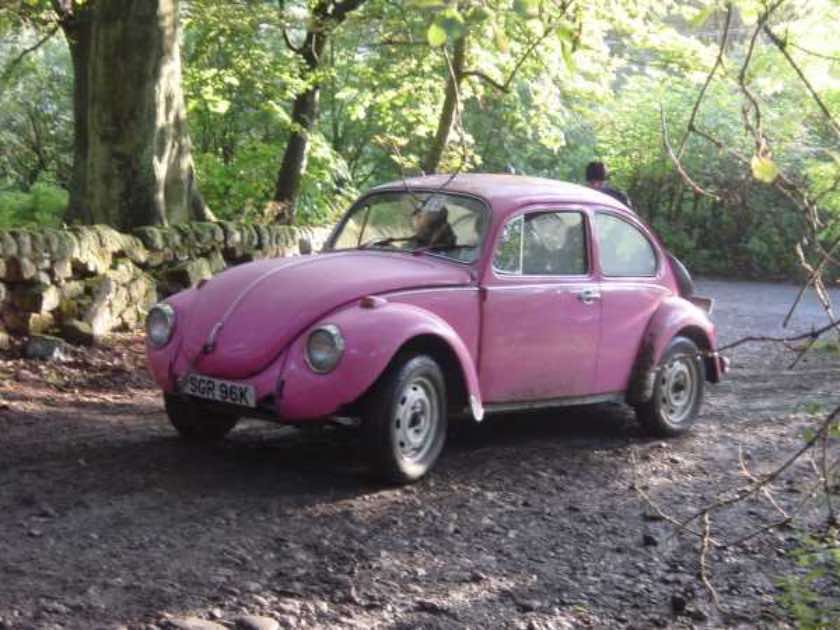
The trial was drawing to a close now, with only two sections remaining. Tipley was just over the road from Simms and was quite rough as usual. The gradient isn’t to severe though, so drivers can chose their line and it didn’t stop many, although it did catch out Colin Sumner in his shocking pink Beetle, quite a change from his usual Morgan. Slippery Sam was the final hill and only claimed a handful of victims this year as it didn’t’ have its usual re-start. 

The days activities were concluded by the usual club supper at the finish venue which was enjoyed and appreciated by All. MCC President Gerry Wollcott presented last years premier awards although he lost his struggle with an ineffective PA. The general conclusion was that this was good Exeter which finished on time despite the delays during the night.


We have been publishing stuff about Classic Trials on the Web since 1995 and always appreciate feedback. Comments, Corrections, Criticism & Concerns are all welcome. You can leave a comment to have your say here on this web site or our Social Media