You have stumbled on a delightful box of tricks, Classic Trials & other perverse stuff from Michael Leete. MCC ACTC and other trials. VW Beetles, Dellows, Marlins, or even Suzuki X90's
With no car available Michael Leete and Mike Hayward marshalled on the Clee Hills
Jeff Buchanan arriving at the hairpin on Phils Folly. It was t0o difficult in the morning, their were delays and the section had to be cancelled.The landowner came to the rescue and tried to improve conditions for the afternoon.All was well for a while but there were problems on the exit road and when Andrew Martin slid into the barbed wire the section was cancelled again.
As I am out of action regarding Trials Driving at the moment Mike Hayward and I decided to marshal on The Clee. We were sent to Phil’s Folly, a new section before the farm on the approach to Gattens Gamble, on the lower slopes of The Long Mynd. The journey there was interesting to say the least, because there was snow on the Shropshire hills so discretion was the better part of valour and we detoured around The Long Mynd.
The section started on a level, rutted track, hair-pinned round a tight right hander and went straight up a muddy tree lined gully before emerging on to the exit track which was recessed into the side of the hill. This was to be the scene of some problems as it was very slippery and later some cars went over the edge.
There were four of us on the section, Michael (Chief Official) and Richard from the MAC, Mike Hayward and I. It was an enjoyable, if challenging, day but we really struggled at times.
The first disaster was that the driver of the Discovery recovery vehicle went up to the hairpin and decided that he would get his vehicle too muddy, went back to the farm and spectated on Gattens Gamble for the rest of the day! After this, the four of us had real problems running the section and had to call on competitors and the farmer to help us.
The first car along was Jeff Buchanan. He couldn’t get his ex Dennis Greenslade Reliant round the corner, he was really stuck and we had to go and ask the farmer for help. He came along with a Mitsubishi 4WD but even that struggled and it was more than 30 minutes before we got Jeff out of the section.
Then David Bowlas got his Midget stuck in the same place but we managed to turn him round in the field and gave him a run at the section. However, he half slipped off the bank on the escape road and in the end, the only way we could extricate him was to lower him down the bank with a rope and winch (the farmer’s idea). By that time, we called Clerk of the Course Jonathan Toulmin and cancelled the section for the lower classes.
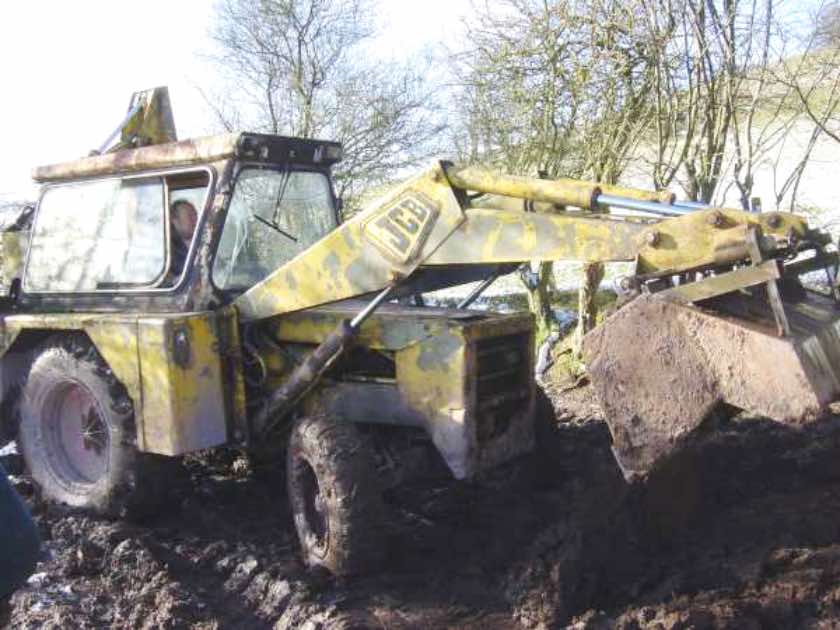
Determined not to give up the farmer bought along his JCB and scrapped the mud of the hairpin, coming down to a stone surface to give the afternoons runners a chance at the section.
Falcons Ian Davis was the first class eight. He rounded the hairpin without any difficulty and blasted up the muddy hill. We thought that as each car went up it would clean more mud away, making it easier for the later numbers. To some extent this was true, but it was too bring other problems as it wore the edge away at the top of the section and on the exit road, tending to drag cars off the track and down the bank.
Most of the class eights cleaned the section OK. It was all a question of getting the line around the hairpin right. Simon Woodall clearly knew all about the hairpin as he came along the approach track with one wheel out of the ruts and up the bank. Although this should have given him the possibility of a wider turn it didn’t work out somehow and his buggy under-steered straight on into the trees. The same befell Stuart Ridge in his flyweight. Tim Foster and Harry Butcher were two more who couldn’t get around in one bite and failed. Dave Foreshew got round OK but his GVS fluffed and stalled at the two marker and took a while to get going.
Difficult as the hairpin was the real drama was at the top of the section on the exit road.
Extricating the two class fives in the morning had weekend the edge of the bank and Simon Woodall’s VW Buggy slipped off the edge into the field below, only Simons skill as a driver preventing a nasty accident. The same thing almost happened to Stuart Harrold and Chris Phillips. The Troll was right on the edge and in the end Chris hoped out, and swung the front round at 90 degrees so Stuart could make a graceful if rather scary slide down the bank.
Most of the cars traversed the exit road OK but Tony Young saw what was happening and drove off the track and down the bank voluntarily.
By now the edge of the track at the top of the section itself was deteriorating and when Andrew Martin slipped off into the barbed wire on the section itself we had a group meeting with the experienced competitors in the queue and decided to call it a day! The farmer was more than disappointed and said that he would dig the track out and put some stone down so the section would be OK for next year!
We have been publishing stuff about Classic Trials on the Web since 1995 and always appreciate feedback. Comments, Corrections, Criticism & Concerns are all welcome. You can leave a comment to have your say here on this web site or our Social Media
Please help spread the word and share this on your Social Media:
My March Hare adventure started a few weeks before the event, when Michael Leete invited me to accompany him to West Yorkshire to look at a Dellow he was going to buy. Having done the deal and on the way home we talked about it’s role in Michael’s competition calendar.
He decided there and then to make the Southern Autos PCT at Brickhill the shake down event and then enter the March Hare. He asked me if I would like to be the passenger for these events. I said yes provided it was OK with the March Hare committee.
It was a little bit cold in the paddock at Brickhill and I began to wonder if I had enough clothes on. But down in the valley it was totally different as the cold wind was blowing above us. Very quickly it was our turn to attack the first section and things couldn’t have gone better, a clean and another clean on the next two hills. What a start. Those of you who were there know that half way around round two, we retired having found all the things wrong that you hoped you wouldn’t but knew you inevitably would. Worn out plug leads, points etc. etc..
Three weeks later, and the day of the March Hare. The day dawned bright and cold but without the predicted overnight frost. Our journey to the start was via the lanes of Hertfordshire rather than the main roads. Our route took us via Old Knebworth, Codicote passing a section near Nup End that was used in the March Hare of 1963, on through Wheathampsted, Harpenden to the A5 and the Truck Stop at Frias Wash.
We joined the queue for scrutineering hoping everything would be OK. It was except for a blown side light bulb. We caught up with all the gossip over a true truckers breakfast and we were ready for the off.
The route then took us back towards Stevenage via New Mill End and Peters Green to a holding control just outside Whitwell. We continued through the village to the first section Nortonstreet Lane, a relatively easy climb without the predicted ruts that were present last year.
On through St Pauls Walden and Preston to Section 2 and a regularity test at Whitehall Lane. I have to admit my education never included how many yards to a mile, only meters to a kilometre. Michael managed to work it out somehow and we went through the section in about 50 seconds.
We then continued on our way this time taking in the delights of the Luton southern bypass to arrive at Section 3, Half Moon Lane. By then it had started to rain and there was only a short queue waiting to find out how deep the mud bath would be this year. The answer, as we discovered, was not very, but the restart was a real test of the drivers skill. Michael placed the Dellow and with a little bit of wheel spin we were on our way again, with snow now falling.
Four miles further on the snow had stopped but the Marshals standing on the hill at Kensworth looked rather cold. Our attempt at the two sections laid out on the hill were not very good although I was surprised we got round the first corner on Section 4. While we were there, we witnessed the climb of the day by Ian Davis who stormed up the very slippery slope to clean Section 4 and ultimately go on to win the event overall.
The sun was out again when we arrived at Edlesbrough for three sections on the slippery hill. Our attempts matched those of the competitors in front of us. Ian Davis was again showing us all how it should be done. Lunch was taken after the third section at Edlesborough and time to catch up with the news from the other competitors.
Most of the entry was at Brickhill and the queue for the Special Test was nearly out the gate. Plenty of time then to take photos. We did alright at Brickhill, cleaning all three sections, all with restarts and all in bright warm sunshine.
Thirteen miles south and a totally new venue to me, came Ivinghoe. After the second Special Test there was another short wait until we could attempt the hill. This gave us enough time to fix the exhaust clamp which had come undone along the road from Brickhill. We were told that the restart had been taken out, so it was then a straight forward climb. Full revs were used to get us over the first steep bit of the section and then it was a long drive along the bank to the next little ridge where the restart should have been.
Continuing, the route then took us via the outskirts of Tring through Wiggington and Cholesbury to Section thirteen, Hawridge Lane, where we had quite a long wait in the lane before the section, caused by a vehicle coming the other way. I had expected some water in the bottom of the valley but there was only mud. The restart however was placed with tree roots all around and caught out a lot of drivers, ourselves included. Clive Booth was the man to show us all how to do it this time. Apparently he just stopped and then drove off the line without drama.
The route then took us back over Cholesbury common to the last section Hill Farm. to be greeted by a happy John Newberry and Ian Lawson who had thawed out from their time on the Kensworth bank. Hill Farm presented no problem and we were then heading for the finish via Berkhamsted, Water End and Flamsted. The results were posted while we had a cup of tea and the trophies presented soon afterwards. Congratulations to Ian Davis on a well deserved win and to the entire organising team including all the marshals and a “Thank you” to Michael Leete, for a very enjoyable day.
Mike Hayward.
We have been publishing stuff about Classic Trials on the Web since 1995 and always appreciate feedback. Comments, Corrections, Criticism & Concerns are all welcome. You can leave a comment to have your say here on this web site or our Social Media
Please help spread the word and share this on your Social Media:
1959 March Hare Trial – Sapsed’s Stopper – The final section on which everything appeared to depend for the results is tackled determinedly by I. C. Wilson (Wilson-Ford)
Unlike Falcon’s Guy Fawkes, which was based in The Cotswolds, its March Hare was a local Trial, using hills in the Herts, Beds and Bucks area. The first running of the March Hare was in 1958. But a trial was first held in June 1956 and again in 1957 when it was known as the Midsummer Trial. The trouble with running a Trial in midsummer is that you can’t see the tracks for the brambles growing along side, which means a lot of hard work clearing the tracks before you can run the event. So in 1958 the date was moved to March and given the name “The March Hare”. Tucker (H. W. Tucker-Peake – The driving Force behind Falcon and the MCC for so many years) was Clerk-of-the-Course and arranged two starts, one in Royston, the other in Hatfield. The finish was at the club’s headquarters, “The Chequers” in Woolmer Green. The main award, the appropriately named “Mad Hatter”, for Best Performance went to, N. Tyler, Best Category 1: F. Freeman, Category 2: A. Hay, Category 3: K. Hobbs. There was one serious incident that was reported on the 1958 March Hare when some competitors cars blocked the road at Hill House and a local resident was upset when the navigator of one car refused to move it.
As with the Guy Fawkes the March Hare seemed to change every year. In 1959 the Trial started from Lisles Garage in Woolmer Green and finished at the Kings Arms, Berkhamsted. Telegraph Hill was introduced to the route. This was, and indeed still is, a very steep hill on The Icknield Way Roman Road between Lilley and Pegsdon. It must have been one of the toughest hills in the trial. Today it’s part of a nature reserve. Another hill that must have been used about that time was Jeremiah’s Nob (also known as Jeremiah’s Hump) a chalk track in Barton-le-Clay which was quite easy in the dry but quite impossible in the wet. Another hill that was included was a hill Tucker called “Harlington” because it was at Harlington! Today it has a nice slab of concrete half way up which would make a good place for a restart. Back in 1959, the hill was just a nice muddy climb. It’s reported that “There was a smaller entry than the previous year but early morning rain did improve some sections”. The Mad Hatter award again went to N. Tyler.
There was another new start, Jacks Hill Cafe, in 1963. Jacks Hill is on the old A1 north of Stevenage. This was a traditional “Greasy Spoon” Transport cafe. Over the years, the building has played a big part in Falcon’s history. The Start of the March Hare in 1963, it later became a Night Club and bar called “The Silver Hall” and not only hosted Falcon’s annual dinners for a few years but became the club’s headquarters as well. Today it is still a part of the clubs history. Under the name of “The Big Pub” it’s the start and finish venue of the March Hare.
In 1964 The March Hare started in Hemel Hempstead, and finished in Berkhamsted. Starting in Berkhamsted meant that the route must have used “Tunnel Hill” in Nettleden and Hill Farm near Cholesbury. It is possible that the route also included “The Crong” near Dancers End.
In 1965 the 59 competitors in the March Hare Trial started from Stevenage to follow a 30 mile course to finish at the Roebuck Hotel. Seven sections were at Latchford Farm, and despite the good weather and apparent easiness of the course, only slightly more than a third of the entry were clean.
The March Hare of 1966 had the tea stop dropped from the route to avoid route troubles. What sort of troubles isn’t reported. The start was at Zenith Motors Stevenage with a route 15 miles long and finishing at Latchford Farm near Puckeridge.
You will have noticed that The March Hare’s road mileage was becoming shorter and the venues less. The trend continued in 1967. The first hill may have been called Bury Lane as its the continuation of a lane of the same name that runs from north of Datchworth to Watton Road, which links Knebworth to Bragbury End. This is now a Bridleway/Footpath. After Bury Lane, the route then included Leatherfield Common followed by Kings Hill. Leatherfield Common is south of Bennington and just north of Blue Hill and is a tree lined mud covered track between two fields. Kings Hill is a little further west, between Haultwick and Levens Green, and passes through a Ford before a short climb on a mud covered stony track. A road section followed this, to Latchford Farm, Colliers End, where the remaining sections were held.
By 1968 the trial had become a single venue event, which that year was held at Ringshall Farm near Hemel Hempstead. Despite the fact that only a single venue was used, the trial was still run under Classic rules. Class winners were, P. Marr, B. Walsh, P. Kerridge, F. Jackson, D. Piper, P. LeCouteur. Special Award to C. Morre1l, Best Lady Miss Ann Robbins. Other Falcon award winners were H. Frost, R. Robbins (both lst), M. Dockray, M. Murray, B. Butler. E. Walsh, Mrs. M. Knight (all won 2nd class awards)
The March Hare Trial was held at Ringshall Farm again in 1969. Class Winners that year were Class 1 P. G. Kerridge, Class 3 C. N. Morrell, Class 5 J. Ventur.
In 1970, the March Hare was held on the 2nd November as, the Guy Fawkes was held in March (very confusing). The venue was Tring Park, a picturesque venue on the outskirts of Tring, which became very popular with competitors. The 1971 event also took place in Tring Park but it had returned to a date in March.
It was touch and go as to whether the 1972 March Hare would take place as there was snow on the ground. Tucker took the decision to let the event run. It was a brave decision but in the end the weather got worse and the event had to be abandoned with one and a half inches of snow on the ground. Enough hills were run however to get a result:- Best Falcon, P. Le Couteur, Venus Cup, M. Furse, 1st Class Awards, D. Greenslade, C. Morrell, W. Hone, J. Tucker-Peake, D. Ovey, A. Davies.
The following year the conditions were completely different, Very dry. Despite Tuckers best efforts to stop the competitors, there were still seven clean sheets from the entry of sixty six. The result was decided on a tie deciding test with John Tucker-Peake the eventual winner in his 1600 cc Ford Pop. Laurie Knight took the award for best invited club in his 1500 cc Ford Escort fitted with a down-draught SU carburettor. Other class winners were Ian Blackburn. (Singer Le Mans). M. Clarke. (VW), J. Bonnett. (Morris), R. Walker (Mini) and Jack Frost. (Beach Buggy), who beat J. Whalley. (Ford Special) and Mike Furse (also in a Ford Special) in the tie deciding test. Cliff Morell was the best Imp on the day dropping 10 marks.
The missing committee minutes are no help again, in recording events until 1977, when The March Hare trial took place at Bury Farm, Houghton Conquest. Secretary: Alan Davies. Clerk-of-the-Course: David Maitland, Scrutineer: Simon Robson, Chief Marshal: C Brown. There were 32 entries, but one was sent home for misbehaviour!
By 1981 The March Hare Trial had been dropped from the calendar of events due to a lack of venues to run the event. With the loss of Tring Park, we had only one good venue at Bury Farm, Houghton Conquest and that was lost due to problems between the landowner and some of the clubs that used it to run events there. I have found an entry form for the 1980 March Hare to be run under Classic Regulations at Bury Farm. But as I can’t find any results or reports, I can only assume the event had to be cancelled.
Falcon was out of the trials scene for a few years, until 1995 when a one of the other local clubs became un-friendly to triallers and a number of renowned local enthusiasts joined Falcon, bringing with them years of organising experience and a host of contacts with local landowners. Soon Trials returned to the Falcon calendar and on 3rd March 1996 the March Hare took place on Edlesborough Hill.
The 1998 event was given the name “The March Hare Mini Classic”. The event was again held on Edlesborough Hill, only instead of having 8 or more hills laid out, there were only four. These were much longer than the previous years PCT type sections. The idea was to make them more like Classic Trials sections. The organisers (Mike Pearson & John Parsons) tried to run everything as close to Classic rules as possible. The morning went brilliantly with 8 challenging hills and two special tests for the 26 starters to enjoy. Unfortunately after lunch, rain made all the hills un-climbable and the event had to be abandoned. The special test times were used to decide the winner from the three clean sheets of, Fred Gregory (Dutton Melos ), Ian Davis (VW Buggy) and Henry Allen (Racecorp). Ian Davis was the winner with Fred Gregory, Tom Goggin and Murray MacDonald all winning their classes.
After the success of the first Mini Classic, the possibility of running another event, linking several venues together was discussed. By the time the year 2000 event took place four venues had been linked to road sections to make the event even more of a Classic Trial. The start and finish were at Brickhill on the 18th April. The competitors then followed the 62-mile route calling in at Mile Tree Farm, Edlesborough and Kensworth, returning to Edlesborough and Miletree Farm and Brickhill for a second time, to complete 14 hills and 2 special tests. Thirty starters enjoyed a smoothly run event, sponsored for the first time by Murray Macdonald’s company, Murray’s VW Spares, with favourable comments from most of the competitors.
It was felt after the 2000 event, that if we were to run a proper Classic Trial, a more suitable Start Finish venue should be found. The Big Pub, on the old Al Trunk Road at Jacks Hill had the space, but was a long way from the venues we wanted to use. The answer was to find some sections between Jacks Hill and the other venues to the west. A new route was planed taking in two sections in Whitwell. Cress Bed Lane and Water Tower Lane. Both lanes were used in the fifties (they were probably named differently). Cress Bed Lane is not very challenging in the dry but is a nice opening to any trial, as is Water Tower Lane which was again used in the March Hare of the Fifties. This hill is a lot longer than Cress Bed Lane and despite being only a few yards further up the hill, is more mud covered than Cress Bed Lane, which has a more stony covering. The route then headed out to Mile Tree Farm and Brickhill. After Brickhill there was another new section used as a special test at Ivinghoe before continuing to Edlesborough and Kensworth. After Kensworth, Half Moon Lane, at Markyate, was added before the competitors returned to Whitwell to climb Nortonstreet Lane and return to The Big Pub and the finish. Norton Street Lane was again used in the March Hare of the fifties but it had a lot more mud on the hill than it does today and as a result was much more of a challenge to the competitors.
Well that was the plan. However, delays in submitting the route to the RAC MSA, because the local Route Liaison Officer didn’t reply to our request’s for approval, forced the organisers to run the event became as a navigational scatter. Not what the organisers (John Parsons, Mike Pearson joint Clarks of the Course, or Verdum Webley, Secretary) or the competitors wanted at all. However 30 cars started from the Big Pub, with most of the competitors returning some hours later having enjoyed the hills, but not finding their own way to them! 2000 winner was Mathew Sharrett.
Having been caught out the previous year, the organisers of the 2001 “Murrays March Hare” started to prepare early in October. All was going well, with the route submitted and approved and the entry getting close to the maximum permitted (fifty). With a month to go to the big day, Foot and Mouth disease reared its ugly head again and the event was cancelled.
All that hard work was not wasted as we now had an approved route ready for the 2002 event and with three new sections added in Devils Pit, south of Barton-Le-Clay and a lunch halt at Ivinghoe everything was set for another March Hare Trial.
However, the 2002 event was not without its problems. The Big Pub decided not to open early for us, which meant that there were no loos or food available at the start. The 4-wheel drive people had churned all the sections at Devils Pit up, and it was very difficult to find three sections to lay out on the Saturday before. The day itself went without a hitch. There was a shortage of marshals on some hills but we just managed to scrape through. The weather was very kind as well and didn’t start to rain until after the last car had reached the finish. There were 32 entries and 28 starters with Ross Nuten the overall winner cleaning every thing in his Dellow.
That’s the story so far but it isn’t finished yet as Falcon’s March Hare is still going strong and there will soon be much more to add to The History Book.
We have been publishing stuff about Classic Trials on the Web since 1995 and always appreciate feedback. Comments, Corrections, Criticism & Concerns are all welcome. You can leave a comment to have your say here on this web site or our Social Media
Please help spread the word and share this on your Social Media:
Mike Hayward’s Falcon Clubmates help him change the diff after Beggars on the 2000 Lands End. Hey! I didn’t know Mk 3 Escorts were Rear Wheel Drive!
As some of you may know this is not the only Classical Gas. There are two more on the Internet, plus a printed version which is distributed with The Falcon Motor Club magazine. This is the main Web Site, which contains much of the material in the printed version, an archive site where lots of old material is stored and a “Web Community” which anyone can join and post pictures and messages.
The heart of this is a message board and sometimes there are some quite long “debates”. Mostly they are pretty un-eventful but following The Gill Morrell Trial things heated up.
It started with Mark Rosten-Edwards putting forward the view that it was unfair that Mike Hayward’s ex-Autocross Escort should be allowed to run in class three. MCC Chairman John Aley chipped in, reminding us that the MCC allows cars to be reclassified “on merit” and suggested that Mike wrote an application to Mike Furse.
Mike thought this was a great idea, responding to say that a letter was on it’s way. This prompted a post from Escortier Jason Daniel putting forward the argument that if Mike was allowed into class 3 he should be allowed to modify his car by fitting coil-over shocks. By now we were into the intricacies of five link rear suspension, Panhard rods and comparisons with the Kalber’s “Runner Bean” Pop.
Simon Woodhall donned his ACTC hat and explained that although the MCC re-classified cars the ACTC certainly did not! This prompted some a series of posts getting into the different philosophies of the MCC and ACTC which got quite exciting at times but stayed just within the “permitted rules of engagement”. It was then pointed out that Class 0 was another route, although only the MAC is the only club to run this class in one day events.
We had 16 messages in all, the longest debate so far on the web community. It was all good clean fun and fully justified the Web Communities existence as a forum for un-edited debate. Me, I’m looking forward to passengering Mike up Bluehills without a re-start!
We have been publishing stuff about Classic Trials on the Web since 1995 and always appreciate feedback. Comments, Corrections, Criticism & Concerns are all welcome. You can leave a comment to have your say here on this web site or our Social Media
Please help spread the word and share this on your Social Media:



 Classical Gas