Rhona’s Buckler

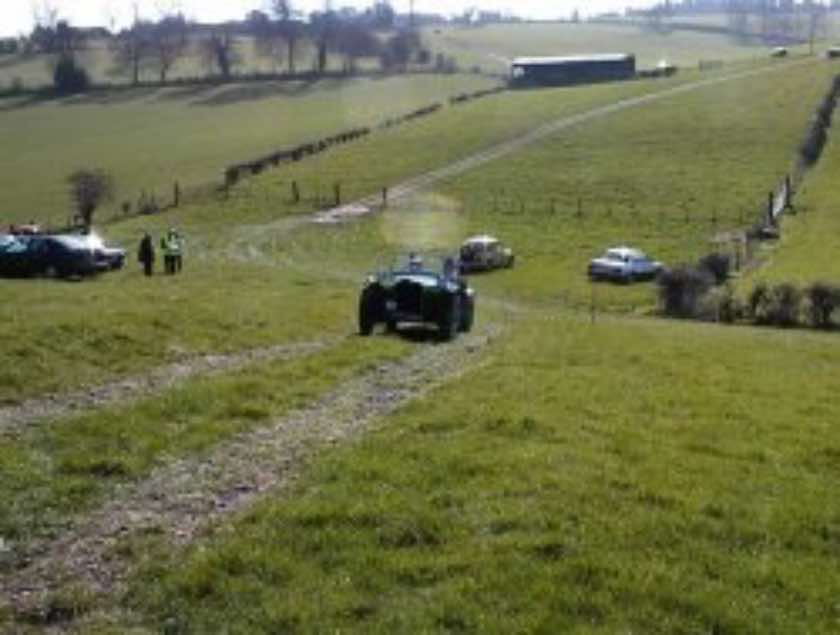
One of the really nice things about Classic Trial’s is the variety of machinery and crews taking part. Every event seems to bring out something or somebody new and the March Hare was no exception with Rhona Boswell making her début in the family Buckler Mk 6. The story of both car and driver are fascinating.

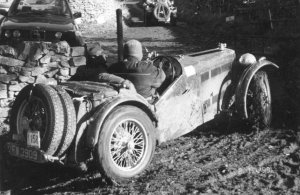
Rhona’s Buckler was re-built from a wreck by her husband Peter, who joined the MCC in 1992. Peter made a new body himself, using the nose cone from Stan Hibbert’s Mk 53. Peter used the car quite a lot on MCC events but Rhona never passengered him. Sadly Peter had a heart attack while he was at work a few years ago and died.

Rhona decided to keep the car and to keep it on the hills where it belonged. This was in the tradition of the cars history as it was used to hard work and had received a trophy for “most used car” at shows. It needed a lot of work but this wasn’t a problem as her daughters partners, Gary Booth and Steve Maskell are both pretty keen and it was Gary who drove the Mk 6 on the 1999 March Hare. This year Rhona decided to drive herself and enjoyed herself, despite a bit of clutch trouble. Lets hope she repeats the experience.

Some other Bucklers

There are quite a few Bucklers in the MCC. Mike Furse has one (or is it more?) and so does Exeter organiser Ken Green who owns a Mk 5 and also runs the Buckler register. You may have seen this car on this years Clee when it was driven by Dave Lucas.

Stan Hibberd is another enthusiast. Stan bough his car back in the early 60’s, used it mainly for autocross and has owned it ever since. He used to race it back then and it made it’s re-acquaintance with a race-track when Stan drove it in a most spirited fashion in a lunchtime demonstration at last years MCC Silverstone bike meeting. Not bad for a guy who had recently recovered from a heart operation!

Bucklers

The Buckler was one of the first commercially available “specials” or “kit cars”. Derek Buckler started by making a car for himself in his well-equipped engineering shop back in 1947. DDP 201 had a tubular construction, space frame chassis and a Ford 10 engine.

Derek used his car with some success in club motorsport of the day and decided to go into production with the design. He had referred to his own car as the “Buckler Colonial”, but he started production with the Buckler Mk V! Derek’s expertise was in building the frame or chassis. Constructed from 40 ton/sq. in tensile CDS alloy steel tube these frames weighed in at 60 to 75 lbs., depending on the model, and being extremely rigid did not require the panelling to help stiffen up the chassis. In consequence, most Bucklers are very light, some weighing little over nine hundredweight. Derek’s idea was to sell the Mk 5 as a general-purpose two seater competition car, that you could use for anything, from 1172 formula racing to trials.

The first production Mk 5 was ERD 96, purchased for speed events by Mike Parrott. Mike bought from Buckler without the body, which was made from aluminium by the man next door! Derek generally sold his cars without a body, thus avoiding paying the 30% purchase tax of the day. The guy next door built bodies for a lot of the cars but owners were free to go where they wished which is why many Bucklers look so different.

Derek went on to build about 500 Bucklers in his Reading factory before ill health forced him to sell-up in 1962. The new owners only built a couple more cars before they closed the business. The number of cars that still survive are testimony to the strength and success of the original design. The great variety of specifications is due to the sheer number of options that were available, most of which were produced in-house. I.F.S conversions, special springs and wheels, alternative diff and box ratio’s and many stages of engine tuning were just for starters. Clearly an enthusiasts dream.


We have been publishing stuff about Classic Trials on the Web since 1995 and always appreciate feedback. Comments, Corrections, Criticism & Concerns are all welcome. You can leave a comment to have your say here on this web site or our Social Media

Edinburgh Notes – By Mike Furse

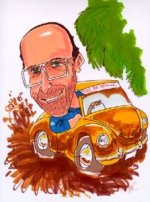
An Edinburgh Montage, featuring Andrew Brown, Pete and Carlie Hart, Ken Green and Terry Ball in the only competing Class Six Beetle. The organisers are trying to clamp down on class 6 so they handicapped him by making him drag his spare wheels to the top.

A few comments from my Edinburgh. Peter Manning certainly whitewashed class five with the only clean sheet. The next best being a bronze. I’m particularly pleased for Gary Booth who has persevered with his old and rather delicate Buckler, which was built by his late father-in-law, and looks like winning the Buckler Register’s trophy for the most successful Buckler in 1999. (To be fair to the others he hasn’t really had a lot of competition this year!) 

I should have got a bronze, but choose to park one front wheel against an outcrop on the restart at Calton, under the eye of Peter Mountain, who will, no doubt, remind me of the incident for some time to come! The other two hills I failed were a bit of a lottery. It rained as I approached Great Hucklow so a successful climb from a restart with 18 psi in the tyres was a bit much for me, and by the time we reached Pindale at the tail end of the trial it was rather dug out to say the least. Not a good excuse, that one, as Arthur Vowden climbed it just after me! Incidentally, I discovered before the start that my Racecorp does not comply with the ACTC Kitcar Spec. sheet, recently revised. I declared this at the start and put myself in Class 8. So, we had the rather strange situation of one Racecorp in Class 8 and the other in Class 7. No one at the A5 scruitineering point was interested at all and the results team didn’t pick it up. Because of the rather strange practice that the Edinburgh organisers have of making Classes 6, 7 and 8 do exactly the same things throughout the trial, it didn’t make a bit of difference, but I hope it can be sorted before I use the Racecorp on a Classic again. 

I met Robin Howard at the breakfast halt. He had an alternator problem and was going to do a few hills before the battery gave up. Then he would go home! Another thing the results team didn’t pick up was that Col (Colin Stevens) used a Skoda instead of the Dutton Special. I suspect that if you don’t finish they don’t bother to check all the details! Alan Bellamy didn’t run after putting a screwdriver through his finger but was well enough to go up to marshal on Corkscrew, for which the club is suitably grateful! I’m told that when we next see the Brasilia, we should be prepared to be impressed….

Bill Bennet exiting Litton in his MG (picture by Ken Green

The cancellation of Putwell for the car classes was inevitable. We were badly let down by the filling station at Newhaven, who apparently couldn’t distinguish between Saturday and Sunday. As a result, the bikes had severe problems finding fuel, and hence got very late indeed. This was not helped by conditions at Excelsior, where a lot of the bikes had great difficulty. This caused such a delay that Dave Turner and Adrian Tucker-Peake established an adhoc control in the village. The villagers, bless them, did not appear to be upset. At one time, we had about 60 cars there and everyone behaved extremely well, although the running order got very distorted! Some competitors were dismayed at the amount of mud left on the main road leading out of the village and there is a looooong storey of how John Hayes dealt with this problem. Suffice to say that the duty policeman who took his call could not believe that the person who made the mess was actually reporting it and offering to pay to clean it up! 

Looking back at the event as a whole, as a competitor I felt it went as well as could be expected, given the difficulties the organisers had. I certainly enjoyed it and have had many positive comments from other competitors. One of the most positive things that I felt about this event is that, at long last, we seem to be building up the popularity with the locals that the Exeter and, particularly, the Lands End have enjoyed for some time.


We have been publishing stuff about Classic Trials on the Web since 1995 and always appreciate feedback. Comments, Corrections, Criticism & Concerns are all welcome. You can leave a comment to have your say here on this web site or our Social Media