You have stumbled on a delightful box of tricks, Classic Trials & other perverse stuff from Michael Leete. MCC ACTC and other trials. VW Beetles, Dellows, Marlins, or even Suzuki X90's
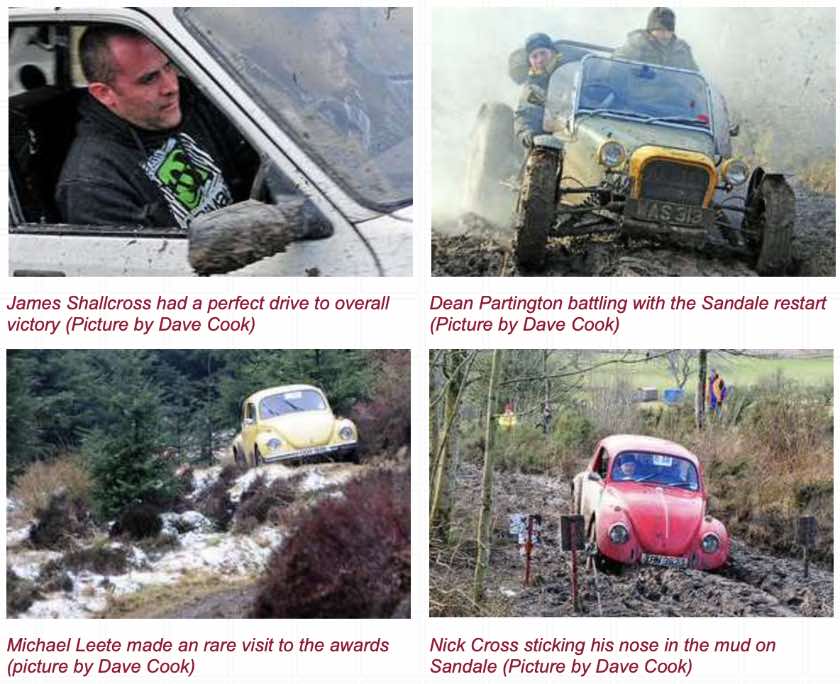
James Shallcross was best overall, dropping 11 marks in his Class 1 Peugeot 205 on an excellent, but poorly supported, Northern Trial
Despite the wet conditions there was plenty of grip on most of the sections. Fell Side had got their class Handicaps pretty much right, with only two marks separating the first three overall, representing three different classes. Michael Leete made a rare visit to the award winners circle and was second overall, dropping 12 in his familiar Beetle, followed by Nick farmer on 13 in his Cannon Alfa.
The organisers must have been very disappointed to receive only 19 entries in the main car classes, reduced to 17 starters when the field left The Stocksman in Wigton.
Wasteland
The action commenced with Jonathan and Pat Toulmin in charge of the first special test. This was on some wasteland at a venue used for a section called Oblivian on the first Northern Trial. This was immediately followed by a muddy section named A Bolivian. There were no re-starts but the higher classes had a deviation, costing Nick Farmer a valuable mark which would be significant later.
Into The Forest
Section 2 saw the first of many forestry sections, the hallmark of The Northern Trial. Despite the apparent mud on Black Hole there was quite a lot of grip and like many of the sections the ruts were not as deep as in previous years. Steve Kenny was having issues with his Liege and dropped nine before retiring a few sections later with a broken A arm and cracked axle case.
After a seven mile road run the trial entered Whinlater Forest for a concentrated batch of sections, starting with Sheepfold, which saw some high scores. John and June Blakeley were in charge here with John conducting a noise test for good measure. Roger Goldthorpe was best of the Lieges on 11 with both Julian Lack, and the shortly retiring Steve Kenny, loosing a full 12. The hill didn’t seem to suit lower powered cars as although there was plenty of grip there wasn’t a lot of run in to the initial steep slope.
Snow on the Hills
Climbing through the extensive forest, some of the overnight snow remained when cars got to Ullister Hill, to get their picture taken by Dave Cook. There was plenty of grip lower down the stoney track but the section continued when this gave out and it was muddy at the top. Only Dean Partington went clear to be the only car remaining with a clean sheet.
There were some superb views down to Bassenthwaite Lake on the way round the sections in this part of the forest, before the route retraced its steps, going back on the road for a short distance before entering Hobcarton Plantation. Everyone lost marks here but it wasn’t until Ladyside B that Dean Partington lost his clean sheet.
Dean didn’t loose any more marks until the penultimate forest section at Routens Romp, where fell Side had introduced a deviation into the trees for all, preceded by a restart for the higher classes. This was to decide the trial. Like most of the 7’s and 8’s Dean dropped nine here, while the leading (and non-restarting) lower class competitors went clear. As difficult as this section was for the higher classes Nick Farmer proved it was possible and this put him into the overall lead of the trial.
Sandale Decides the Winner
It was fitting that the final section at Sandale decided the winner of The Northern Trial. The higher classes had their usual restart in the mud. None of them could get away, costing Nick 3 marks and dropping him into third place behind James Shallcross and Michael Leete, who had made good consistent climbs all day.
All in all an excellent trial with good sections and plenty of marshals. Lets hope it will be better supported in the future.
We have been publishing stuff about Classic Trials on the Web since 1995 and always appreciate feedback. Comments, Corrections, Criticism & Concerns are all welcome. You can leave a comment to have your say here on this web site or our Social Media
Please help spread the word and share this on your Social Media:
With no car available Michael Leete and Mike Hayward marshalled on the Clee Hills
Jeff Buchanan arriving at the hairpin on Phils Folly. It was t0o difficult in the morning, their were delays and the section had to be cancelled.The landowner came to the rescue and tried to improve conditions for the afternoon.All was well for a while but there were problems on the exit road and when Andrew Martin slid into the barbed wire the section was cancelled again.
As I am out of action regarding Trials Driving at the moment Mike Hayward and I decided to marshal on The Clee. We were sent to Phil’s Folly, a new section before the farm on the approach to Gattens Gamble, on the lower slopes of The Long Mynd. The journey there was interesting to say the least, because there was snow on the Shropshire hills so discretion was the better part of valour and we detoured around The Long Mynd.
The section started on a level, rutted track, hair-pinned round a tight right hander and went straight up a muddy tree lined gully before emerging on to the exit track which was recessed into the side of the hill. This was to be the scene of some problems as it was very slippery and later some cars went over the edge.
There were four of us on the section, Michael (Chief Official) and Richard from the MAC, Mike Hayward and I. It was an enjoyable, if challenging, day but we really struggled at times.
The first disaster was that the driver of the Discovery recovery vehicle went up to the hairpin and decided that he would get his vehicle too muddy, went back to the farm and spectated on Gattens Gamble for the rest of the day! After this, the four of us had real problems running the section and had to call on competitors and the farmer to help us.
The first car along was Jeff Buchanan. He couldn’t get his ex Dennis Greenslade Reliant round the corner, he was really stuck and we had to go and ask the farmer for help. He came along with a Mitsubishi 4WD but even that struggled and it was more than 30 minutes before we got Jeff out of the section.
Then David Bowlas got his Midget stuck in the same place but we managed to turn him round in the field and gave him a run at the section. However, he half slipped off the bank on the escape road and in the end, the only way we could extricate him was to lower him down the bank with a rope and winch (the farmer’s idea). By that time, we called Clerk of the Course Jonathan Toulmin and cancelled the section for the lower classes.
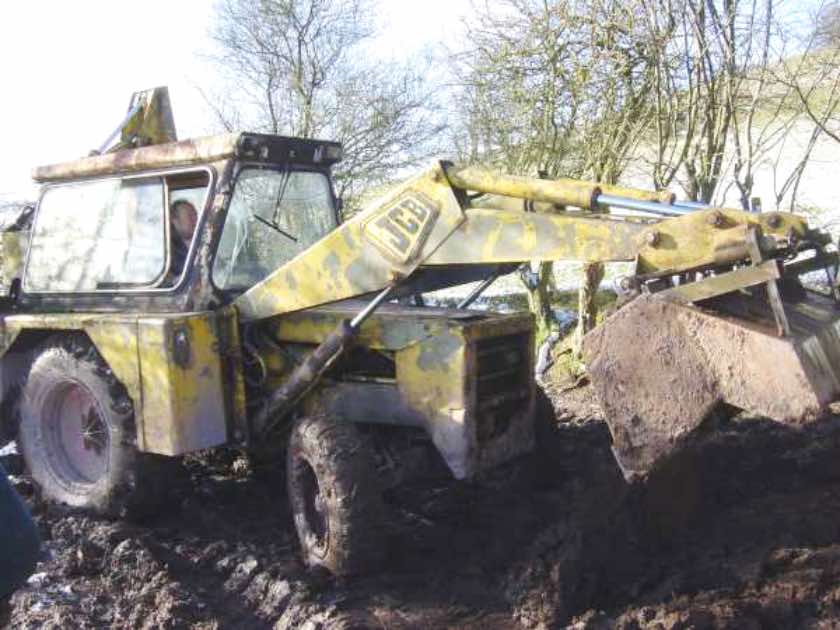
Determined not to give up the farmer bought along his JCB and scrapped the mud of the hairpin, coming down to a stone surface to give the afternoons runners a chance at the section.
Falcons Ian Davis was the first class eight. He rounded the hairpin without any difficulty and blasted up the muddy hill. We thought that as each car went up it would clean more mud away, making it easier for the later numbers. To some extent this was true, but it was too bring other problems as it wore the edge away at the top of the section and on the exit road, tending to drag cars off the track and down the bank.
Most of the class eights cleaned the section OK. It was all a question of getting the line around the hairpin right. Simon Woodall clearly knew all about the hairpin as he came along the approach track with one wheel out of the ruts and up the bank. Although this should have given him the possibility of a wider turn it didn’t work out somehow and his buggy under-steered straight on into the trees. The same befell Stuart Ridge in his flyweight. Tim Foster and Harry Butcher were two more who couldn’t get around in one bite and failed. Dave Foreshew got round OK but his GVS fluffed and stalled at the two marker and took a while to get going.
Difficult as the hairpin was the real drama was at the top of the section on the exit road.
Extricating the two class fives in the morning had weekend the edge of the bank and Simon Woodall’s VW Buggy slipped off the edge into the field below, only Simons skill as a driver preventing a nasty accident. The same thing almost happened to Stuart Harrold and Chris Phillips. The Troll was right on the edge and in the end Chris hoped out, and swung the front round at 90 degrees so Stuart could make a graceful if rather scary slide down the bank.
Most of the cars traversed the exit road OK but Tony Young saw what was happening and drove off the track and down the bank voluntarily.
By now the edge of the track at the top of the section itself was deteriorating and when Andrew Martin slipped off into the barbed wire on the section itself we had a group meeting with the experienced competitors in the queue and decided to call it a day! The farmer was more than disappointed and said that he would dig the track out and put some stone down so the section would be OK for next year!
We have been publishing stuff about Classic Trials on the Web since 1995 and always appreciate feedback. Comments, Corrections, Criticism & Concerns are all welcome. You can leave a comment to have your say here on this web site or our Social Media
Please help spread the word and share this on your Social Media:
Michael with Mike Hayward in his Dellow on The March Hare. The high bonnet line, outside fiddle brake and abscence of doors identify it as a Mk 1.As can be seen from this picture there is a lot of work to do to bring the car back to good condition.
I have had many years of enjoyable trialling in my Yellow Beetle since I bought it back in 1990. It’s been developed into a very capable Classic Trials car, but in recent years I found it lacking in two respects.
When I changed to a 1300 so I could compete in class 4 to reduce the number of re-starts I managed to obtain the ex-Robert Clough Triple winning engine. This is a great motor for classics, but is far to “peaky” for the local PCT’s,.
The family bought me a Nova for Christmas and I had fun in that until Murray arranged for me to passenger Dudley Sterry which decided me I wanted an open car. A Troll was my first choice and I had my eye on David Aldersons car before David Thompson snapped it up.
Then, on this years Clee Hills I suddenly decided to get a Dellow. Not an original spec car, an 1172 side valve and 3 speed box wasn’t appealing, No, I wanted a class 8 cross-flow car.
It was remarkably easy to find one. An e-mail enquiry to The Dellow register put in me in touch with Jim Harvey who told me there were two cars available that fitted my spec. One was in the West Country in good nick, the other in Yorkshire and a bit tatty. They were both the same price! Further questioning revealed that the good one had worn three registration numbers in its career and it didn’t have a chassis number. The tatty one had a complete provenance and that was the one that ended up in my garage.
It’s a Mk1 which means no doors, a high bonnet line at the front and that glorious outside fiddle brake. It left the factory on 8th December 1950 for The Regal garage in West Croydon who had it on their books until 2nd May 1951 when it was bought by a Mr Herbert Wilson. He sold it three years later and it went though a succession of owners until it ended up disused in a barn near Chichester.
It came to light again during a house clearance and was acquired by Porsche enthusiast Peter Wilson who had it converted to its present spec by his local agricultural engineer.
The conversion is functional rather than elegant. The Escort axle has a much wider track than the original so the wheels stick out. Most conversions use the narrower axle from a 105E. The other very noticeable thing is that the air filter sticks out of the bonnet which rather offends the purists.
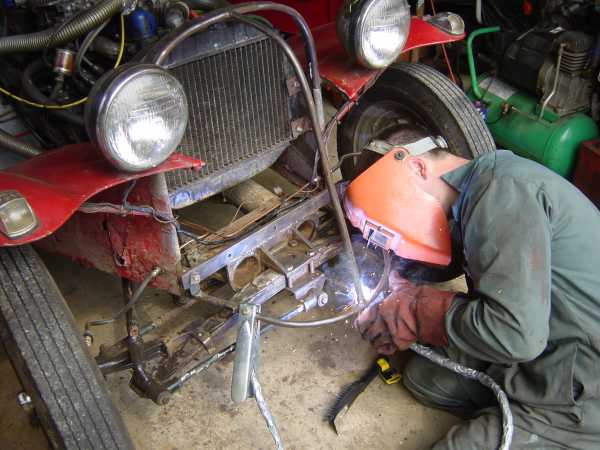
Frankly a lot of the engineering on the conversion was not done very well and as the body has never been restored it is not a pretty car. That is part of its charm. It goes and I can use it but there is plenty of scope for me to exercise my mechanical skills.
In the time I have owned it I have completely stripped and rebuilt the brakes, introducing me to the joys of making brake pipes. Fifty years of grime and rust have been cleaned from half of the chassis and new paint applied. I have also done quite a bit of re-wiring and got some of the instruments to work.
It has had five competitive outings, two PCT’s, the March Hare and two autotests. I have discovered that under high bonnet temperature can cause it to refuse to start when hot, so I have fitted a decent electric fan which seems to solve the problem.
So I am certainly enjoying my Dellow but it will be a while before it ventures to far from home. First because it needs a lot more work before it can be trusted mechanically. The second is that I have to find a way to fit my lanky 6ft frame into it properly!
Following “Me and My Dellow” I had an interesting email from Nigel Brown which he has given me to publish here:-
Michael,
Very pleased to see you have joined the Dellow brigade. I ran my Mark 1 in various forms over the 17 years that I trialled it.
Gutless E93A on original SU’s.
E93A plus Shorrocks.
100E plus Willment OHIV on SU’s
100E plus OHIV plus Shorrocks
and finally 1500 pre cross-flow Ford on SU’s.
Sold ECL 787 in ”87 as I had got the Allard Special well sorted by then and I needed the money to help restore our C16th ruin of a cottage! I still have the (basket-case) Lightweight Dellow (and the above OHIV engine) that Tony Marsh built for speed events. Terrific photo of it on the grid at ’54 Silverstone over on the Dellow Register website.
Even with the well tuned 1500 my Dellow never ran hot on its original radiator. Yours looks to have been fitted with a very much smaller modern rad.
Terminology. Dellow’s don’t have “fiddle brakes”. NTF cars do – to operate either back wheel, Dellows never did. The outside handbrake on mine (when on original cables) operated front brakes when pushed forward and vice versa.
Wide axle. When Peter Le Couteur and I set about putting a “modern” axle in our Dellows we discussed and arrived at the following. 105E axle. In standard form the pinion flange is in fact offset to one side. By cutting opposite side casing only (around 2″ from memory) we brought axle width down and centralised pinion. We had just one halfshaft to respline, recut along shaft (using originals to register cutter) and then finally took the approx. 2″ off the end. This, with 4-to-5 stud adaptor plates we made, gave us exactly the same width rear track as the original axle.
If you have any queries and think I may be able to help, please don’t hesitate to email or phone me. You deserve a medal for the website, it is informative and unfailingly interesting. It is now the only way that I keep in touch with the sport.
Good luck with the Dellow.
Regards
Nigel Brown
We have been publishing stuff about Classic Trials on the Web since 1995 and always appreciate feedback. Comments, Corrections, Criticism & Concerns are all welcome. You can leave a comment to have your say here on this web site or our Social Media
Please help spread the word and share this on your Social Media:
My March Hare adventure started a few weeks before the event, when Michael Leete invited me to accompany him to West Yorkshire to look at a Dellow he was going to buy. Having done the deal and on the way home we talked about it’s role in Michael’s competition calendar.
He decided there and then to make the Southern Autos PCT at Brickhill the shake down event and then enter the March Hare. He asked me if I would like to be the passenger for these events. I said yes provided it was OK with the March Hare committee.
It was a little bit cold in the paddock at Brickhill and I began to wonder if I had enough clothes on. But down in the valley it was totally different as the cold wind was blowing above us. Very quickly it was our turn to attack the first section and things couldn’t have gone better, a clean and another clean on the next two hills. What a start. Those of you who were there know that half way around round two, we retired having found all the things wrong that you hoped you wouldn’t but knew you inevitably would. Worn out plug leads, points etc. etc..
Three weeks later, and the day of the March Hare. The day dawned bright and cold but without the predicted overnight frost. Our journey to the start was via the lanes of Hertfordshire rather than the main roads. Our route took us via Old Knebworth, Codicote passing a section near Nup End that was used in the March Hare of 1963, on through Wheathampsted, Harpenden to the A5 and the Truck Stop at Frias Wash.
We joined the queue for scrutineering hoping everything would be OK. It was except for a blown side light bulb. We caught up with all the gossip over a true truckers breakfast and we were ready for the off.
The route then took us back towards Stevenage via New Mill End and Peters Green to a holding control just outside Whitwell. We continued through the village to the first section Nortonstreet Lane, a relatively easy climb without the predicted ruts that were present last year.
On through St Pauls Walden and Preston to Section 2 and a regularity test at Whitehall Lane. I have to admit my education never included how many yards to a mile, only meters to a kilometre. Michael managed to work it out somehow and we went through the section in about 50 seconds.
We then continued on our way this time taking in the delights of the Luton southern bypass to arrive at Section 3, Half Moon Lane. By then it had started to rain and there was only a short queue waiting to find out how deep the mud bath would be this year. The answer, as we discovered, was not very, but the restart was a real test of the drivers skill. Michael placed the Dellow and with a little bit of wheel spin we were on our way again, with snow now falling.
Four miles further on the snow had stopped but the Marshals standing on the hill at Kensworth looked rather cold. Our attempt at the two sections laid out on the hill were not very good although I was surprised we got round the first corner on Section 4. While we were there, we witnessed the climb of the day by Ian Davis who stormed up the very slippery slope to clean Section 4 and ultimately go on to win the event overall.
The sun was out again when we arrived at Edlesbrough for three sections on the slippery hill. Our attempts matched those of the competitors in front of us. Ian Davis was again showing us all how it should be done. Lunch was taken after the third section at Edlesborough and time to catch up with the news from the other competitors.
Most of the entry was at Brickhill and the queue for the Special Test was nearly out the gate. Plenty of time then to take photos. We did alright at Brickhill, cleaning all three sections, all with restarts and all in bright warm sunshine.
Thirteen miles south and a totally new venue to me, came Ivinghoe. After the second Special Test there was another short wait until we could attempt the hill. This gave us enough time to fix the exhaust clamp which had come undone along the road from Brickhill. We were told that the restart had been taken out, so it was then a straight forward climb. Full revs were used to get us over the first steep bit of the section and then it was a long drive along the bank to the next little ridge where the restart should have been.
Continuing, the route then took us via the outskirts of Tring through Wiggington and Cholesbury to Section thirteen, Hawridge Lane, where we had quite a long wait in the lane before the section, caused by a vehicle coming the other way. I had expected some water in the bottom of the valley but there was only mud. The restart however was placed with tree roots all around and caught out a lot of drivers, ourselves included. Clive Booth was the man to show us all how to do it this time. Apparently he just stopped and then drove off the line without drama.
The route then took us back over Cholesbury common to the last section Hill Farm. to be greeted by a happy John Newberry and Ian Lawson who had thawed out from their time on the Kensworth bank. Hill Farm presented no problem and we were then heading for the finish via Berkhamsted, Water End and Flamsted. The results were posted while we had a cup of tea and the trophies presented soon afterwards. Congratulations to Ian Davis on a well deserved win and to the entire organising team including all the marshals and a “Thank you” to Michael Leete, for a very enjoyable day.
Mike Hayward.
We have been publishing stuff about Classic Trials on the Web since 1995 and always appreciate feedback. Comments, Corrections, Criticism & Concerns are all welcome. You can leave a comment to have your say here on this web site or our Social Media
Please help spread the word and share this on your Social Media:
Adrian Marfell won this years Mechanics Trial, but in a Beetle this time rather than his usual special. There were quite a few clean sheets so Adrian’s win was decided on special test times and he was fastest by a long way
Adrian Marfell with his Mechanics Trial winning Beetle
Unusually for my reports this one will be written in the first person as running at the front of the field I didn’t see much of what went on and didn’t stand waiting in many queues to chat to competitors and marshals!
This was the second year Stroud had run The Mechanics as a road trial. It was born out of the clubs one off Anniversary Trial, organised by Andrew Brown and Rich Welch, but never ran because of Foot and Mouth. The event was taken over by the Hayward clan and run by taking The Mechanics Trial out on the road. With the Cotswold Clouds running in the area there must have been a great temptation to use some of the well-known hills. However, this was resisted and there was no duplication with “The Clouds” apart from the start and finish venues.
Mike Hayward, (who is not related to the organising family) and I had entered “The Mechanics” last year but never even got to the start as my Beetles Brakes seized only a few miles from home. We managed a bit better this year, which was really good as we were especially looking forward to The Mechanics, which promised us new hills and a route in the area of Falcon’s old Guy Fawkes Trial.
We were running only a few cars from the front so it was an early start, leaving Bedfordshire at 4.30am and arriving at The Little Chef just off the M5 at Stonehouse dead on 7 for our slap up breakfast. This was not to be, as along with Clive Booth and John Allsop we waited in vain for some sign of life, giving up at 7.30 in favour of a bacon bap at The Ryford! We were first in line at scruitineering and started to worry as there were was no scruitineer, no organisers and no other competitors. There were signs of life just before 8 and the formalities were soon completed and we were on our way with a few nice words from Ken Hobbs, thanking us for journeying out to the Cotswolds for the event.
Clive Booth and John Allsop in good form on the start line at Tin Pan Alley
It was right out of Gordon’s garage, as would be usual for the Clouds, but instead of turning left we went straight on, past the Little Chef that was now open, and crossing and re-crossing the M5 to the first hill. This first section was not the problem hill of last year where so many people got stuck, but Tin Pan Alley which May’s Wheelspin tells me was first used before the war on the Bristol’s Clubs Fedden Trial when it was called Tramps Paradise.
A very un-tramp like John and June Blakeley greeted competitors on this gentle warm-up hill. Like most of the hills it was a long and leafy lane and as an early number there were so many fallen leaves it was difficult to see the surface underneath.
A passengers eye view of Alf’s delight as Mike Hobbs waits on the start line.
Eric Wall greeted us a few miles up the road at “Alfs Delight” another long leafy section which finished by going over a carpet to get the mud off the wheels before emerging onto a very clean and tidy estate road that led us to the new Age Traveller encampment at the Crooked Mustard/Axe cross roads so familiar on The Cotswold Clouds.
Things got a bit tougher at Boxwell where we approached through Scrubbets Farm. Looking at an old Guy Fawkes program from 1960 I see that the last two hills were “Axe” and “Scrubbets” and Mike and I reckoned that this was the same hill. It was approached with quite a steep downhill so the Guy Fawkes section could have been the Mechanics approach road. Anyway today’s section was easy enough, apart from the restart at the end which was on a big bump leading to a very sharp left at tee.
Robert Gregg hustles his Troll towards the tricky re-start on Boxwell
Waiting at the start we heard Mike Hobbs fail the restart in his Beetle and then David Bowlas do the same in his Midget and when we arrived we made it three in a row! Looking through the results afterwards we saw that around one third failed and two thirds got away clean, including both Dave and John Sargeant in their Beetles who were running just behind us.
Dave Sargeant approaching the summit of Wood Lane watched by some of the many spectators from nearby Nailsworth.
The route then led into the centre of Nailsworth and Wood Lane, a tree lined track with a grassy surface, that would have been tricky had it been wet, but didn’t trouble the scorer in the dry. The route then wound its way round the houses and cottages up and down some very, very steep single-track tarmac roads to Ferris Court where Simon Harris was in charge at the start of another hill used on the 1960 Guy Fawkes. Simon warned us that the exit track was extremely over-grown. The section was nice and long with two quite sharp hairpins, the first left, the second right and what I thought at the time was an easy re-start but from the results I see it stopped a few competitors, notably one Andrew Brown!
We were soon back in Cotswold Clouds territory, passing Merves Swerve and down Catswood (used on the 1960 Guy Fawkes) where we stopped to observe the two minutes remembrance silence. At the bottom we went straight across to King Charles Lane, which again was very, very long with the track developing a deep vee gully towards the summit so it was important to keep up the momentum if you wanted to avoid toppling over!
Jim Scott marks Carl Talbot’s card as he heads towards the fallen tree on Greenway Lane
The route now headed north towards Cheltenham up the A46 to Greenway Lane where Jim Scott was on the start line and Stuart Cairney on the restart. The surface was smooth at the start but it became rougher and rockier then deviated off to the right around a fallen tree where there were two different restarts for the higher classes. It looked pretty fearsome as there was a steep step on the inside but by keeping right it was possible to avoid it and most of the experienced drivers went clean.
Mike Hobbs on Laverton
The distance between the sections started to markedly increase now and we went into the suburbs of Cheltenham coming out again on heading South east on the A40 towards Oxford turning off on the B4632 through Winchcombe to Laverton, a hill I’m sure I remember reading about but can’t find any reference to! It looked innocuous enough at the bottom but the ruts soon got deeper just before we reached a huge rocky step, which had experienced an extremely local downpour. The yellows and reds had a restart but we were able to go straight through so we just eased the Beetle over the bump for a clean. There was a very long exit track and as we were getting hungry and it was one o’clock we stopped for the best part of twenty minutes to eat our sandwiches. We didn’t see any competitors while we waited so there must have been some delays somewhere.
The route wound through Winchcombe again and back north towards Cheltenham, interrupted only by a special test at Postlip managed by Bill Foreshew and his wife. This was another familiar name from the Guy Fawkes, featuring in the 1970 event, my first Classic trial as a competitor, bouncing for Pete Smith in his Anglia.
Bryan Phipps leaving it very late to turn into the hairpin at the top of Noverton Lane. To late as having lost his ballast on the restart Bryan compounded his problems by under-steering into trees immediately after this picture was taken!
The trial was coming to an end now but there was a sting in the tail at Noverton Lane with Tim Lakin at the start. It started easy enough with a gentle track through a wood but soon the gradient and the rocks started. There were separate restarts for whites to yellows/reds. Just as I slowed for our restart I heard a loud hissing and on the restart stuck my head out of the window to see a rear tyre going down. We tried to pull away but not to hard as we could see a horrendous rock step ahead and we didn’t fancy our chances getting over with a wheel down to the rim. Mark Linforth had a rescue crew here with a tractor and a Landrover and they dragged us up to a lay-by where we changed the wheel and took a few pictures. We saw that competitor’s troubles didn’t end at the step as there was a very sharp hairpin left just before the finish and this caught out a lot of drivers who under-steered into the trees.
We weren’t the only Beetle to get a puncture here as both John and Dave Sargeant were changing wheels at the summit. All that remained was a special test at Burcombe Lane and an observed section called Viaduct before the finish on Minchinghampton Common. It wasn’t that easy though as we got well and truly lost, as did a few other competitors, and we were pretty certain that all was not well with the road book here.
Mike and I signed off just before 4pm and headed straight for home, as I had to get up at 4 the next morning. We arrived back in Bedfordshire at 7pm having driven though a bit of rain!
We enjoyed our Mechanics Trial. Lots of nice long sections, all on real tracks. OK Noverton Lane was a bit rough but as Andrew Brown says there was plenty of grip so you could pick your speed and line. Like a lot of the hills it could have been a very different storey in the mud! All round we really enjoyed our Mechanics Trial and we will be back next year.
We have been publishing stuff about Classic Trials on the Web since 1995 and always appreciate feedback. Comments, Corrections, Criticism & Concerns are all welcome. You can leave a comment to have your say here on this web site or our Social Media
Please help spread the word and share this on your Social Media:
Golf Gti driver Michael Collins won a Clee Hills that was heavily handicapped against class eight. It was a sticky event, with everyone having to cope with deep ruts but the Class eights had some tough re-starts and alternative routes as well.
Peter Manning checking out his Midget in the queue for Round Oak which was later cancelled for his class.Michael Leete’s Beetle stands all alone at the back of the field while it waits it turn at HungerfordDick Glossop pictured on his unsuccessful attack on the left hander at HungerfordDick Glossop pictured on his unsuccessful attack on the left hander at Hungerford
There had been a fair amount of rain the week before the trial, but the weather was warm enough to ensure there was no snow this year. Cars run in class order on The Clee and Stuart Harrold and Chris Phillips led the field away from The Boyne Arms in Burwarton near Bridgenorth in Shropshire. As the rest of the field followed the more privileged (or is it disadvantaged?) had Pink Floyd drummer Nick Mason’s brother Tony thrust a microphone under their noses as he interviewed them for a Discovery Channel program that will be shown some time in the summer.
Farlow was first on the agenda. It had not been used for three years, as it wasn’t included the last time the event was run because of PR problems with the occupier of the house at the bottom. The section is a straight, muddy blind, cutting off a hairpin on the tarmac road. Grip was quite a problem for the early numbers and Stuart Harrold, Nigel Moss and Mike Chatwin all floundered on the lower reaches in their Trolls. At least they got further than David Thompson who didn’t make the start when he couldn’t get the ex-David Alderson machine fired up and had to stay at home in Kettering. The ruts became deeper with the passing of each car but later numbers with sufficient ground clearance found plenty of grip and most of the Class One’s cleaned the section.
There was a long road section of over 20 miles to the next hill, an even muddier section with yet more deep ruts. This had never been used for car trials before, although bikes had used it in the 50’s and 60’s. Most of the class eights came out the top of this one, but Stuart Harrold ground to a halt again and so did Tony Rothin in the Cannon Alfa. Crews in the other classes really struggled and Terry Ball was the only saloon to gain a clear. The Escorts all hated this hill, grounding out in the deep ruts by the left hander and causing a big queue to build up while they were dragged out.
The Class fours didn’t fare much better and most of them under-steered into the bushes immediately after the start line, including Giles Greenslade and Richard Peck. When Richard backed out his Beetle looked decidedly lopsided and he retired, limping home to Derbyshire with a suspected broken torsion bar. Clerk of the Course Simon Woodhall was in attendance and he decided to cancel the hill for the remaining classes, leaving class four to run last on the road. Michael Leete made the penultimate ascent and he trickled through the mud at the start, staying in the ruts and slowly building momentum, blasting through the deep stuff at great speed before the clinging mud sucked him to a stop just short of the section ends board.
Bill Rosten had problems on the following road section. A lot of mud had been sucked into the engine compartment as he backed out of Round Oak and the alternator had stopped charging. The descent to the start of Adstone was pretty rutty and there was no going back if you changed your mind! The section didn’t present too many problems and neither did Rattlinghope or Gatten’s Gamble. They were all nice long sections though, with some absolutely fabulous views on what was now a clear day.
The views continued on the run over The Long Mynd with another long section before Harton Wood, which had to be tackled on road pressures after Pete Hart and his crew had leapt out in the road to do a diff test. There was another delay at Hugerford, one of the highlights of The Clee. This presented Mike Jones and John Sargeant with a lot of problems as they tried to get competitors queued up off the main road. The section is quite hard to turn into and drivers were allowed to swing into the road if they wished. The class eights didn’t have any problems at the bottom but they had a tough re-start just before the hump at the top and very few could get away. As the field went through so the bottom became very badly cut-up and it became difficult to get round the corner at all. It caught out both Dave Sargeant and Dick Glossop in their Beetles. Dave got around the corner at the expense of quite a bit of body damage while Dick just couldn’t get round at all. The character of the section had changed a lot since it was last used as the trees edging the gully had been felled and the section itself had become very muddy and cut up by the work vehicles. There were a few rocks remaining though and both Ian Ramsey and Neil Bray punctured. Hungerford also saw the end of Bill Rosten’s day when he retired with a broken Hardy Spicer joint.
Longville was nice and easy if you didn’t have any restarts; although it was all too much for Emma Flay’s Escort and she retired. The class eight’s had to re-start of course and only a couple got away cleanly, including Adrian Marfel and Mike Pearson in his Dellow Replica. The class eight handicap was hammered home when they diverted to Majors Leap while the rest of the field tackled the hairpin at Ippkins Rock. None of the class eights got beyond the ten marker while over at Ippkins around half the entry emerged without penalty, the right-hand hairpin causing the demise of the remainder.
The Clee’s traditional stopper, The Jenny Wind came next, despite some PR problems with the householder at the bottom. The club had tried to minimise the disturbance by erecting a huge tarpaulin to provide a visual screen and contain the flying dirt from spinning wheels. Class eight had a re-start at the eight marker, which slowed them down and the leaders only got as far as the five. Adrian Marfel was in the lead in his rear engined rail, a couple of marks ahead of Tony Young. Carl Talbot had been going well in the Morris Trialsmaster and would have been level with Adrian but for a fail on the first special test. Terry Ball came to The Jenny Wind with a clean sheet in his class six Beetle, as did Paul Allaway in his Astra, Michael Collins in his Gti and Terry Coventry in the AX, albeit the class ones were aided by Round Oak being cancelled for their class. All these clean sheets were blown to the wind here but Paul Allaway went that bit further to take the lead of the trial.
Harley Bank was a few hundred yards up the road. A lovely long blind up through the woods for the lower classes, although things were spiced up for seven and eight with a sharp left hander that proved impossible and an eight was the best anyone could muster. Even without the diversion Harley was pretty tough unless you had a lot of ground clearance and a fair amount of power to blast through the mud and ruts.
Talking of mud and ruts Simon Woodhall made sure a class eight wouldn’t win overall by sending them up Meadowley which was very slippery after all the rain. He reckoned without Adrian Marfel though, who actually made it to the top but the eight lost on the hairpin at Harley Bank dropped him out of overall contention as the field made it’s way back to Burwarton for the final sections within the Boyne estate with Paul Allaway in the overall lead by one mark. They were running last car on the road by now, after stopping to help David Haizelden who had mechanical problems. They had a great run on the last section called Forsters Fright but lost the lead to Michael Collins after getting a fail on the final special test.
So a class one emerged victorious with Michael Collins dropping 15 in his Golf Gti. He was one mark ahead of Terry Coventry on 16, the same score as Michael Leete but the Beetle driver had a much slower special test time. Adrian Marfel was best class eight but with their extra sections, restarts, alternative routes and high tyre pressures he could only manage ninth overall. Clive Kalber won class three on special test times after finishing on equal points with Paul Eamer.
The 2002 Clee will probably be a talking point for some time. In particular Were the class seven and eights to heavily handicapped. Perhaps they were, perhaps they weren’t. At the end of the day organiser Simon Woodhall is a class eight driver so he knew what they could or couldn’t do. It was unusual for class one to do so well and there’s no doubt that cancelling the muddy Round Oak helped them. Me, I thought it was a great event, but perhaps I am just a shade biased!
We have been publishing stuff about Classic Trials on the Web since 1995 and always appreciate feedback. Comments, Corrections, Criticism & Concerns are all welcome. You can leave a comment to have your say here on this web site or our Social Media
Please help spread the word and share this on your Social Media:
Driving a Volkswagen Beetle does induce a certain amount of complacency, they may be rather strange contraptions but they are just about as reliable as a trials car can be, especially if you leave as much as possible as Herr Volkswagen, well Dr Porsche actually, intended. When you do see a Beetle retiring it’s normally the mucked about bit that’s bust. Well, at least that’s what I thought until this year’s Cotswold Clouds!
Years of bouncing around the nations trials hills with the weight of those spare wheels on the back bumper creased the body over the rear wingsStraightening out the dents is a regular taskhings got rather ground away on the way home!The handbrake operating arm should pivot in that hole!
I have had the Beetle since 1990, which I guess is longer than most marriages last these days, and have done between six and eight trials a year since. I can’t say that it’s exactly as I bought it as it’s on its 3rd engine and about the fourth of fifth gearbox. There are a few original bits, like the top half of the body, the steering wheel and the back brakes, which I shall return to later.
During all that time have always driven it home, even on the two occasions that I have retired. The first occasion I had any real trouble on an event was my second Exeter, which I think was in 1993. Brother in law Simon was passengering, it was the first event he had done where we were staying over and he was particularly looking forward to an evening with the lads out of site of “she who must be obeyed”. At that time, the car still had the engine it came with, a well-worn and completely standard 1600 twin port. We were running along with Fred Gregory in the days when he had his Skoda. I can’t recollect how we were doing, but we were certainly enjoying ourselves when we hit problems on Stretes. The car seemed to be going pretty well, but the engine was starting to sound a bit fruity.
On the road down to Honiton we realised something was wrong as it was making a horrible noise. We stopped but couldn’t find anything wrong. We had a good look at all the machinery in the car park at Exeter Services but could find nothing amiss. The exhaust was in one piece, the timing was OK, we even took the valve covers off and checked the tappets. We found one at 22 thou instead of six, closed it up a bit, and pressed on. The long dual carriageway stretch down to Tillerton revealed that something was very wrong. I was all for retiring but the disappointed look on Simon’s face when I mentioned it made me press on. We finished by driving on a very light throttle on the road and only opening it up on the hills, to the accompaniment of the most horrible noise.
We had a great evening and limped home the next day to more and more noise, and less and less power. I had already decided to fit a new engine that was waiting in Murray MacDonald’s lock-up, but was still interested to know what was wrong. It turned out that one of the studs securing the exhaust to the head had sheered and the exhaust gasket had blown completely away!
It wasn’t that much later that I had my first trials retirement since I broke the diff on my Mini at a PCT in the early seventies. It was on the Edinburgh that finished so late, I think it was the first Laurie Knight event. I had spent some time prettying the car up before the event, even painting the wheels, and it looked very nice. Everything was fine on the run up to Derbyshire but on the descent down to Putwell I heard a distinct knocking from the rear on the over run. A ra-a-tat-tat, just like a CV joint on its way out in my Mini days. There was a big queue for Putwell and I slipped underneath to peer intelligently at the drive-shafts, nothing appeared amiss so we pressed on. The noise got worse and worse as the day went on and the trial got later and later. It was gone six in the evening when we came down the exit road from Haggside, the weather wasn’t very good and we had a couple of sections to go, including Litton Slack. The noise was really loud now, we had failed a couple of sections, so there was going to be no medal and we retired rather than risk being stuck with a broken drive shaft at he bottom of Litton late at night.
In those days, the Edinburgh finished at The Haddon Hall. We were staying there and got in for dinner at about eight, quite late but not as bad as the last competitor, David Alderson, who arrived just before midnight!
The following morning we thought about calling the RAC, but decided to try and limp home under out own steam. I was convinced one of the UJ’s had gone and was already planning a quick change as soon as I got home, for we were entered in The Ebworth Chase the following Saturday. We made it back to Bedfordshire to the sound of really loud knocking as soon as the car was off load. The Beetle was promptly up on the axle stands to change the drive shafts. Damn, forgot to undo the wheel nuts, not much hope but lets see if they will come off with the wheels in the air. Oh dear, all the wheel nuts are loose!
What had happened of course is I has painted the wheels with Hammerite, did the nuts up over the paint and they slackened off after a hundred miles or so. A hard lesson.
The only other time I have retired the Beetle was at a Brickhill PCT. If memory serves me, right this was the first event after the big changes in Falcon when all the disgruntled “SODS” joined us. Anyway, Mike Furse was Clerk of the Course and he had a special test, which involved driving forward down hill, stopping and reversing back up. I had the family in the car and wanted to put on a show. We went flying down, I dipped the clutch, slammed it in reverse and it immediately jumped out of gear. Nothing would persuade it to stay in reverse and as something had clearly broken inside, I decided to call it a day. We stayed to take some pictures and drove gingerly home. I hadn’t had this box very long, it was a 1300 with a low ratio and I had recently had it rebuilt because it wouldn’t stay in reverse! Anyway, I had apparently bent some selector fork or other. Rather than repair it I got another box part exchange, but I never took the old one back and it’s still in my garage as a spare at the cost of a lost deposit.
Apart from punctures, I then had a long trouble free period while out on events. Not that there was no work on the car. Another new engine came along, again curtsy of Murray MacDonald. This was a 1300, putting the beetle in class four, escaping many of the dreaded re-starts that organisers had introduced to subdue the performance of the type 4 monsters. I had fitted yet another gearbox, not because there was anything the matter with the other one, but I wanted an ultra low final drive and a 4-planet diff. Then of course there was the endless work on the body, doing battle with the tin worm and straightening out the inevitable dents. Things became a bit more serious when the body started to crease at the back over the wheel arches, necessitating a lot of work to pull it out and brace it to keep it in place as best I could. The bracing bars ran under the engine so I could no longer use the Trekker “bootscraper” skid plate that was bolted direct to the crankcase. A large sheet of upturned chequer plate replaced this. All this reduced the ground clearance so I had to raise the suspension even more to compensate. I had to grind a bit off the bottom of the spring plate’s to give some suspension movement which means the CV joints bind upon full droop!
All of this of course took place in the garage rather than on the road. All the more surprising then when we had a very strange problem on the 2000 Allen Trial. It started on a road section quite early in the event. There was a funny pulling feeling at the back, as if one of the brakes had come on. It only lasted a second. I tried all the brakes, everything seemed OK and we pressed on. A little later, after Guys Hill, it happened again, in a more pronounced fashion. This time I thought we had a puncture so we stopped and hopped out but there didn’t appear to be a problem. The truth came after Burledge. We had an honourable attempt at the hill but bellied out when we ran out of ground clearance at the top. We were about to reverse down but we were only a few yards from the summit so a Land Rover backed down to haul us out. I hauled on the handbrake to stop us rolling back and it just kept coming!
We stopped and had a good think. Clearly something had broken but it was out of site inside the drum and at a couple of hundred ft-lbs of torque I couldn’t take it off to have a look inside. We knew there weren’t any horrid reverse back down hills ahead so we pressed on with the handbrake working only on one wheel. The footbrake seemed to work OK and all seemed well apart from the occasional horrible graunching noise from the back when whatever it was got stuck between the linings and the drum!
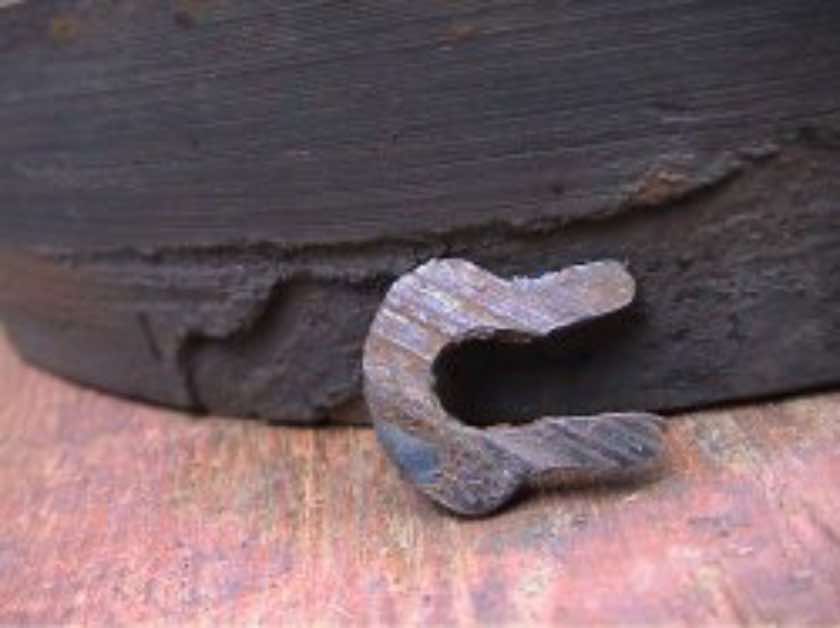
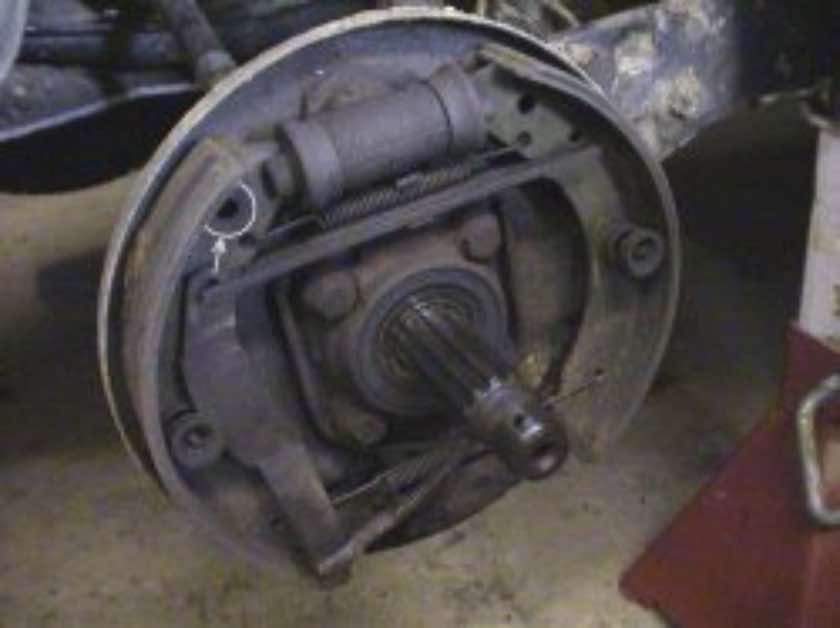
We finished the event and drove carefully home. When I took the brakes apart, the following weekend I saw that the clip holding the handbrake arm pivot pin had fallen out, as had the pin itself. With the arm detached from the shoe, the handbrake didn’t work although the hydraulic footbrake did. The offending components were still inside the drum, but in a bit of a mess, as were the lining and the drum itself. A quick telephone discussion with Murray MacDonald explained the problem. I had always thought the clip securing the pin was just pushed on and held in place by its springiness, although it never appeared to have very much spring! Not surprising really, as you are supposed to clinch the clip shut and it’s made out of a nice soft material to help you!
I suppose I had been lucky really, as I had been driving around with those clips holding on with a wing and a prayer for the last ten years and although I have religiously stripped and cleaned the brakes every summer I had only ever pushed the clips back on!
We have been publishing stuff about Classic Trials on the Web since 1995 and always appreciate feedback. Comments, Corrections, Criticism & Concerns are all welcome. You can leave a comment to have your say here on this web site or our Social Media
Please help spread the word and share this on your Social Media:
Generally I don’t write first person accounts of Trials as I think “Triple” contains more than enough reports of “….and we lost the Milky Bar under the seat on Sugg Lane” variety. However, I hope you will appreciate this report is an exception as it’s about my day passengering with Dudley Sterry on The Exmoor Trial.
Dudley Sterry and Michael Leete put on their best grins for the photograherPeter Fear crests the rise on Floyd’s bank.The Jones family lift a wheel as they tackle the special test at Lower MollandWere’s Judy? Would Exmoor winner Adrian Dommett have got so close to that goarse bush if it had been his side?Bill and Carol Foreshew at speed on Sepscott 2
I had my first experience of trialling in an open car when I passengered Dudley Sterry on The Exmoor. The drive through the breaking dawn from The New Forest up to Barnstaple was of course an experience in itself. This I will write about later! All the class eight’s were running together at the head of the field and we were third car on the road. This meant that apart from a handful of class eight’s and the occasional late biker we saw very few other competitors all day.
Jenny Wren was the first section and we had a long wait, first at a holding control, then at the foot of the section itself, as the bikes were having major problems in the slippery conditions. We heard that Adrian Marfell, who is the current man to beat, didn’t get off the re-start, but when our time came we did. Although all the sections apart from Beggars were new to me none of them held any surprises for Dudley. He knew the class 8 restart was going to be on some slippery slate. His advance strategy was to trickle off, that’s exactly what he did and it worked!
The Hallsinger test was a blast forward, then back and then forward again. Dudley directed me to hang on tight and hold the gear lever in place while we were reversing. All this while trying to keep clear of his flailing arms as they sawed away at the wheel trying to keep the little car in a straight line as we rocketed back and forth. While we were waiting our turn I saw Tony Young knock a marker flying, which according to the route card meant he should not have had a time recorded, but looking at the results he got away with it.
Sepscott 1 and 2 and Snapper 1 and 2 were in a wood and neither posed any problems for Dudley’s J2 although Snapper 1 was a bit hairy where the track was washed away. The worst bit was after the section ends and I should think the lower classes would have had problems getting out the top.
Riverton was reserved for Solo’s and Class 8. This was because the track was badly eroded. The J2 didn’t have any problems although if we had stopped it would have tipped on it’s side we were at such an angle.
We lost our clean sheet on High Bray. It looked easy from the start line but then I couldn’t see what was around the corner! We got of the re-start OK and Dudley tried to drive up the left-hand part of the track, avoiding the “Grand Canyon” on the right. Unfortunately we didn’t quite have enough momentum and the rear slid into the canyon and that was that, well after a spirited attempt to “burn-out” it was! Adrian Dommet went clear and that decided the result of the trial as Adrian Marfell failed to get his Fiat engined rail off the restart.
We were back into another wood at for Pheasants Hill and Lower Mouland, both of which we cleaned easily, although we got a flat front tyre and had to change the tube, which is nice and easy if you don’t have to break the bead! Beggars was a no problem at all. It looked completely different to The Lands End, when the restart area is rough and rocky, whether with doctoring or because it gets cut up by the earlier numbers, or both!
We got a route amendment at Beggars, substituting Lyncombe Bridge with Scoresdown (anybody know why?). This was nice and easy which is more than could be said for the last hill at Floyds Bank, a grassy weave amongst or through the gorse bushes. The J2 didn’t want to steer properly and Dudley couldn’t get it straight enough to attack the last bank so we dropped another couple of marks. I would think this would have been a nightmare for the lower classes.
John Lees came over for a quick chat at the finish then there just remained the matter of the drive back to The New Forest to pick up my Volvo to go back to Bedfordshire. I got home at 9.30 pm having left at 2.45 am. 600 miles in all, two thirds of it in an open car with no hood and no windscreen! A long day but what a fantastic adventure.
I will be honest the trial went much as I expected. Dudley is a very skilled and competitive driver. The car performed magnificently. The engine is beautifully tuned and will pull from almost nothing well into the high fives. The thing that really surprised me was how well it went on the road. Like many of you I guess I have been overtaken on the A303, the little J2 flashing by in a red blur, but this didn’t prepare me for just how well it performs on tarmac. The engine is extremely tractable at low revs and is very smooth as the speed increases to far beyond what the boys in blue are prepared turn a turn a blind eye to. We went along the A35, which has got a lot of long sweeping bends that the J2 handled with ease. Later Dudley showed me the modern suspension tweeks, all carefully hidden away so they don’t disturb the period look.
The class eights are certainly a varied lot. Some of them look a bit rough and there are some pretty weird contraptions that don’t look particularly road worthy no matter how well they go on the hills. Like Dudley I am anti-trailer and my view is that classic trial competitors should drive their cars to and from events. If this were ever to become a rule I am sure some of the stranger machines would disappear which (imho) would be good for the image of the sport.
We have been publishing stuff about Classic Trials on the Web since 1995 and always appreciate feedback. Comments, Corrections, Criticism & Concerns are all welcome. You can leave a comment to have your say here on this web site or our Social Media
Please help spread the word and share this on your Social Media:
I was really looking forward to my Mechanic’s Trial, and so was Mike Hayward. It promised to be really interesting, the first “new” event for us since we did The Exe Valley a few years ago. It was particularly poignant for us as Falcon enthusiasts, as it promised to use some of the sections from The Guy Fawkes, back when it was a road trial in The Cotswolds.
by Michael Leete
The event was first planned as “The Anniversary Trial” to celebrate Stroud’s 50th. Andrew Brown and Rich Welch organised it as a day/night event, with relatively easy sections, with the emphasis on the team award. They had sought out a mixture of old and new sections in the Cotswolds, using the area to the North of “The Cloud’s” stamping ground. Andrew had done a tremendous amount of research, including seeking out some of the sections used on the old Falcon Guy Fawkes. The event was first called off because of floods and then Foot and Mouth got in the way. By this time both Andrew and Rich ran into time problems and the event was put on the back burner.
It was a waste to throw away all the hard work, so Stroud’s Hayward clan took up the mantle and the club decided to make their Mechanic’s Trial a road event. It was to use some of the defunct “Anniversary’s” route, but with some new ones to make it a rather tougher event, in the normal Stroud style. Mike and I had originally planned to do The Anniversary in Mike’s Escort but we entered The Mechanic’s in my Beetle.
The car had been resting in the garage over the summer and I hadn’t really done anything to it since The Lands End. It had gone well on The Edinburgh, despite the little problem when the brakes disappeared. The first time this happened was in the queue for Putwell. I went to move the car forward and the footbrake went to the floor! A pump of the pedal and there was a little bit of brake, another pump and it was back to normal. I leapt out of the car and dived underneath. No evidence of leaks. Up with the hood to check the reservoir, all looked well and the pedal was back.
We continued with caution and all seemed well. An hour or so later we were coming down a hill in convoy with Mike Pearson and Simon Robson and the pedal went to the floor again. Turning into a lay by we checked. Again there was no fluid loss and the pedal came back after a pump or two. I went back and talked to Mike and Arnold and they reckoned the master cylinder was on the way out. I decided to continue albeit at quite a slow pace! We finished the trial and drove home the next day with no problems. Back at base, I could find nothing wrong, although I noticed the front brakes were dragging a bit.
The next weekend I fitted a new master cylinder, which was bit of an effort, as the other one hadn’t been fitted properly. The pushrod passed through the double-skinned front bulkhead on the floor pan. It is only supposed to bolt to the outer skin, using a couple of spacers to extend the length of the bolts. The manual gives dire warnings about not dropping these down into the void. I didn’t, because they weren’t there! Someone had lost them when changing the master cylinder on a previous occasion! I used a magnet to fish about down the hole to no avail, presumably they had fallen out when I had a section of the frame head replaced in the early days of owning the car.
The previous owner had secured the master cylinder by putting large washers under the bolts and securing the master cylinder through both skins, which without the spacers had collapsed the inner one in a bit. I didn’t want to repeat the error so I made a couple of new ones up out of a couple of bits of pipe, skimming them flat with the little model makers lathe I bought earlier in the year. I put everything back together and everything worked, except the front brakes seemed to be dragging a bit. I took the car for a spin and everything seemed to function so I put it away until the Mechanics Trial.
Mike and I set out early, chatting away, without a care in the world. We got to Ampthill, about ten miles away from home and I braked for a roundabout. Pulling away I smelt burning and soon realised it as coming from the brakes. We stopped and I saw how hot the front hubs were. Hoping whatever was wrong would right itself we carried, on but the car wouldn’t pull the skin off a rice pudding. Stopping we jacked the front up. The brakes were locked on pretty solid.
It was raining but we had good look but couldn’t come up with any better ideas other than the new master cylinder was faulty. I hammered away at the pads until they were free of the disks and we limped home on the handbrake. We talked of going down and spectating on The Mechanics but decided this was not a good idea as we didn’t know where any of the hills were so we went to the VW Swap Meet at Slough instead.
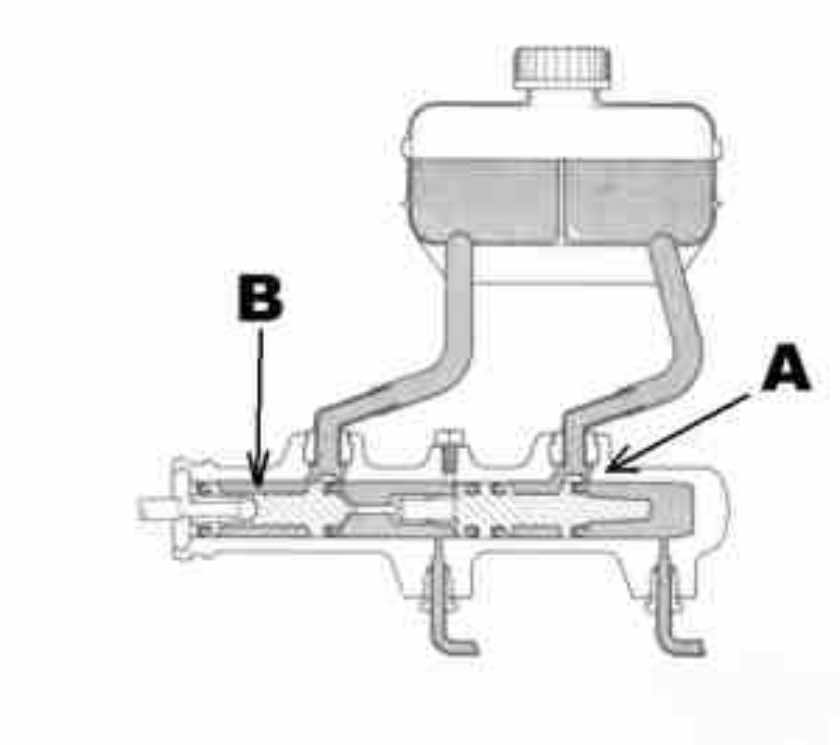
In order for the fluid to go back up to the reservoir when the pedal is released so the pads can go back channel A must be open which means there must be clearance b between the pushrod and cylinder.
Looking at the car the first idea was that I hadn’t adjusted the master cylinder pushrod correctly, preventing the fluid going back up to the reservoir when the brakes are released. I slackened this right off and it made no difference. Then I undid the bleed nipples, releasing any pressure, still no difference. Then I took the brake pipes off, still no difference! So that only left the callipers, which were only a couple of years old but there was nothing else. Putting the pipes back, I persuaded Lesley to get in the car and put the brakes on. I then got a drift and knocked one of the pads back. I got her to put her foot on the pedal again. The piston didn’t move. Harder and harder, she pushed and slowly it moved forward with many creaks and groans. I took the pad out and got my big crowbar and levered the piston back. We repeated the process for about ten minutes until the piston moved freely. I put the pad back and went on top the next one.
I was pretty annoyed with myself for not trying this in the lay-by but there we are. The brakes worked but I decided not to take any chances and got a new pair of callipers. Now all I have to do is stop the fluid leaks having undone all those brake pipes! So, why had the brakes failed on The Edinburgh? Murray’s theory is that they were rubbing then and that the heat had boiled the brake fluid. Any better idea’s?
We have been publishing stuff about Classic Trials on the Web since 1995 and always appreciate feedback. Comments, Corrections, Criticism & Concerns are all welcome. You can leave a comment to have your say here on this web site or our Social Media
Please help spread the word and share this on your Social Media:








 Classical Gas