Ilkley Trial

Bill Bennett Best Car

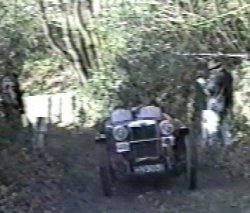
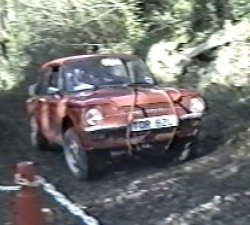
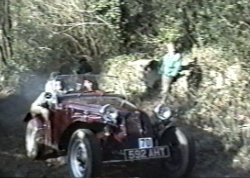
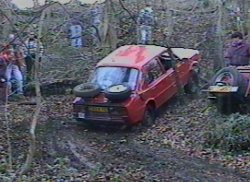
The Ilkley Club were lucky with the weather. It was a nice early summer day for the event, but wet weather during the week spiced the sections up a bit. Bill Bennett was a decisive winner, dropping only two marks after the second slippery PCT section. The higher classes had some extra challenges, including an “impossible” section at Peel’s Wood. However, even without these Bill would still have won.

The competitors all enjoyed this unique event which, incorporating a lot of grassy sections, PCT marking and stopping to have score cards marked on each section, falls somewhere between a conventional Classic and a Production Car Trial.

Bill Bennett picks his way through the rocks at the Dob Park Watersplash on his way to winning The Ilkley Trial (Picture by Dave Cook)

Dave Cooks Photos

The grounds of Ilkley Rugby Club provided ample room for parking and formalities although one wondered if the club should have been there as the burglar alarm was in full song for quite a while!

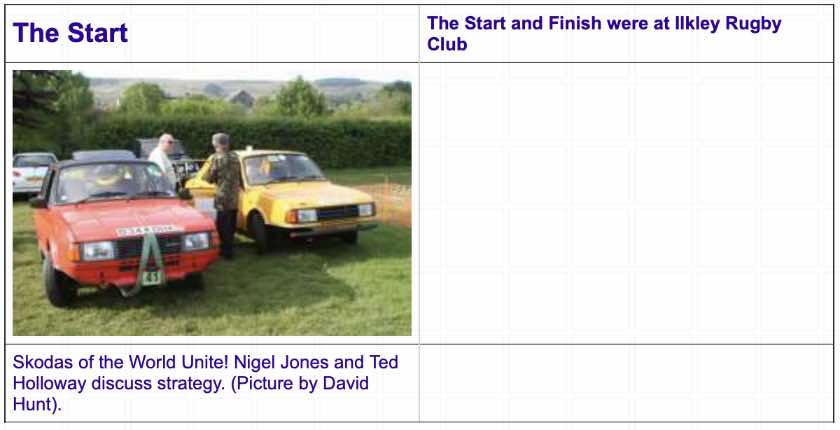
The first two section sections were pure PCT affairs in a grassy field and any doubts if there were penalties for hitting the markers were dismissed when Nigel Jones was penalised for brushing the seven marker on the first one. This was cleanable though, with a gentle foot, and about half the entry managed this. The second section was similar in nature but a sharp right hander got the diffs working and John Rhodes was the only car to go clean. No other car got further than the six. Bill Bennett dropped nine here in his MG J2, his biggest loss as he was to drop only two more during the rest of the event.

This super little section had a restart on a sharp left hand corner. You had to get going of the start line first though and two didn’t, including Boyd Webster from the organising club who couldn’t coax his Canon away, dropping 12 marks that would hand the class award to Dean Partington at the finish.

There were quite a few unique aspects to The Ilkley and the special tests were one of them. You had to go as slowly as possible, incurring a fail for stopping. Times ranged from 6.3 seconds to the 53.9 of John Rhodes.
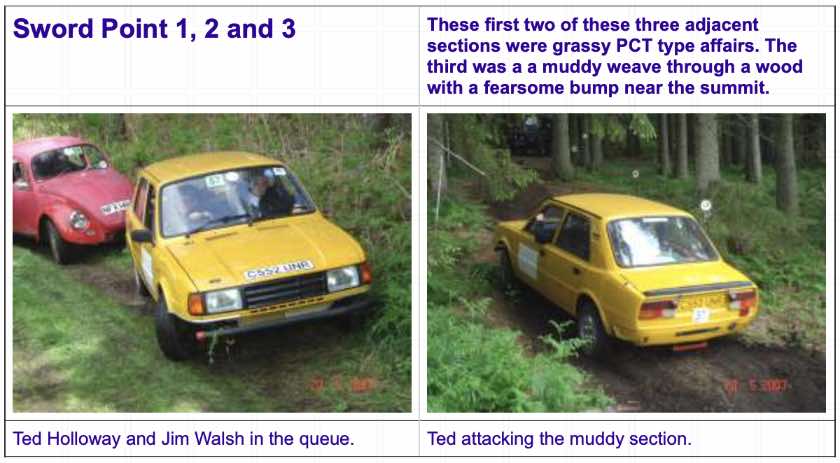
The two grassy PCT sections required a very delicate foot on the throttle, especially the second one where the higher classes had a more difficult alternative start, they were possible though, unless you were in a front wheel drive car! The third one was completely different in nature, a muddy, bumpy blast through the trees and there were only three cars, all in class eight got to the top.

There were a couple of retirements here, neither Richard Parker (Austin Seven) or Derek Reynolds (DAF 66) going any further.
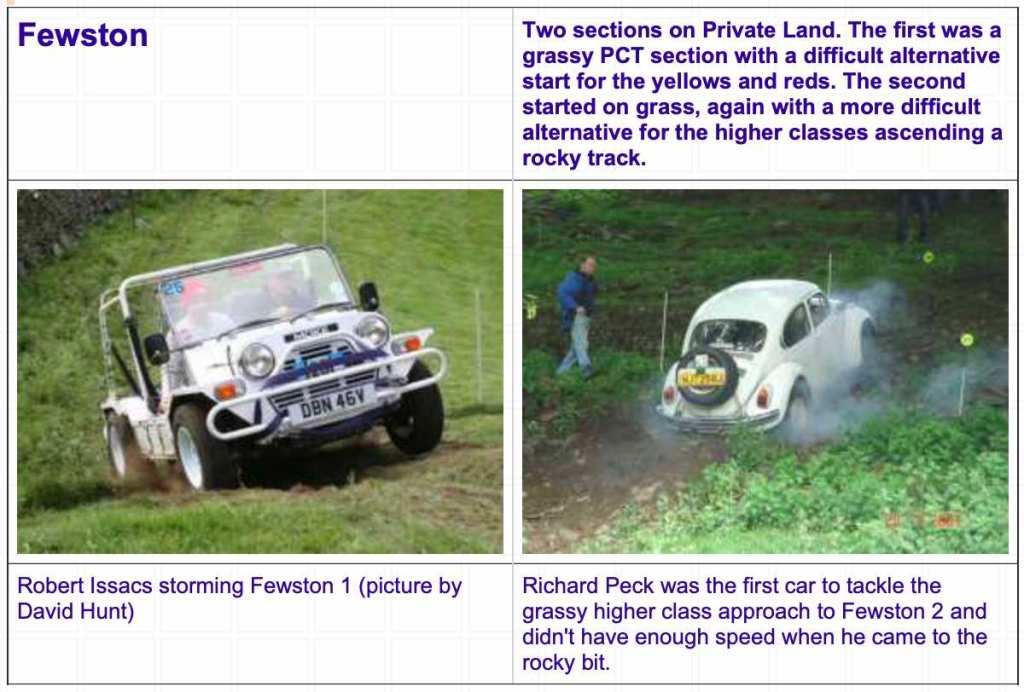
Both of these sections severely penalised the higher classes and only three cars reached the summit of Fewston 2, these included Dudley Sterry who achieved notoriety the previous year when he nearly went sideways over the steep bank.
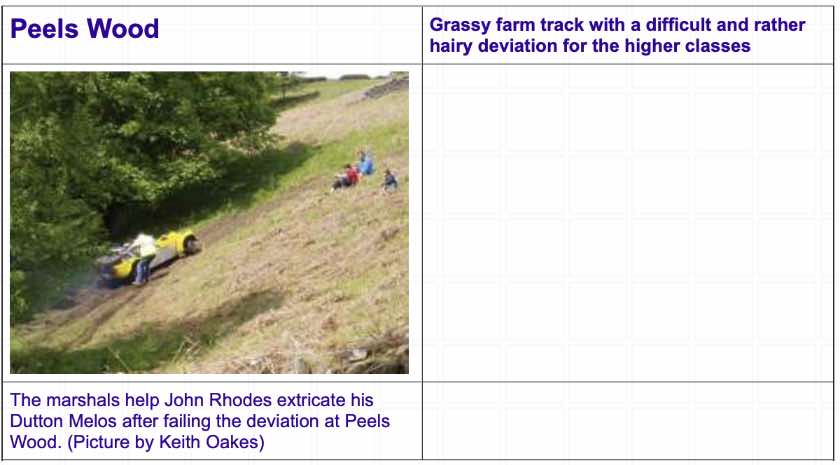
Any hopes anyone in classes six, seven or eight had of beating Bill Bennett were dashed here. While the lower classes had a gentle poodle up a gentle grass track the yellows and reds had a horrendous deviation down into a gulley where they had to assault a steep, slippery grass bank after which they had to make sure they kept straight while reversing down to make sure they didn’t turn over!

Looking through the results only Falcons Ed Nikel (Dellow Mk2 Replica) conquered the bank and even he dropped three.
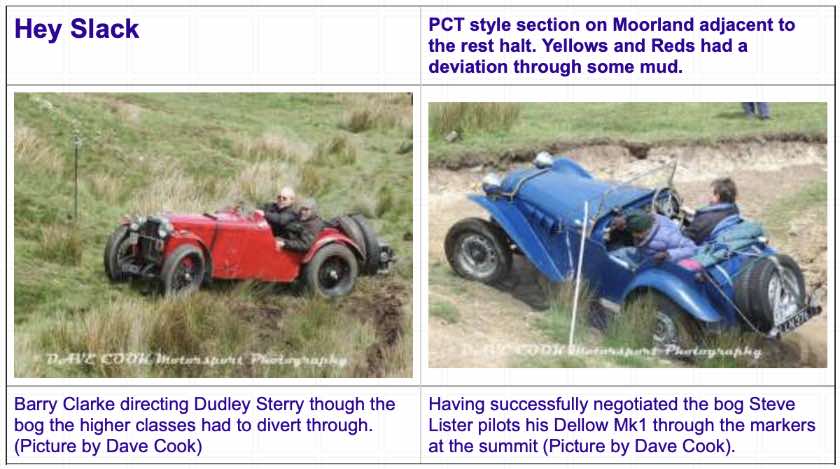
The final section of the morning was on Moorland on top of a hill that would have been very windy had the wind been blowing. Inspection was permitted and the higher classes could see they had to fight their way through a bog before tackling a steep bank. The lower classes skipped the bog but everyone had to start by going over a steep bump where you could ground out if you weren’t careful and this is what happened to Falcon’s Nicolas Cross, Ted Holloway and Michael Leete. The club had moved their chuck wagon giving those who weren’t running late a chance to grab a bite to eat.
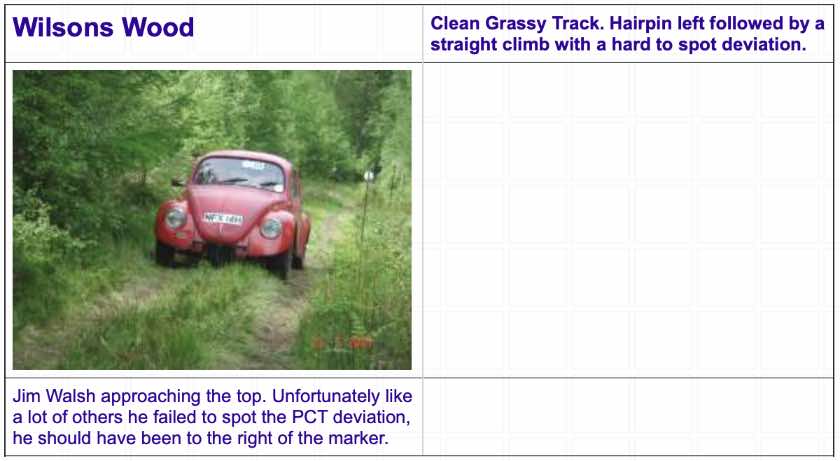
After the lunch break the route passed the mushroom globes at Mentwith Hill Station, complete with machine gun totting police at the gate. Wilsons Wood was off quite a busy road. The section was a grassy track, starting with a couple of sharp corners then a gentle climb. Unfortunately there was a big snag in so much as the official route deviated off the left to run through the undergrowth parallel to the track. This caught out nearly half the entry who followed the track itself.
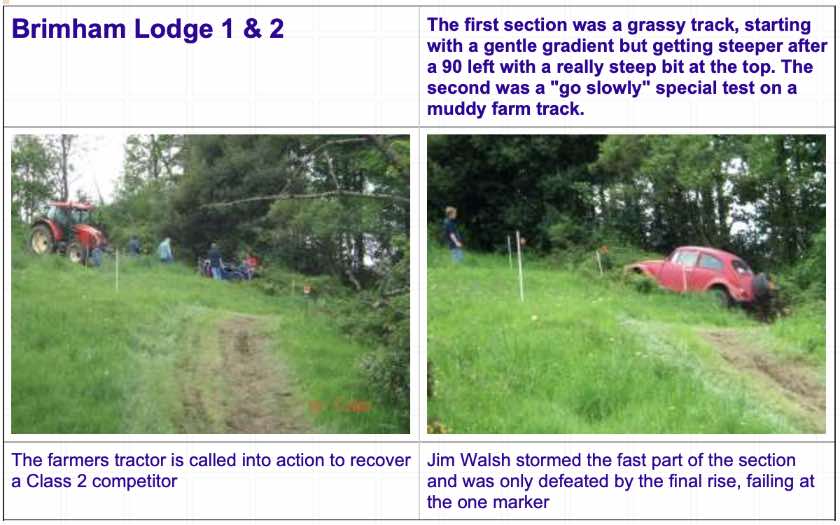
The special test was another “go slow” affair through a puddle. The section was a nice challenge however, making excellent use of the venue and ending with a steep bank as a sting in the tail. The results show three of the FWD cars clearing the section which is surprising as most of the other cars in the lower classes failed apart from the on-form Bill Bennett.
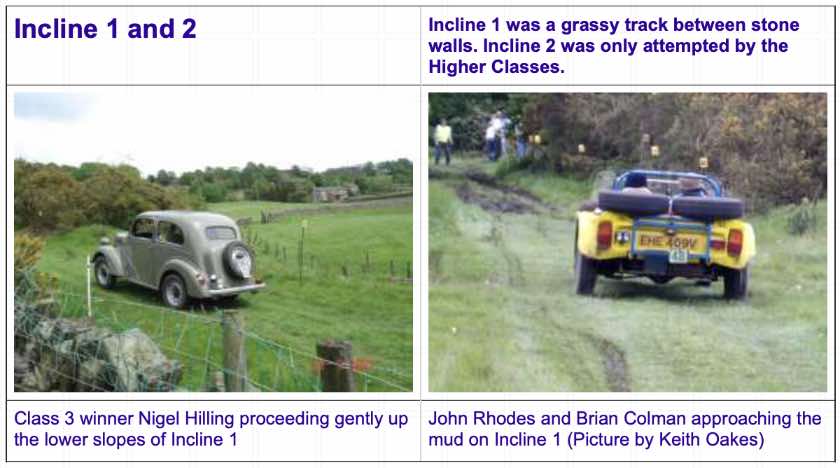
The club had some PR problems here and some of the later runners were delayed for half and hour while the officials sorted out some irate locals. Once that drama was over there was a shallow deceptively slippery grass track between stone walls too climb. No problem if you were gentle on the throttle but if you gave it to  much welly and the wheels started to spin there was no hope, as Ted Holloway, Michael Leete and a few others discovered.

Incline 2 came shortly after and was attempted only by the higher classes with quite a few making clean climbs this year.
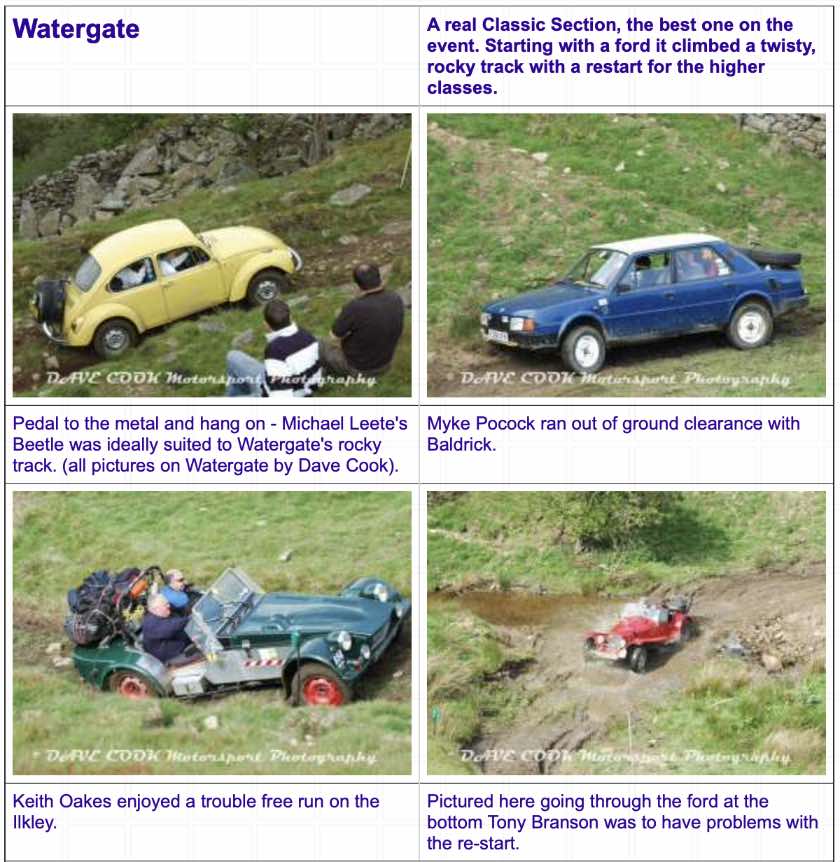
For many Watergate was the best hill of the event, a real classic section. There was a ford at the start and it needed plenty of welly to climb the stony bank the other side. After this the track got a bit rocky and ground clearance became an issue, defeating the Skodas of Ted Holloway, Nigel Jones and Myke Pocock.

Like Wilsons Wood there was trap if you didn’t look out carefully for the markers half the cars missed the “gate” at the nine marker, including Ilkley member and well know rally driver Tony Fall who was driving a Nissan Micra and appeared to be enjoying every minute of it judged by the smile on his face.

Tony wasn’t the only one to miss the nine marker as class eight contenders Dean Partington and Dudley Sterry did the same thing. Nigel Jones ended his trial here. Nigel and David Hunt had been struggling with the clutch on their Skoda for sometime and having used up all the adjustment decided to call it a day.
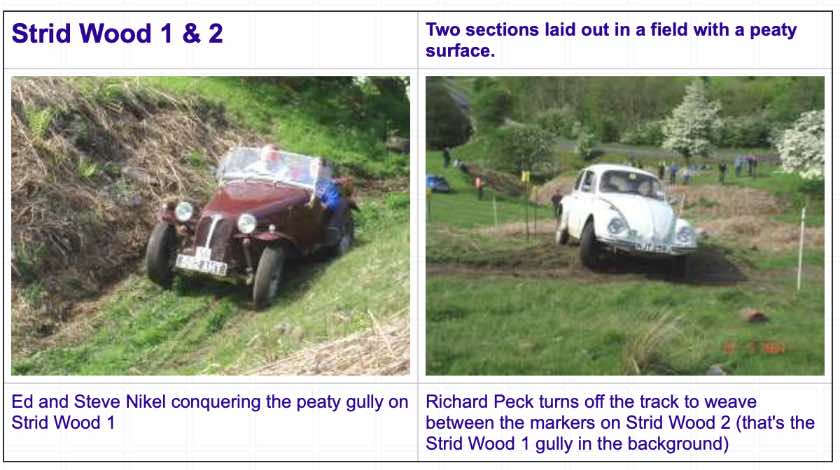
Strid Wood 1 was a nice friendly little affair but Strid Wood 2 was pure PCT and required considerable agility from car and driver. It was certainly a problem for long wheel base cars and Keith Oakes and Dudley Sterry dropped marks here.
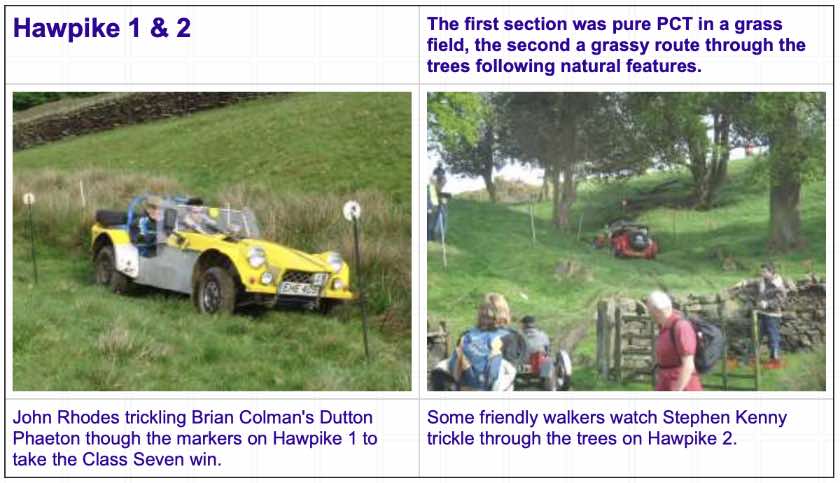
Hawpike 1 was another pure PCT section. There wasn’t much space between the markers and the marshals were watching out for the slightest touch, even penalising Bill Bennett for his only lost mark of the afternoon. 

The final competitive section was a very strange affair. Another “go slow” special test on a grassy bank. The problem was that the marshals didn’t impose the “four wheels out” rule so some cars deviated a long way off route without penalty. John Rhodes had the longest time of 167 seconds but somehow incurred a six point penalty, although he was sufficiently in front of Stephen Kenny to keep his class lead. 

Back at the finish their was an excellent pie and peas supper to entertain competitors while they waited for the results which showed Bill Bennett a conclusive winner. Everyone seemed to enjoy their Ilkley Trial. Its different to its southern counterparts but accept it for what it is and its a super day out, not just for the sections but the route through the Yorkshire countryside as well. It’s a nice time of year to hold the event as well as the club would have had problems with all the grassy sections in the winter.

Best OverallBill Bennett (MGJ2) – Class 211
Best IDMCBoyd Webster (Cannon) – Class 836
Class Winners
 1Nick Pullen (Nissan Micra)60
 2Don Griffiths (Austin 7)33
 3Nigel Hilling (Ford Pop)64
 4Jim Welsh (VW Beetle)25
 5John Bradshaw (Morgan 4/4)63
 7John Rhodes (Dutton Phaeton)29
 8Dean Partington (D. P. Wasp)25

We have been publishing stuff about Classic Trials on the Web since 1995 and always appreciate feedback. Comments, Corrections, Criticism & Concerns are all welcome. You can leave a comment to have your say here on this web site or our Social Media
The Jenkins Debate

One of the nice things about the Web version of Classical Gas is the e-mails I get from all sorts of people, many of whom I have never met. Sometimes there is quite a bit of debate on some of the things I have published, none so much as about a picture I included in an article about Jenkins Chapel back in October 1997.

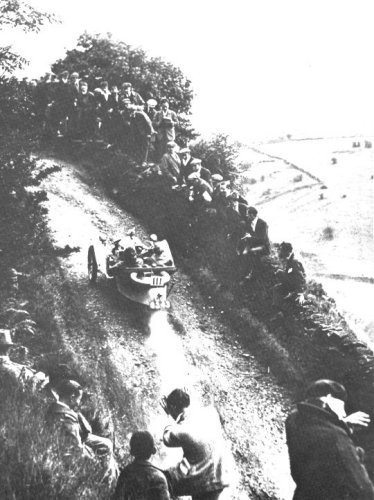
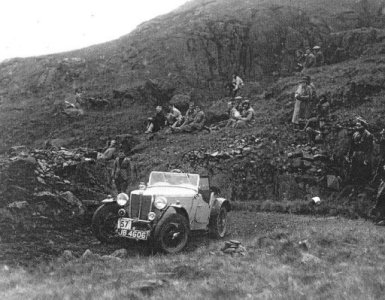
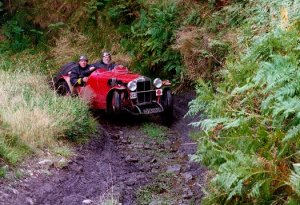
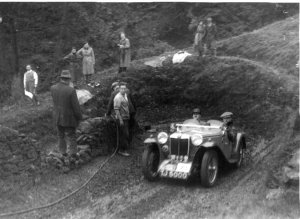
To recap this was a brief piece about the hill which was used under the name “Jenkins Chapel” back in the 30 and resurrected by the MCC as “Corkscrew” in 1993. It’s a rough, narrow hill with two hairpins, followed by some nasty steps. I published a couple of pictures which I reproduce here. The one of Dudley Sterry was taken by our own Mike Furse a few years ago and is definitely Jenkins. I scanned the other one out of a book and this is the image that caused the controversy, and really set the letters pages of Classical gas on the Net going with some most enjoyable correspondence, with many famous “trials families” participating.

It was ACTC rights of way officer Andrew Brown who first smelt a rat. Then Tony Branson raised his doubts too”I share Andrews doubts that the old picture of the MG is really this hill. I too have spent some time with Jonathan Toulmin pouring over old trials photos trying to recognise which sections they are. It’s amazing how much the landscape changes over the years, trees move and cottages sprout or lose chimneys.

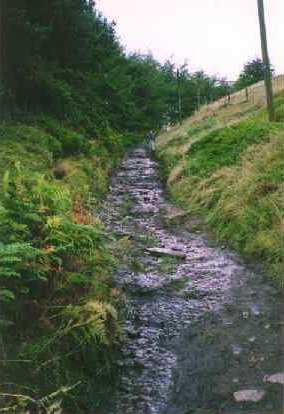
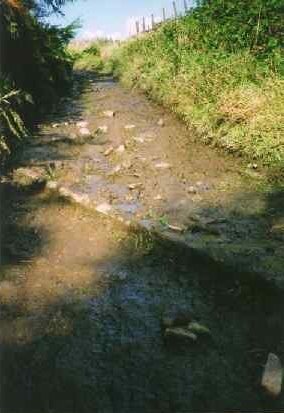
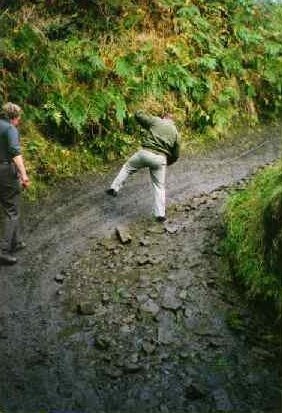
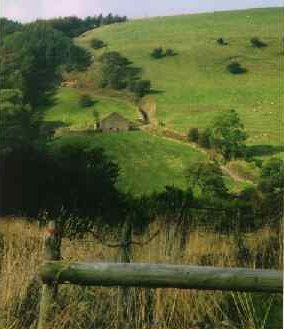
After the 1993 Edinburgh Jonathan, Pat, Derek and I walked the section and I bemoaned the fact that class 3 didn’t get a shot at it. I have since gone up it twice in the Marlin and my propshaft tunnel has the scars to prove it. I attach some photos I took that day. The first shows the section from across the valley, The second the infamous first corner with Derek having a little trouble on the restart and the other two the rocky steps in the upper reaches.”

A few days later Andrew Brown came back to me after some considerable research. “I don’t where you got the original photograph from, but it is on Page 34 of Roger Thomas’ excellent ‘M.G. Trials Cars’ book where it is captioned as “Lewis Welch in Athos on the 1935 M.C.C. One Day Sporting Trial in Derbyshire at the upper part of Jenkins Chapel”. The registration is clearly shown as JB 4606 and the competition number as 57. JB 4606 was one of the three MG NEs (1287cc) which ran in the 1934 TT, were converted to trials cars for a short period in 1935 when they ran as ‘The Three Musketeers’ team, and were then re-converted to race cars for the 1935 TT. According to Roger Thomas they entered only four trials (Lands End, Edinburgh, Abingdon, and Rushmere) and the Welsh Rally. Donald Cowbourne’s book lists Welch in a 1287cc MG Magnette in both the Lands End (No.399) and the Edinburgh (No.57), and in a 1408cc Magnette in the MCC Sporting (No.89). So, unless there is some amazing coincidence, I think it’s a pretty fair assumption that the picture was taken on the 1935 Edinburgh.

But where is it? Cowbourne lists only four Observed Hills for the 1935 Edinburgh – Park Rash and Summer Lodge in the Yorkshire Dales, Wrynose Pass and Hard Knott Pass in the Lake District. I’m not familiar with any of these hills but have seen enough photographs of Park Rash and Summer Lodge to be pretty sure that it’s neither of them unless the photographer stood at a particularly unusual location. There’s a picture on Page 256 of the Cowbourne book of an AC in the 1935 Edinburgh at a location that looks remarkably like the Welch MG picture. So, does anyone recognise either of these pictures as somewhere on Wrynose or Hard Knott Passes? My money’s on Wrynose Pass, but I’m not really a betting man.”

Things were really hotting up now and Pat Toulmin kindly delved into the family archives. “Further to the debate about Jenkins Chapel, the photo of Lewis Welch is not on Jenkins Chapel. Indeed it is not even of the 1935 Sporting Trial – in Donald Cowbourne’s excellent and well researched trials book, Lewis Welch was number 89 on the Sporting Trial (see page 463). In the photo you publish, he was number 75 (I think Pat meant to say 57) and this is the number he ran on the 1935 Edinburgh Trial, 7th and 8th June. This had 4 sections only – Park Rash, Summer Lodge, Wrynose and Hard Knott. The latter two are in the Lake District and it seems likely that the photo is on one of these. See pages 190, 256 and 283)

I attach two photos that Maurice Toulmin stated are Jenkins Chapel. Both photos are by W J Brunell. The one of JB 7521 we took with us on the walk with Tony and Derek and we were able to confirm that it is Jenkins, the building is still there and the approach road was very characteristic and exactly the correct shape. This photo was used as the basis of the drawing on the cover of Roger Thomas’s excellent book on pre war MG Trials Cars, published in 1995. We have other photos of Maurice on Jenkins Chapel. PS -The section which we use today on the MCC Edinburgh Trial known as Calton was called Taddington Moor in the 1930s.”

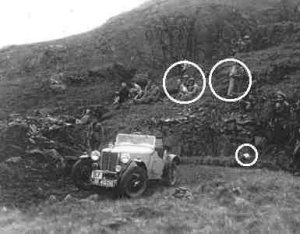
Then Kevin Barnes e-mailed me “Just seen the Jenkins Chapel debate and thought I would try and help. I think that (99% sure) the picture may actually be of Wrynose Pass on the London-Edinburgh. I enclose a picture of my grandfather J.D.Barnes on this section. (wrynose.jpg) It’s not as good quality as the MG picture but after studying it at high zoom levels I believe that some of the people and features in the background are the same as in the MG picture. I have highlighted them on the MG . I will have a look at the competition numbers for that trial to see if I am right when I get time.

The caption of the original picture says “J.D.Barnes entering the second loop of the tricky Wrynose Pass Climb in the London-Edinburgh”. I think the MG by the way is on the first corner just before this picture was taken. Hope this sheds some light/debate on the picture.

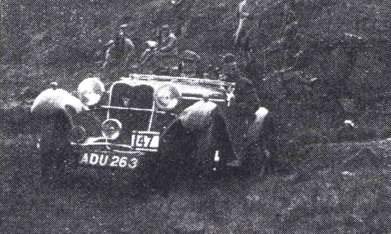
Then a few days later Kevin came back after yet more research “Back again with some more detail on Wrynose and another picture of the hill. MCC Edinburgh Trial 1935 – 182 cars entered, Singer 1.5 litre J.D. Barnes No.47, M.G. Magnette L.A. Welch No.57. This picture (wryn2.jpg) is taken in 1936 MCC Edinburgh, the picture I sent to you before of ADU 263 was 1935. The caption reads “Two Loops” were used on Wrynose Pass, off the normal track. Here is L.E.C. Halls Singer on the second loop. I’m not sure if this is the same area of the hill as the MG and previous Singer picture but the picture would obviously have been taken from the opposite direction to this on the second corner we can see so I suppose it could be. Wrynose Pass is located in the Lakes near Lake Windermere. “The route led to Wrynose Pass, a narrow hill with, on its lower stretches, a fearsome drop on one side. Wrynose Pass was included for the first time last year (1935), and this year it was approached by a different road leading over Blea Tarn, where a little corckscrew climb, quite steep provided interest.

On Wrynose itself there were two points of difficulty in 1936. First there was a test of the now common to and fro variety, and then competitors were diverted off the track proper round two loops. The 1936 trial saw an incident with an MG skidding over the steep bank and roll down the hill. Luckily, only broken bones resulted. The trial then moved on up the road to Hard Knotts Pass. Hopefully that has solved the identification of the picture/hill. Anyone with anymore unsolved trials mysteries?”

Many thanks to Kevin, Pat, Andrew and Tony for solving this mystery. Just shows you can’t believe everything you read, especially in Classical Gas!


We have been publishing stuff about Classic Trials on the Web since 1995 and always appreciate feedback. Comments, Corrections, Criticism & Concerns are all welcome. You can leave a comment to have your say here on this web site or our Social Media
Exe Valley Trial 1998

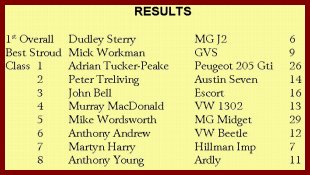
Overall victory went to Dudley Sterry in his venerable MG J2. Murray MacDonald won his class on a wet and exciting, Exe Valley. Brian Alexander had the misfortune to break his gearbox on the last section.

  • Best Overall Dudley Sterry MG J2 – 5
  • Class
  • 1 David Hazelden (Golf) – 16
  • 3 David Heale (Escort) – 11
  • 4 Murray MacDonald (VW 1302) – 9
  • 5 Dennis Greenslade (Reliant) – 20
  • 6 Gary Browning (VW Beetle) – 24
  • 7 Roger Bricknell (Vincent) – 6
  • 8 Adrian Dommet (100E Special) – 7

It was a was an early start, and a long drive down the M5, for Murray and Hazel MacDonald and Michael Leete/Mike Hayward in their VW Beetles, to the start at the Halfway House Inn near Cullompton in Devon. It wasn’t so far for the third Falcon, as Fiat enthusiast Brian Alexander only lives a few miles up the road.

    Brian’s wasn’t the only Fiat taking part. Alongside him there were two more Fiat 850’s, not a coincidence though. One was Brian’s spare car, the other the one he used at Brickhill, and still in PCT trim. Brian had lent the car to a neighbour for the day, in thanks for helping out with preparation of his Fiat fleet. The third Fiat also had an Alexander connection as Brian was its previous owner. 

    Just down the road from the start was an hours delay at the start of Section three. Yes I did say section three, as the first two were cancelled. It was to be one of those mornings. There was another hours delay at second hill and then it was on for a near two hour wait at sections five and six which were then cancelled while Nigel Allen’s passenger was helicoptered out with a suspected broken leg! So, it was gone two o’clock when the Falcon trio got to the third observed section which was number seven! There had been problems though. Murray had punctured getting out of the cancelled section and Brian was struggling with his Fiats gear selection.

    Sections seven and eight were pegged out in a slimy wood. The first one was easy enough for Murray and Brian but as Michael is in class six he had an alternative route through a deep water filled hole, followed by a steep muddy bank which he couldn’t negotiate. The following section twisted around though the trees, then darted up a steep bank. Murray did very well here and got up to the four, taking the class lead in front of Giles (son of our hero) Greenslade.

    The next section wasn’t really a hill it was a River! From the start all you could see was a marshal standing on the opposite bank and pointing up-stream. It started out OK, but it wasn’t long before the water actually got into Murray’s car so that tells you how deep it was! After 50 yards we re back on dry land. All the Falcons and Brian’s collection of Fiats made it OK but a few competitors didn’t, and ground to a halt with wet bottom’s. Great stuff.

    Westacott was originally to have been a special test but was changed to an observed section at the last moment. It wasn’t difficult and the whole entry cleaned it. This was followed by Iron Mill, another muddy track with deep ruts, and a re-start which caught out quite a few cars. These included Brian, who was now getting very concerned about his gearbox, although the rest of the Italian collection was doing just fine.

    Kennels was entirely different, a muddy wind through the trees with a tricky re-start. Michael and Brian didn’t get much beyond the first corner but Murray showed the way. He got of the re-start OK but not much further and dropped five. Along came Giles Greenslade who got to the four, putting him level with Murray again.

    Bidgood Lane turned out to be the hill they call Port Lane on the Exmoor Clouds. This is a really fantastic section. It starts in the village and looks innocuous. Once you get going it soon changes character, getting steeper, muddier and more rutted. It’s very, very long and it takes a fair old time to get to the  top and even longer to reverse back down again! All the class eight’s cleaned it, and so did Murray and Giles. Michael nearly made it but didn’t attack the last step with sufficient momentum and ground to a halt. He was very disappointed but didn’t feel so bad when the results showed that our hero himself had also failed at the two marker.

    The final observed section was called Doddiscombe. There’s a bridge over a stream just after the start. The blues and whites were allowed to use it but the others, including Michael, had to go through the stream and up the bank the other side. The early number and the super-heroes didn’t have to much of a problem, but it wasn’t so easy for mere mortals running at the back of the field. Michael and Mike looked at the obstacle was some trepidation but decided to give it a go. Down the steep slope went the Beetle. Into the stream, then boot it and try to get all the yellow perils 50 bhp into action. Up the other side it shot. It slowed, Mike bounced, the wheels span, the Beetle clawed its way up, it was just going to make it. No, it stopped, keep the power on, bounce, sway, anything, everything. It was to no avail. The car had slipped sideways and dug its way into some soft soil up to its axles, so deep it was only just possible to open the door.

    Crew and Marshals tried everything to extricate the car to no avail. They couldn’t push it out forwards and it wouldn’t go out backwards either. After ten minutes or so it was still stuck and the official in charge of the hill came down to see what was up. It was Tim Wheelock! He rapidly sized up the situation and departed. Presumably to fetch a JCB so he could bury car and driver! No, he soon returned with extra help and the Beetle was eased back into the stream to do a 3 point turn. After some persuasion it was then coaxed back out the way it came. Michael was very grateful and henceforth Tim Wheelock will be called “a very nice man” in this column!

    That was nearly it. Just a funny regularity section to end the day. But it wasn’t very funny for Brian as his Fiats transmission finally called enough. Murray, Giles and Matthew Sharratt had equal scores on the hills and the regularity section but Murray and Hazel got the class with a fast tome in the special test. Then it was off for the long drive home. The Beds and Herts crews getting back around mid-night. Definitely an adventure.


We have been publishing stuff about Classic Trials on the Web since 1995 and always appreciate feedback. Comments, Corrections, Criticism & Concerns are all welcome. You can leave a comment to have your say here on this web site or our Social Media
Torbay win for Dudley Sterry

by Hazel MacDonald and Stuart Cairney

Stuart Cairney flys round the bottom corner so he can get a run at Simms

We had three Falcon crews at the Finlake Holiday complex near Chudleigh on 1st March for the start of this years Torbay. With two runs up Simms on the agenda it had lot’s of promise, and what an event it tuned out to be! Starting with a special test a few yards from the start. This consisted of a short blast along a straight bumpy track, followed by about 200 yards on tarmac, which included a couple of sharp turns. It was here that Murray MacDonald put down his marker, recording fastest overall time. Beating some Escort drivers who were indulging in some exuberant sideways motoring (and were risking exclusion if they went on the grass)! It was an amazing special test, more of a special stage really.

    The first observed section was Simms. At this point it was Simms 2 Murray 2 for the Mac’s, but afterwards it was Simms 2 Murray 3. The others weren’t so fortunate. Brain Alexander got a two, while Stuart Cairney took a bad line and ground to a halt below the three marker.

    From here it was on to Lower Dean. The lower part of this hill looks a bit like a moonscape with lots of bumps, all out of phase. Then there are some horrendous gullies near the top, after the class 6-8 restart. Brian retired after this hill, which caught a few people out. Baddaford Lane followed, but was not too bad this year, only class 8 had a restart, but nearly half the 16 motorcycles scored a 6 here.

    The next hill was scheduled to be Middle Rocombe, which is the hill that the ‘men’ tackle on the Exeter, whilst the girls in their tin tops fail the restart on Slippery Sam!! However, a last minute re-route denied competitors a look at what Fred Gregory calls ‘The hill from hell’ and they went straight to Higher Rocombe (Slippery Sam). In the daylight he restart, which was in the usual place, was starting to look well cut up. No Falcon fails today and Stuart even found the tight right hand slot afterwards! Higher Shells followed, just a mile down the road and was cleaned by most. From here it was back to Finlake for another special test and the lunch halt. Murray was clean and leading the class at this point with Stuart on three.

    After lunch came Finlake sections 7, 8 and 9. You drove up the hill a few yards and pulled into a lay by affair. On the marshals’ instructions competitors tackled the first hill, quickly followed by the second and then a third, through heavily rutted clay. It was 6,000 all the way for the Mac’s and JAZ powered it’s way through. Not so for Stuart who was swallowed up by an enormous crater on “three” and had to be towed out, but with aces like Paul Bartlemann stuck as well he didn’t feel to bad! Hero of the Day award must go to the guy who had the job of getting down in the mud to attach the tow rope – he was absolutely covered in it!

    There were some ambiguities in the route card now and the next road section saw groups of cars parked at road junctions, having a conference to decide the correct route, with a lengthy detour up the dual carriageway and back for those who got it wrong. Eventually everyone found Northwood, which was no problem with all the Falcons clear. However, section 10, Pitt Farm (Waterless Lane) was a problem for a lot of people. Stuart’s Imp didn’t have enough ground clearance and needed a push to clear the deep muddy ruts. Murray provided excellent entertainment as he went sideways, scuffed the wing and filled the bumper with mud. 

    Tipley was next and stopped all of class 4. Stopping astride a restart line, rather than in a box, does not allow much room for manoeuvre. When, by what ever means, competitors did finally get clear of the restart there was no time to gain momentum before arriving at the class 6,7 & 8 restart. Murray kept saying “I hate that Tipley” and after a great deal of effort, especially from Hazel, they got away from the line, only to get stuck on the re-start designed for the other classes. A lot of cars wrecked tyres here, Stuart amongst them.

    Lenda Lane was the next section. It was supposed to be sub divided 12 – 0, but instead they had put a restart in a deep crater half way up, which defeated all class 3 and all but Nathan Mitchell and Giles Greenslade in class 4. Murray’s class lead going out the window at this point. If you were in an Imp the problems started before the section. Two drainage pipes had been laid across the entrance track with just enough gap in between for an Imp wheel to drop in. Stuart and Jim Scott had to throw their passenger’s out in order to increase the ground clearance!

    Then it was back to Simms, now pretty slippery, with two restart lines on the steep bit, one for classes 6&7 and one for class 8. Only Nathan and Murray went clean in class 4, Stuart managing another three. All that remained now was an 8 mile run back to Finlake and the final section, a PCT like climb of a mound. It had a slippery camber on the right. You had to keep as straight as possible, maintain speed and try not to slide across to the right. Murray floored it (I think this is the correct expression) and it worked.

    Murray came third in class behind Giles Greenslade and Nathan Mitchell who won the class. Giles got a two on each attempt at Simms and failed the Tipley re-start but managed to clean Lenda Lane. Leaving Murray with12 and those two with 10 each. First position in the class was decided on special test times and it went to Nathan Mitchell in his Skoda.

A challenging trial, tough on the cars but well organised. The overall win went to “Super Dud” who went round clean.

  • Overall Winner – Dudley Sterry (MG J2) 0
  • Class 1 & 2 – Peter Treliving (Austin Seven) 2
  • 3 – Paul Bartleman (Escort) 9
  • 4 – Nathan Mitchell (Skoda) 10
  • 5 – Dennis Greenslade (Reliant) 15
  • 6 – Gary Browning (VW) 6
  • 7 – Adrian Marfell (VW-Alfa) 0

We have been publishing stuff about Classic Trials on the Web since 1995 and always appreciate feedback. Comments, Corrections, Criticism & Concerns are all welcome. You can leave a comment to have your say here on this web site or our Social Media
Cotswold Clouds 1998

Six Falcon crews took part in a suburb Cotswold Clouds on 1st February. We won two awards, Murray and Hazel MacDonald won class four after a day long battle with Neil Bray and Marc Lawrence. Overall victory went to Dudley Sterry in his MG J2, pictured here on Nailsworth Ladder.

Stroud and Districts Cotswold Clouds stands alone. It is not part of any championship and there is no triple or anything linking it to other events. It’s to be enjoyed for itself and it’s over subscribed entry stands testimony to its popularity. It has some good sections in a very nice part of the country. But to me it’s the organisation that stands it apart from the rest. It has a very relaxed and informal atmosphere, but it’s very well run. The Stroud boys (and girls) certainly know how to run a trial and the list of officials reads like the top half of the ACTC championship table. It’s not just the main official’s. Nearly every hill had well-known competitors marshalling. No shortage of experience here. 

A quartet of Falcon crews gathered at the Stonehouse Little Chef for breakfast before the off. The New Falconers were joined by Clive Booth and John Allsop with Clive’s Dellow Rep. Neil Bray had a puncture on the way down so departed early in order to use the Garages bead breaker so he could fit a new tube. 

The approach to Sandfords was frosty and hard. Perhaps the soft ground at the bottom of the section would be easy to traverse. There have been years when even getting to the section was difficult. The first bit was OK, but just before the gate it got really boggy and Michael Leete had difficulty getting through. Fred’s troubles started on the line when the Dutton coughed and stalled. A turn of the key saw Fred and Pete away and they were delighted to hear the marshals had taken sympathy and given them a clear. 

Crooked Mustard was on form. None of the Falcons made it out of the top but Neil Bray got to the three to get the furthest. This is definitely one of the stiffest challenges in the trials calendar. Rushmire didn’t present any problems, despite the re-start but Fred’s Melos had fluffed badly and team Falcon descended on it with the spanners at the holding control for Axe. The points had closed up and the timing was way out. This was put right and the Melos went better, but the motor was clearly on the way out, and at times it was hard to know if the smoke came from the oil or the tyres! Axe is a nice long hill, but it’s not too difficult, and all the Falcons made successful climbs, at the cost of a puncture for Neil and Marc.

Nailsworth Ladder was next on the agenda. Six, sevens and eight’s had a restart just before the step. This made things very tricky. Fred and Pete couldn’t get the Melos away from the re-start. Michael struggled in the Beetle but Mike stepped up the bouncing and got the wheels to grip. They got over the step but didn’t have enough speed and spun to a stop just after. Clive and John struggled to get away but once they started to move they rocketed up. Our class fours didn’t have this hindrance and were able to blast straight through in front of a spectating Stuart and Andrew Cairney. They reckoned Murray hit it the step hardest, the 1302’s suspension soaking up the blow and gliding serenely over. However, Neil was the most spectacular, getting the Skoda’s rear wheels right up in the air.

Mackhouse two was a shock. It started as a straight muddy track with very little gradient. You had to be careful though and it caught out Simon Robson who didn’t have enough speed and got bogged down. The muddy bit went on for some time then opened out as the section followed the edge of a field before diving into a rocky gully which Fred reckoned was filled with Dinosaur eggs! After a short while the section turned right out of the gully over a rocky steep lip. It was a question of how brave you were on the last bit. It needed plenty of power. Michael didn’t give it enough welly and needed a pull from a Land Rover to get out of the section into the field above. There he saw Neil Bray changing his third wheel of the day. The drama wasn’t over as the exit road was just as exciting as the section! 

The lunch-time break was taken at the Stroud Tesco’s as usual. The club must have some influence to let us trapse into the coffee shop in our muddy boots! There was no rest for Neil, he had to flats on the back while the rest of us ate our lunch he was of in search of a tyre depot.

After the first special test came Fred’s Folly. A nice blast up through the trees. I wonder how the hill got it’s name? Was it because our Fred had some of his rear glass pop out when competing in his first Cloud’s in a FWD Renault? Merves Swerve was it’s usual slippery self, with differential start lines and re-starts to handicap the higher classes. And we had to perform in front of a spectating Mike Furse and Ken Green. Neil was the only Falcon to get out of the top with Murray and Simon stopping just short of the one. 

The Highwood sections were up to standard. Although they are right next to each other in the same complex they have a completely different character. The main feature of “One” is a fearsomely steep slope, dead straight, and slippery today now the ground had thawed out. “Two” doesn’t have much gradient but is muddy without a lot of bottom, so it needs a good blast. Murray, Simon and Neil were allowed a clear run at “one” but the slippery gradient defeated them all. Michael, Fred and Clive had a re-start just before the steep bit so couldn’t take a run at it. They all failed on the lower reaches so were spared the fearsome reverse back down and the omni present threat of the plunge to oblivion!

“Two” consisted of a blast through the tree to a muddy chicane with a re-start immediately afterwards. This wasn’t too difficult if you could get that far,which Michael couldn’t. Clive got to the restart but couldn’t get away and the others cleared the section OK. Climperwell is a muddy meander through the trees up a gently rising muddy track with ruts so deep you needn’t worry about steering as they act as railway lines. The excitement is provided by a restart with two huge holes for your wheels to fall into!

Bull Banks one and two provided the finale. They are both about restarts on polished pebbles. As one of the Stroud boys said “don’t lift off!” Murray, Neil and Simon cleaned them both, Michael and Clive failed both and Fred failed one. The challenge was definitely the first section as we had to perform in front of Stuart and Andrew! That was the last of sections. It just remained to drive a few miles back to the finish at the Ragged Cot Inn at Hyde to sign off. Another great “Clouds”.


We have been publishing stuff about Classic Trials on the Web since 1995 and always appreciate feedback. Comments, Corrections, Criticism & Concerns are all welcome. You can leave a comment to have your say here on this web site or our Social Media
Jenkins Chapel to Corkscrew

One of the hills in this years Edinburgh is listed as Corkscrew. If you look through the magazines you may think this a relatively recent addition, dating from 1993, but it has a much longer history. The hill was originally known as Jenkins Chapel and was first used in the 1930’s.

The hill continued to be used under this name, pre war and post war, for many years, but fell out of use for several interesting reasons. There was a problem with the neighbouring farmers who were conducting a feud. One was strongly in favour of the trial so his neighbour objected as a matter of principal. PR is especially important with this hill as the access road has a rather peculiar status. A plate at the bottom saying that the local council has closed it to all but visitors to the house at the bottom and the MCC! These days there is also a gate across the bottom to inhibit access by the cowboys.

The section itself is not very smooth! There are two hairpins followed by some nasty steps. They are not particularly steep but are pretty rough, and it would be very easy to damage the car if you went to quickly. There have been problems on Jenkins over the years, even though the famous right hand hairpin is said to be nothing like as severe as it was in the 30’s. One dry autumn a Fiat 600 (fitted with two litres of Uncle Henrys V4) jumped out of gear and caught fire in the gully. The walls were so close the occupants couldn’t get out at first and it was quite scary for a while, although it ended up all right, and they eventually emerged unscathed.


20 June 1999 – All may not be as it seems. I have received a couple of E-Mails that throw doubt on the authenticity of the old photograph’s.

Andrew Brown says “Re: Your page on Jenkins Chapel.”

Although I’m familiar with the picture that you show of the MG (and I too have seen it categorically captioned as being taken on Jenkins Chapel), I’ve never been entirely sure that this is correct. I’ve never been to the hill except when competing, and one never has time to look at the view from that point(!), but my recollection of waiting at the start line is that the backdrop (now of trees) is much lower and further away than shown in the MG picture. Any comments?

Jonathan Toulmin and I have a whole ‘catalogue’ of mis-captioned or un-captioned photographs in various books but I haven’t tackled him on this one – I’m still on a ‘mission’ to track down the various ‘Kinetons’ and ‘Guitings’ used in 1930s before venturing further afield.”

Tony Branson adds

“Reference Andrew Brown’s letter about Jenkins Chapel/Corkscrew, I share his doubts that the old picture of the MG is really this hill. I too have spent some time with Jonathan Toulmin poring over old trials photos trying to recognise which section they are. It’s amazing how much the landscape changes over the years, trees move and cottages sprout or lose chimneys.

After the 1993 Edinburgh Jonathan, Pat, Derek and I walked the section and I bemoaned the fact that class 3 didn’t get a shot at it. I have since gone up it twice in the Marlin and my propshaft tunnel has the scars to prove it. I attach 4 photos I took that day. The first shows the section from across the valley, The second the infamous first corner with Derek having a little trouble on the restart and the other two the rocky steps in the upper reaches. Hope they are of interest.”


I started to marvel at the amazing exploits of car and driver, competing, and often beating, the Trolls and Cannons that mostly travelled to and from events on trailers. No such namby pamby stuff for Dudley. He always drives his trials car to and from events, rain or shine, with no hood, toneau cover or even a proper windscreen. Now clearly something was a little non-standard about this machine. For a start it says 1,466 cc’s on the entry list. Now all my books on MG history say that the J2 was 847cc and had a two bearing crankshaft! Then there is the enormous belt driven blower sticking out the side. MG did produce a few blown J3’s, but the Powerplus supercharger was mounted under the front apron and driven direct from the crankshaft.

All this set me thinking and I wanted to know more about this fascinating car. But “super-Dud” is not the sort of person the likes of me slide up to, poke a tape recorder under his nose, and ask all about his motor for Classical Gas. The solution came when Brian Butler gave me a bundle of “Wheelspin” magazines. In the April ’87 edition I found an article about Dudley and his car by our own David Alderson. From this I learned that Dudley acquired his car as a box of bits in 1964. When he put them together he had an MG J2 with an 1172 sidevalve Ford engine! Anyway Dudley started trialling his machine, gaining his first triple in 1968.

Then the car was involved in a road accident near Carlisle on the Edinburgh. (Yes I did say Carlisle, the Edinburgh actually went to Edinburgh in those days). Dudley rebuilt the car on a new chassis and it emerged with a 1250cc T series engine. Over the years Dudley developed his car, acquiring first a supercharger, then a 1466cc block from a TF in the late 1970’s. These days the “J2” is a very special machine, but mostly uses MG parts, including an axle from an MGB an a self made four planet diff.

Now the purists may be appalled at this “bastard” machine, but don’t blame Dudley, it wasn’t a proper MG J2 when he bought his box of bits all those years ago.


We have been publishing stuff about Classic Trials on the Web since 1995 and always appreciate feedback. Comments, Corrections, Criticism & Concerns are all welcome. You can leave a comment to have your say here on this web site or our Social Media