
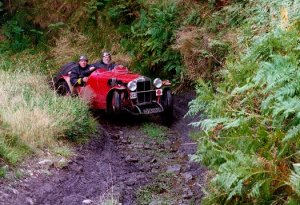
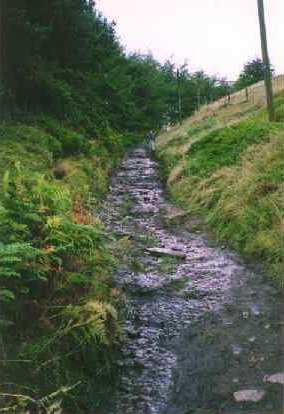
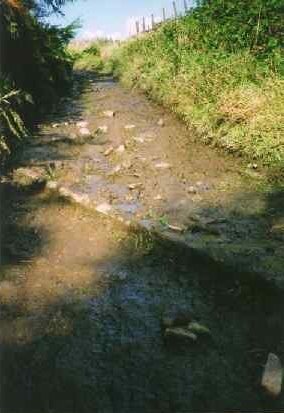
To recap this was a brief piece about the hill which was used under the name “Jenkins Chapel” back in the 30 and resurrected by the MCC as “Corkscrew” in 1993. It’s a rough, narrow hill with two hairpins, followed by some nasty steps. I published a couple of pictures which I reproduce here. The one of Dudley Sterry was taken by our own Mike Furse a few years ago and is definitely Jenkins. I scanned the other one out of a book and this is the image that caused the controversy, and really set the letters pages of Classical gas on the Net going with some most enjoyable correspondence, with many famous “trials families” participating.
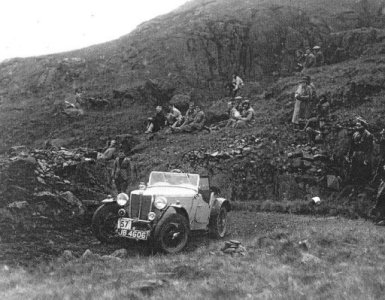
It was ACTC rights of way officer Andrew Brown who first smelt a rat. Then Tony Branson raised his doubts too”I share Andrews doubts that the old picture of the MG is really this hill. I too have spent some time with Jonathan Toulmin pouring over old trials photos trying to recognise which sections they are. It’s amazing how much the landscape changes over the years, trees move and cottages sprout or lose chimneys.
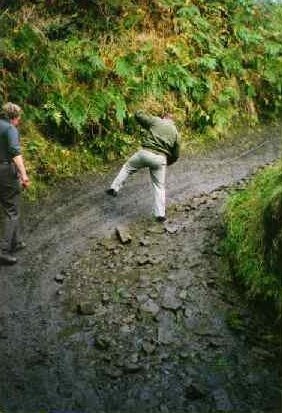
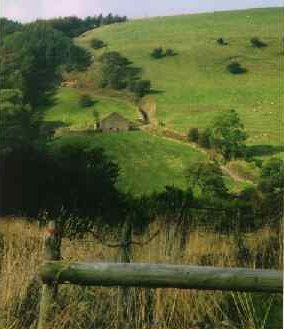
After the 1993 Edinburgh Jonathan, Pat, Derek and I walked the section and I bemoaned the fact that class 3 didn’t get a shot at it. I have since gone up it twice in the Marlin and my propshaft tunnel has the scars to prove it. I attach some photos I took that day. The first shows the section from across the valley, The second the infamous first corner with Derek having a little trouble on the restart and the other two the rocky steps in the upper reaches.”
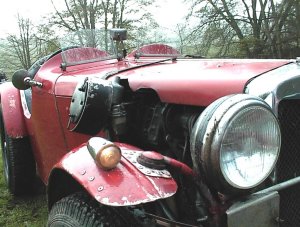
A few days later Andrew Brown came back to me after some considerable research. “I don’t where you got the original photograph from, but it is on Page 34 of Roger Thomas’ excellent ‘M.G. Trials Cars’ book where it is captioned as “Lewis Welch in Athos on the 1935 M.C.C. One Day Sporting Trial in Derbyshire at the upper part of Jenkins Chapel”. The registration is clearly shown as JB 4606 and the competition number as 57. JB 4606 was one of the three MG NEs (1287cc) which ran in the 1934 TT, were converted to trials cars for a short period in 1935 when they ran as ‘The Three Musketeers’ team, and were then re-converted to race cars for the 1935 TT. According to Roger Thomas they entered only four trials (Lands End, Edinburgh, Abingdon, and Rushmere) and the Welsh Rally. Donald Cowbourne’s book lists Welch in a 1287cc MG Magnette in both the Lands End (No.399) and the Edinburgh (No.57), and in a 1408cc Magnette in the MCC Sporting (No.89). So, unless there is some amazing coincidence, I think it’s a pretty fair assumption that the picture was taken on the 1935 Edinburgh.
But where is it? Cowbourne lists only four Observed Hills for the 1935 Edinburgh – Park Rash and Summer Lodge in the Yorkshire Dales, Wrynose Pass and Hard Knott Pass in the Lake District. I’m not familiar with any of these hills but have seen enough photographs of Park Rash and Summer Lodge to be pretty sure that it’s neither of them unless the photographer stood at a particularly unusual location. There’s a picture on Page 256 of the Cowbourne book of an AC in the 1935 Edinburgh at a location that looks remarkably like the Welch MG picture. So, does anyone recognise either of these pictures as somewhere on Wrynose or Hard Knott Passes? My money’s on Wrynose Pass, but I’m not really a betting man.”
Things were really hotting up now and Pat Toulmin kindly delved into the family archives. “Further to the debate about Jenkins Chapel, the photo of Lewis Welch is not on Jenkins Chapel. Indeed it is not even of the 1935 Sporting Trial – in Donald Cowbourne’s excellent and well researched trials book, Lewis Welch was number 89 on the Sporting Trial (see page 463). In the photo you publish, he was number 75 (I think Pat meant to say 57) and this is the number he ran on the 1935 Edinburgh Trial, 7th and 8th June. This had 4 sections only – Park Rash, Summer Lodge, Wrynose and Hard Knott. The latter two are in the Lake District and it seems likely that the photo is on one of these. See pages 190, 256 and 283)
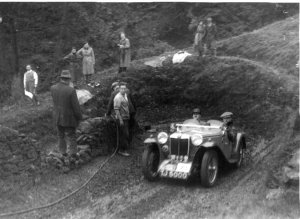
I attach two photos that Maurice Toulmin stated are Jenkins Chapel. Both photos are by W J Brunell. The one of JB 7521 we took with us on the walk with Tony and Derek and we were able to confirm that it is Jenkins, the building is still there and the approach road was very characteristic and exactly the correct shape. This photo was used as the basis of the drawing on the cover of Roger Thomas’s excellent book on pre war MG Trials Cars, published in 1995. We have other photos of Maurice on Jenkins Chapel. PS -The section which we use today on the MCC Edinburgh Trial known as Calton was called Taddington Moor in the 1930s.”
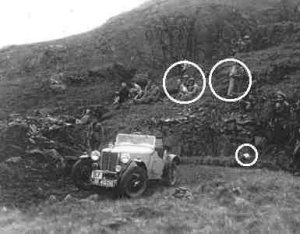
Then Kevin Barnes e-mailed me “Just seen the Jenkins Chapel debate and thought I would try and help. I think that (99% sure) the picture may actually be of Wrynose Pass on the London-Edinburgh. I enclose a picture of my grandfather J.D.Barnes on this section. (wrynose.jpg) It’s not as good quality as the MG picture but after studying it at high zoom levels I believe that some of the people and features in the background are the same as in the MG picture. I have highlighted them on the MG . I will have a look at the competition numbers for that trial to see if I am right when I get time.
The caption of the original picture says “J.D.Barnes entering the second loop of the tricky Wrynose Pass Climb in the London-Edinburgh”. I think the MG by the way is on the first corner just before this picture was taken. Hope this sheds some light/debate on the picture.
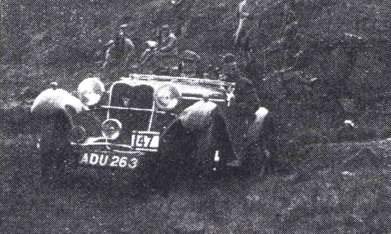
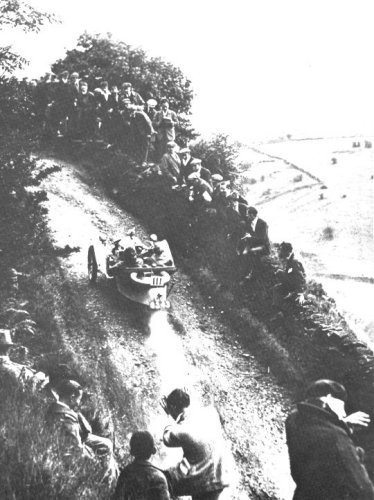
Then a few days later Kevin came back after yet more research “Back again with some more detail on Wrynose and another picture of the hill. MCC Edinburgh Trial 1935 – 182 cars entered, Singer 1.5 litre J.D. Barnes No.47, M.G. Magnette L.A. Welch No.57. This picture (wryn2.jpg) is taken in 1936 MCC Edinburgh, the picture I sent to you before of ADU 263 was 1935. The caption reads “Two Loops” were used on Wrynose Pass, off the normal track. Here is L.E.C. Halls Singer on the second loop. I’m not sure if this is the same area of the hill as the MG and previous Singer picture but the picture would obviously have been taken from the opposite direction to this on the second corner we can see so I suppose it could be. Wrynose Pass is located in the Lakes near Lake Windermere. “The route led to Wrynose Pass, a narrow hill with, on its lower stretches, a fearsome drop on one side. Wrynose Pass was included for the first time last year (1935), and this year it was approached by a different road leading over Blea Tarn, where a little corckscrew climb, quite steep provided interest.
On Wrynose itself there were two points of difficulty in 1936. First there was a test of the now common to and fro variety, and then competitors were diverted off the track proper round two loops. The 1936 trial saw an incident with an MG skidding over the steep bank and roll down the hill. Luckily, only broken bones resulted. The trial then moved on up the road to Hard Knotts Pass. Hopefully that has solved the identification of the picture/hill. Anyone with anymore unsolved trials mysteries?”
Many thanks to Kevin, Pat, Andrew and Tony for solving this mystery. Just shows you can’t believe everything you read, especially in Classical Gas!
We have been publishing stuff about Classic Trials on the Web since 1995 and always appreciate feedback. Comments, Corrections, Criticism & Concerns are all welcome. You can leave a comment to have your say here on this web site or our Social Media

 Classical Gas