You have stumbled on a delightful box of tricks, Classic Trials & other perverse stuff from Michael Leete. MCC ACTC and other trials. VW Beetles, Dellows, Marlins, or even Suzuki X90's
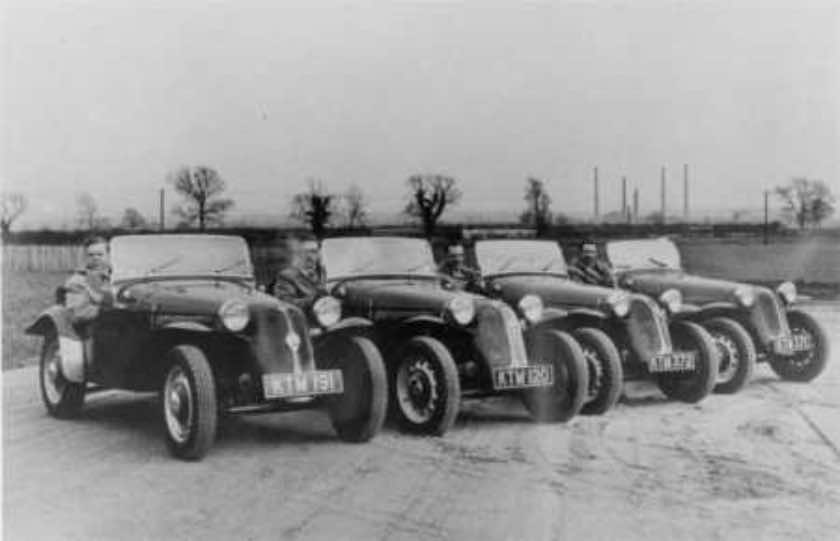
From the Dellow Register we hear that Falcon president Ron Warrens’s old Dellow Mk2 KTM 191 is for sale. This was one of four cars bought by a large firm of agricultural implement manufacturers whose salesmen had to cover some really rural terrain.
The Company in question was Fords (Finsbury) Ltd. of Chantry Avenue, Bedford. Fords was a maker of milk bottling equipment, putting those foil caps on the bottles, which were installed in small farm dairies. Their advertising literature of the time was headed “The Fellow in the Dellow”.
KTM 191 went on to have a distinguished trials career in Ron’s hands before Richard van der Fransen bought it . In 1970 he sent it back to Lionel Evans (who made the original bodies) to have it re-skinned. Sadly Rick is most un-well and has decided to part with Ron’s old car provided it can be found a good home.
The four “reps” Dellow’s in a typical Bedfordshire setting. All four are still very much alive and kicking, although KTM 372 has emigrated to the USA.Ron and bouncer Alan Preston stand either side of KTM 191 in company with Derek Fleming (Primrose), H . W. Tucker-Peake (Tucker-MG) and John Tucker-Peake (Minor with Ford Consul power). The Falcon’s are pictured on the way home from the1962 Exeter Trial.
We have been publishing stuff about Classic Trials on the Web since 1995 and always appreciate feedback. Comments, Corrections, Criticism & Concerns are all welcome. You can leave a comment to have your say here on this web site or our Social Media
Please help spread the word and share this on your Social Media:
My March Hare adventure started a few weeks before the event, when Michael Leete invited me to accompany him to West Yorkshire to look at a Dellow he was going to buy. Having done the deal and on the way home we talked about it’s role in Michael’s competition calendar.
He decided there and then to make the Southern Autos PCT at Brickhill the shake down event and then enter the March Hare. He asked me if I would like to be the passenger for these events. I said yes provided it was OK with the March Hare committee.
It was a little bit cold in the paddock at Brickhill and I began to wonder if I had enough clothes on. But down in the valley it was totally different as the cold wind was blowing above us. Very quickly it was our turn to attack the first section and things couldn’t have gone better, a clean and another clean on the next two hills. What a start. Those of you who were there know that half way around round two, we retired having found all the things wrong that you hoped you wouldn’t but knew you inevitably would. Worn out plug leads, points etc. etc..
Three weeks later, and the day of the March Hare. The day dawned bright and cold but without the predicted overnight frost. Our journey to the start was via the lanes of Hertfordshire rather than the main roads. Our route took us via Old Knebworth, Codicote passing a section near Nup End that was used in the March Hare of 1963, on through Wheathampsted, Harpenden to the A5 and the Truck Stop at Frias Wash.
We joined the queue for scrutineering hoping everything would be OK. It was except for a blown side light bulb. We caught up with all the gossip over a true truckers breakfast and we were ready for the off.
The route then took us back towards Stevenage via New Mill End and Peters Green to a holding control just outside Whitwell. We continued through the village to the first section Nortonstreet Lane, a relatively easy climb without the predicted ruts that were present last year.
On through St Pauls Walden and Preston to Section 2 and a regularity test at Whitehall Lane. I have to admit my education never included how many yards to a mile, only meters to a kilometre. Michael managed to work it out somehow and we went through the section in about 50 seconds.
We then continued on our way this time taking in the delights of the Luton southern bypass to arrive at Section 3, Half Moon Lane. By then it had started to rain and there was only a short queue waiting to find out how deep the mud bath would be this year. The answer, as we discovered, was not very, but the restart was a real test of the drivers skill. Michael placed the Dellow and with a little bit of wheel spin we were on our way again, with snow now falling.
Four miles further on the snow had stopped but the Marshals standing on the hill at Kensworth looked rather cold. Our attempt at the two sections laid out on the hill were not very good although I was surprised we got round the first corner on Section 4. While we were there, we witnessed the climb of the day by Ian Davis who stormed up the very slippery slope to clean Section 4 and ultimately go on to win the event overall.
The sun was out again when we arrived at Edlesbrough for three sections on the slippery hill. Our attempts matched those of the competitors in front of us. Ian Davis was again showing us all how it should be done. Lunch was taken after the third section at Edlesborough and time to catch up with the news from the other competitors.
Most of the entry was at Brickhill and the queue for the Special Test was nearly out the gate. Plenty of time then to take photos. We did alright at Brickhill, cleaning all three sections, all with restarts and all in bright warm sunshine.
Thirteen miles south and a totally new venue to me, came Ivinghoe. After the second Special Test there was another short wait until we could attempt the hill. This gave us enough time to fix the exhaust clamp which had come undone along the road from Brickhill. We were told that the restart had been taken out, so it was then a straight forward climb. Full revs were used to get us over the first steep bit of the section and then it was a long drive along the bank to the next little ridge where the restart should have been.
Continuing, the route then took us via the outskirts of Tring through Wiggington and Cholesbury to Section thirteen, Hawridge Lane, where we had quite a long wait in the lane before the section, caused by a vehicle coming the other way. I had expected some water in the bottom of the valley but there was only mud. The restart however was placed with tree roots all around and caught out a lot of drivers, ourselves included. Clive Booth was the man to show us all how to do it this time. Apparently he just stopped and then drove off the line without drama.
The route then took us back over Cholesbury common to the last section Hill Farm. to be greeted by a happy John Newberry and Ian Lawson who had thawed out from their time on the Kensworth bank. Hill Farm presented no problem and we were then heading for the finish via Berkhamsted, Water End and Flamsted. The results were posted while we had a cup of tea and the trophies presented soon afterwards. Congratulations to Ian Davis on a well deserved win and to the entire organising team including all the marshals and a “Thank you” to Michael Leete, for a very enjoyable day.
Mike Hayward.
We have been publishing stuff about Classic Trials on the Web since 1995 and always appreciate feedback. Comments, Corrections, Criticism & Concerns are all welcome. You can leave a comment to have your say here on this web site or our Social Media
Please help spread the word and share this on your Social Media:
I finally got the Dellow going, but as usual work got in the way & car preparation was left to “last minute motors”. On the Good Friday morning I had the petrol tank out to solder the drain plug back in. Anyway, that’s my excuse for not testing the car fully loaded.
Jim & I set off at 4.30 for Popham and got to Reading before we realized that the burning rubber on right hand bends was ours. The new exhaust was great unladen, but too big for the wheel arch with a full crew, tools and tank of petrol & was cutting a groove in the tyre. Nothing for it but to screw the dampers up & go home. Spent all day on Saturday modifying the new exhaust to side exit in front of the wheel.
Regards
Peter
Please help spread the word and share this on your Social Media:
Julian Dommett won the Allen for a record third time. It was a close thing though, as there were four clean sheets. Julian won by a second on special test times, beating Giles Greenslade, Bill Bennett and Philip Mitchell. David Foreshew was the best class eight but everyone in this class dropped marks somewhere as a result of their extra restarts.
Michale Leete smiling for the camera, as in the background competitors can be seen tackling the new section at Birch HillNeil Bray changing his drive shaft after Nanny HurnsStuart Harrold and Chris Phillips grounding out on BurledgeAnyone for Class Nine! Stuart Ridge out for a gentle Sunday drive on Burledge.
Pete Hart and his team kept The Allen to its established format, with all the hills, with the exception of Nanny Hurns, run on well-established tracks. There were changes though. There was a new hill and the route was a little different as the start had to be moved a few miles up the road this year.
Last years winner, Adrian Marfell, led the field away from The White Hart in Cold Ashton in near ideal trialling conditions. The weather was overcast, but dry, after some very heavy rain the previous two days, and even on the morning itself, to spice things up. This was a good thing as The Allen’s sections are not particularly difficult in the dry.
The route from the start passed the top of Tog Hill, the normal first hill, on the way to Bitton Lane, which was the first competitive section this time. The Blues and Whites had a clean run at the hill. Yellows and Reds had the usual restart on the left hand bend but this didn’t present much of a problem and only Arthur Jones in his Liege failed to get away.
The trial followed its usual route through Keynsham to Uplands where “Little Uplands” was on the agenda this year while it’s “big” cousin was given a rest. This was the end of Stephen Potters trial when his magnificent Trojan cried enough. This was a shame but Trojan fans still had John Wilton’s similar machine to watch. Like all except the reds the Trojan crew had a clear run through, so they could build a bit of momentum over the rough rocky bit in the middle. Class eight weren’t let off so easy and this is where they had their restart, which was to prove pretty challenging. Last year’s winner Adrian Marfell failed to get away properly and he wasn’t the only one. Stuart Harrold (Troll), Anthony Young (VW Special) didn’t get away either. The three class eight Falcon’s all failed to re-start. Although John Parsons actually got going he slipped back quite a few inches in the process and was given a fail.
Next came the infamous Guy’s Hill, where everyone has to reverse and come back down after the land-mark right-of-way judgement of a few years ago. Guy’s Hill is dead straight and doesn’t have a tremendous gradient. It’s the surface that makes the section difficult, with a combination of polished stones and tree roots. Blue and White were allowed a clean run and those who built up sufficient momentum got to the summit OK. There were a few that didn’t though. In class One Paul Allaway stopped at the one and Adrian Tucker-Peake couldn’t get past the six. All the class three’s got up except Stuart Deacon (Escort) and Murray Montgomery-Smith (Morris Minor), both of whom retired not long afterwards. The section didn’t present much of a problem to class four although Michael Leete didn’t drive it very well and stopped at the two.
Life was different for the Yellows and Reds who had to restart half way up and tackle the upper reaches without the benefit of momentum. Most either failed for a six or stuttered a few yards to gain a five. It was cleanable though and Mike Hobbs stormed to the top in his Big Beetle, followed by Julian Dommett in his side valve Dellow Mk 1. A few of the class eights were successful including Adrian Marfell, Carl Talbot and Falcon’s Mike Pearson.
Everyone had to restart on Sandy Lane and this was all about stopping in the right place. Surprisingly it was the class seven’s who seemed to have the most difficulty and ACTC Rights of Way Officer and “Wheelspin” webmaster Andrew Brown was one of the failures. After a wonderfully muddy, rutted track and a series of tiny lanes came Strode, which is also all about the restart for all except the blues. This one didn’t present many problems and it was followed more or less immediately by a special test involving going across and then back through a puddle of muddy water!
The route continued it’s traditional way to Travers where again the yellows and reds had to re-start, although this was a little higher up the section than usual. Without a restart it wasn’t too difficult, provided you didn’t have a puncture of course! Unfortunately Neil Bray did and had to change the wheel on the section in order to clear the way for those following. The restart area was quite rocky. John Parsons stopped quite high up and got away but Mike Pearson chose to come to a halt lower down and got his wheels stuck in a dip.
There were a dozen clean sheets at the Chew Valley reservoir rest halt, but that was to change just up the road at Burledge. This is a real classic trials hill. The lower reaches are in a tree-lined gully, rocky but pretty smooth. After a 45 degree right hander the section goes straight as an arrow up a rutted track with a restart for yellows and reds and less and less ground clearance a you get near the top. Tyre pressures are critical, especially for the restarters. As Chief Official Nigel Moss said, “you need 6 psi to get off the re-start then fifty psi to maximise ground clearance at the top!
The guys with the big wheels did well here; although the section was to see the end of Dudley Sterry. In Class One David Haizelden and Michael Collins were to loose their only marks of the day in their VW Golf’s. Phillip Mitchell stormed up in his David Turner prepared blower BMW and so did Giles Greenslade and Dick Glossop in Class Four. It was a tough section for the restarters although it clearly suited the big Beetles as four of them got up. In class seven wheel size was everything and all the Marlins failed but Julian Dommett (Dellow) and Arthur Jones (Liege) were clean.
Quite a few of the class eights stopped, either failing to get away from the restart or running out of ground clearance just before the summit. Mike Pearson couldn’t get away but Clive Booth in his similar Reg Taylor/Geoff Jackson built Dellow Replica got off the re-start only to fail at the two. Poor John Parsons got out the top of the section but was judged to have failed the restart.
Seven competitors lost their clean sheets on Burledge and the remaining five approached Nanny Hurns with all to play for. The special test was separate to the section this year. Julian Dommett set another fast time and this put him in the lead of the trial. The section was its usual self, short, muddy and slippery but cleanable with skill. It’s necessary to get the speed just right. To slow and you won’t get over the bank, to fast and you under-steer into the trees. All of the leaders slid over the bank OK and the entire field cleaned the following Tog Hill after Stony Hill had to be cancelled due to an influx of New Age Travellers. Neil Bray had to change a drive shaft on the way when a rat-tat-tat from the rear indicated that one of the CV’s were on its way out.
It was north up the A46 now, over the M4 in the gathering gloom to a new section called Birch Hill, presided over by John Sargeant. The hill was quite long. The first bit had a gentle gradient but was quite badly rutted, catching out Mike Hobbs in his Big Beetle. It entered a tunnel of trees, rounded a gentle right hander then wiggled through a muddy quagmire with a restart for Reds right on the edge where the grip went away. The weather was to play its part here as the heavens opened up to make things more interesting. Getting through the mud was all about burning your way through with sheer power or building speed and using pure momentum if you didn’t have to re-start. Jeremy Flann (Austin Seven) lost his clean sheet here so it was down to four as then field wound it’s way to John Walker which was to be the final hill of the day.
The section was it’s usual magnificent self, by no means a “stopper” but a pure pleasure to drive. It can catch out the unwary though, as Clive Booth found out when he flooded out in the ford. So there were four clean sheets in the end, with overall victory going to Julian Dommett on Special Test times. It was a well-fought trial and the result could have been different. Clee winner Michael Collins had faster times than Julian but got a three on Burledge. What a year if a Class One driver had won two ACTC events! And spare a thought for Adrian Marfell who also did better on the Special Tests but couldn’t restart on the dinosaurs eggs at Little Uplands! But well done to Julian Dommett who on the day was the best driver in a well-prepared car. And thank you to Pete & Carlie Hart, Mark Tooth and all the team for another excellent and well judged Allen Trial.
We have been publishing stuff about Classic Trials on the Web since 1995 and always appreciate feedback. Comments, Corrections, Criticism & Concerns are all welcome. You can leave a comment to have your say here on this web site or our Social Media
Please help spread the word and share this on your Social Media:
Ross Nuten won Murray’s March Hare in his Dellow with the only clean sheet of the day. It was a close run thing, with Dave Nash fastest on the special tests, and only missing victory when he failed the Edlesborough re-start.
Falcon had 31 entries for the third running of The March Hare as a road trial in recent years. It was a nice varied entry, with a number of Classic Trial debutantes, fulfilling Falcon’s ambition of using the event as a way to get a taste of the sport. The machinery was pretty varied, the only certain thing that either a Dellow, or a Dellow inspired car, was going to win class eight, as all six entries came from that stable. There were four original cars, plus Clive Booths Replica that was constructed by Reg Taylor and Geoff Jackson and the RDT, which Reg constructed on Dellow principles a few years ago, but with a wider body and IFS.
Keith Pettit about tackling the step at the summit of Cress Beds on his way to win class 5
Nick Iken led the field away from the Big Pub, next to Neil Bray’s garage in Graveley, for a gentle run through the Hertfordshire Lanes to the first two sections at Whitwell. Cress Beds and Water Tower are on the same lane, which is bisected by a tarmac road so the section is split into two parts. There was a brief delay at the foot of Cress Beds while Julian Robinson got the Herts VW team into position. The short opener had a re-start which caught out Peter Morley who was driving in only his second trial, and first classic, in a standard Beetle.
Colin Perryman, going well on Water Tower, had to retire at Devils Pit
Then it was across the road to tackle Water Tower. The section starts with some really deep ruts, which weren’t too muddy. Most of the sections were pretty dry as the event took place in a bit of a dry window and the strong winds had dried the ground out appreciably in recent weeks. There was re-start again and this very long section claimed four victims.
Sponsor Murray MacDonald had organised three sections at Devils Pit in Barton, a venue mainly used for Four Wheel Drive off-roading. The first section had a tricky right hander at the start and caused problems for Colin Perryman when a drive shaft failed when he applied the power. Fortunately Colin was carrying a spare and set about changing it, only to derange the steering on the very next section. By this time Colin was running very late and decided to head for home. This section wasn’t very Skoda friendly as Neil Bray did exactly the same thing and had to spend half an hour doing an impromptu re-tracking job. Seeing all this back marker Simon Robson took things very gently in his Liege, lost momentum and failed at the nine.
Neil’s Skoda was fine on the drive to the next section at Mile Tree Farm, but didn’t go any further as a drive shaft broke. It was simple enough to change, except he wasn’t carrying a spare. No matter, Dave Nash lived nearby and nipped home to get a couple of Skoda drive shafts. No problem then? Well yes, there was a small one, Neil has modified his car to use Beetle shafts! The second section at Mile Tree claimed a number of victims where the re-start was positioned just before the steep final bank.
We were in the heart of Falcon trials territory now and organiser John Parsons had laid out two sections at Brickhill and these shaped the course of the event. The first one caused a few problems as the run up to the wood was slippery and neither Nick Iken nor John Rowland in class one managed to traverse the slippery patch. Michael Leete got over this part OK, but understeered off later in the section, to drop his only four marks of the day. Geoff May had been going well in his blown Dellow, despite (or because of?) having no rear shockers. One of the mountings had broken on the way to the start and rather than miss the fun Geoff solved the problem by disconnecting the other one as well.
Overall winner Ross Nuten, pictured at Edlesborough, was the only car to get a clean sheet
The section at Ivinghoe was all about the re-start where Arnold Lane was in charge on top of a very cold and windy hill. This was followed by a re-grouping control with Andrea Lane and Tom Goggin in the Falcon Chuck Wagon dispensing very welcome hot food and drink. While the competitors were relaxing, many of the marshals were travelling across country to officiate on the afternoon’s hills. These started at Edlesborough with Geoff Jackson in charge. This was un-believable, using almost every feature of this familiar PCT venue to produce one long section. The wind had dried everything out and conditions were very different to the Clubmans trial a few weeks before. It was here the event was decided, when Dave Nash dropped six, handing the lead and the trial to Ross Nuten.
At Kensworth the sections were named after John Barber, the land owner who sadly passed away recently. The first section was a pure grass slalom, with a nasty turn on a adverse camber which claimed the front wheel drive cars and some of the less experienced drivers. The second went straight up the stone track before venturing onto slippery grass beside the fence and most of the entry slid to a stop here.
The trial was drawing to a close now, but it was back to county roads and there were a couple of treats in store. The first was at Half Moon Lane where Mike Pearson had drained most of the water out of the sump in deference to the lower slung machinery! It wasn’t difficult if you had the ground clearance but a lot of fun never less. Simon Robson failed when he stayed out of the muddy ruts and got stuck sideways when he was forced back into them and had to be bodily lifted out by JP, Verdun Webley and the crew. There was a further treat in store just after the section ended where it was very difficult to get through the mud.
David Sheffield and Owen Turner trying in vain to re-start on Norton Street Lane
The final section was back at Whitwell, this time to Norton Street Lane. This is a very long section, which is always changing as the water alternately, washes mud and stones down the track. The big challenge is at the top where Julian Robinson and Murray MacDonald had positioned a re-start on loose stones with a diversion for class seven and eight. The only problem with this was, that with their narrow track, the Dellows were able to stay out of the ruts to find firm ground! For those forced into the ruts it required a delicate foot on the throttle as John Bell discovered in his Escort, but John, who has taken part in all three March Hares since it became a road trial again, still won class three. Most of the low slung cars needed a pull from the Range Rover here, but it could be done, even with relatively little ground clearance, as Keith Pettit proved in his Frogeye Sprite.
There was plenty of Food and Drink available back at The Big Pub, where Ross Nutern was the well-deserved and popular winner. The many competitors who had taken part in their first road trial were full of stories of their adventures and hopefully their appetites have been wetted for the future. The organisers had put on a really good event that was tremendous fun for those taking part. Role on the next Murray’s March Hare.
We have been publishing stuff about Classic Trials on the Web since 1995 and always appreciate feedback. Comments, Corrections, Criticism & Concerns are all welcome. You can leave a comment to have your say here on this web site or our Social Media
Please help spread the word and share this on your Social Media:
This piece was conceived about a year ago, when I first saw Peter Mountain’s Morgan. I had often admired his well-prepared Skoda and knew he was re-building a Dellow, but when I saw that Morgan I just had to know more about car and driver.
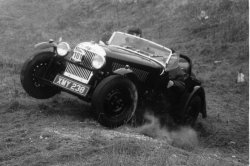
Peter MountainPeter on Crackington in his Morgan in the 1990 Lands EndPeter Mountain splashing his way through the ford at the foot of Bareleg in his Skoda on the 1994 Edinburgh.
Peter’s first car was a 1937 Austin Ten, which he bought for the proverbial fifteen quid. It was a horrible thing, in terrible condition. Foot flat on the floor it would reach fifty but the reality was you actually daren’t drive it over forty, it was so un-stable! An Armstrong Siddeley Lanchester was next. It had a Wilson pre-selector gear box, the same as was used in the ERA’s. It had six cylinder’s and hydraulic tappets but like the Austin Ten it didn’t last very long and followed it to the local scrap yard. Then came a series of Escorts and an ex Evening Standard Minivan before the Morgan arrived.
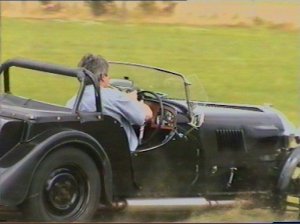
Peter acquired XMY 238 in 1968, after seeing an ad in the Exchange and Mart. He was running around in the Minivan and had planed to use the Morgan as his regular road car. However, although the car looked nice it was quite evil. It had lived a hard life, everything was worn out, to the extent that Peter had to change the engine the next day. Once this was done Peter used it regularly for a year or two, driving it on the road and competing in trials and sprint’s, before acquiring a company car, whereupon XMY 238 disappeared into the garage for a quick two week chassis change! The old one had become rather rusty, a common fate for the early cars, as the steel used for the chassis was pretty appalling and they didn’t last very long. A brand spanking new frame was obtained from Malvern Link for the princely sum of £65. Just one small thing, the two weeks expanded rather, into an eleven year re-build!
As you can imagine, the car has had many alterations and modifications over the years. It now has cycle type front wings (acquired from the same source as Dudley Sterry’s), disc brakes, a modified TR4 engine, radial tyres,15 inch wheels and numerous chassis modifications. Some of these changes offend the purest members of the Morgan club, but they were quite normal modifications in the late sixties and early seventies, around the time that Plus Four production ceased. However, they do mean that this old car is quite fast on the road and is well able to hold it’s own in modern traffic.
Peter got into trials when he drove by Milk Hall Farm on the way home from a Veteran Car run a couple of years before. He saw something interesting was going on and went in to have a look. He got chatting to Mike Furse, who talked him into doing an MCC trial, and the rest is history! Peter used the Morgan in PCT’s, Classic’s and Sprints for several years, before and after the re-build. In the early 90’s he did all three of the MCC events one year. But the hill’s were getting rougher and he was concerned about the way the underside was getting knocked about. Peter particularly remembers the ruts on Waterloo. Smash, smash, smash. The cross member is still banana shaped after the experience! The problem is that the suspension movement is so limited.
The car is raised an inch and a half at the front and two inches at the back, but it has so much overhang at the back that the tail is still extremely vulnerable. The final straw came when the diff and the gearbox broke on Bamford. The diff wasn’t to much of a problem but the Morgan uses the same Moss gearbox as an XK120. Bits are very hard to find and are very expensive when you do locate them. Peter managed to find another box but it had a high bottom gear that was not suitable for trials. This prompted him to decide that the Classic’s were now to rough for such an old lady and he bought a Skoda.
The Morgan still comes out for selected PCT’s and the occasional autotest when it is driven with great verve! Future plans for the car include hill climbs and Peter rather fancies the Manx Classic. However XMY 238 will need another engine, as the present one is now very tired .
Before we leave Morgans it’s interesting to hear that Peter was responsible for introducing Rob Wells, the well-known Morgan racer and London dealer, to trialling. They went to the same school so they go back a long way. Peter has team managed the Morgan team at some of the long distance relay races, including the 24 hour event at Snetterton which they won, only to be disqualified afterwards. Rob and Peter have shared quite a few motorsport experiences, including driving a Beetle on the Lands End. Then they shared a left hand drive Plus 4 for a couple of years. This was a Fiat engined car that they built up from a pile of bits.
There have been two Skoda’s. The first was an Orange one, acquired in 1993 and used by James as a road car. It was then turned into a trials machine, but was totally gutless with it’s standard engine. They got hold of a rally prepared motor and de-tuned it a bit but the cam is still a bit hairy. Later the mechanical’s were moved into another shell that forms the basis of the current car. The gearbox has broken a couple of times but otherwise Peter reckons it’s pretty robust. Over the time he has had the Skoda he has developed the it considerably. He’s removed the anti-roll bar to give a bit more suspension movement at the front and there are some hush-hush tweaks at the swing axle end back end. Recently the car engine has been de-tuned even more in search of more torque. It’s fitted with a 40 DCOE Weber that now has quite small chokes to make it more tractable.
Peter has had his Dellow for about two years. He doesn’t know much about the history of this particular car. It’s a Mk 1 chassis, no 35, and was already fitted with a brand new 1600 Crossflow. Theoretically it was practically ready to run but Peter wasn’t happy with a lot of the workmanship and decided to give it a compete re-build. According to the MCC programs it was last trialled in 1986. It was also used in speed events, for the purpose of which it had the main cross tube cut out, so the engine could be set lower in the frame. So the first thing Peter did was to replace it, as the chassis was a bit flexible to say the least!
Peter has had his Dellow for about two years. He doesn’t know much about the history of this particular car. It’s a Mk 1 chassis, no 35, and was already fitted with a brand new 1600 Crossflow. Theoretically it was practically ready to run but Peter wasn’t happy with a lot of the workmanship and decided to give it a compete re-build. According to the MCC programs it was last trialled in 1986. It was also used in speed events, for the purpose of which it had the main cross tube cut out, so the engine could be set lower in the frame. So the first thing Peter did was to replace it, as the chassis was a bit flexible to say the least!
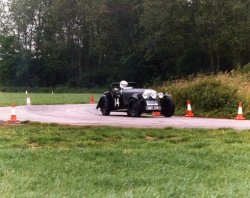
Full Chat – Peter autotesting XMY at a Falcon autotest at Upper Caldecote in the summer of 1998Taking good care of the old car on the 1989 Testing TrialPeter sprinting XMY 238 at Curborough in 1988
We have been publishing stuff about Classic Trials on the Web since 1995 and always appreciate feedback. Comments, Corrections, Criticism & Concerns are all welcome. You can leave a comment to have your say here on this web site or our Social Media
Please help spread the word and share this on your Social Media:
If there was a prize for the smartest car at the July Autotest it would have been won by Geoff Jacksons new trials car the “Sprint”. Geoff has all the qualifications for the job. My first recollection of him was on the 1971 Guy Fawkes when he was driving a Morris. Latterly he has campaigned a class eight Dellow on MCC events. (Kindly towing me out of a mud hole on the muddy exit from Calton a few years ago).
Geoff started to build his new car about five years ago. He started by putting a melamine “surface plate” on a couple of trestles and laying out the chassis tubes on that. The Sprint uses a Ford back axle located by twin trailing arms. A mark 4 Cortina provided the front hubs and the suspension owes a lot to Westfield and the Ford Transit, while a friendly Escort donated it’s steering rack!
Geoff resisted the temptation to fit a Ford Kent engine and the Sprint is powered by a 1500 lump from a Triumph Spitfire, running a single SU. The mechanics are finished off by a very well made body, nicely painted in Red. It’s a super car and did very well at Upper Caldecote in the hands of Geoff’s two sons. Watch out for the Sprint on the Edinburgh.
We have been publishing stuff about Classic Trials on the Web since 1995 and always appreciate feedback. Comments, Corrections, Criticism & Concerns are all welcome. You can leave a comment to have your say here on this web site or our Social Media
Please help spread the word and share this on your Social Media:




 Classical Gas