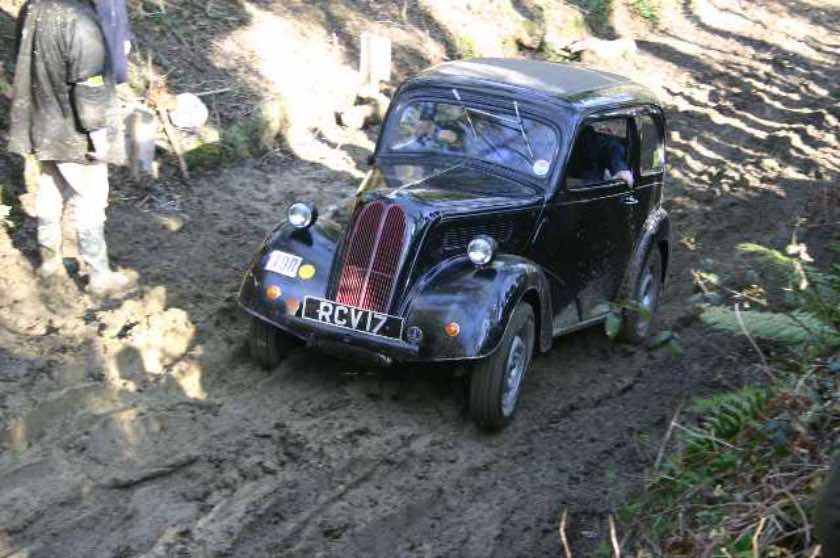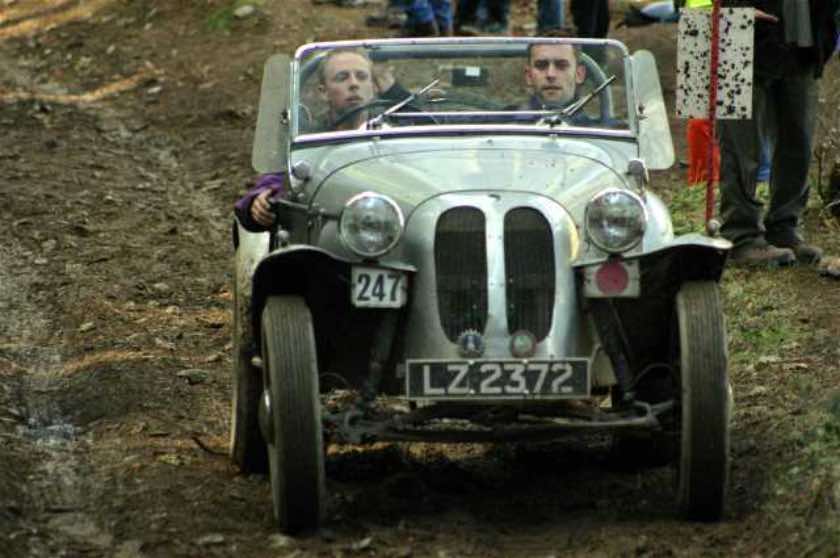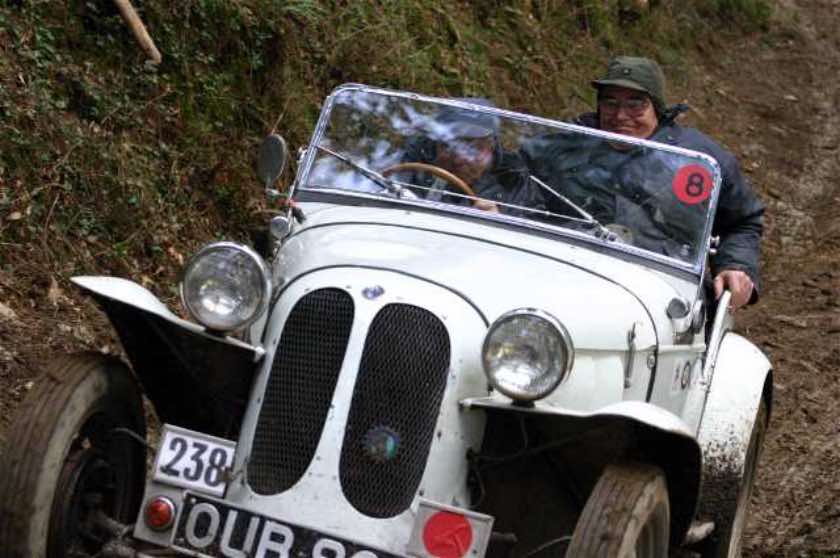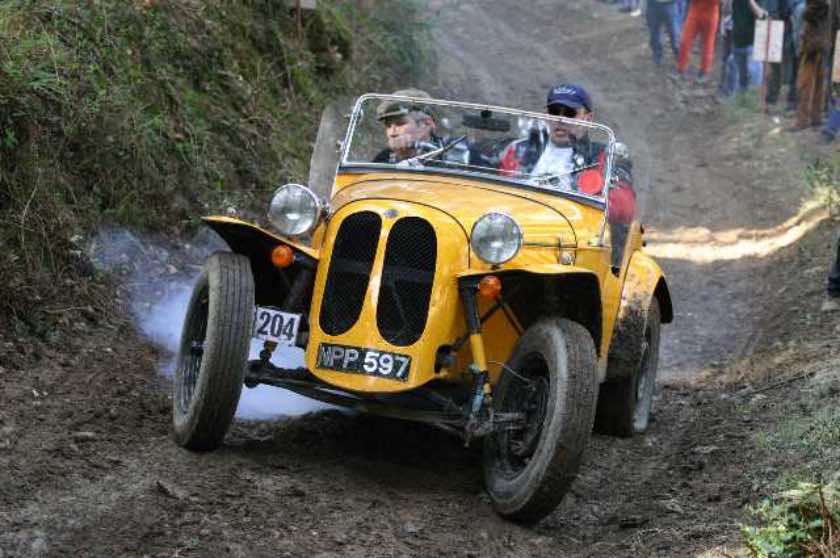
Lands End Class 0

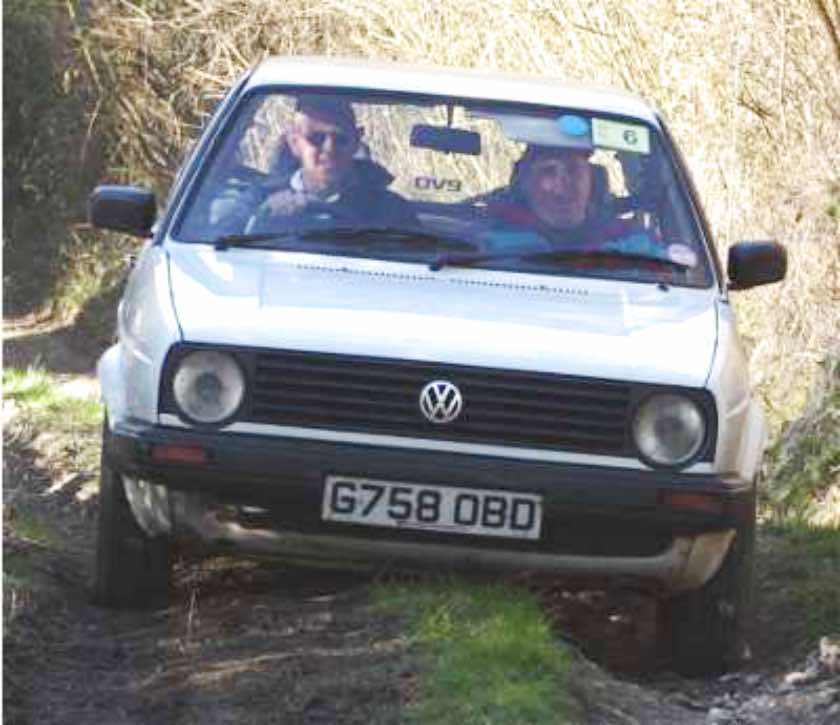
Chris Clarke competed in Class 0 on the Lands End in his Golf. Here is his report.

When we first discussed the Lands End with experienced competitors; for some reason the impression we gained was one of a series of off and on road driving sections interspersed with meal stops – or was it the other way round? We like our food (the VW suspension is up-rated for good reasons) so it seemed a good idea to give it a go. Unfortunately at our first attempt the car ran out of energy (alternator failure) after only the third refreshment stop, so that was the end of it for 2004. 

For 2005 we set off in good time for the start to allow plenty of time for our evening meal, plus signing on etc. Suitably fortified we set off on the first road section, taking advantage of the holding control to fine tune the headlights, and then into Catsash, which we climbed without event. Whilst pumping up the tyres, we remarked on how difficult even the simplest task becomes at night, what with fiddling about with torches and if you drop anything small it’s gone for ever. 

On to Up Ewey and Grabhurst where it was noticeable how much more traction and control the new tyres gave over last year. What was more remarkable was how bright the moon had become; it was almost possible to drive without lights, although I suspect our navigator was not impressed by my practical demonstration of this. 

We left the Culborne Inn (bacon sandwich) and drove down Countisbury and up Porlock Hill, these are challenging in a modern car so it’s hard to imagine what they must have been like on an early c20th motorcycle.

The restart on Barton Steep was the first serious challenge, as the larger wheels on the Golf have raised the gear ratio and it took a lot of clutch slipping and some burning smells to ensure a fool-proof getaway. We were promised more of the same at Upper Molland and the feeling of trepidation was heightened by the optical illusion, as you descend into the clearing at the start, that the hill is steeper than it actually is. A VW beetle looked remarkably like its namesake as it climbed the track opposite. In fact the restart on loose surface was a lot easier on the clutch (obvious when you think about it) and we climbed it with only some wheel twirling on the corner.

Beyond this we were further than 2004, but no mention was made of this at the time for fear of “Murray Walkering” our chances until we reached the services at Roundswell (coffee & chocolate bars). Wargery and Roly Poly passed without incident and we continued to the café (control point) at Wilsey Down – ham, egg and chips with a mug of tea – excellent – and a chance for a nap in the sunshine. At Petherwin it was nice to see our first spectators there, but there was a scary moment as we rounded the first corner by Ruses Mill, trying to build up speed for an unknown gradient ahead and just missing a large stone covered with about 400 years worth of scrape marks.

We arrived at the Lady Vale test to a pressure building combination of spectators and the distant sound of a car struggling up something like the North face of the Eiger. In fact this test had one huge advantage, it was not necessary to engage reverse gear (refer to previous March Hare articles for an explanation of this), and we completed the test in what seemed a reasonable time, although I haven’t seen the results when writing this so may have to eat those words. The subsequent Mays Hill was very enjoyable and we approached Adrian’s Way with mounting confidence. 

The section was a bit slippery at the start, then a nice few yards to build up speed round the corner and a steepish climb to something I can’t tell you about because we never made it. There were two routes round the corner. I took the left hand one and avoided the rut, but unfortunately hit a large lump of earth on the inside which killed our momentum and we just did not have enough grip to make it to the top. At this point our navigator, quite out of character, suggested a more gung-ho approach which involved dropping a wheel into the rut (wall of death), thus firing the car round the corner and up the hill to certain success. At the time I was too surprised to challenge this view, but subsequently we concluded that you would have probably have either grounded with the wheel in free space or dented the (newly repaired) wing on the bank. 

We opted to do only the first part of Bishops path, a wise decision looking at what followed and stopped for a few minutes (sorry) to watch a Skoda literally fly over the top of the rock slope on the way to a clean. We’ve got a digital film of this if anyone is would like a copy. 

At Perranporth car park we could have spent the rest of the day explaining why we were driving around Cornwall in a car covered in mud, but had to move on the final section at Blue Hills. My apologies to all those who tried to encourage us to give the big one a go, but having spent the previous Saturday panel beating and with a good chance of making it home in one piece I didn’t want to take any chances and took the soft option. This took us safely to the finish control at the Crossroads Motel (yes that really is its name) where we relaxed and reflected on a very enjoyable event over a pasty and pint. It really is a pleasure to take part in an event on this scale and our thanks to the (literally) hundreds of organisers and marshals who make it possible. This particularly applies to those who cover the class O sections, where I imagine the smaller number of competitors makes it a bit quiet, but we really appreciate the chance to get used to these events in stages.


We have been publishing stuff about Classic Trials on the Web since 1995 and always appreciate feedback. Comments, Corrections, Criticism & Concerns are all welcome. You can leave a comment to have your say here on this web site or our Social Media
Lands End 2005

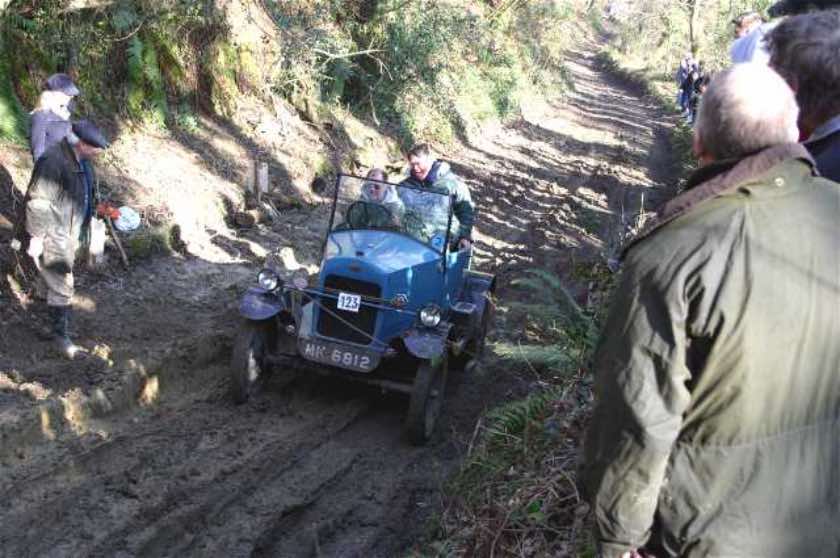
83rd Lands End Trial – It was a competitive Lands End despite the dry weather leading up to the event. The reintroduction of Cutliffe Lane and tricky restarts on Hoskins and Blue Hills One mean the MCC will not be paying out much for triples this year.

It was a nice dry night for the run in to eligibility scruitineering at North Petherton. 

Felons Oak – The restart box was very short, some of the competitors described it as almost a line but the boards were in fact about 6 feet apart, but there was limited scope for careful positioning in what is becoming an increasingly “competitive” restart.. This caught out around 50 competitors including the cars of Keith Oakes, Ted Holloway, Geoff Hodge, Peter Mountain, Brian Alexander and Bill Rosten for what was to be his only fail of the day. Simon Groves was judged to have failed to stop for the restart which was not a good start to his trial. 

Stoney Street – This long , rocky hill didn’t present to many problems although both Ross Nuten and Colin Sumner were delayed by other competitors and credited with baulks. 

Beggars Roost – The section had to be cancelled when Ian Bates in the course opening Land Rover found the track blocked by a vehicle. It soon became clear that this was put there deliberately by one of the local farmers. He became more than a little aggressive when Ian tried to reason with him and it was prudent to pull the hill rather than cause trouble in the middle of the night. 

Riverton – There was a lot of mud for the bikes and delays built up when a number of riders hit the deck. It’s a long section so the delays continued to build and by the final cars came along they were stacked up, not just on the approach track but well down the road as well. It wasn’t to challenging for the four wheeled brigade and PCT expert Nick Politt was one of the few to fail in his Nissan Micra. 

Cutliffe Lane – Another section with a lot of mud and clay that caused a lot of problems for the bikers to stay upright and stopped around half the cars, especially those running towards the end of the field. 

Sutcombe – The hill was used from a different direction this year. It wasn’t to difficult although it caught out both Brian Alexander in his Fiat and Giles Greenslade in his 1835 beetle which was starting to get a bit hot now the chill of the night had passed. 

Darracott – With the previous delays there wasn’t too long to wait at the Goosenham holding control. Just long enough for Simon Robson to adjust his clutch. Ed Nikel had been having problems with the front suspension on his buggy and on investigation found one of the shock absorber mountings had collapsed. Fortunately he wasn’t far from a friends place and diverted there for repairs that kept him in the trial, even though he slipped down the field. Ted Holloway had problems here as well and retired. 

Crackington

There was still evidence of the devastation caused by the flash flood last summer, although the bridge at the bottom of the hill had been rebuilt, saving some wet feet. The hill itself didn’t appear to have been doctored as much as usual, although there had been the usual localised rain shower in the restart area. There was a little aggravation here when one of the marshals in the restart area stood on the dry part of the track for a while, forcing competitors into the deepest part of the mire where some of them failed. There was some heated “discussion” with his fellow officials, in front of a sizable crowd, which didn’t do a lot of good to the image of the sport. 

Most of the bikes were able to cope quite well, although some of those who weren’t going fast enough lost momentum through the mire, lost “steerage way” and either had to foot or fell off. Those that were brave enough to go up at some speed had no problem. None faster than Chris Beare on his 350 Suzuki but goodness knows how much damage he would have done to himself if he had fallen off. 

Tony Young was the first car to arrive and had an unhurried climb. Then came another dozen bikes before the cars arrived in earnest. Mike Warnes was the first failure of the day in his very smart Triumph TR7. Former “Old Spot Piglet” driver Clive Cook was taking things very easily and stopped before the mire to become the second candidate for the very efficient recovery crews winch. Then came Richard Shirley in his Class Seven Dellow, who stopped and restarted, as did quite a few more class sevens who came a long later. It appears that some drivers were confused because although the route card said they didn’t have a restart the boards were yellow with a black R, indicating they should stop. Class eight only restarts being shown in the route card as red with a black R. 

In Class 1 Paul Allaway made a very impressive full throttle climb, neither slowing, nor deviating from his line through the tricky stuff. They were followed by David Symons who was equally impressive in his Citroen AX. Most of the cars in class 2 made clean climbs although neither Steve Potter nor John Wilton’s Trojans had enough power. It will be interesting to see if John Turner is shown as cleaning the hill. His Austin Seven stopped in the restart area before getting going again with a shove from the controversial marshal.

Giles Greenslade retired at the foot of Crackington with a very hot Beetle. It had been getting more and more overheated as the trial went on until Giles finally decided to retire rather than cause permanent damage.

After the hours break at The Wilsey Down at Hallworthy came Warleggan by which time Brian Alexander had to retire. 

Hoskin

Competitors with clean sheets approached Cardinham Woods with some trepidation as Hoskin was lying in wait. They weren’t to be disappointed. Hoskin is steep and under a layer of loose stuff there is a solid, polished stone surface. 

The lower classes weren’t to badly off as they were allowed a straight run through, but even so the hill couldn’t be taken for granted as its so steep. Lower powered engines can easily bog down unless they generate a bit of wheel-spin, but too much and you are in trouble on the slippery surface. In class four Dave Sargeant and Bill Rosten got it just right and flew up but Terry Ball had too much wheelspin, lost momentum and came to a stop in the class eight re-start area. Most of the powerful Escorts in class three and stormed to the summit, Simon Groves managing to wag his tail from side to side in the process.

In Class 2 Bill Bennett had no difficulty but the other members of his team didn’t do so well and Ian Williamson got well and truly stuck in his attempts to turn and go back down. 

Classes six and Seven had a restart on a more gentle part of the gradient but even if they got away it was difficult for them to build enough speed to get over the lumps and bumps in the class eight restart area. All credit to those that were successful, including Andrew Martin in his Dutton Melos and Roger Bricknell who had the audacity to change into second before the summit! In class six Mark Tooth did everything right and trickled away from the restart but was just unable to build enough speed and spun to a stop after a good attempt. 

If it was difficult for the lower classes it was really tough for class eight. Their restart was on the steepest part of the hill and there were lots of little steps and little rocks to trap the unwary. The main line was very slippery as the polished rock was exposed and no one, not even Dudley, could get away on this surface. The trick was to go either to the right or left and trickle away on the loose stuff, before putting the power down when it became a case of controlling the wheel spin as the track narrowed and the car forced onto the polished surface. Mike Chatwin got it right in his Troll and so did Ross Norman in his Deere Special who had no problems. David Bache managed to trickle off the line just right and although it was a struggle powered the Mk1 Dellow to the summit. Climb of the day though went to Tim Whellock. Wheelspin set in almost as soon as he left the line but he kept his foot down and he and Anne bounced and bounced and finally the Fugitive edged forward only to stop again as one of the front wheels came up against a rock. They repeated the process several times until finally the tyres gripped properly and the car flew to the summit. 

In the nearly, but not quite, category came Peter Mountain who went well to the right off the slippery stuff and pulled away nicely, but the camber dragged the Mk1 Dellow down onto the polished stone and that was that. Emma Flay went well to the left and trickled away from the line really nicely, keeping her wheels off those polished centre tramlines. It looked as if Emma would trickle her way to the summit but a front wheel came up against a rock, the Troll slowed, Emma blasted but didn’t have enough momentum and in the end had to give best to the hill. 

Bishopswood – There was a tricky restart for the Yellows and Reds, situated on the bump over the cross track as usual. It was far from straightforward and caught out Stuart Harrold who was running towards the front of the field. There was some unhappiness about the restart and many competitors thought that it was impossible for lower powered cars and a lottery for the others. 

Blue Hills 1 – Although this is a tricky section it hardly counts as a hill and this year the restart was a very narrow box right on the stone surface back on to the road. Unusually this was for Yellows Reds and Class Three! Car after car failed to get the necessary grip and failed. Ed Nikel had his throttle go over centre and shot out at an enormous speed, just avoiding the bank the other side. Fellow Falcon Colin Sumner had the reverse problem as his throttle became disconnected and he stopped without any power. This certainly wasn’t a Falcon friendly hill and only Keith Oakes and Ross Nuten were judged to be clean. 

Blue Hills 2

The hillside surrounding Bluehills 2 was thronged with spectators who had glorious weather for their afternoons entertainment. There was restart for yellows and reds in the middle of the artificial deviation. Most of the Sevens and Eights didn’t have a problem but the Beetles in class six struggled and neither John Sargeant nor Mark Tooth could pull away. Then along came Dave Sergeant who didn’t have to restart in his 1300 Beetle but failed anyway. He was followed by Terry ball who made up for his debacle on Hoskin and stormed up in his smart orange car. 

The outside bank on the artificial deviation claimed quite a few causalities as it acted as a magnet for Escorts and Midgets, many of which damaged their bodywork in the process. 

There was a new finish at The Crossroads Lodge at Scorrier where competitors reckoned it was an enjoyable and competitive Lands End.


We have been publishing stuff about Classic Trials on the Web since 1995 and always appreciate feedback. Comments, Corrections, Criticism & Concerns are all welcome. You can leave a comment to have your say here on this web site or our Social Media