A Fishy Tale

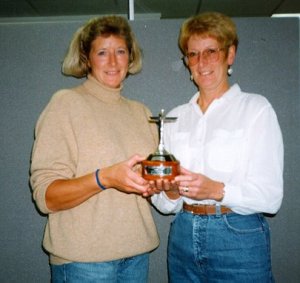
Susan Jamieson and Maralyn Knight with Tuckers Triple. Presented to Falcon as the clubs new Trials Trophy.

What connects a Nipper to a Lobster besides the fact that it’s claw nips?  You don’t know, really!…. read on.It all began with my frightful gaff in the April edition of Classical Gas, saying that Falconry’s former editor, Maralyn Knight, was the first lady to gain a coveted MCC Triple.  Fortunately for historians Ron Warren corrected me the following month.  I was delighted, not only that he set the record straight, it also confirmed that someone out there is reading this stuff!

Ron’s correction sent me scurrying to Peter Garniers book, not that I didn’t believe him.  In the thirty years since I first met Ron I have learned that he doesn’t say something unless he’s pretty certain it’s right!    No, I was after material for a story and here it is.

Maralyn’s father, Tucker, was president of both Falcon and the MCC.  Tuck conceived, built and drove the Tucker MG, perhaps the ultimate all round sporting machine.  Not only did he campaign it in trials, it was also his circuit racer.  Tucker and Betty had two daughters, Maralyn and Susan, and they took them trialling whenever possible, Tuck even converted his car to a four seater!    However, the time came when they couldn’t go with mum and dad anymore.   Tucker responded by building them a trial’s machine of their own, based on a 5cwt Ford Van.  The name was inspiration itself, “The Tucker Nipper Special”.   With sister Sue as passenger Maralyn had five successful years with the car,   becoming the second woman to win a triple and the first to win two.

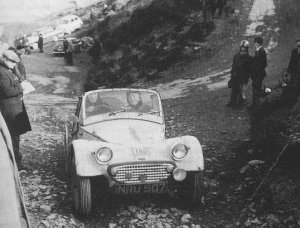
The Miss Tucker-Peakes in the “Tucker-Nipper Special” at the foot of Bluehills 2

Maralyn married Peter Knight in 1967 and gave up trials driving, but not motorsport.  The couple became RAC timekeepers, officiating in many major events, especially at Silverstone.  Maralyn didn’t severe her trial’s connections completely as she is heavily involved in producing “Triple”, the MCC’s magazine.  I don’t  know what happened to the “Nipper”, but the Tucker MG is presently being restored by Jim Templeton.

Meanwhile, sister Susan had taken to saloon car racing, first with an Anglia, then an Escort and finally a season racing all over Europe as a Skoda works driver.  When Tuck built Susan’s Escort she sold the Anglia to boy friend David Ovey.  David later went on to race at Le Mans in Charles Ivey’s Porsche and became an airline pilot.  He is now married to Tomorrows World presenter Sharnaz Pakravan, lives in London, and is fully occupied as a house husband!

I can remember marshalling at Nottingham Sports Car Club meetings at Silverstone when Sue and David were racing.  David’s sister Marion was also a Falcon member around this time.  She was a keen marshal, and an occasional rally driver, she even had a certain Michael Leete as her navigator on one occasion!  Marion was a studying hotel and catering management at the time.   Today she owns and runs the Lobster Tail restaurant in Great Offley.   Specialising in fish this is a very nice place with excellent food, it’s recommended.

As Ron pointed out Margaret Woodall was the first lady to win a Triple.  Margaret was married to Bert Woodall who with his brother Victor built the big Wolseley-Ford special in 1938.  After the war Bertie built a second (Mk 2) Ford special in 1951, winning him a triple in 1952 with Maggie getting hers in the same car in 1955.  Margaret is still involved with the sport, running the finish controls at MCC events.

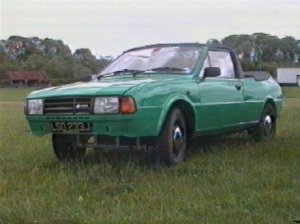
Bert and Margaret’s son, Simon, organised   the Clee Hills classic for many years and is the current ACTC chairman.  Simon competes in the ACTC series with a class 8 VW buggy and a rather special convertible BAJA in class 7 in the MCC events.

Isn’t amazing what you can learn by reading Classical Gas!!!

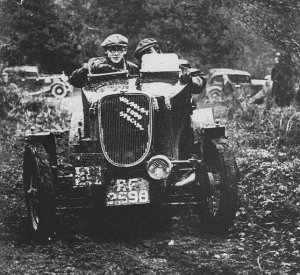
Bertie Woodall in the Wolesley-Ford Special.

Link to a Nipper Update


We have been publishing stuff about Classic Trials on the Web since 1995 and always appreciate feedback. Comments, Corrections, Criticism & Concerns are all welcome. You can leave a comment to have your say here on this web site or our Social Media
Michael’s Mechanic’s

I was really looking forward to my Mechanic’s Trial, and so was Mike Hayward. It promised to be really interesting, the first “new” event for us since we did The Exe Valley a few years ago. It was particularly poignant for us as Falcon enthusiasts, as it promised to use some of the sections from The Guy Fawkes, back when it was a road trial in The Cotswolds.

by Michael Leete

The event was first planned as “The Anniversary Trial” to celebrate Stroud’s 50th. Andrew Brown and Rich Welch organised it as a day/night event, with relatively easy sections, with the emphasis on the team award. They had sought out a mixture of old and new sections in the Cotswolds, using the area to the North of “The Cloud’s” stamping ground. Andrew had done a tremendous amount of research, including seeking out some of the sections used on the old Falcon Guy Fawkes. The event was first called off because of floods and then Foot and Mouth got in the way. By this time both Andrew and Rich ran into time problems and the event was put on the back burner.

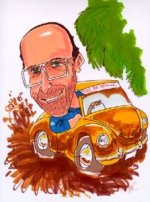
It was a waste to throw away all the hard work, so Stroud’s Hayward clan took up the mantle and the club decided to make their Mechanic’s Trial a road event. It was to use some of the defunct “Anniversary’s” route, but with some new ones to make it a rather tougher event, in the normal Stroud style. Mike and I had originally planned to do The Anniversary in Mike’s Escort but we entered The Mechanic’s in my Beetle.

The car had been resting in the garage over the summer and I hadn’t really done anything to it since The Lands End. It had gone well on The Edinburgh, despite the little problem when the brakes disappeared. The first time this happened was in the queue for Putwell. I went to move the car forward and the footbrake went to the floor! A pump of the pedal and there was a little bit of brake, another pump and it was back to normal. I leapt out of the car and dived underneath. No evidence of leaks. Up with the hood to check the reservoir, all looked well and the pedal was back.

We continued with caution and all seemed well. An hour or so later we were coming down a hill in convoy with Mike Pearson and Simon Robson and the pedal went to the floor again. Turning into a lay by we checked. Again there was no fluid loss and the pedal came back after a pump or two. I went back and talked to Mike and Arnold and they reckoned the master cylinder was on the way out. I decided to continue albeit at quite a slow pace! We finished the trial and drove home the next day with no problems. Back at base, I could find nothing wrong, although I noticed the front brakes were dragging a bit.

The next weekend I fitted a new master cylinder, which was bit of an effort, as the other one hadn’t been fitted properly. The pushrod passed through the double-skinned front bulkhead on the floor pan. It is only supposed to bolt to the outer skin, using a couple of spacers to extend the length of the bolts. The manual gives dire warnings about not dropping these down into the void. I didn’t, because they weren’t there! Someone had lost them when changing the master cylinder on a previous occasion! I used a magnet to fish about down the hole to no avail, presumably they had fallen out when I had a section of the frame head replaced in the early days of owning the car. 

The previous owner had secured the master cylinder by putting large washers under the bolts and securing the master cylinder through both skins, which without the spacers had collapsed the inner one in a bit. I didn’t want to repeat the error so I made a couple of new ones up out of a couple of bits of pipe, skimming them flat with the little model makers lathe I bought earlier in the year. I put everything back together and everything worked, except the front brakes seemed to be dragging a bit. I took the car for a spin and everything seemed to function so I put it away until the Mechanics Trial.

Mike and I set out early, chatting away, without a care in the world. We got to Ampthill, about ten miles away from home and I braked for a roundabout. Pulling away I smelt burning and soon realised it as coming from the brakes. We stopped and I saw how hot the front hubs were. Hoping whatever was wrong would right itself we carried, on but the car wouldn’t pull the skin off a rice pudding. Stopping we jacked the front up. The brakes were locked on pretty solid.

It was raining but we had good look but couldn’t come up with any better ideas other than the new master cylinder was faulty. I hammered away at the pads until they were free of the disks and we limped home on the handbrake. We talked of going down and spectating on The Mechanics but decided this was not a good idea as we didn’t know where any of the hills were so we went to the VW Swap Meet at Slough instead.

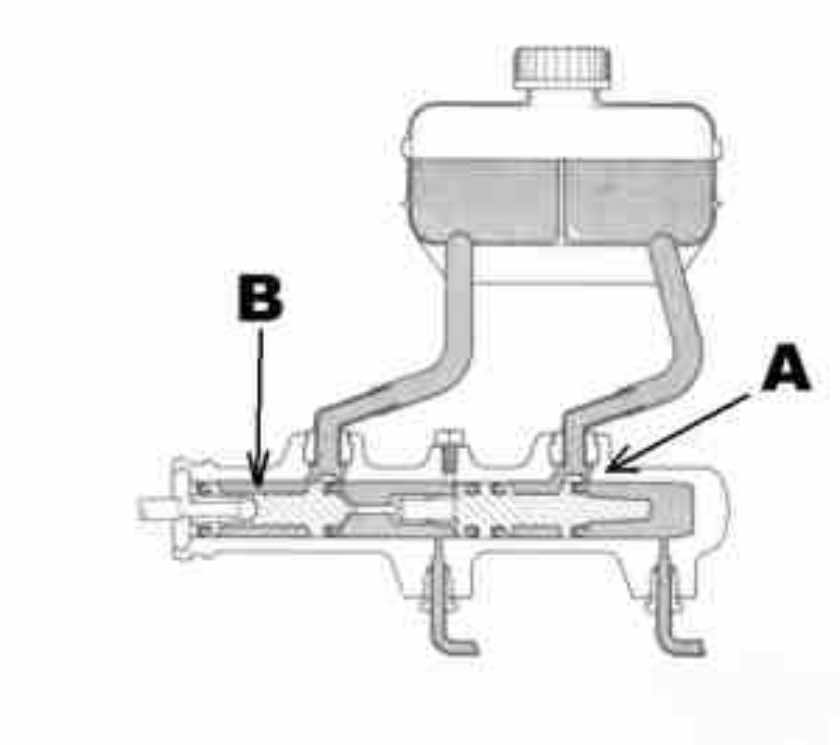
In order for the fluid to go back up to the reservoir when the pedal is released so the pads can go back channel A must be open which means there must be clearance b between the pushrod and cylinder.

Looking at the car the first idea was that I hadn’t adjusted the master cylinder pushrod correctly, preventing the fluid going back up to the reservoir when the brakes are released. I slackened this right off and it made no difference. Then I undid the bleed nipples, releasing any pressure, still no difference. Then I took the brake pipes off, still no difference! So that only left the callipers, which were only a couple of years old but there was nothing else. Putting the pipes back, I persuaded Lesley to get in the car and put the brakes on. I then got a drift and knocked one of the pads back. I got her to put her foot on the pedal again. The piston didn’t move. Harder and harder, she pushed and slowly it moved forward with many creaks and groans. I took the pad out and got my big crowbar and levered the piston back. We repeated the process for about ten minutes until the piston moved freely. I put the pad back and went on top the next one.

I was pretty annoyed with myself for not trying this in the lay-by but there we are. The brakes worked but I decided not to take any chances and got a new pair of callipers. Now all I have to do is stop the fluid leaks having undone all those brake pipes! So, why had the brakes failed on The Edinburgh? Murray’s theory is that they were rubbing then and that the heat had boiled the brake fluid. Any better idea’s?


We have been publishing stuff about Classic Trials on the Web since 1995 and always appreciate feedback. Comments, Corrections, Criticism & Concerns are all welcome. You can leave a comment to have your say here on this web site or our Social Media