Derek Fleming’s Primrose

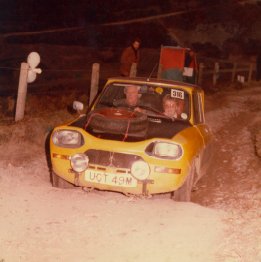
Our birthday run re-united original “Falconer” team member Derek Fleming with his old trials car Primrose. Derek and his fellow team members, Tucker and Ron Warren were a very successful combination, winning the MCC team award on several occasions.

THE STORY OF PRIMROSE IS QUITE FASCINATING. Back in the 60’s Derek was in the motor trade when Tucker talked him into competing in the Lands End with a brand new Minx. A look underneath afterwards showed Derek how unsuitable this particular car was for trialling! The poor old petrol tank and underside were looking decidedly second-hand after their battering on the Cornish rocks.

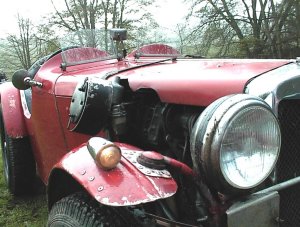
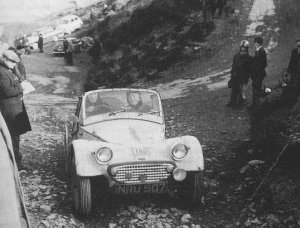
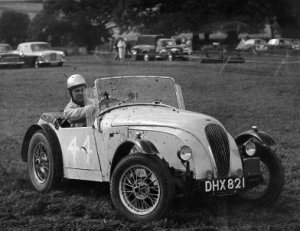
While looking at the damage to the Minx Derek found out a pal had smashed up his XK 120. He acquired the wreck, but the only usable bit was the bonnet. Derek had often talked about building a trials special but had never actually got round to starting it. Then one day he came back from lunch to find his mechanics had propped up the XK bonnet and laid out four wheels and an axle round it, and that’s how Primrose started. It isn’t just the bonnet that makes the old car so distinctive. Derek also built her with independent front suspension which was very unusual at the time.

The parts came from a Standard 10. Primrose is very well made. The wings are beautifully finished with rolled wired edges. The rear lights are another nice feature. When Derek finished the car the chassis stuck out from the body a bit so he wanted to set the rear lights back. The delectable looking housings are in fact cut down oil filter canister cylinders! Another nice touch is the rear number plate. It looks frightfully low and vulnerable. Until you realise it is hinged, rising out of harms way when the ruts come along.
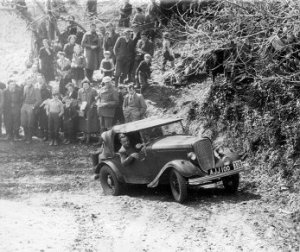
How did the car get its name? Originally Derek entered it as a Ford special. Having built the car in his spare time his wife had been left on her own a lot. They were looking forward to spending time together on the events, but when the first one came along his wife wasn’t at all thrilled. It was a cold Lands End, and the car didn’t have a heater yet. But when the day dawned and they were going down all those narrow Cornish lanes all the Primroses were out in the hedges. The Secretary of the event, Jack Davis must have heard them talking about it because although Derek entered the next event as a “Ford Special” the Secretary put “Primrose” on the entry list and the name stuck.

When Derek was building the car people often asked him what colour he was going to paint it. Something exciting like British Racing Green? No “nothing gaudy” said Derek “just plain old yellow and black” So when he finished it he had to paint it yellow and black. Derek is delighted that Primrose is still active, so many other specials were left to languish under a tree and rust away. Although Derek still owns her Primrose has been on loan to Neil Bray for many years. Neil fitted a modern cross flow engine and a roll bar, using the old car on the classics for many years before going class four with a Skoda on some events to avoid the re-starts!

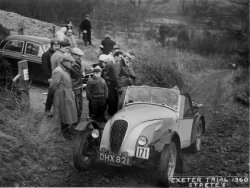
The barbecue after the run gave Derek and Ron Warren the opportunity to reminisce about their competition career. Derek won the Guy Fawkes in Primrose one year and also the Badderely on the Lands End a number of times.
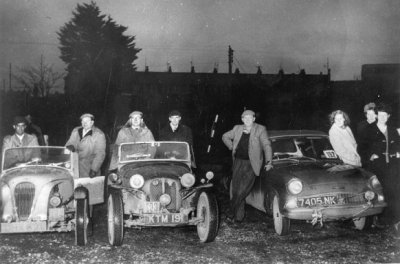
Ron remembers when you had to register as a triple contender. Ron got three first class awards one year but no triple because he hadn’t registered. Reggie Marrions was Club Captain and stood no nonsense, rules are rules. Then Ron recalled one Exeter when the engine of his Dellow cried enough and he took it to a local garage. The mechanics fell on the car and quickly removed the engine. They had to fit a new piston and four exchange con-rods. Ron missed a section by about ten minutes but went on to do the rest of the trial.

Ron and Derek talked about another Falcon members special “The Lawford”. This was a real fly-weight that challenged Derek in Primrose on one Guy Fawkes. It was built by Mike Lawrence and “Lawford” came from “The Lawrence-Ford Special”. They were both clean on the sections but Derek was quicker on the special tests. He reckoned it was all down to his gear ratios Mike had a box from and “eight” while Derek’s was from a “ten”. It was super to see car and builder reunited again. Derek certainly enjoyed himself. Who knows we may yet see him on another Lands End.

We have been publishing stuff about Classic Trials on the Web since 1995 and always appreciate feedback. Comments, Corrections, Criticism & Concerns are all welcome. You can leave a comment to have your say here on this web site or our Social Media
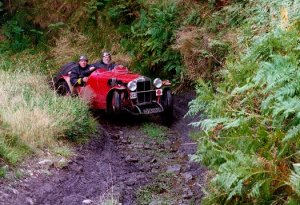
Jenkins Chapel to Corkscrew

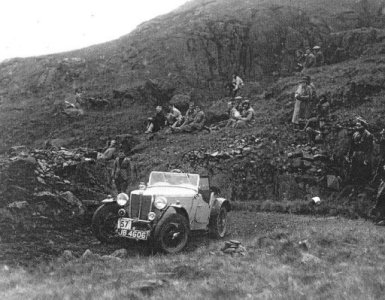
One of the hills in this years Edinburgh is listed as Corkscrew. If you look through the magazines you may think this a relatively recent addition, dating from 1993, but it has a much longer history. The hill was originally known as Jenkins Chapel and was first used in the 1930’s.

The hill continued to be used under this name, pre war and post war, for many years, but fell out of use for several interesting reasons. There was a problem with the neighbouring farmers who were conducting a feud. One was strongly in favour of the trial so his neighbour objected as a matter of principal. PR is especially important with this hill as the access road has a rather peculiar status. A plate at the bottom saying that the local council has closed it to all but visitors to the house at the bottom and the MCC! These days there is also a gate across the bottom to inhibit access by the cowboys.

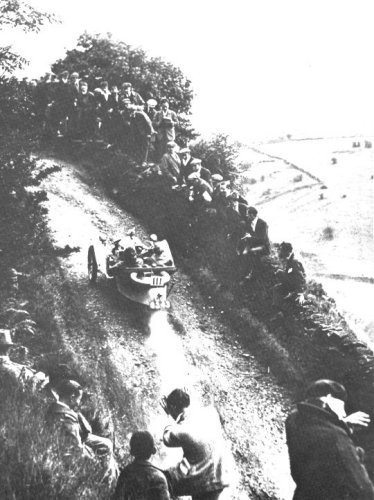
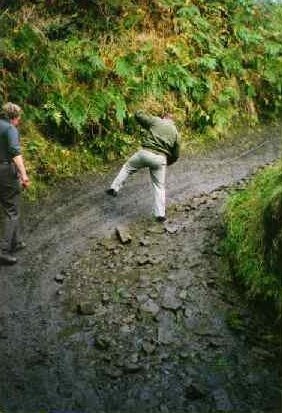
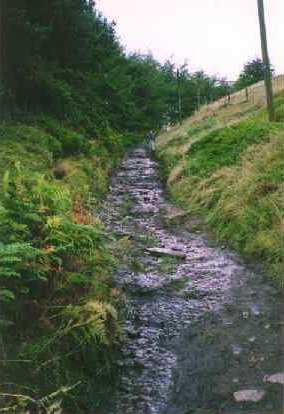
The section itself is not very smooth! There are two hairpins followed by some nasty steps. They are not particularly steep but are pretty rough, and it would be very easy to damage the car if you went to quickly. There have been problems on Jenkins over the years, even though the famous right hand hairpin is said to be nothing like as severe as it was in the 30’s. One dry autumn a Fiat 600 (fitted with two litres of Uncle Henrys V4) jumped out of gear and caught fire in the gully. The walls were so close the occupants couldn’t get out at first and it was quite scary for a while, although it ended up all right, and they eventually emerged unscathed.


20 June 1999 – All may not be as it seems. I have received a couple of E-Mails that throw doubt on the authenticity of the old photograph’s.

Andrew Brown says “Re: Your page on Jenkins Chapel.”

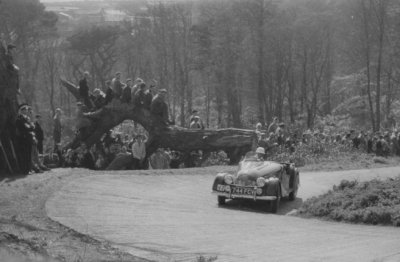
Although I’m familiar with the picture that you show of the MG (and I too have seen it categorically captioned as being taken on Jenkins Chapel), I’ve never been entirely sure that this is correct. I’ve never been to the hill except when competing, and one never has time to look at the view from that point(!), but my recollection of waiting at the start line is that the backdrop (now of trees) is much lower and further away than shown in the MG picture. Any comments?

Jonathan Toulmin and I have a whole ‘catalogue’ of mis-captioned or un-captioned photographs in various books but I haven’t tackled him on this one – I’m still on a ‘mission’ to track down the various ‘Kinetons’ and ‘Guitings’ used in 1930s before venturing further afield.”

Tony Branson adds

“Reference Andrew Brown’s letter about Jenkins Chapel/Corkscrew, I share his doubts that the old picture of the MG is really this hill. I too have spent some time with Jonathan Toulmin poring over old trials photos trying to recognise which section they are. It’s amazing how much the landscape changes over the years, trees move and cottages sprout or lose chimneys.

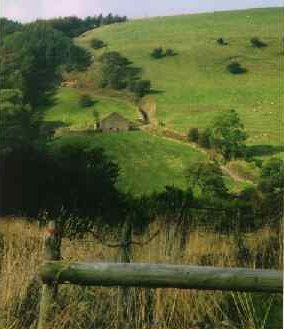
After the 1993 Edinburgh Jonathan, Pat, Derek and I walked the section and I bemoaned the fact that class 3 didn’t get a shot at it. I have since gone up it twice in the Marlin and my propshaft tunnel has the scars to prove it. I attach 4 photos I took that day. The first shows the section from across the valley, The second the infamous first corner with Derek having a little trouble on the restart and the other two the rocky steps in the upper reaches. Hope they are of interest.”


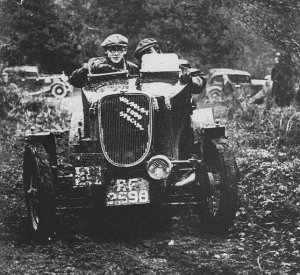
I started to marvel at the amazing exploits of car and driver, competing, and often beating, the Trolls and Cannons that mostly travelled to and from events on trailers. No such namby pamby stuff for Dudley. He always drives his trials car to and from events, rain or shine, with no hood, toneau cover or even a proper windscreen. Now clearly something was a little non-standard about this machine. For a start it says 1,466 cc’s on the entry list. Now all my books on MG history say that the J2 was 847cc and had a two bearing crankshaft! Then there is the enormous belt driven blower sticking out the side. MG did produce a few blown J3’s, but the Powerplus supercharger was mounted under the front apron and driven direct from the crankshaft.

All this set me thinking and I wanted to know more about this fascinating car. But “super-Dud” is not the sort of person the likes of me slide up to, poke a tape recorder under his nose, and ask all about his motor for Classical Gas. The solution came when Brian Butler gave me a bundle of “Wheelspin” magazines. In the April ’87 edition I found an article about Dudley and his car by our own David Alderson. From this I learned that Dudley acquired his car as a box of bits in 1964. When he put them together he had an MG J2 with an 1172 sidevalve Ford engine! Anyway Dudley started trialling his machine, gaining his first triple in 1968.

Then the car was involved in a road accident near Carlisle on the Edinburgh. (Yes I did say Carlisle, the Edinburgh actually went to Edinburgh in those days). Dudley rebuilt the car on a new chassis and it emerged with a 1250cc T series engine. Over the years Dudley developed his car, acquiring first a supercharger, then a 1466cc block from a TF in the late 1970’s. These days the “J2” is a very special machine, but mostly uses MG parts, including an axle from an MGB an a self made four planet diff.

Now the purists may be appalled at this “bastard” machine, but don’t blame Dudley, it wasn’t a proper MG J2 when he bought his box of bits all those years ago.


We have been publishing stuff about Classic Trials on the Web since 1995 and always appreciate feedback. Comments, Corrections, Criticism & Concerns are all welcome. You can leave a comment to have your say here on this web site or our Social Media
Jack Williams – Cars I have owned

Jack Williams is a familiar face at our trials, always doing well in his smart red Tempest. I knew he had been trialling for a long time and after a brief chat on the phone he agreed to be the subject of my second “cars I have owned” feature. Jack let me borrow some pictures from his collection and in the lunch break at our Edlesborough trial we sat on his trailer and talked.

Jack was born and bred in Cornwall and his first recollection of motorsport was being taken to Bluehills on Easter Saturdays. This was in the mid 30’s and Jack remembers that the old hill was still used. There was no Bluehills One in those days. Competitors hairpined left up what is now the surfaced road.

After the war Jack passengered a few times before driving his first Lands End in 1959. In those days you could drive a genuine road car and Jack used his special bodied 1934 BMW 316. It had a six cylinder, 12hp engine and had two Solex updraft carburettors, sucking up like an Austin 7. So there’s nothing new about doing Classic Trials in old cars!

By now the bug had really started to bite. Jack was managing a specialist sports car garage just outside Truro. They were the Morgan distributors for Cornwall so Jack naturally took one trialling and it wasn’t your standard car either. In conjunction with Peter Morgan Jack specified an alloy body and bucket seats. The car was also unique as the first Morgan to have its sidelights mounted on the wings. Originally a special for Jacks car Peter Morgan liked the idea so much it became standard.

The Morgan looked superb in British Racing Green and was registered FCV 444. It had a Standard Vanguard Engine because although Triumph’s Sir John Black was an ex-Morgan apprentice he wouldn’t give Morgan the TR engine. However, Jack persuaded Chris Lawrence, the Morgan wizard of the day, to tune the Standard Vanguard engine. By the time he had finished the car went jolly well and the motor looked just the business with it’s twin Strombergs.

Jack competed with the Morgan for a while. The car had to work for it’s living as it doubled as the business’s demonstrator. On the sporting front the Morgan wasn’t only trialled. Jack used to do the Lands End, stay in Penzance and then drive in the Speed Hill climb at Trenwainton on the Sunday.

After the Morgan Jack trialled a spate of Triumph Heralds. Starting with a 1200 Duo Tone in 1961. Then a customer, who was also a member of the local Motor Club, bought a 1200 and fitted it with a Shorrocks super-charger. Another member had an original 948 Herald with twin SU’s. Not to be outdone Jack’s partner got hold of a convertible and had it fitted with a Brabham conversion, complete with a 1200 Coventry Climax motor. The three entered a team in the ’61Lands End and won the team award, beating the Morgan works team when Sid Margullis blew his diff!

Next Jack dabbled with rear engined machinery when he bought a 750cc Renault CV4, the predecessor to the Renault Dauphine. This was a pretty little car but it was a bit short on power so Jack fitted a bigger engine from a Dauphine and souped it up with a Gordini head. They entered the Lands End but only got as far as Beggars where a drive shaft broke.

Then came a trials sabbatical as Jack moved up to Surrey and was out of action from 1963 to ’68/9. He came back with a couple of Midgets but wasn’t impressed with them. Then the garage took a BMW 2002 in part-exchange. Jack thought it would do the business on the hills but it blew its diff somewhere in darkest Devon. Jack was so disgusted he left it there!

By now Jack’s garage was a Citroen distributor and he decided to take the marque trialling. However, they weren’t standard cars. There was a nice AMI Super. This came with an 1015cc motor. Jack swapped it for an 1,220 engine from a GSA and promptly won his class on the Exeter in 1983.

The Mehari was a utility vehicle originally designed for the French army. It was a tough car, built strong enough to travel slung underneath a helicopter before being dropped the last few feet to the ground. The design was based on the AMI platform chassis. Jack really liked the Mehari and had it for some time, but the chassis on his car wasn’t very good. He had an AMI that he wasn’t using, so he wiped the body of that and put the Mehari “top” in its place, even though it was designed for a twin rather than 4 cyl engine. The only problem was the necessity to remove the headlights to change the spark plugs!

Next came a couple of 2CV’s. Jack got on well with these on PCT’’s, finding they would outclimb practically any other front wheel drive car, even though they had a very restricted lock with a 40 ft turning circle. This was because of the swinging arm front suspension. The larger engined 602cc cars were pretty low geared, but the original 425cc machines had an incredibly low diff, something like 8:1, so Jack naturally fitted his larger engined car with the ‘box from the smaller engine.

Then came the famous Mazda that Jack used for many years. There weren’t many of this model imported. It was very narrow and short to suit the Japanese tax system. It was actually smaller than a Hillman Imp, ideal for trials, especially after Jack replaced the 1300 motor with a with a 1400 and fitted the ultra low diff from a 1000cc car. Jack won several MCC awards with the Mazda and competed in hundreds of PCT’s. Before Jack got hold of it the Mazda had been owned by the actress Prunella Scales, who loved it dearly. Jack’s business took it in part exchange but Ms Scales kept track of it and was horrified to hear about the ordeals it experienced in its new career!

The Mazda is still going strong and was last seen running around as a shopping car. It never failed to get Jack home, even when the pin came out of the diff in Derbyshire. However, because the crownwheel overlapped the pin it couldn’t come out completely although it got quite beaten up.

Finally comes the Tempest, Jacks current trial’s machine. This was selected as it could be used for trials and as an occasional second car for road use. Like me Jack believes that most cars specifically built for trialling are not really suitable for a trip down to the pub. However, Jack doesn’t believe the Tempest is man enough for classics, although a couple have been seen out with some success. So that’s the story so far. Jack is concentrating on PCT’s these days, very successfully, and has been in contention for the RAC title for the last couple of years.

Going back to classics we talked about how the events have changed. Immediately after the war entry lists were dominated by the E93A Ford Pop, complete with family, kids and suitcase on back! They did very well, often better than the specials. This was because in those days production cars could use Town and Country tyres. The Dellows had to use road pattern cross plies and a Pop with a decent driver could outclimb them. So it was hardly surprising that most of the entry comprised standard production cars. Jack feels very sad that these days production cars are in the minority and those that do compete have to be so heavily modified in order to cope with the rough conditions now the hills have deteriorated so much.

Apart from trials Jack competed in one or two speed events, remembering an “autotest” at Perranporth airdrome in 1962. It consisted of a third mile sprint down the runway. Round a pylon and back again. Very enjoyable, especially when Jack’s Morgan beat the TR’s.

We started to talk about some of the things Jack had seen over the years. Like when Sydney Allard charged around the Exeter on his new J2 Allard, only to find it was too wide for the bridge at Fingle! Then there was time for no more. Lunch was over and there was trialling to be done.


We have been publishing stuff about Classic Trials on the Web since 1995 and always appreciate feedback. Comments, Corrections, Criticism & Concerns are all welcome. You can leave a comment to have your say here on this web site or our Social Media
The Sprint – Geoff Jackson’s New Car

If there was a prize for the smartest car at the July Autotest it would have been won by Geoff Jacksons new trials car the “Sprint”. Geoff has all the qualifications for the job. My first recollection of him was on the 1971 Guy Fawkes when he was driving a Morris. Latterly he has campaigned a class eight Dellow on MCC events. (Kindly towing me out of a mud hole on the muddy exit from Calton a few years ago).

Geoff started to build his new car about five years ago. He started by putting a melamine “surface plate” on a couple of trestles and laying out the chassis tubes on that. The Sprint uses a Ford back axle located by twin trailing arms. A mark 4 Cortina provided the front hubs and the suspension owes a lot to Westfield and the Ford Transit, while a friendly Escort donated it’s steering rack!

Geoff resisted the temptation to fit a Ford Kent engine and the Sprint is powered by a 1500 lump from a Triumph Spitfire, running a single SU. The mechanics are finished off by a very well made body, nicely painted in Red. It’s a super car and did very well at Upper Caldecote in the hands of Geoff’s two sons. Watch out for the Sprint on the Edinburgh.


We have been publishing stuff about Classic Trials on the Web since 1995 and always appreciate feedback. Comments, Corrections, Criticism & Concerns are all welcome. You can leave a comment to have your say here on this web site or our Social Media
The Skeetle – by Alan Bellamy

Have you noticed how most modern cars look the same. Ford or Fiat, Rover or Renault, from fifty yards it’s hard to tell the difference. It’s the same with trials machines. It’s all Beetles, Escorts, Marlins and Troll/Cannon/Dellow. When you do see a new special they tend to be what Tom Threlfall calls a “Latvian tractor chassis with a Beetle engine”. (Letters to Tom please, not me!).

Into this dull world come a couple of characters who liven the scene with something a bit different, Dave Nash and Alan Bellamy. Alan has campaigned a VW Notchback in class six for quite a few years and is currently restoring a Brasilia. After a few years with a very rapid Rapide, Dave Nash embarked on some special building. Here is the tale, told by Alan Bellamy.

The completed Skeetle has yet to be blooded in competition. It has a really super paint job. Will it compete in class seven or eight?
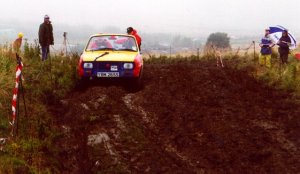
“Noddy” at the top of Calton on the Edinburgh in 1994, before the ruts were filled in. Afterwards Dave re-painted the car a conservative blue out of genuine concern for Alan Foster’s blood pressure.

“Nashy tells me you want to write about the Skeetle.  Well here’s how it all started, from my point of view.  Many years ago, like 35,  I used to do a bit of mud plugging.  Dave was quite a bit younger than me, so he could only come and watch.   I went on to have a go at many other forms of motor sport and lost touch with Dave when he moved to Milton Keynes.

Eventually we got together again, about eight years ago, when I was looking for a navigator for the Lands End.  Dave really enjoyed himself and decided he had to have a go himself.  I was the one with the work shop and tools but it was Dave who had the enthusiasm.  His step-father was a Skoda main agent so Dave decided to support the marque and use one of the Czech rear engined machines for his Classic attack.  We talked about all sorts of ideas and mods, mostly on the long drive home after MCC events.   We could see the potential and started with an ex autocross car from Holland, but the cam was a bit too hairy.  Then came a lovely blue car, which unfortunately ended up losing a head on clash with a fire engine!!!!

Next came the yellow car, and we really started to modify this machine.  However the main problem we had was getting a good power to weight ratio.  A tweaky cam was necessary to get the motor to produce any decent power but this was all at the top end and we wanted it lower down the rev band. So one day on our return from the Lands End we dreamt up the car that ended up as Noddy.  We had the opinion that removing all the interior trim would help to bring the power to weight ratio more in our favour.

Unfortunately we got a bit carried away and ended up removing 24 inches out of the middle of the car.  When we welded it back up again we eliminated all non-essentials, including the roof!  This had the desired effect and with the engine from one of the later Skoda’s went very well, picking up some medals on the way and setting FTD at the Testing Trial.  With my uncle having been the work shop foreman at Frazer Nash for over twenty years, and Dave’s surname being Nash, it just had to be Skoder-Nash .   When it was finished it looked just like Noddy’s car so we painted red blue and yellow!  Unfortunately some MCC luminaries didn’t share our sense of humour so we re-painted it in a conservative shade of blue.  Noddy hated his new colour and detached himself from the A frame while being towed home from the paint shop to the detriment of his body work!

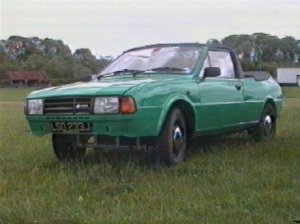
We wanted more power so we started looking at bigger and more powerful engines. The Fiat twin cam was the top of our list, the question was would the gear box take the power?   After much debate it seemed obvious that a new car was going to come about.   With Dave’s passion for Skoda’s and mine for VW’s a bit of each seemed the way to go!  So the Skeetle was born.  Dave managed to get hold of one of the original Skoda Cabriolets, and we eventually married it to a Beetle floor pan.   Now we needed a 1600 VW engine and one came along thanks to a rather rusty Brasilia from Andy Clarke.  Dave wanted to take the engine out and scrap the rest.  But I managed to talk him out of this by giving him a good type three motor.  This fits well and gives a lower centre of gravity and more room in the boot area (enough for a spare wheel to be mounted over the engine).

Well, that’s about it, two years later the Skeetle is on the road, registered as a modified Beetle it sports a 25 year exempt tax disc.  What shall we do now?   There’s a Brasilia to finish, well that’s another story.”


We have been publishing stuff about Classic Trials on the Web since 1995 and always appreciate feedback. Comments, Corrections, Criticism & Concerns are all welcome. You can leave a comment to have your say here on this web site or our Social Media
A Fishy Tale

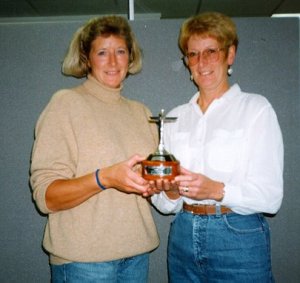
Susan Jamieson and Maralyn Knight with Tuckers Triple. Presented to Falcon as the clubs new Trials Trophy.

What connects a Nipper to a Lobster besides the fact that it’s claw nips?  You don’t know, really!…. read on.It all began with my frightful gaff in the April edition of Classical Gas, saying that Falconry’s former editor, Maralyn Knight, was the first lady to gain a coveted MCC Triple.  Fortunately for historians Ron Warren corrected me the following month.  I was delighted, not only that he set the record straight, it also confirmed that someone out there is reading this stuff!

Ron’s correction sent me scurrying to Peter Garniers book, not that I didn’t believe him.  In the thirty years since I first met Ron I have learned that he doesn’t say something unless he’s pretty certain it’s right!    No, I was after material for a story and here it is.

Maralyn’s father, Tucker, was president of both Falcon and the MCC.  Tuck conceived, built and drove the Tucker MG, perhaps the ultimate all round sporting machine.  Not only did he campaign it in trials, it was also his circuit racer.  Tucker and Betty had two daughters, Maralyn and Susan, and they took them trialling whenever possible, Tuck even converted his car to a four seater!    However, the time came when they couldn’t go with mum and dad anymore.   Tucker responded by building them a trial’s machine of their own, based on a 5cwt Ford Van.  The name was inspiration itself, “The Tucker Nipper Special”.   With sister Sue as passenger Maralyn had five successful years with the car,   becoming the second woman to win a triple and the first to win two.

The Miss Tucker-Peakes in the “Tucker-Nipper Special” at the foot of Bluehills 2

Maralyn married Peter Knight in 1967 and gave up trials driving, but not motorsport.  The couple became RAC timekeepers, officiating in many major events, especially at Silverstone.  Maralyn didn’t severe her trial’s connections completely as she is heavily involved in producing “Triple”, the MCC’s magazine.  I don’t  know what happened to the “Nipper”, but the Tucker MG is presently being restored by Jim Templeton.

Meanwhile, sister Susan had taken to saloon car racing, first with an Anglia, then an Escort and finally a season racing all over Europe as a Skoda works driver.  When Tuck built Susan’s Escort she sold the Anglia to boy friend David Ovey.  David later went on to race at Le Mans in Charles Ivey’s Porsche and became an airline pilot.  He is now married to Tomorrows World presenter Sharnaz Pakravan, lives in London, and is fully occupied as a house husband!

I can remember marshalling at Nottingham Sports Car Club meetings at Silverstone when Sue and David were racing.  David’s sister Marion was also a Falcon member around this time.  She was a keen marshal, and an occasional rally driver, she even had a certain Michael Leete as her navigator on one occasion!  Marion was a studying hotel and catering management at the time.   Today she owns and runs the Lobster Tail restaurant in Great Offley.   Specialising in fish this is a very nice place with excellent food, it’s recommended.

As Ron pointed out Margaret Woodall was the first lady to win a Triple.  Margaret was married to Bert Woodall who with his brother Victor built the big Wolseley-Ford special in 1938.  After the war Bertie built a second (Mk 2) Ford special in 1951, winning him a triple in 1952 with Maggie getting hers in the same car in 1955.  Margaret is still involved with the sport, running the finish controls at MCC events.

Bert and Margaret’s son, Simon, organised   the Clee Hills classic for many years and is the current ACTC chairman.  Simon competes in the ACTC series with a class 8 VW buggy and a rather special convertible BAJA in class 7 in the MCC events.

Isn’t amazing what you can learn by reading Classical Gas!!!

Bertie Woodall in the Wolesley-Ford Special.

Link to a Nipper Update


We have been publishing stuff about Classic Trials on the Web since 1995 and always appreciate feedback. Comments, Corrections, Criticism & Concerns are all welcome. You can leave a comment to have your say here on this web site or our Social Media