

These days onboard 12v compressors seem to be in vogue for trials cars but most of us still have a foot pump somewhere in our garage even if we don’t use it while on a trial. Continue reading “Footpumps – All You Need to Know”
You have stumbled on a delightful box of tricks, Classic Trials & other perverse stuff from Michael Leete. MCC ACTC and other trials. VW Beetles, Dellows, Marlins, or even Suzuki X90's
Book Review – Vintage British Foot Pumps 1900 – 1950 by Gordon Edwards
These days onboard 12v compressors seem to be in vogue for trials cars but most of us still have a foot pump somewhere in our garage even if we don’t use it while on a trial. Continue reading “Footpumps – All You Need to Know”
We had a stranger in the camp at the Gill Morrell memorial Trial, in the form of JAB’s, James Alexander’s Sporting Trials car. He had a familiar face in the passenger’s seat, none other than John Boswell, who is more commonly seen driving his Dutton Phaeton with great gusto. A brief chat with John wetted my appetite and I could feel an article coming on!
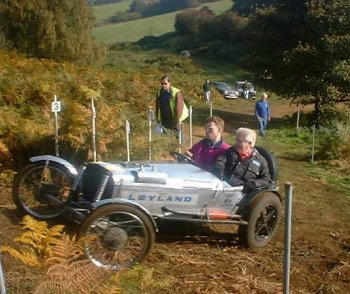
In my ignorance, I thought that JAB’s was short for John Boswell and that he had built the car. However, John soon put me right, saying that he was about as useful with a toolkit as a chocolate teapot! The car was actually built by John Benson in the mid-seventies when the BMC “A” series was the motor to have. James’ father Robin Alexander acquired JAB’s and had a real crack at the National title in the early eighties. It was Robin who got John into trials back in 1983 when he passengered Robin. They never won, but came very close, occupying the number two spot in both 1983 and 1984.
All this wetted John’s appetite and they reversed roles when John started to drive in Classic’s, that he felt suited his committed driving style. Robin continued with JAB’s for another season before swapping it for a Cannon, which he soon sold on, reinvesting in a Kincraft. This was to get little use as sadly Robin died of cancer in 1988 at the young age of 44.
JAB’s passed through a couple of hands, ending up in the care of Martin Halliday, the custodian of several fine old trials cars, including one of Colin Chapman’s early Lotus’. By now, James Alexander was anxious to re-acquire his father’s old car. John put him in touch with Martin and JAB’s was soon back in the Alexander family. They went to a Peterborough Motor Club event but James couldn’t compete, as he didn’t have a licence. So his first event was the Robin Alexander memorial trial, held in honour of his late father, down in Cornwall. He found it pretty tough going and decided he needed a bit more practice. A quick call to JP saw Robin and John out at our Brickhill event, getting the feel of the car under easier conditions than are found on the flyweight circuit.
The car has been developed considerably since Robin owned it. It’s still A series powered, but the iron block 1275 Midget motor has now been bored out a bit. Things have changed in the transmission department too and the cogs are now courtesy of a certain Mr Hewland. It still has rather old fashioned mechanical fiddle brakes but John reckons these are an advantage as you can actually “feel” if a wheel is spinning. James has joined the 750 MC so he can get entries to Sporting Trial events and John hopes to do a bit of passengering in the old car.
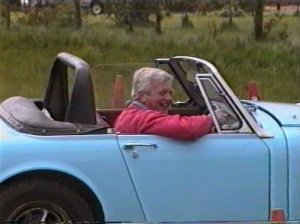


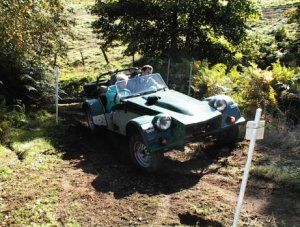
What about “Bossey” as he is known to some. Well, after Robin Alexander introduced him to Classics he competed quite regularly in his Midget, but got fed up with driving down to Cornwall and breaking the car on the first hill! After destroying thirteen diffs in a season he converted the back axle to take Ford components and then started breaking gearboxes! All this prompted John to acquire a Dellow from Jim Harvey. The only problem was it was in bits and it sat in a lock-up for several years before Steve Strutt bought it and John used money to buy his well known “wash and go” Dutton Phaeton.
John found this car very reliable and has had very few problems with it. It bought some success too, and John won the ACTC Crackington Trophy in 1990. It also achieved TV fame when the BBC used it as a camera car on the televised Lands End. John had to take things easy for a few years as he was having health problems with his heart. He was better in time to partner David Alderson in his assault on the ACTC Wheelspin series and they won the championship together in 1996. John then used both his Dutton and Midget in local PCT’s and Autotest’s but had an overwhelming desire to go Motor Racing. The only problem was that he needed to do it without spending a lot of money! Inspiration came one night in the pub during a chat with Mark Wilson from Milton Keynes Motor Club and they decided to get 2CV and take part in the Mondello 24 hour race, competing with such luminaries as TOCA’s Alan Gow and Marcos creator Jem Marsh.
They qualified 22nd and got up to 10th at the end of the first hour. Then the engine blew up. They had a spare but it took two hours to change it. After all that effort the team decided to drive for a finish, cutting back on the revs and short shifting to take care of the little 602cc motor. They succeeded, finishing in 22nd place, really enjoying themselves and vowing to return. John’s plans for the future include another crack at the Mondello 24 hours and competing in PCT’s with the Dutton, all with one objective, to have some fun!
We have been publishing stuff about Classic Trials on the Web since 1995 and always appreciate feedback. Comments, Corrections, Criticism & Concerns are all welcome. You can leave a comment to have your say here on this web site or our Social Media
Both Falcon and the MCC owe a lot to the Tucker-Peake family whose drive and energy has had a profound effect on both over the years. “Tucker” was perhaps the most prominent but he was not the only one. This article is a small appreciation.
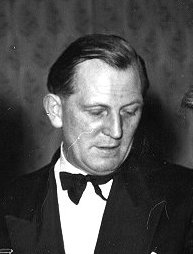
Like most organisations individuals heavily influence Motor Clubs and Falcon is no exception. In our case, and the MCC’s, one of our biggest influences has been the Tucker-Peake family who were the main stay of the club for many years
H. W. Tucker-Peake was born in Cornwall and christened Herbert, but was known as “Tucker” to most of us, or even “Tuck” if you were on very good terms. Tucker’s interest in Motorsport all started when he saw Lands End competitors passing by his Launceston home each Easter. When he left school, Tuck moved up to Hertfordshire as an apprentice at Sir Henry Birkin’s workshops at Welwyn. They prepared the famous 4.5 litre “blower” versions for the pre-war Bentley Le-Mans assaults. W.O. Bentley himself never approved of blowers. Believing that there was no substitute for litres W.O. left Sir Henry to finance the blower team by himself. He soon spent all his own money, then worked through his fathers before bankrupting him.
All was not over because the dashing “Tim” attracted the attention of a rich spinster, The Hon Dorothy Padgett. With her funding the team was able to continue and achieved Le Mans fame in 1930 with it’s battle with Carraciola’s vast 7 litre Mercedes. Birkin’s searing pace broke the Mercedes, which retired, but it had taken too much out of the Blower Bentley which had to give up itself soon afterwards, leaving one of W.O.’s 6.5 litre factory cars to take the chequered flag in the hands of Wolf Barnato and Glen Kidson. Birkin tried to continue with his team but when Miss Padgett’s money was all gone, he had to call it a day and close his Welwyn workshop, leaving Tucker out of a job.
Tucker was not out of work for long. He got on his bike and cycled North to Stevenage, where he persuaded HRD motorcycles to take up his apprenticeship. It was through Vincent’s that Tucker started his competition career, courtesy of the legendary Aussie, Phil Irving. Irving was anxious to prove the superiority of the new radial valved Python engine, and entered an outfit in the 1932 Lands End. Irving drove himself with his newly signed up apprentice, Tucker in the chair. In those days the Lands End only had one start and Irving and Tucker had a short run down to Virginia Water to get away just after 10 in the evening. They started off well but during the night run the Python developed an intermittent miss-fire. They arrived at the Taunton breakfast control just after 4am and despite being frozen to the marrow decided to change the contacts in the magneto. An official spotted them and said they would be disqualified, as there was to be no work done on the machinery in controls. However, they carried on and the bike went much better.
They went up Doverhay, like a rocket, the Python motor pulling like a train. Beggars Roost was next, in those days one of the most feared hills, but they cleaned this as well. Things were going well and thoughts of the publicity accruing from winning a Gold medal went through Irving’s mind. They were in Cornwall now, Tucker was back home. They made a steep winding descent through Burlone Eglos, through a small ford to the foot of Hustyn. It didn’t look to bad, it was pretty steep but there was a hard stone surface and they had cleaned harder hills already. Irving and Tucker attacked the hill with gusto, the Python singing like a bird. Irving saw a rock step ahead, eased the throttle as the front wheel went over it and gunned the motor, which promptly cut dead. The spectators helped the crestfallen pair to the summit and they managed to re-start the engine, which never missed another beat all the way through the trial.
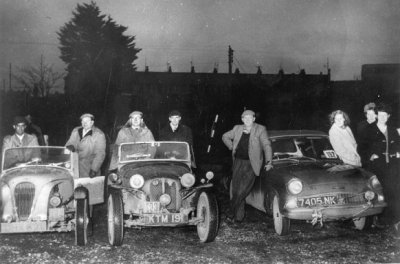
From then on Tucker took every opportunity to take part in Motorsport, riding bikes in trails, speed trials and races whenever and wherever he could. Work-wise Tuck had moved on, to ERA at Bourne, home of the famous predecessors to the BRM. After the war, Tucker and brother John set up “Shelford and Crowe” a garage business in Stevenage High Street. By now Tucker had move to four wheels for his Motorsport, trialling a much modified MG Magnette before building The “Tucker-MG”. Tuck was very successful in the “Tucker” which won circuit races and speed events as well as trials.
By now Tucker and his wife Betty had two daughters, Maralyn and Susan who were not allowed to miss out on the fun. When they became to big, to be crushed in behind the seats Tuck converted the “Tucker” to a four seater! Later on Tuck built them their own trials car called “The Tucker Nipper Special” which I have written about recently. Maralyn was the driver and sister Sue the bouncer. Maralyn won two triples with this car before retiring to become an RAC timekeeper! Today she is actively involved with producing the MCC magazine. Susan took to circuit racing with Anglia’s and Escorts before taking in a season of continental racing with the Skoda works team. These days Susan lives in Launceston and is Secretary of the Lands End Trial.
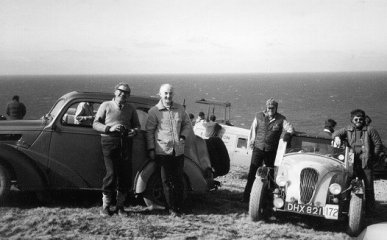
Brother John was Tuckers business partner in their garage in Stevenage High Street. A quiet, thoughtful man, John was a superb trials driver and car builder. Before the war John was apprenticed to the Riley Company, starting his trials career on a 250cc Villiers engined James. He moved up the scale with the cessation of hostilities, trialling a 1000cc Vincent Rapide twin, successfully!
Moving to four wheels John built a succession of very special cars. The first was a real fly-weight, “The Scarlett Runner” made up of all sorts of bits and pieces with fiddle brakes on the rear wheels. In the early sixties John built “The Olympic” this was a Morris Minor shell with a big Ford Consul engine and running gear. It was probably John’s least successful Trials Iron but was great at the traffic light Grand Prix! Finally came the “Runner Bean” which he built with his son Adrian. It was basically a Ford Capri with a Pop body and would climb anything “The Bean” is still competing in trials in the hands of Tom and Clive Kalber and will still climb anything as they demonstrated on the Mini Classic. Adrian was an early editor of Triple and is currently campaigning a front wheel drive Peugeot in Classic Trials, following in the family tradition by taking the kids in the back!

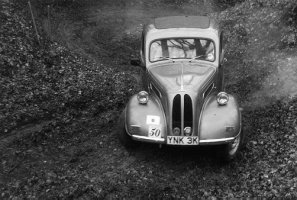
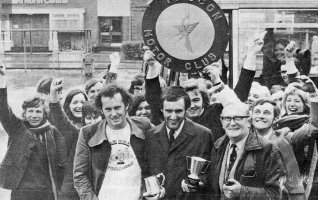
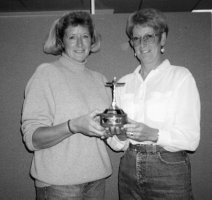
Tucker was actively involved as an official and organiser for both the MCC and Falcon. He became an MCC committee member in 1954 and was involved with Falcon almost since it’s inception. He was the organiser of the Land s End for a very long time and Clerk of the Course at the Silverstone race meeting. He organised a great number of events for Falcon over the years, running the Guy Fawkes both as road trial and a PCT. Later he was the driving force behind the Knebworth Park autocross. Tucker was President of both clubs when he sadly passed away a few years ago. Always trying new things, and forever young at heart, Tucker was the inspiration for so many young Falcon members.
We have been publishing stuff about Classic Trials on the Web since 1995 and always appreciate feedback. Comments, Corrections, Criticism & Concerns are all welcome. You can leave a comment to have your say here on this web site or our Social Media
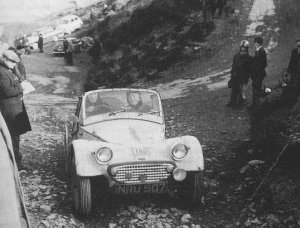
I recently had a nice letter from Maralyn Knight with news about “The Tucker Nipper Special”. For the full storey about this famous old car you need to go back to the July ‘97 Classical Gas, but there’s space here for a quick resume.
Maralyn’s father was of course the late H. W. Tucker-Peake. Tucker and Betty campaigned their “Tucker-MG” for many years. The car evolving to create space for Maralyn and Susan to ride in the back. In due course they wanted a trials car of their own so Tucker built “The Nipper”, based on the running gear and chassis from a Ford 5 cwt van. With sister Susan in the passenger seat Maralyn was very successful with her car and won two triples. Maralyn explains that until recently she hadn’t heard anything about the Nipper since selling it to a lady called Rosemary Cond from Gloucestershire back in the late 60’s. She knew that Rosemary had done a few competitions with it but that was that. Before Tucker passed away he had heard that the famous old car was in a barn somewhere. Sadly his detective work was never completed as tragically he couldn’t speak properly after suffering a stroke.
However, quite by chance, a friend of Maralyn’s spotted an ad for a “Nipper” in a magazine and low and behold it was her old car. She got in touch with the person selling it and found it was Rosemary Cond’s old passenger. But by then the Nipper had already been sold. Maralyn traced the new owner to Barton le Clay, close to where it was born! The car was in remarkably good condition, considering it’s age, and the new owner was prepared to sell. But it would have taken a fair bit of time and money to restore it and Maralyn decided to let it go. She regrets that now, but that’s life! The latest news is that Nipper is under restoration by a gentleman in Lechlade in Gloucestershire. Maralyn is in touch with him and has provided him with some pictures of the car as it was originally built. She hopes it will soon be returned to its former and original glory, in particular that the new owner will do away with the Lotus 7 style nose and front wings that it acquired in later years.
What we need now is a “Classic Specials” class so cars like the Nipper and Primrose can be seen on the MCC hills again.
20 June 1999 – I received an interesting E-Mail from Simon Woodall the other week, this corrects some of the facts in my original piece.
Further news is that the gentleman in Letchlade has put the “Nipper” up for sale at £3,000. There is an ad in the July Practical Classics magazine.
We have been publishing stuff about Classic Trials on the Web since 1995 and always appreciate feedback. Comments, Corrections, Criticism & Concerns are all welcome. You can leave a comment to have your say here on this web site or our Social Media
This update on Alan Bellamy’s Brasilia was prompted by a family outing to Bug Jam at Santa Pod this summer. We were walking from our car to the track side when the junior member of the family announced “look there’s a Skoder Nash”. Ignorant boy, it wasn’t “a” Skoder Nash it was “the” Skeetle, don’t they teach them anything at school these days?

What we didn’t notice at first was the car behind, Alan’s rare Brasilia, looking very normal beside Dave’s creation and all the other wild rides nestling in the Bedfordshire countryside. It’s quite a few month’s since Alan finished the rebuild and all has not gone smoothly. The first event was the Lands End, when the Brasilia started to run roughly on the way to Popham. Alan stopped to tinker and the so and so absolutely refused to fire up again. Suspecting fuel starvation Alan squirted some jungle juice directly down its throat(s) and turned the motor over. It duly spat the fuel back out of the carbs and the wiring caught fire. The Brasilia was on the retired list before reaching the start!
Once the wiring was remedied the original problem had to be fixed and it was an interesting one. If the Brasilia was left overnight it would fire up and run OK for a while, then cough and die, defying all attempts to re-start. However, if it was left a while it started quite readily again. But would only run a short while before repeating the whole ghastly sequence. Finally Alan found the problem. Have you guessed? That’s right, there was a piece of paper in the brand spanking new petrol tank. It got sucked over the tank outlet, starving the engine of fuel. However, as the petrol pump stopped sucking the paper would eventually float away, allowing the motor to start again. Boy oh boy!
Anyway, the tank problem was all sorted out in time for the Manx Classic, so it was off on the Steam Packet to the Isle of Man. It started well, but half way through the event the engine started a terrible knock which Alan finally diagnosed as a small end on the way out. He retired and limped home, with Dave Nash in close attendance in case the Brasilia expired on the motorway. Surprisingly things didn’t get any worse, but the noise continued, and Alan prepared to rip the motor apart as soon as he got home. No sooner he taken the silencer off when it clanked and rattled as he put it down. You’ve guessed, the “small end” was a loose baffle. Nearly as bad as when I retired from the Edinburgh with loose wheel-nuts!
This was soon sorted and off went entries for the Testing Trial and The Edinburgh. During the Testing Trial the gearbox started to lock up and Alan discovered that there is terrible play in the diff that needs investigating. Meanwhile the linkage to one of the carbs broke and couldn’t be mended on the spot. Alan set the tick-over up high on the offender and drove home using the other carb!
No time to fix the diff before the Edinburgh. But look out for Alan as he will be driving his familiar Type 3 Fastback. As my friend Rowland Derry used to say when things were not going so well “it’s good here in’it”.
Alan’s new tank came from a VW part’s outlet in Venezuela. This guy can supply practically any Brasilia part except the front wings. The phone bills not to much of a problem, as Alan uses E-Mail to contact him, at the cost of a local call. It’s just as well that Alan found him. Just imagine the reaction of your local VW dealership if you went in “got a tank for a Brasilia squire”.
We have been publishing stuff about Classic Trials on the Web since 1995 and always appreciate feedback. Comments, Corrections, Criticism & Concerns are all welcome. You can leave a comment to have your say here on this web site or our Social Media
Peter Mountains Morgan has an interesting history. It’s a rare example of a car sold as rolling chassis by the Malvern factory. It was bought by a gentleman called Bert Range for £350. He completed the build and went on to use it for Racing and Rallying.
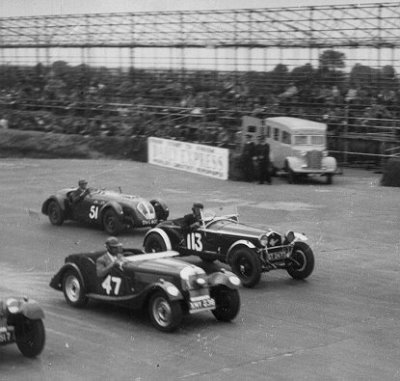
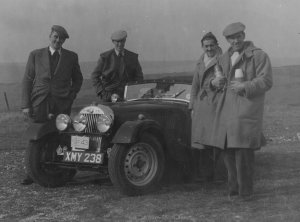
IN 1951 THE MORGAN COMPANY FOUND THEMSELVES IN TROUBLE WITH THEIR BODY BUILDERS and were not able to complete cars. Because they had all the supplies of chassis, engines, gearbox’s etc, they put an advertisement in the motoring press to the effect that if anyone had the facilities to complete a car they would supply the parts as a kit without any purchase tax.
Bert Range took up their offer and built his car at his business premises at Kings Cross in London where he ran a fleet of lorries. It took him about six months, working in the evenings, to make the bodywork and fit all the parts. He then had it professionally sprayed in British Racing Green with Black wings.
Originally it was supposed to be a two seater but as he had two small children Bert decided to forgo one of the two spare wheels and extend the body backwards so as to provide a reasonable seat for them. When his car was finished Bert took his car back to Malvern. The works were surprised he had made it into a four seater but were pleased at the quality of his work.
Bert was on the committee of the Cemian Motor Club at the time and was later to become it’s chairman. Cemian were one of the “Eight Clubs” who promoted racing at Silverstone. On 7 June 1952 they ran a race meeting using the reorganised Club Circuit of 1.608 miles. Two Morgan Plus 4’s were entered, Bert’s and A. R. Morton’s of the 750 Motor Club. In the one-hour high-speed trial for 1501-3000 cc cars Bert was one of only four cars to complete the required thirty-two laps (51.46 miles), the others being a supercharged Alfa Romeo, a 2.5 litre Riley and a similarly engined Healey. Bert finished his day by finishing fourth in a five lap handicap race.
We have been publishing stuff about Classic Trials on the Web since 1995 and always appreciate feedback. Comments, Corrections, Criticism & Concerns are all welcome. You can leave a comment to have your say here on this web site or our Social Media
This piece was conceived about a year ago, when I first saw Peter Mountain’s Morgan. I had often admired his well-prepared Skoda and knew he was re-building a Dellow, but when I saw that Morgan I just had to know more about car and driver.
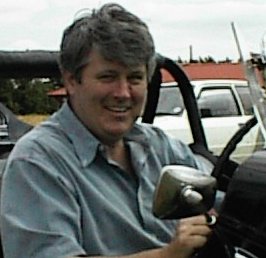
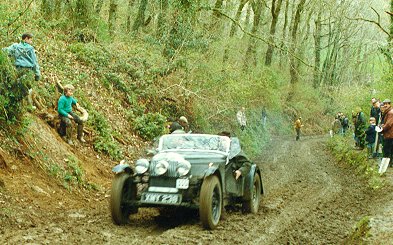
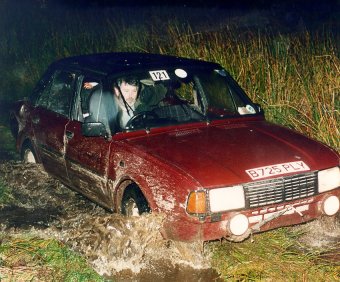
Peter’s first car was a 1937 Austin Ten, which he bought for the proverbial fifteen quid. It was a horrible thing, in terrible condition. Foot flat on the floor it would reach fifty but the reality was you actually daren’t drive it over forty, it was so un-stable! An Armstrong Siddeley Lanchester was next. It had a Wilson pre-selector gear box, the same as was used in the ERA’s. It had six cylinder’s and hydraulic tappets but like the Austin Ten it didn’t last very long and followed it to the local scrap yard. Then came a series of Escorts and an ex Evening Standard Minivan before the Morgan arrived.
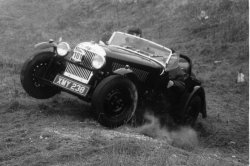
Peter acquired XMY 238 in 1968, after seeing an ad in the Exchange and Mart. He was running around in the Minivan and had planed to use the Morgan as his regular road car. However, although the car looked nice it was quite evil. It had lived a hard life, everything was worn out, to the extent that Peter had to change the engine the next day. Once this was done Peter used it regularly for a year or two, driving it on the road and competing in trials and sprint’s, before acquiring a company car, whereupon XMY 238 disappeared into the garage for a quick two week chassis change! The old one had become rather rusty, a common fate for the early cars, as the steel used for the chassis was pretty appalling and they didn’t last very long. A brand spanking new frame was obtained from Malvern Link for the princely sum of £65. Just one small thing, the two weeks expanded rather, into an eleven year re-build!
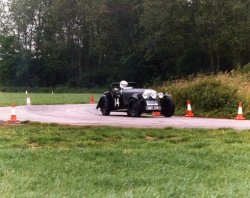
As you can imagine, the car has had many alterations and modifications over the years. It now has cycle type front wings (acquired from the same source as Dudley Sterry’s), disc brakes, a modified TR4 engine, radial tyres,15 inch wheels and numerous chassis modifications. Some of these changes offend the purest members of the Morgan club, but they were quite normal modifications in the late sixties and early seventies, around the time that Plus Four production ceased. However, they do mean that this old car is quite fast on the road and is well able to hold it’s own in modern traffic.
Peter got into trials when he drove by Milk Hall Farm on the way home from a Veteran Car run a couple of years before. He saw something interesting was going on and went in to have a look. He got chatting to Mike Furse, who talked him into doing an MCC trial, and the rest is history! Peter used the Morgan in PCT’s, Classic’s and Sprints for several years, before and after the re-build. In the early 90’s he did all three of the MCC events one year. But the hill’s were getting rougher and he was concerned about the way the underside was getting knocked about. Peter particularly remembers the ruts on Waterloo. Smash, smash, smash. The cross member is still banana shaped after the experience! The problem is that the suspension movement is so limited.
The car is raised an inch and a half at the front and two inches at the back, but it has so much overhang at the back that the tail is still extremely vulnerable. The final straw came when the diff and the gearbox broke on Bamford. The diff wasn’t to much of a problem but the Morgan uses the same Moss gearbox as an XK120. Bits are very hard to find and are very expensive when you do locate them. Peter managed to find another box but it had a high bottom gear that was not suitable for trials. This prompted him to decide that the Classic’s were now to rough for such an old lady and he bought a Skoda.
The Morgan still comes out for selected PCT’s and the occasional autotest when it is driven with great verve! Future plans for the car include hill climbs and Peter rather fancies the Manx Classic. However XMY 238 will need another engine, as the present one is now very tired .
Before we leave Morgans it’s interesting to hear that Peter was responsible for introducing Rob Wells, the well-known Morgan racer and London dealer, to trialling. They went to the same school so they go back a long way. Peter has team managed the Morgan team at some of the long distance relay races, including the 24 hour event at Snetterton which they won, only to be disqualified afterwards. Rob and Peter have shared quite a few motorsport experiences, including driving a Beetle on the Lands End. Then they shared a left hand drive Plus 4 for a couple of years. This was a Fiat engined car that they built up from a pile of bits.
There have been two Skoda’s. The first was an Orange one, acquired in 1993 and used by James as a road car. It was then turned into a trials machine, but was totally gutless with it’s standard engine. They got hold of a rally prepared motor and de-tuned it a bit but the cam is still a bit hairy. Later the mechanical’s were moved into another shell that forms the basis of the current car. The gearbox has broken a couple of times but otherwise Peter reckons it’s pretty robust. Over the time he has had the Skoda he has developed the it considerably. He’s removed the anti-roll bar to give a bit more suspension movement at the front and there are some hush-hush tweaks at the swing axle end back end. Recently the car engine has been de-tuned even more in search of more torque. It’s fitted with a 40 DCOE Weber that now has quite small chokes to make it more tractable.
Peter has had his Dellow for about two years. He doesn’t know much about the history of this particular car. It’s a Mk 1 chassis, no 35, and was already fitted with a brand new 1600 Crossflow. Theoretically it was practically ready to run but Peter wasn’t happy with a lot of the workmanship and decided to give it a compete re-build. According to the MCC programs it was last trialled in 1986. It was also used in speed events, for the purpose of which it had the main cross tube cut out, so the engine could be set lower in the frame. So the first thing Peter did was to replace it, as the chassis was a bit flexible to say the least!
Peter has had his Dellow for about two years. He doesn’t know much about the history of this particular car. It’s a Mk 1 chassis, no 35, and was already fitted with a brand new 1600 Crossflow. Theoretically it was practically ready to run but Peter wasn’t happy with a lot of the workmanship and decided to give it a compete re-build. According to the MCC programs it was last trialled in 1986. It was also used in speed events, for the purpose of which it had the main cross tube cut out, so the engine could be set lower in the frame. So the first thing Peter did was to replace it, as the chassis was a bit flexible to say the least!
We have been publishing stuff about Classic Trials on the Web since 1995 and always appreciate feedback. Comments, Corrections, Criticism & Concerns are all welcome. You can leave a comment to have your say here on this web site or our Social Media
Our birthday run re-united original “Falconer” team member Derek Fleming with his old trials car Primrose. Derek and his fellow team members, Tucker and Ron Warren were a very successful combination, winning the MCC team award on several occasions.
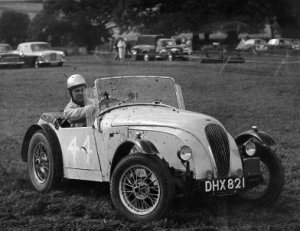
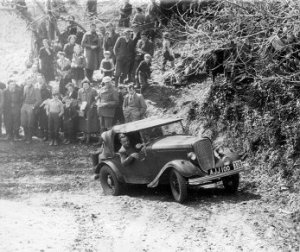
THE STORY OF PRIMROSE IS QUITE FASCINATING. Back in the 60’s Derek was in the motor trade when Tucker talked him into competing in the Lands End with a brand new Minx. A look underneath afterwards showed Derek how unsuitable this particular car was for trialling! The poor old petrol tank and underside were looking decidedly second-hand after their battering on the Cornish rocks.

While looking at the damage to the Minx Derek found out a pal had smashed up his XK 120. He acquired the wreck, but the only usable bit was the bonnet. Derek had often talked about building a trials special but had never actually got round to starting it. Then one day he came back from lunch to find his mechanics had propped up the XK bonnet and laid out four wheels and an axle round it, and that’s how Primrose started. It isn’t just the bonnet that makes the old car so distinctive. Derek also built her with independent front suspension which was very unusual at the time.
The parts came from a Standard 10. Primrose is very well made. The wings are beautifully finished with rolled wired edges. The rear lights are another nice feature. When Derek finished the car the chassis stuck out from the body a bit so he wanted to set the rear lights back. The delectable looking housings are in fact cut down oil filter canister cylinders! Another nice touch is the rear number plate. It looks frightfully low and vulnerable. Until you realise it is hinged, rising out of harms way when the ruts come along.
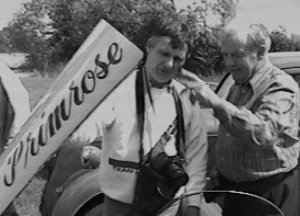
How did the car get its name? Originally Derek entered it as a Ford special. Having built the car in his spare time his wife had been left on her own a lot. They were looking forward to spending time together on the events, but when the first one came along his wife wasn’t at all thrilled. It was a cold Lands End, and the car didn’t have a heater yet. But when the day dawned and they were going down all those narrow Cornish lanes all the Primroses were out in the hedges. The Secretary of the event, Jack Davis must have heard them talking about it because although Derek entered the next event as a “Ford Special” the Secretary put “Primrose” on the entry list and the name stuck.
When Derek was building the car people often asked him what colour he was going to paint it. Something exciting like British Racing Green? No “nothing gaudy” said Derek “just plain old yellow and black” So when he finished it he had to paint it yellow and black. Derek is delighted that Primrose is still active, so many other specials were left to languish under a tree and rust away. Although Derek still owns her Primrose has been on loan to Neil Bray for many years. Neil fitted a modern cross flow engine and a roll bar, using the old car on the classics for many years before going class four with a Skoda on some events to avoid the re-starts!

The barbecue after the run gave Derek and Ron Warren the opportunity to reminisce about their competition career. Derek won the Guy Fawkes in Primrose one year and also the Badderely on the Lands End a number of times.
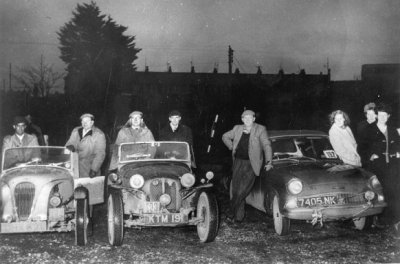
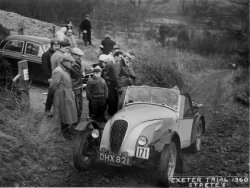
Ron remembers when you had to register as a triple contender. Ron got three first class awards one year but no triple because he hadn’t registered. Reggie Marrions was Club Captain and stood no nonsense, rules are rules. Then Ron recalled one Exeter when the engine of his Dellow cried enough and he took it to a local garage. The mechanics fell on the car and quickly removed the engine. They had to fit a new piston and four exchange con-rods. Ron missed a section by about ten minutes but went on to do the rest of the trial.

Ron and Derek talked about another Falcon members special “The Lawford”. This was a real fly-weight that challenged Derek in Primrose on one Guy Fawkes. It was built by Mike Lawrence and “Lawford” came from “The Lawrence-Ford Special”. They were both clean on the sections but Derek was quicker on the special tests. He reckoned it was all down to his gear ratios Mike had a box from and “eight” while Derek’s was from a “ten”. It was super to see car and builder reunited again. Derek certainly enjoyed himself. Who knows we may yet see him on another Lands End.

We have been publishing stuff about Classic Trials on the Web since 1995 and always appreciate feedback. Comments, Corrections, Criticism & Concerns are all welcome. You can leave a comment to have your say here on this web site or our Social Media
Jack Williams is a familiar face at our trials, always doing well in his smart red Tempest. I knew he had been trialling for a long time and after a brief chat on the phone he agreed to be the subject of my second “cars I have owned” feature. Jack let me borrow some pictures from his collection and in the lunch break at our Edlesborough trial we sat on his trailer and talked.
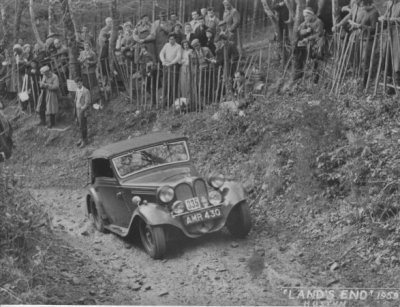
Jack was born and bred in Cornwall and his first recollection of motorsport was being taken to Bluehills on Easter Saturdays. This was in the mid 30’s and Jack remembers that the old hill was still used. There was no Bluehills One in those days. Competitors hairpined left up what is now the surfaced road.
After the war Jack passengered a few times before driving his first Lands End in 1959. In those days you could drive a genuine road car and Jack used his special bodied 1934 BMW 316. It had a six cylinder, 12hp engine and had two Solex updraft carburettors, sucking up like an Austin 7. So there’s nothing new about doing Classic Trials in old cars!
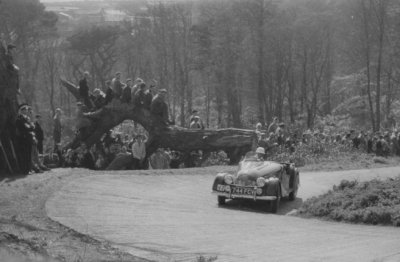
By now the bug had really started to bite. Jack was managing a specialist sports car garage just outside Truro. They were the Morgan distributors for Cornwall so Jack naturally took one trialling and it wasn’t your standard car either. In conjunction with Peter Morgan Jack specified an alloy body and bucket seats. The car was also unique as the first Morgan to have its sidelights mounted on the wings. Originally a special for Jacks car Peter Morgan liked the idea so much it became standard.
The Morgan looked superb in British Racing Green and was registered FCV 444. It had a Standard Vanguard Engine because although Triumph’s Sir John Black was an ex-Morgan apprentice he wouldn’t give Morgan the TR engine. However, Jack persuaded Chris Lawrence, the Morgan wizard of the day, to tune the Standard Vanguard engine. By the time he had finished the car went jolly well and the motor looked just the business with it’s twin Strombergs.
Jack competed with the Morgan for a while. The car had to work for it’s living as it doubled as the business’s demonstrator. On the sporting front the Morgan wasn’t only trialled. Jack used to do the Lands End, stay in Penzance and then drive in the Speed Hill climb at Trenwainton on the Sunday.
After the Morgan Jack trialled a spate of Triumph Heralds. Starting with a 1200 Duo Tone in 1961. Then a customer, who was also a member of the local Motor Club, bought a 1200 and fitted it with a Shorrocks super-charger. Another member had an original 948 Herald with twin SU’s. Not to be outdone Jack’s partner got hold of a convertible and had it fitted with a Brabham conversion, complete with a 1200 Coventry Climax motor. The three entered a team in the ’61Lands End and won the team award, beating the Morgan works team when Sid Margullis blew his diff!
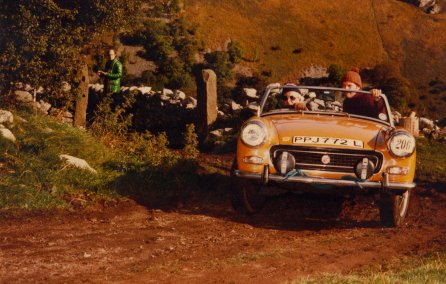
Next Jack dabbled with rear engined machinery when he bought a 750cc Renault CV4, the predecessor to the Renault Dauphine. This was a pretty little car but it was a bit short on power so Jack fitted a bigger engine from a Dauphine and souped it up with a Gordini head. They entered the Lands End but only got as far as Beggars where a drive shaft broke.
Then came a trials sabbatical as Jack moved up to Surrey and was out of action from 1963 to ’68/9. He came back with a couple of Midgets but wasn’t impressed with them. Then the garage took a BMW 2002 in part-exchange. Jack thought it would do the business on the hills but it blew its diff somewhere in darkest Devon. Jack was so disgusted he left it there!
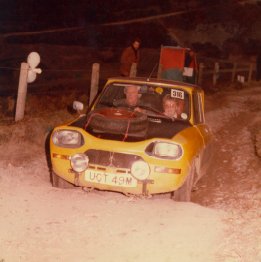
By now Jack’s garage was a Citroen distributor and he decided to take the marque trialling. However, they weren’t standard cars. There was a nice AMI Super. This came with an 1015cc motor. Jack swapped it for an 1,220 engine from a GSA and promptly won his class on the Exeter in 1983.

The Mehari was a utility vehicle originally designed for the French army. It was a tough car, built strong enough to travel slung underneath a helicopter before being dropped the last few feet to the ground. The design was based on the AMI platform chassis. Jack really liked the Mehari and had it for some time, but the chassis on his car wasn’t very good. He had an AMI that he wasn’t using, so he wiped the body of that and put the Mehari “top” in its place, even though it was designed for a twin rather than 4 cyl engine. The only problem was the necessity to remove the headlights to change the spark plugs!
Next came a couple of 2CV’s. Jack got on well with these on PCT’’s, finding they would outclimb practically any other front wheel drive car, even though they had a very restricted lock with a 40 ft turning circle. This was because of the swinging arm front suspension. The larger engined 602cc cars were pretty low geared, but the original 425cc machines had an incredibly low diff, something like 8:1, so Jack naturally fitted his larger engined car with the ‘box from the smaller engine.
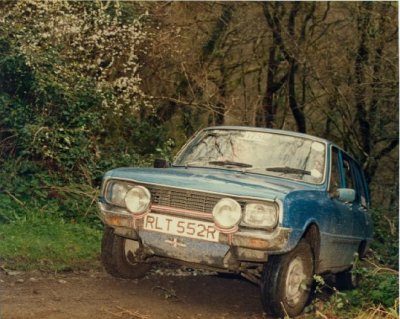
Then came the famous Mazda that Jack used for many years. There weren’t many of this model imported. It was very narrow and short to suit the Japanese tax system. It was actually smaller than a Hillman Imp, ideal for trials, especially after Jack replaced the 1300 motor with a with a 1400 and fitted the ultra low diff from a 1000cc car. Jack won several MCC awards with the Mazda and competed in hundreds of PCT’s. Before Jack got hold of it the Mazda had been owned by the actress Prunella Scales, who loved it dearly. Jack’s business took it in part exchange but Ms Scales kept track of it and was horrified to hear about the ordeals it experienced in its new career!
The Mazda is still going strong and was last seen running around as a shopping car. It never failed to get Jack home, even when the pin came out of the diff in Derbyshire. However, because the crownwheel overlapped the pin it couldn’t come out completely although it got quite beaten up.
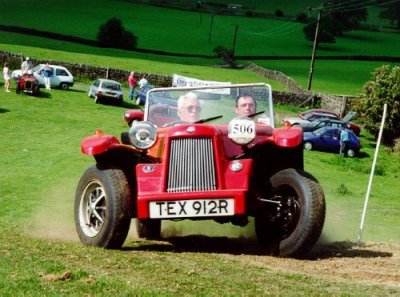
Finally comes the Tempest, Jacks current trial’s machine. This was selected as it could be used for trials and as an occasional second car for road use. Like me Jack believes that most cars specifically built for trialling are not really suitable for a trip down to the pub. However, Jack doesn’t believe the Tempest is man enough for classics, although a couple have been seen out with some success. So that’s the story so far. Jack is concentrating on PCT’s these days, very successfully, and has been in contention for the RAC title for the last couple of years.
Going back to classics we talked about how the events have changed. Immediately after the war entry lists were dominated by the E93A Ford Pop, complete with family, kids and suitcase on back! They did very well, often better than the specials. This was because in those days production cars could use Town and Country tyres. The Dellows had to use road pattern cross plies and a Pop with a decent driver could outclimb them. So it was hardly surprising that most of the entry comprised standard production cars. Jack feels very sad that these days production cars are in the minority and those that do compete have to be so heavily modified in order to cope with the rough conditions now the hills have deteriorated so much.
Apart from trials Jack competed in one or two speed events, remembering an “autotest” at Perranporth airdrome in 1962. It consisted of a third mile sprint down the runway. Round a pylon and back again. Very enjoyable, especially when Jack’s Morgan beat the TR’s.
We started to talk about some of the things Jack had seen over the years. Like when Sydney Allard charged around the Exeter on his new J2 Allard, only to find it was too wide for the bridge at Fingle! Then there was time for no more. Lunch was over and there was trialling to be done.
We have been publishing stuff about Classic Trials on the Web since 1995 and always appreciate feedback. Comments, Corrections, Criticism & Concerns are all welcome. You can leave a comment to have your say here on this web site or our Social Media

If there was a prize for the smartest car at the July Autotest it would have been won by Geoff Jacksons new trials car the “Sprint”. Geoff has all the qualifications for the job. My first recollection of him was on the 1971 Guy Fawkes when he was driving a Morris. Latterly he has campaigned a class eight Dellow on MCC events. (Kindly towing me out of a mud hole on the muddy exit from Calton a few years ago).
Geoff started to build his new car about five years ago. He started by putting a melamine “surface plate” on a couple of trestles and laying out the chassis tubes on that. The Sprint uses a Ford back axle located by twin trailing arms. A mark 4 Cortina provided the front hubs and the suspension owes a lot to Westfield and the Ford Transit, while a friendly Escort donated it’s steering rack!
Geoff resisted the temptation to fit a Ford Kent engine and the Sprint is powered by a 1500 lump from a Triumph Spitfire, running a single SU. The mechanics are finished off by a very well made body, nicely painted in Red. It’s a super car and did very well at Upper Caldecote in the hands of Geoff’s two sons. Watch out for the Sprint on the Edinburgh.
We have been publishing stuff about Classic Trials on the Web since 1995 and always appreciate feedback. Comments, Corrections, Criticism & Concerns are all welcome. You can leave a comment to have your say here on this web site or our Social Media
 Classical Gas