You have stumbled on a delightful box of tricks, Classic Trials & other perverse stuff from Michael Leete. MCC ACTC and other trials. VW Beetles, Dellows, Marlins, or even Suzuki X90's
Got car MOTd 3pm Friday and for the first time in a while actually managed 4hours kip before setting off for a 01.03 start from Popham (ever mindfull of the recent discusions…) which made a heck of a difference I must admit.
Although I thought I’d read the route card properly, like many others I failed to spot the fact that only the route from Haynes onwards was compulsory, not the route from Popham to Haynes museum. As it happened we didn’t miss any slots this time but with the fog as it was I would have probably opted for the 303 if I’d realised.
I have just swopped my emission type Dellortos for non-emission Dellortos allows much more adjustment of the bottom end which is usefull for PCTs). Although it seemed to be running OK I knew it was a bit rich down the bottom but had other preparation to worry about so thought it would be OK; which it was until we had dawdled our way for the last few miles to Normans. By then the plugs had sooted up and we couldn’t get off the line due to the resultant missfire. Same thing on Clinton but we were invited to roll back and take a run up and consequently got to the top albeit having already failed – this blast seemed to clear things and from then on we went OK.
Tillerton seemed as rough as ever around the restart area which we fortunatley don’t have to stop at and on the road section soon after this we stopped briefly when we saw Ed Nickle parked up having had carb problems then somebody side swipeing his Imp and I gather he toubles were still not over as he eventually retired with a slipping clutch which apparently was caused by a problem with the thrust mechanism.
Comparing notes with Richard Tompkins later on we both agreed that Windout, with no restarts this year, was great fun in an Imp and a bit of a hooligan’s delight being all tarmac with slippery hairpins!
Colin Perryman blew his Skoda’s engine on Fingle. On Wooston steep I was a little suprised to pass two ‘section ends’ boards till I realised that after our section had ended we joined the class 0 route at the fork just after the short steep downhill bit.
And so to Simms – I was determined to have a good shot at it and mindfull of the earlier problems changed the plugs before the attempt. We had a real good go at it but I probably went too far to the left, hit a rock with the rear wheel, punctured and stopped.
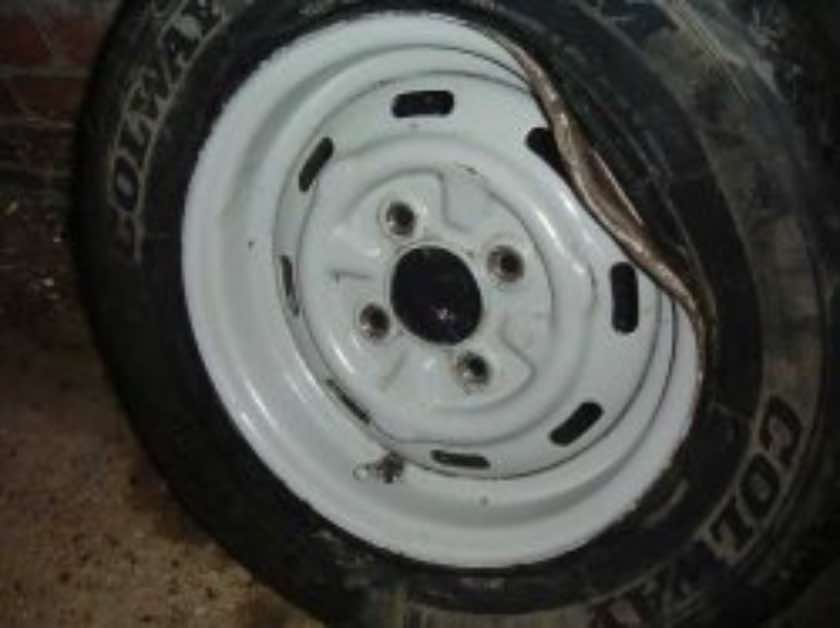
I attach a pic of the wheel which is the worst wheel damage I have incurred with the Imp. My tyres were nowhere near flat and well into double figoures at xx lbs(!) and the mind boggles at the force required to damage a rim like that with one hit.
Bill Roston was the only Imp to clean Simms, I believe, on his way to Gold. Tipley was quite rough and very slippery but without the restart which causes all the failures on the Torbay trial. Overall a really enjoyable event after the lay off which was still competitive without the restarts for us girlies!
We have been publishing stuff about Classic Trials on the Web since 1995 and always appreciate feedback. Comments, Corrections, Criticism & Concerns are all welcome. You can leave a comment to have your say here on this web site or our Social Media
Please help spread the word and share this on your Social Media:
A relaxed chat at a Dinner table set me scrabbling amongst my books and many sessions trawling the Internet to find out more about Derek Fleming’s “Greyhound”
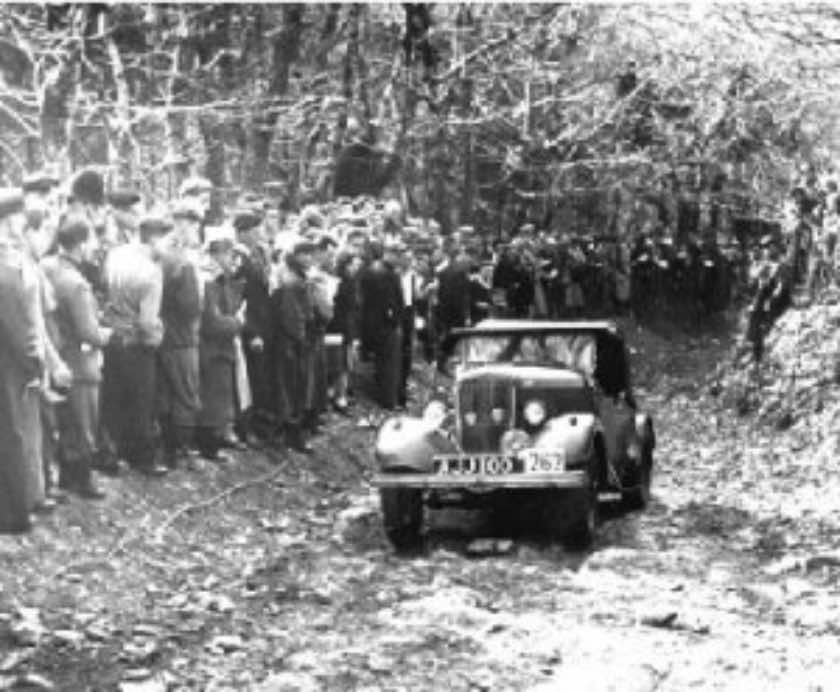
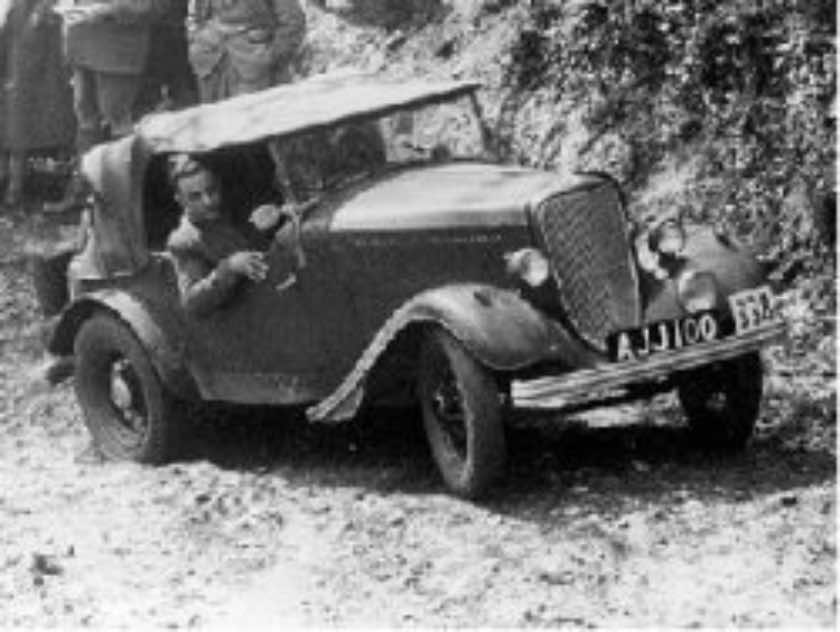
Derek Fleming driving his Ford “Greyhound” on an MCC event in the mid-50’s Derek bought the car for trialling while he was building “Primrose”, after damaging the under-side of hiis brand new Hillman Minx.
Sitting at the dinner table with Derek Fleming at the MCC Centenary Dinner we got to talk about his cars. Derek got into trials through fellow garage owner Tucker, and he started out competing in his brand new Hillman Minx. This went well, but inevitably, it suffered quite a bit underneath and when the petrol tank got damaged Derek decided to get another car for trialling while he was building Primrose.
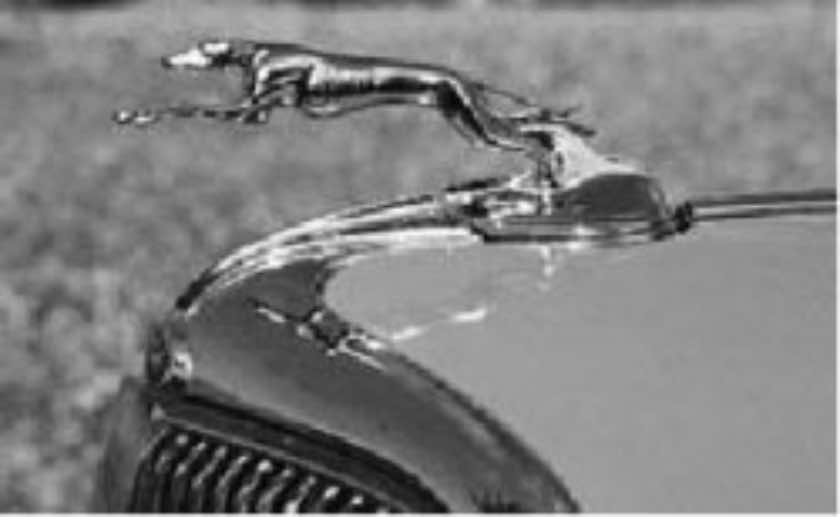
An open pre-war Ford Tourer came Derek’s way, which he refers to as a “Ford Greyhound”. This interested me and when I got home, I looked it up on the Internet, without success! What I did find was a large amount of information on radiator mascots.
Back in the 20’s and early 30’s it was very popular to have a mascot on your radiator cap. Some manufacturers provided them as standard, but with Ford it was an accessory, a greyhound! So, “greyhound” was not really a clue to the origins of the car.
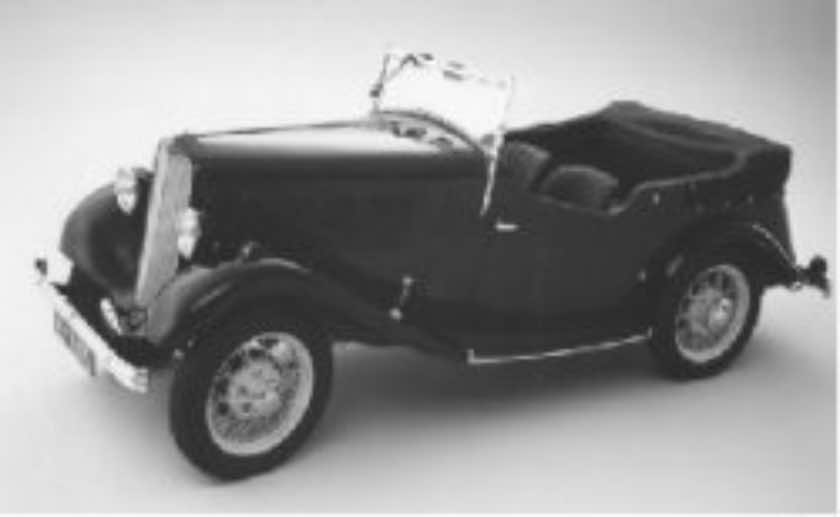
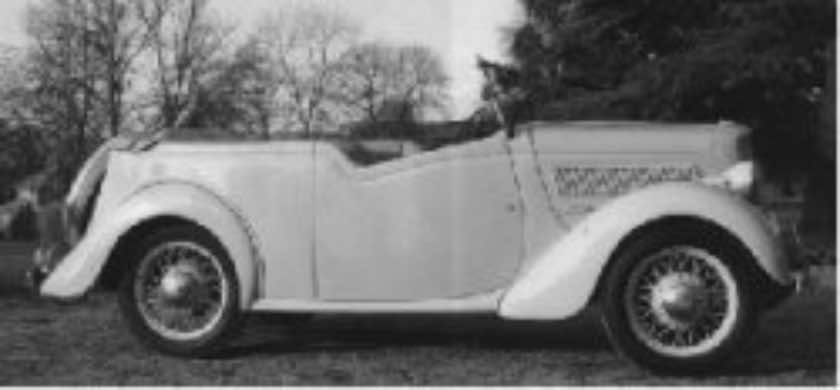
Comparing Derek’s car with the 1932 “Y” with body by Abbey Coachworks shows many similaritiesThe greyhound radiator cap was a popular accessory for Fords. It was available as an option from Ford, but a number of aftermarket companies also sold greyhound radiator caps for Ford cars. Each company rendered its own version of the greyhound so differences can be found.Derek in his “Greyhound” tackles Darracott in 1956. Compare the shape of the doors and the windscreen mounting with the two pictures at the bottom of the page. A standard “CX” Tourer is very different.
A phone call to Derek didn’t shed a lot more light on the cars history. He couldn’t remember who he bought it from, although he did remember it said “Greyhound” in the logbook. Derek reckoned it could have been a special body built on a standard chassis. But was it? Research on the Internet revealed that Ford started to produce the Y type in the summer of 1932. This was known as the short radiator model and it had a straight bumper. After this in October 1933 the ‘long rad’ model, with its longer radiator grille and front bumper with the characteristic dip was produced.
Ford never produced an open Y type but when the “C” came along they did produce a tourer version of the CX. However, you can see that Derek’s car is not one of these when you look at the shape of the bottom front of the door, and the way the windscreen mounts to the body. Anyway, Derek had pointed out that his car had a straight ribbed bumper. This was a clue to the cars age as it must have been an early short rad model. Derek also mentioned that he used the car with 16 inch wheels but this was a red herring. Ford produced their pre-war cars with 17 inch, Firestone shod, wheels. Mitchelin were promoting their 16 inch tyres and gave away a set of 16-inch wheels if you bought a full set of their rubber. This of course lowered the gearing!
So Derek’s car was not a CX, it was based on a an early Y type. Further trawling on the Net confirmed that Ford did not produce an open top car because it was thought that the chassis was too flexible, however several specialist coachbuilders produced a range of attractive model ‘Y’ tourers. After yet more surfing I found a picture of a 1932 Y with a Tourer body by Abbey Coachworks and I set about comparing this with Derek’s car. They are both short rad models with straight ribbed bumpers. The doors look the same, so does the windscreen mount.
In conclusion it looks as if Derek’s “Greyhound” was a 1932 or 1933 Y type produced in chassis form by Ford with a body built by Abbey Coachbuilders. What is certain is that the car gave Derek a lot of fun and not a little success. Derek attributes its climbing ability to its flexible chassis that ensured the wheels were always in contact with the ground, however rough and rocky terrain. There were disadvantages of course. The doors tended to fly open over the bumps unless they were tied shut!
The reason the chassis flexed so much was that the rivets had all come loose. When Derek sold the car to Ian Wilson he welded it up. It was nice and stiff afterwards, improving the handling on the road no end, but it never climbed very well again!
We have been publishing stuff about Classic Trials on the Web since 1995 and always appreciate feedback. Comments, Corrections, Criticism & Concerns are all welcome. You can leave a comment to have your say here on this web site or our Social Media
Please help spread the word and share this on your Social Media:
Mike Hayward’s Falcon Clubmates help him change the diff after Beggars on the 2000 Lands End. Hey! I didn’t know Mk 3 Escorts were Rear Wheel Drive!
As some of you may know this is not the only Classical Gas. There are two more on the Internet, plus a printed version which is distributed with The Falcon Motor Club magazine. This is the main Web Site, which contains much of the material in the printed version, an archive site where lots of old material is stored and a “Web Community” which anyone can join and post pictures and messages.
The heart of this is a message board and sometimes there are some quite long “debates”. Mostly they are pretty un-eventful but following The Gill Morrell Trial things heated up.
It started with Mark Rosten-Edwards putting forward the view that it was unfair that Mike Hayward’s ex-Autocross Escort should be allowed to run in class three. MCC Chairman John Aley chipped in, reminding us that the MCC allows cars to be reclassified “on merit” and suggested that Mike wrote an application to Mike Furse.
Mike thought this was a great idea, responding to say that a letter was on it’s way. This prompted a post from Escortier Jason Daniel putting forward the argument that if Mike was allowed into class 3 he should be allowed to modify his car by fitting coil-over shocks. By now we were into the intricacies of five link rear suspension, Panhard rods and comparisons with the Kalber’s “Runner Bean” Pop.
Simon Woodhall donned his ACTC hat and explained that although the MCC re-classified cars the ACTC certainly did not! This prompted some a series of posts getting into the different philosophies of the MCC and ACTC which got quite exciting at times but stayed just within the “permitted rules of engagement”. It was then pointed out that Class 0 was another route, although only the MAC is the only club to run this class in one day events.
We had 16 messages in all, the longest debate so far on the web community. It was all good clean fun and fully justified the Web Communities existence as a forum for un-edited debate. Me, I’m looking forward to passengering Mike up Bluehills without a re-start!
We have been publishing stuff about Classic Trials on the Web since 1995 and always appreciate feedback. Comments, Corrections, Criticism & Concerns are all welcome. You can leave a comment to have your say here on this web site or our Social Media
Please help spread the word and share this on your Social Media:
Adrian Marfell won the first ACTC trial after the enforced break with a clear run on the Exmoor Clouds. He was chased hard all day by Paul Bartleman in his new Troll and Dudley Sterry in his venerable MG.
by Ian Davis
As in 2000, this year’s Exmoor Clouds started at the Ralegh’s Cross Inn high on the Brendon Hills. Unlike last year though the morning dawned bright and sunny and the 52 motorcycle and 66 car competitors enjoyed beautiful autumn sunshine all day. The hills were in prime condition after a wet week and although one or two of the old favourites were missing, due to foot and mouth precautions, the route was similar to that used in the last couple of years.
Giles Greenslade won class 4. Dudley Sterry only dropped three marks but was pipped at the post for second overall by Paul Bartleman on spevcial test times.Adrian Marfel (shown, like the ones below, in this John Salter picture on the Ebworth Chase) won first ACTC trial after the break with a clean run.
After a gentle opener in the form of Steep Lane, the trial moved on to Port Lane where considerable delays built up as the motorcyclists tackled (with varying degrees of success) this long classic section. Five saloons saw the section ends board although only four cleaned the hill. The fifth, driven by William Rosen, was judged to have stopped lower down and then got moving again – a pity as it is some achievement to get an Imp over the rock steps at the top on tiny 12″ wheels.
The next three hills were to prove decisive. The first, Northmoor, was very muddy at the bottom with a deviation off the main track to the restart line, which stopped three quarters of Class 8. The usual suspects went clear and were joined by Paul Bartleman in what was listed as a Ford Special but what everyone else seems to call the ‘Cream Cracker’ Troll.
Following on from Northmoor was the first Special test of the day where Bill Foreshew threw the GVS II round in style to set FTD. Ski Slope was next and with the sun warming the grass, we had hopes of getting off the steep and slippery restart. These were soon dashed as the hill proved to be in fine form with a sticky patch lower down which stopped all the saloons bar one – David Turner’s BMW. He was joined at the top by Tommy Kalber in his Dutton and just three Class 8 specials – eventual winner Adrian Marfell, Dudley Sterry (after some determined bouncing) and local man David Dyer in a Canon who made it look easy, despite having shifted his rear axle on Port Lane. Falcon’s Murray and Hazel Mac were marshalling on the hill and Murray described how one special had almost rolled when attempting to climb the bank up to the restart – apparently only the fact that the spare wheel carrier had dug into the ground stopped it from flipping over backwards.
Pin Quarry followed and in contrast to Ski Slope, where the whole hill can be seen from the bottom, the start was out of sight. Not many cars saw the top either, most being stopped by a muddy bank or the hollow that followed immediately after. Following the route thereafter was also something of a challenge as it twisted and turned PCT-style up to the top of the old section. We met a Dellow driver at the top who arrived from a completely different direction but was convinced he’d cleaned the hill!
Allercott also had something of the PCT about it starting downhill and after climbing slightly descending further before the steep rutted grassy slope at the finish. Having made a mess of this last year, I was determined to blast straight up the final slope. All went well until the 5 marker landed on the bonnet, followed shortly by the 4 marker! I suppose the marshal gamely jumping into our path to vainly try and direct us up the left hand side should have given the game away but we weren’t the only ones to be caught out by the subtle route-marking and the penalties incurred for striking marker posts.
On to Middlecombe Woods where the first of two sections featured another downhill start to a wide left hand bend and then a long roller coaster climb with a choice of routes at the six marker – either a tight squeeze between two stout trees or round to the left. Although fairly straightforward for class 8, no car cleared the section from Classes 1-7 and delays again built up. The situation wasn’t helped when the recovery vehicle got into difficulty trying to reach the Hazelden Golf and took a full half-hour to get mobile again.
The second Middlecombe section proved less challenging, much to the relief of most of the field who had cleared only two or three sections by this stage – two thirds of the way through the trial! Land’s End section Hindon also proved easy this year. The good relations Dick Hutchins and the team have with the locals were in evidence here as farmer and family was sat in the sunshine spectating. Apparently, the key to Dick’s success (he has something like 40 hills to chose from) is the invitation to the club’s annual dinner extended to the landowners of the sections used each year
Not far from Minehead, the slippery tree roots at the top of Avill Ball stopped all the saloons and most of the bikes although most in Class 8 managed to avoid the large stump at the top and clean the section.
On to Tarr Cot, which proved a real challenge for the saloons, only Clive Kalber in his Escort and Giles Greenslade going clear to secure their respective class wins. There appeared to be some communication problem here as some cars were sent off while others were coming back down having failed. Clearly not ideal, especially as you need to press on a bit to get across an adverse camber half way up… Those who made the top uninterrupted were treated to a glorious view over the Bristol Channel to South Wales.
Down through Roadwater and along the old mineral line to what looked like abandoned Iron ore workings for the final two stages – one for class 8 and one for everyone else. Getting to the start of these sections required climbing a track, which could serve as a section in itself. Unfortunately it proved too challenging for some of the saloons, especially as most arrived well after nightfall and their section was rightly cancelled – this area definitely not being somewhere to get stuck in the dark. Class 8 arrived earlier, however, and were able to tackle a long steep section with big drops to the right hand side and a slippery grassy finish which stopped most of the class. We gave it death and were pleased to get to the top only to see Adrian Marfell cruise up in second gear to complete the only clear round of the day and a well-deserved victory. Paul Bartleman finished a fine second, having dropped only 3 points, with Dudley Sterry a couple of seconds behind on special test times.
All in all a great day’s sport for us in class 8 – all the more so after an enforced close season of 8 months. For those in some of the other classes though it must have been a very long (and in places rough) day with the last competitor finishing at 8.30pm and then facing the drive home.
We have been publishing stuff about Classic Trials on the Web since 1995 and always appreciate feedback. Comments, Corrections, Criticism & Concerns are all welcome. You can leave a comment to have your say here on this web site or our Social Media
Please help spread the word and share this on your Social Media:
After a certain amount of uncertainty due to the foot and Mouth epidemic, The Buckler Register staged it’s 2001 Buckler Day and Road Run at the Memorial Hall Long Lawford Rugby. The weather was perfect close to 30c, and nine Buckler cars from bare frame to road legal turned up to take part. Our friends from the Ford Sidevalve OC also brought three cars, the tea pot never ran dry all day and a lot of interested people visited to chat and look at the cars.
Bucklers, and an interloping Dutton!, basking in the sunshine at Long Lawford.
It can fairly be claimed that this Buckler Day ranks with the 40th and 50th Anniversary days as one of the best events staged by the Register. In common with those other memorable days the weather was brilliant, also as in those events we had a road run. This in my view is important. Only by encouraging cars to be driven to and at events are we able to increase the number of road legal runners. Also on show were three examples of the Buckler chassis building art. The Mark V rolling chassis of MYG 10 was brought by Ken Green and Chris Hackney, the rebuild of this car should be fairly rapid as Chris is keen to have running it on the road in next years road run!! Brian Malin brought his hybrid Buckler chassis, which we think was intended to have a Ford V8, fitted. As part of the build up to the event my DD2 frame was collected from the lock up and Red Oxide applied by Messrs. Hackney & Green and Hibberd to the replaced tubes in order to make it look a little decent to illustrate what a light strong space frame should look like.
The roadworthy Bucklers present were Keith Ambrose in the pretty Peco DD2, 800 KBH, Keith retains the Pete Boswell trophy for another year for driving the car up from Bristol. Brian Malin, Mark V BLY 618, Ken Green Mark V DFB 140, the Boswell family brought their Mark VI JVS 347 from Thatcham. My own Mark VI NAC 344 making the shortest journey to the event. One of the things that made every Buckler owner envious was the Mk5 (KBL), brought down from Blackburn by Trevor Anderton, Henry Allen spotted this car in Lawford on Saturday, he ‘phoned me to say that Bucklers were arriving, it was a nice surprise to see the car with it’s very complete history.
Our visitors from the FSOC were Alan Hart from Shipston on Stour with a very pretty 1962 Ford 100E saloon, John Porter from Nuneaton with a Siva tourer. C. Hammond from Hillmorton came in his Shirley Mk 2 and Rob Daniels visited, but was unable to bring his Rochdale. Keith and Claire Oakes were invited and turned up with their Dutton trials car. Both Keith and Claire go back a long way to the 1960s with the Allen Bucklers in trials, right up until the Dutton arrived and began to do the business for them.
Everyone turned up pretty promptly, and when we had found parking for all the cars and trailers it was time for our Road Run to get under way. Rhona took the little green car for a spin round the village, sadly the car suffered a repeat of its prop shaft problems, which had led to it arriving on a trailer, so JVS was out of the run. Brian Malin disappeared in his Mark V to get petrol just as the run was getting under way and nothing further was seen of them until the run was over. Henry and I ambled off in NAC dispensing with the route card, as we knew the route, having traveled round it time or two. When we reached the Canal at Willoughby we paused for a few minutes and were joined by two Buckler Mark V’s. Ken and Chris in DFB and Trevor and Steven Anderton in KBL. The narrowboat Martin E arrived with my family aboard, so we had liquid refreshment and chat on board before resuming our wander round the leafy lanes.
A little while later we found a Buckler DD2 in a gateway and it’s driver round the corner in the pub, so we paused for lunch with Keith Ambrose. Also in the posh bit at the pub were Rhona and family but we settled for a very good and reasonably priced Ploughmans in the bar. During lunch I was lectured on the difference between a right and a left turn, funny how we all managed to end up in the same pub. I think my mistake had the cars running around a bit on the approach to Shuckborough, my claims of deliberate mistake didn’t go down too well. Then the highlight of the day for me. Our little convoy of Bucklers then set off toward Lawford and the finish, we all enjoyed the drive “home” it’s nice to drive our Bucklers but it’s much more enjoyable in company with three others. Trevor Anderton described it today as ultra relaxing.
Back at base in the Hall lots of interested visitors, both enthusiasts attracted through the Internet, and several locals who came and looked round. Tea and snacks went down a treat, plenty of chat, David Hayes drove down from Manchester and identified his Buckler car (so far unseen by the Register) as being a modified DD2 with alloy body. Geoff Roe from Nottingham spent the day with us and brought a piece of the original rear frame from the Carnegie Buckler Mark V for us to see. The welding was typical Buckler – funny shape though! By 4.30pm people were drifting away, the car park emptying, the washing up done, by 5.00pm we were cleared up and all the cars away by 5.30 pm.
A memorable event hopefully the first of many of it’s kind, ideal venue, superb weather, good turnout (on the day) a new car turned up. Trevor Anderton was presented with one of the Malcolm Buckler 50th anniversary mugs to mark his turning up with a “new car” and driving it round with us on the run. We also recruited two new members. Magic……
Please help spread the word and share this on your Social Media:
Driving a Volkswagen Beetle does induce a certain amount of complacency, they may be rather strange contraptions but they are just about as reliable as a trials car can be, especially if you leave as much as possible as Herr Volkswagen, well Dr Porsche actually, intended. When you do see a Beetle retiring it’s normally the mucked about bit that’s bust. Well, at least that’s what I thought until this year’s Cotswold Clouds!
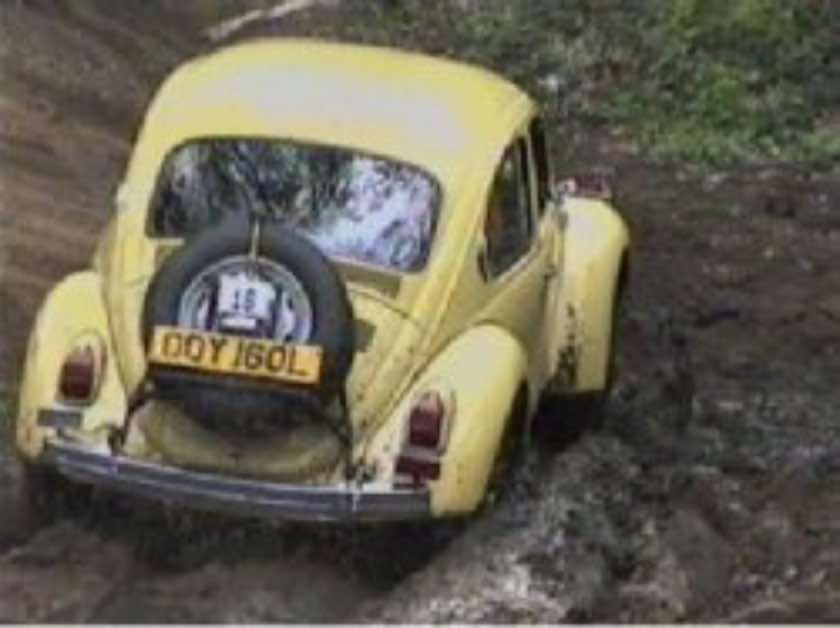
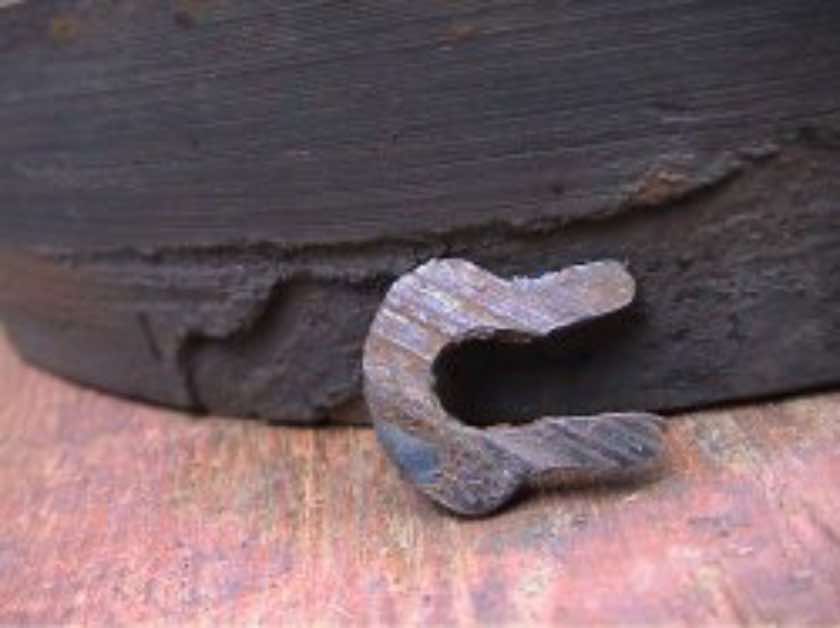
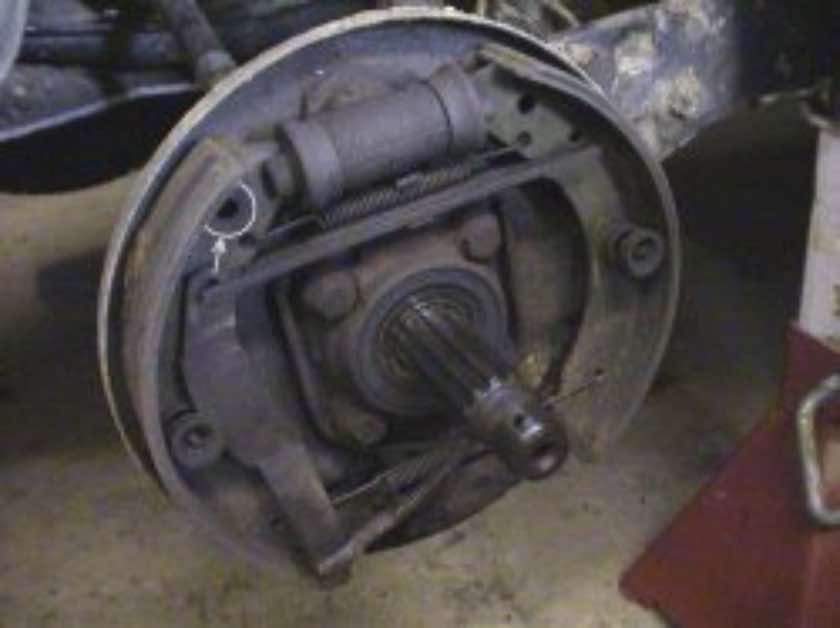
Years of bouncing around the nations trials hills with the weight of those spare wheels on the back bumper creased the body over the rear wingsStraightening out the dents is a regular taskhings got rather ground away on the way home!The handbrake operating arm should pivot in that hole!
I have had the Beetle since 1990, which I guess is longer than most marriages last these days, and have done between six and eight trials a year since. I can’t say that it’s exactly as I bought it as it’s on its 3rd engine and about the fourth of fifth gearbox. There are a few original bits, like the top half of the body, the steering wheel and the back brakes, which I shall return to later.
During all that time have always driven it home, even on the two occasions that I have retired. The first occasion I had any real trouble on an event was my second Exeter, which I think was in 1993. Brother in law Simon was passengering, it was the first event he had done where we were staying over and he was particularly looking forward to an evening with the lads out of site of “she who must be obeyed”. At that time, the car still had the engine it came with, a well-worn and completely standard 1600 twin port. We were running along with Fred Gregory in the days when he had his Skoda. I can’t recollect how we were doing, but we were certainly enjoying ourselves when we hit problems on Stretes. The car seemed to be going pretty well, but the engine was starting to sound a bit fruity.
On the road down to Honiton we realised something was wrong as it was making a horrible noise. We stopped but couldn’t find anything wrong. We had a good look at all the machinery in the car park at Exeter Services but could find nothing amiss. The exhaust was in one piece, the timing was OK, we even took the valve covers off and checked the tappets. We found one at 22 thou instead of six, closed it up a bit, and pressed on. The long dual carriageway stretch down to Tillerton revealed that something was very wrong. I was all for retiring but the disappointed look on Simon’s face when I mentioned it made me press on. We finished by driving on a very light throttle on the road and only opening it up on the hills, to the accompaniment of the most horrible noise.
We had a great evening and limped home the next day to more and more noise, and less and less power. I had already decided to fit a new engine that was waiting in Murray MacDonald’s lock-up, but was still interested to know what was wrong. It turned out that one of the studs securing the exhaust to the head had sheered and the exhaust gasket had blown completely away!
It wasn’t that much later that I had my first trials retirement since I broke the diff on my Mini at a PCT in the early seventies. It was on the Edinburgh that finished so late, I think it was the first Laurie Knight event. I had spent some time prettying the car up before the event, even painting the wheels, and it looked very nice. Everything was fine on the run up to Derbyshire but on the descent down to Putwell I heard a distinct knocking from the rear on the over run. A ra-a-tat-tat, just like a CV joint on its way out in my Mini days. There was a big queue for Putwell and I slipped underneath to peer intelligently at the drive-shafts, nothing appeared amiss so we pressed on. The noise got worse and worse as the day went on and the trial got later and later. It was gone six in the evening when we came down the exit road from Haggside, the weather wasn’t very good and we had a couple of sections to go, including Litton Slack. The noise was really loud now, we had failed a couple of sections, so there was going to be no medal and we retired rather than risk being stuck with a broken drive shaft at he bottom of Litton late at night.
In those days, the Edinburgh finished at The Haddon Hall. We were staying there and got in for dinner at about eight, quite late but not as bad as the last competitor, David Alderson, who arrived just before midnight!
The following morning we thought about calling the RAC, but decided to try and limp home under out own steam. I was convinced one of the UJ’s had gone and was already planning a quick change as soon as I got home, for we were entered in The Ebworth Chase the following Saturday. We made it back to Bedfordshire to the sound of really loud knocking as soon as the car was off load. The Beetle was promptly up on the axle stands to change the drive shafts. Damn, forgot to undo the wheel nuts, not much hope but lets see if they will come off with the wheels in the air. Oh dear, all the wheel nuts are loose!
What had happened of course is I has painted the wheels with Hammerite, did the nuts up over the paint and they slackened off after a hundred miles or so. A hard lesson.
The only other time I have retired the Beetle was at a Brickhill PCT. If memory serves me, right this was the first event after the big changes in Falcon when all the disgruntled “SODS” joined us. Anyway, Mike Furse was Clerk of the Course and he had a special test, which involved driving forward down hill, stopping and reversing back up. I had the family in the car and wanted to put on a show. We went flying down, I dipped the clutch, slammed it in reverse and it immediately jumped out of gear. Nothing would persuade it to stay in reverse and as something had clearly broken inside, I decided to call it a day. We stayed to take some pictures and drove gingerly home. I hadn’t had this box very long, it was a 1300 with a low ratio and I had recently had it rebuilt because it wouldn’t stay in reverse! Anyway, I had apparently bent some selector fork or other. Rather than repair it I got another box part exchange, but I never took the old one back and it’s still in my garage as a spare at the cost of a lost deposit.
Apart from punctures, I then had a long trouble free period while out on events. Not that there was no work on the car. Another new engine came along, again curtsy of Murray MacDonald. This was a 1300, putting the beetle in class four, escaping many of the dreaded re-starts that organisers had introduced to subdue the performance of the type 4 monsters. I had fitted yet another gearbox, not because there was anything the matter with the other one, but I wanted an ultra low final drive and a 4-planet diff. Then of course there was the endless work on the body, doing battle with the tin worm and straightening out the inevitable dents. Things became a bit more serious when the body started to crease at the back over the wheel arches, necessitating a lot of work to pull it out and brace it to keep it in place as best I could. The bracing bars ran under the engine so I could no longer use the Trekker “bootscraper” skid plate that was bolted direct to the crankcase. A large sheet of upturned chequer plate replaced this. All this reduced the ground clearance so I had to raise the suspension even more to compensate. I had to grind a bit off the bottom of the spring plate’s to give some suspension movement which means the CV joints bind upon full droop!
All of this of course took place in the garage rather than on the road. All the more surprising then when we had a very strange problem on the 2000 Allen Trial. It started on a road section quite early in the event. There was a funny pulling feeling at the back, as if one of the brakes had come on. It only lasted a second. I tried all the brakes, everything seemed OK and we pressed on. A little later, after Guys Hill, it happened again, in a more pronounced fashion. This time I thought we had a puncture so we stopped and hopped out but there didn’t appear to be a problem. The truth came after Burledge. We had an honourable attempt at the hill but bellied out when we ran out of ground clearance at the top. We were about to reverse down but we were only a few yards from the summit so a Land Rover backed down to haul us out. I hauled on the handbrake to stop us rolling back and it just kept coming!
We stopped and had a good think. Clearly something had broken but it was out of site inside the drum and at a couple of hundred ft-lbs of torque I couldn’t take it off to have a look inside. We knew there weren’t any horrid reverse back down hills ahead so we pressed on with the handbrake working only on one wheel. The footbrake seemed to work OK and all seemed well apart from the occasional horrible graunching noise from the back when whatever it was got stuck between the linings and the drum!
We finished the event and drove carefully home. When I took the brakes apart, the following weekend I saw that the clip holding the handbrake arm pivot pin had fallen out, as had the pin itself. With the arm detached from the shoe, the handbrake didn’t work although the hydraulic footbrake did. The offending components were still inside the drum, but in a bit of a mess, as were the lining and the drum itself. A quick telephone discussion with Murray MacDonald explained the problem. I had always thought the clip securing the pin was just pushed on and held in place by its springiness, although it never appeared to have very much spring! Not surprising really, as you are supposed to clinch the clip shut and it’s made out of a nice soft material to help you!
I suppose I had been lucky really, as I had been driving around with those clips holding on with a wing and a prayer for the last ten years and although I have religiously stripped and cleaned the brakes every summer I had only ever pushed the clips back on!
We have been publishing stuff about Classic Trials on the Web since 1995 and always appreciate feedback. Comments, Corrections, Criticism & Concerns are all welcome. You can leave a comment to have your say here on this web site or our Social Media
Please help spread the word and share this on your Social Media:
The Stroud Club found a window in the wet weather and although some of the sections were very boggy put on yet another excellent event. Nigel Moss set out to bring the event closer to a “classic format” and the sections had a more natural feel with very little “tree weaving”.
David Thompson storming Crooked Mustard in his Troll Jim Scott got up a long way but couldn’t get his Stilleto round the corner (pictures by John Salter).Paul Bartleman eases his Escort up Nailsworth Ladder on the famous cars last event. Hazel MacDonald being beckoned to avoid the post at the top of Ham Mill.
Stroud had their usual full entry for their event, which stands alone, no championship, triples or anything at stake, you do this one for it’s own sake. There were a couple of non-starters, including Clive Booth, so second reserve Ian Davis got a run as second reserve.
With Sandfords know longer available Nigel Moss had found a new hill called Crawley for the first section. This was pretty muddy, but there was plenty of grip, so it didn’t pose many problems. Hazel MacDonald wouldn’t agree as she under-steered off into the scenery on the hairpin!
There was a queue for Crooked Mustard and Andrew Brown had to hold later numbers out on the main road for some time. The old section was quite slippery and there was a big step between the second and third corners. Most of the class eight’s got up OK, and a few of the sixes and sevens, but the rest floundered on, or in between, the corners. There were exceptions of course and local man Mark Linforth came out of the top in his Escort. So did Mick Workman in his class seven Imp. Colin Perryman broke a drive shaft on the first corner and dropped nine. However, he managed to repair the Skoda and went on to win class four. Mike Pearson found he had damaged a wheel quite badly and had to stop to hammer it straight.
Rushmire was badly washed out so part of it was used as a down hill special test. The challenge here was to stop on the finish line and this caught out a few including David Heale, Paul Bartleman and Adrian Marfell. Neil Bray broke his gearbox, loosing first and reverse and retired to limp home after a bit of spectating on Nailsworth. Michael Leete was also given a fail, even though he and Mike Hayward were certain they performed the test correctly, perhaps it was for setting such a slow time!
There was a holding control in the lane before the road to prevent a build-up at the foot of Axe, which was causing a few problems this year. It didn’t seem to be causing any PR problems as the lady in the pub at the start was keeping Clerk of the Course Nigel Moss supplied with tea served on a proper cup and saucer! All the rain had made Axe pretty claggy in a couple of places, one just after the start and the other quite near to the top. This caused problems for the lower classes with their lees powerful engines and lower ground clearance. However, the results make interesting reading. Adrian Tucker-Peake went clean in his Front Drive Peugeot but local men Mark Linforth and Mike Hobbs both failed even though they had just cleaned Crooked Mustard! The class 4 Imp’s all failed but Stuart Cairney and Jim Scott were level pegging with local Ian Moss.
There was lots of grip on Nailsworth Ladder and there were very few failures, even amongst the restarting class eight’s. The Ham Mill restart was just after the corner this year, which made it much easier and there were not very many failures. Although it still caught out a few, including Dick Glossop and Ade Welsh in class four, Mark Smiths powerful Beetle and all the class ones apart from Adrian T-P.
Nathan Camm was disapointed not to win The Ian Moss Trophy for best presented carThe Welsh family Beetle knocking it’s kness at the thought of Ade behind the wheelArthur Vowden couldn’t get his Marlin off the Merves Swerve re-start (picture by John Salter).The marshalls were flexible when it came to Ralph Talbot’s interpretation of being normally seated on Climperswell.
Lunch was taken in the civilised surroundings of the Tesco cafeteria, civilised for us maybe, but I don’t know what the shoppers thought of the muddy triallers and their strange collection of cars! Fred’s Folly was the usual glorious long blast up through the trees, there were special tyre pressure restrictions but no nonsense like restarts to impede progress. It is pretty boggy and rutty up near the top and like Axe you needed a combination of power, ground clearance and a heavy right foot to get through. This caught out both Stuart Cairney and Jim Scott, letting Ian Moss into the lead of the Imp battle.
The trial was to be decided on the next section, a new Catswood, reached after a lovely long drive through the forest below Merve’s Swerve. The Forshew family was in charge here, some of the many regular competitors who were out marshalling, for what must be the strongest trials club in the country. The lower reaches of the hill aren’t a problem, these started after a cross track where there was a restart and a ninety left ninety right, followed by a very steep, muddy gradient which nobody cleaned. Most of the competitive class eights got to the two, but Dudley Sterry failed lower down for a four and I can vouch how hard it is for Dudley to get the narrow tracked J2 up such a section as it won’t go in the ruts! This was also where all the Falcon class eight’s failed, including David Thompson, out for his first trial in his Troll.
Merves Swerve was next on the agenda, a “Clouds favourite! Not for John Bell though as he broke the gearbox on his Escort. Only classes seven and eight had to restart. The challenge for the rest was to crest the slippery big bump on the sharp right hand bend, which defeated all but Nigel Allen in his big engined Beetle. The class sevens all struggled and hot shot Arthur Vowden couldn’t even get away from the restart. Neither could David Thompson who was still adapting his driving style to the Troll. David had been told it wouldn’t trickle and was still to learning how to slip the clutch on the line and blast it! Dudley Sterry, Mike Chatwin and Peter Fear were amongst a select group of class eight’s to come out the top of the section. So was Adrian Marfell who was also one of the few to get away from the muddy restart on Highwood 1. David Thompson got away here as well with only Dudley Sterry and Mike Chatwin joining them to succeed in class eight.
Although there was, a lot of mud there seemed to be a fair amount of grip on both the Highwood sections. However, there was a horrible hump at the top of Highwood 2 and most of the entry bottomed out and faced the horrible task of reversing down carefully or risk a plunge to oblivion. Mike Chatwin cleaned the section, putting him into an unassailable lead. Ian Davis was the only successful Falcon. There was no doubt a short wheelbase helped, as the section turned left after the bump this year and the turn was very tricky.
Cimperswell was a glorious mud bath with a tricky restart with tree roots just waiting too catch out the un-wary. A lot of the class eight’s managed it OK, including David Thompson, but Mike Pearson failed. Apart from the leading class 3’s and Colin Perryman in class four competitors in the lower classes failed on or around the restart. Adrian Tucker-Peake didn’t have to restart in his class one Peugeot but never less must be congratulated for emerging from the Climperswell bog in a forward direction.
There were just the two Bulls Bank sections to complete the day. Hazel MacDonald got away from both of them and would have challenged for second in class if it wasn’t for her mistake on the first section.
We have been publishing stuff about Classic Trials on the Web since 1995 and always appreciate feedback. Comments, Corrections, Criticism & Concerns are all welcome. You can leave a comment to have your say here on this web site or our Social Media
Please help spread the word and share this on your Social Media:
Generally I don’t write first person accounts of Trials as I think “Triple” contains more than enough reports of “….and we lost the Milky Bar under the seat on Sugg Lane” variety. However, I hope you will appreciate this report is an exception as it’s about my day passengering with Dudley Sterry on The Exmoor Trial.
Dudley Sterry and Michael Leete put on their best grins for the photograherPeter Fear crests the rise on Floyd’s bank.The Jones family lift a wheel as they tackle the special test at Lower MollandWere’s Judy? Would Exmoor winner Adrian Dommett have got so close to that goarse bush if it had been his side?Bill and Carol Foreshew at speed on Sepscott 2
I had my first experience of trialling in an open car when I passengered Dudley Sterry on The Exmoor. The drive through the breaking dawn from The New Forest up to Barnstaple was of course an experience in itself. This I will write about later! All the class eight’s were running together at the head of the field and we were third car on the road. This meant that apart from a handful of class eight’s and the occasional late biker we saw very few other competitors all day.
Jenny Wren was the first section and we had a long wait, first at a holding control, then at the foot of the section itself, as the bikes were having major problems in the slippery conditions. We heard that Adrian Marfell, who is the current man to beat, didn’t get off the re-start, but when our time came we did. Although all the sections apart from Beggars were new to me none of them held any surprises for Dudley. He knew the class 8 restart was going to be on some slippery slate. His advance strategy was to trickle off, that’s exactly what he did and it worked!
The Hallsinger test was a blast forward, then back and then forward again. Dudley directed me to hang on tight and hold the gear lever in place while we were reversing. All this while trying to keep clear of his flailing arms as they sawed away at the wheel trying to keep the little car in a straight line as we rocketed back and forth. While we were waiting our turn I saw Tony Young knock a marker flying, which according to the route card meant he should not have had a time recorded, but looking at the results he got away with it.
Sepscott 1 and 2 and Snapper 1 and 2 were in a wood and neither posed any problems for Dudley’s J2 although Snapper 1 was a bit hairy where the track was washed away. The worst bit was after the section ends and I should think the lower classes would have had problems getting out the top.
Riverton was reserved for Solo’s and Class 8. This was because the track was badly eroded. The J2 didn’t have any problems although if we had stopped it would have tipped on it’s side we were at such an angle.
We lost our clean sheet on High Bray. It looked easy from the start line but then I couldn’t see what was around the corner! We got of the re-start OK and Dudley tried to drive up the left-hand part of the track, avoiding the “Grand Canyon” on the right. Unfortunately we didn’t quite have enough momentum and the rear slid into the canyon and that was that, well after a spirited attempt to “burn-out” it was! Adrian Dommet went clear and that decided the result of the trial as Adrian Marfell failed to get his Fiat engined rail off the restart.
We were back into another wood at for Pheasants Hill and Lower Mouland, both of which we cleaned easily, although we got a flat front tyre and had to change the tube, which is nice and easy if you don’t have to break the bead! Beggars was a no problem at all. It looked completely different to The Lands End, when the restart area is rough and rocky, whether with doctoring or because it gets cut up by the earlier numbers, or both!
We got a route amendment at Beggars, substituting Lyncombe Bridge with Scoresdown (anybody know why?). This was nice and easy which is more than could be said for the last hill at Floyds Bank, a grassy weave amongst or through the gorse bushes. The J2 didn’t want to steer properly and Dudley couldn’t get it straight enough to attack the last bank so we dropped another couple of marks. I would think this would have been a nightmare for the lower classes.
John Lees came over for a quick chat at the finish then there just remained the matter of the drive back to The New Forest to pick up my Volvo to go back to Bedfordshire. I got home at 9.30 pm having left at 2.45 am. 600 miles in all, two thirds of it in an open car with no hood and no windscreen! A long day but what a fantastic adventure.
I will be honest the trial went much as I expected. Dudley is a very skilled and competitive driver. The car performed magnificently. The engine is beautifully tuned and will pull from almost nothing well into the high fives. The thing that really surprised me was how well it went on the road. Like many of you I guess I have been overtaken on the A303, the little J2 flashing by in a red blur, but this didn’t prepare me for just how well it performs on tarmac. The engine is extremely tractable at low revs and is very smooth as the speed increases to far beyond what the boys in blue are prepared turn a turn a blind eye to. We went along the A35, which has got a lot of long sweeping bends that the J2 handled with ease. Later Dudley showed me the modern suspension tweeks, all carefully hidden away so they don’t disturb the period look.
The class eights are certainly a varied lot. Some of them look a bit rough and there are some pretty weird contraptions that don’t look particularly road worthy no matter how well they go on the hills. Like Dudley I am anti-trailer and my view is that classic trial competitors should drive their cars to and from events. If this were ever to become a rule I am sure some of the stranger machines would disappear which (imho) would be good for the image of the sport.
We have been publishing stuff about Classic Trials on the Web since 1995 and always appreciate feedback. Comments, Corrections, Criticism & Concerns are all welcome. You can leave a comment to have your say here on this web site or our Social Media
Please help spread the word and share this on your Social Media:
Snow caused the cancellation of this years Midland Automobile Club Clee Hills Trial
Competitors leave the start at The Boyne Arms, but the route led home rather than to the first section as “The Clee” was snowed off.
The weather was reasonably clear for most competitors travelling to Shropshire for The Clee Hills Trial. There was a little light snow but it wasn’t settling and they were looking forward to a good day. However, once they passed thorough Bridgenorth and started the climb to the start at Burwarton the snow started to settle and several who were trailering their pride and joy had problems getting up some of the hills.
By the time the first cars arrived at the start Clerk of the Course Simon Woodall had already re-routed the trail to avoid The Long Mynd and Barbera Selkirk issued amended directions bypassing sections three to six. The start was delayed by 30 minutes while Simon went out to inspect the route and it wasn’t long before he phoned in to say the lanes and byways had so much snow that he had no option but to cancel the trial.
So it was home for an early bath for the early numbers. As they descended the hills back towards Bridgenorth they passed later numbers who were still on their way to the trial who must have been very confused why so many people were going the wrong way!
We have been publishing stuff about Classic Trials on the Web since 1995 and always appreciate feedback. Comments, Corrections, Criticism & Concerns are all welcome. You can leave a comment to have your say here on this web site or our Social Media
Please help spread the word and share this on your Social Media:
The MCC ran a truly excellent Exeter Trial over the first weekend in January. There were two new early morning sections and the weather was just right and all the hills were in prime condition, although one or two were a bit on the rough side!
With all the bad weather between Christmas and New Year the Exeter organisers had an anxious Christmas. But by the Friday the snow had gone and the hills were in prime condition.
Fred Gregory easing his Dutton Melos off the Passaford Lane re-start on a cold January dawn.Happiness is fixing your broken axle at the bottom of Tillerton – Ian Grassham MG PBEmma Flay is somewhere in there on Simms (picture by John Lees)Stuart Roach didn’t have enough power to better Emma’s smoke cloud (picture by John Lees)
DRAMA BEFORE THE START
There were a few notable non-starters. Ian Blackburn had been under the weather for a while and wasn’t able to get his Singer ready, or help Kevin Barnes prepare his, for what would have been Kevin’s first competitive MCC event. As it happens with Tillerton and Slippery Sam being so rough this may have been no bad thing!
We were also deprived of seeing Alan Bellamy’s unique Brasilia. Alan decided not to start with only 10 psi in his new dry sumped motor. David Alderson sold his ACTC championship winning Troll just before Christmas, but didn’t want to miss out, so he and John Boswell wheeled out son Liam’s ex Graham Brasier 1303 Beetle, complete with type 4 motor. Unfortunately the car had been the victim of some dodgy preparation in the past and one of the wheels parted company with it’s hub on the way to Cirencester, so they were relegated to spectating.
Fred Gregory made it to Popham, but not without drama. One of the sealed beam light units went on the blink on the way to the start. Not to worry, as Fred and Pete Stafford were carrying a complete spare. However, when they put it in that wasn’t working either! Thinking there was a problem with the wiring they swapped the good one over and it worked fine so the trouble was clearly with the units themselves. The predicament was that it was going to be pretty difficult to find a sealed beam unit at half past nine on a Friday night. But Fred and Pete didn’t intend to miss their weekend. Calling in at a garage they managed to convince the cashier behind a locked grille that they wanted a headlight bulb. Pete then carefully knocked the back of the sealed beam unit and our intrepid pair tank taped their precious bulb in place to make the start, albeit a bit late.
In class 7 both Pete Hart and John Salter had problems even before the action started. Neither car had been used for a while, and both played up in protest. John’s Vincent refused to run properly whatever he did to it. Finally, having to decided to give the trial a miss, he just threw it back together and gave one last turn of the key to drive it back in the garage. Low and behold, it purred sweetly into action, although as things were to transpire it was only lulling him into a false sense of security!
MORE DRAMA BEFORE BREAKFAST
Pete and Carlie hadn’t used their Marlin in anger since last years Lands End. All was well on the way to the start but the problems started once they had left Popham. The engine died in the middle of a roundabout and the crew had to push it some way to work on it safety. They managed to get going and limp to the Haynes museum. En-Route Carlie realised her handbag wasn’t in the car. They were about to retrace their steps when Pete decided to stop and ring Carlies mobile. It was answered by Patrick Osbourne’s passenger, as the Citeron 2CV crew had found it in the middle of the road and reunited it with it’s rightful owner at the Tintinhull breakfast halt. Who says trials are no longer an adventure!
Verdun Webley made the start OK but the Scruitineer at Tintinhull took exception to his new tyres and the Marlin continued under the threat of the MCC version of a Stewards enquiry. Barry Topgood’s Burlington Arrow was another car to spend a lot of time in the scruitineering bay, presumably it’s huge six bolt wheels infringed some rule or other.
THE ACTION BEGINS IN BOVEY WOODS
The field finally arrived at Gatcombe Lane on a clear dry night. With very limited gradient this opening hill didn’t pose any problems, so it was on into Bovey woods for the start of the real action. Normans Hump is long and dead straight. The recent wet weather had made nice and muddy but there was plenty of grip underneath. Class 8’s had it easy this year, as their restart was on the cross track along with the yellows, allowing them a nice run at the hump itself. This is defiantly not Stuart Cairney’s favourite hill as once again the Imp bogged down on the steep bit just before the section ends board. This is certainly a deceptive hill, it looks pretty slippy but there is usually bags of grip, and the penalty for going too low on the tyre pressures is to come off the cam if you loose momentum, which spells disaster for those of us with peaky engines.
Clinton, marshalled by Falcon Motor Club, whose crew included Barrie Parker the RAC/MSA PCT Champion, was the long version, with the re-start situated in the same place as the start was located last year. This years start was further down the hill, which meant competitors failing on the lower reaches had to be hauled up to the first cross track. When the long hill was used a couple of years ago Falcon had a super four wheel drive tractor allocated to them which made mince meat of the job. This year they were given an old two-wheel drive affair, over thirty years old, with a dodgy gearbox. This made life pretty difficult for the driver, who I believe is one of the Flay family, and with around a third of the entry having to be towed up he couldn’t avoid digging some pretty deep ruts. This made life more difficult for competitors causing even more to fail as time went on.
Neil Bray came out of the top, but with a puncture, the first of many as usual! Stuart Cairney wasn’t so lucky as the Imp just didn’t have the power to get up the gradient on the lower slope. The Pop team lost their leader here when Tommy Kalber broke his half shaft just after the restart. He had a spare but wasn’t able to get the broken bit out of the Fack Diff and retired.
THE BATTLE OF WATERLOO
Waterloo had a lot of loose stuff on the hill this year, causing problems for David Haizelden who failed on the lower reaches. Neil Bray got up OK but at the expense of another puncture. Verdun Webley was having problems with his lights and stopped in a garage forecourt to fix them. Neil Bray also stopped there to change his two ruined tubes and Dave Nash had to remind him that it was still night time and attacking the bent wheel rims with a club hammer was likely to disturb the neighbours!
At Stretes there was a long climb up the old section to a special test that started just as the hill flattens out at the top. It was a nice simple special test. Just flat out and stop aside line B. No taxing of the brain cells so early in the morning!
NEW SECTIONS AT SIDMOUTH
Normally the route goes north up to Honiton after Stretes but not this year. It was south down the A375, to loop back through Sidford and into the woods just West of Sidmouth, for two super new hills, Bulverton Steep and Passaford Lane. They were both similar in character. Start on the level with a blind ninety right immediately after the start, after which came the gradient, although you couldn’t see it from the line! There was a solid surface somewhere deep down but a fair old layer of mud covered it. Some ruts developed but basically nothing too damaging.
Just like Clinton and Waterloo the blind bends caught out a few competitors including Richard Tompkins and John Salter both of whom approached the corner with too much caution and didn’t have enough momentum to cope with the gradient.
Passaford Lane had a relatively gentle re-start for the yellows and Reds just before a final hillock at the top. Although they didn’t have to stop this hillock caused a few heart-stopping moments for some of the front wheel drive brigade as there was no recovery in sight and it was an awful long way if they had to reverse back down! Dudley Sterry had problems of a different kind on Passaford Lane when his bonnet strap got caught on a protruding branch and ripped right away, necessitating Darren Baker making a fair old hike to retrieve it once the MG got to the top.
RETIREMENTS AT EXETER SERVICES
There was no fettling allowed at Exeter Services and early entries got there well ahead of schedule. Plenty of time to catch up on all the gossip for some. But not for Tony Branson. The Marlin was becoming increasingly difficult to start, so he nipped off to the local Industrial Estate to work on the car. All seemed well and Tony and Sally Bolam continued, only to have to retire on the M5 slip road. Stuart Cairney had also run out of sparks and retired. The distributor was red hot, the advance/retard had seized and the electronic ignition cooked its goose. It ran after a fashion once it cooled down and Stuart went down to spectate on Simms.
TILLERTON ROCKS TEST TRANSMISSIONS AND SUMP-GUARDS
There was the usual queue on the approach road to Tillerton, even for the early numbers. The hill itself was pretty rough, as all the loose material had been washed away, leaving some large, awfully solid rock steps. The yellows and reds had it easy in a way as they had to stop here. The lower powered brigade were allowed to go straight through and had the dilemma of whether they should go through gently and risk bogging down or loosing grip, or building momentum and risk damaging the underside of the car.
David Heale chose the momentum way, necessitating a bit of club hammer work on the rear wings at the top where the body had distorted. There were a few broken transmissions as well. Alan Grassham broke the axle on his MG PB and was last seen taking the floor out trying to fix it. Richard Tompkins had his transaxle let go in a big way and with no way to fix it left his Imp at the foot of the hill till the next day so he could join his Falcon clubmates for the club supper in the evening.
While most of the competitive blues and whites could, blast their way over the boulders if they were brave, or stupid, enough things weren’t so clear cut for the restarting yellows and reds. It was very critical where you stopped. Tillerton has always been Fred Gregory’s problem hill, but this year he and Pete Stafford positioned the Melos in exactly the right place and pulled smoothly away. Clive Booth had been having a good run up until now. There was an unfamiliar face in the passenger seat. Regular bouncer John Allsop was not available for family reasons, so James (VW Fugitive) Lindsay was substituting. Young and energetic he may be, but James couldn’t bounce the Dellow Rep off the re-start. Clive dropped back six inches, still within the box and just drove away. Yes it was all to do with positioning and quite a few were to be caught out, including David Thompson and Mike Pearson.
WOOSTONS STEEP!
After Fingle came Wooston Steep, where Mike Pearson made up for his disappointment on Tillerton and was first out the top, closely followed by David Thompson. Pete and Carlies Marlin was running like a train and they romped to the top, the first class seven car to clean the section. John Salters Vincent had been running a bit rough ever since Tillerton and gave up the ghost here when it lost most of its power in a cloud of smoke just after the restart. John carried onto to get a finish by voluntarily stopping just after the start line on the remaining hills. Keith Sanders was a bit luckier and came out of the top in his Rickman Ranger. However, a few miles up the road he lost drive when the prop came out of the gearbox when one of the “U” bolts securing the back axle broke. Several competitors stopped to help, notably Mike Warnes, Clive Kalber and Harvey (jump the queue on Hoskin) Waters. They got the Ranger mobile, but Keith was another who decided to retire and do some spectating on Simms.
Geoff May about to tackle Wooston SteepThat’s my Vincent! (picture by John Salter)The bikes went up before Simms became really slippery (picture by John Salter)
SHATTERED DREAMS AT SIMMS
The trial was drawing to a close now, but there were still some formidable obstacles to come. A tremendous crowd of spectators greeted competitors and they were not to be disappointed. The old hill was in fine form, climbable, but certainly not suffering fools gladly. There were two elements in a successful climb. Momentum and going up the right track, which popular opinion reckoned was the middle this year.
The Dellow Reps of Clive Booth and Mike Pearson both failed but David Thompson and Ian Davies crested the summit with ease in their VW Buggies, in front of some distinguished spectators. These included PCT ace Mike Stephens and MSA head honcho John Quenby, who is still putting his MG back together after it’s trip across Houndkirk Moor on the Edinburgh. Simms was to break its usual quota of hearts though and Michael Leete and Pete Hart were among those that lost their clean sheets here.
A couple of the three wheelers had problems. Clive Cooke broke the transmission of The Old Spot Piglett and Sue and Paul Davey had a double roll in their Citeron Special when they lost control reversing back down. A spectating Stuart Cairney was impressed by the class eights of Stuart Harrold and Dudley Sterry, both for the noise they made on full throttle and the height they flew over the bumps on their way to clean climbs. He makes special award to Clive Booth who managed to slip backwards at least fifteen feet while the wheels wee still driving forward! However, the unanimous vote for “best entertainer” was Bill Foreshew, who managed to get three feet up the left bank, then three foot up the right bank, without lifting off, to clean the section while the spectators fled for their lives!
STING IN THE TAIL
All to soon the field arrived at the final Hill on the outskirts of Torquay. Higher Gabwell for the Boys and Slippery Sam for the Girls. Actually Slippery Sam was pretty rough this year. It had been resurfaced some time in the last few months. It wasn’t to bad at the bottom but the loose material became bigger and bigger as the summit beckoned and the contractor had dumped a load of dinosaur eggs art the top where the restart was positioned adjacent to a deep washed out gully. Most competitors choose the eggs, which reeked havoc on their undersides.
Over on Higher Gabwell the yellows were allowed a clean run but the poor old reds had to restart and again it was very critical where you stopped. Clive Booth got it right but Mike Pearson was among the many who failed.
At the Torquay finish, popular opinion was that it was a good Exeter. OK Tillerton and the last hill were a bit rough, probably far to rough for newcomers but just about acceptable to the regulars. The two new hills were great, filling a normally boring middle section of the trial.
We have been publishing stuff about Classic Trials on the Web since 1995 and always appreciate feedback. Comments, Corrections, Criticism & Concerns are all welcome. You can leave a comment to have your say here on this web site or our Social Media
Please help spread the word and share this on your Social Media:





 Classical Gas